Table of Contents >> Show >> Hide
- Why Baseboards Matter More Than You Think
- Choose the Right Baseboard Before You Start Cutting Anything
- Tools and Materials You’ll Want Nearby
- Prep the Room Like a Smart Person Who Enjoys Fewer Problems
- How to Install Baseboards Step by Step
- 1. Start with the longest, simplest wall
- 2. Understand inside corners before they emotionally damage you
- 3. Cut outside corners with patience, not optimism
- 4. Use scarf joints on long walls
- 5. Dry-fit before you nail
- 6. Nail into studs, not random hope
- 7. Deal with gaps like a grown-up
- 8. Fill, sand, caulk, and paint
- What to Do When the Room Fights Back
- Common Mistakes That Make Baseboards Look Amateur
- Can You Install Baseboards Without a Nail Gun?
- Should Baseboards Go in Before or After Flooring?
- The Final Word on DIY Baseboard Installation
- Real-World Experiences: What It’s Actually Like to Install Baseboards Without Calling Your Dad
- Conclusion
There comes a moment in every DIY project when you stand in the middle of a room, holding a piece of trim like it’s a philosophical problem. The walls look fine. The floor looks fine. And yet somehow the gap between them is giving “unfinished basement with trust issues.” That, dear reader, is where baseboards come in.
If you’ve been putting off baseboard installation because it sounds like something only a retired carpenter or your dad can do while squinting knowingly, good news: you can absolutely handle it yourself. Installing baseboards is not magic. It’s a series of very normal steps involving measuring, cutting, test-fitting, nailing, and resisting the urge to caulk your way out of every mistake.
This guide will walk you through exactly how to install baseboards, cut corners without losing your mind, deal with wavy floors, and finish everything so it looks intentional. Not “good enough from across the street,” but actually good.
Why Baseboards Matter More Than You Think
Baseboards do more than make a room look polished. They cover the joint between wall and floor, protect drywall from vacuum bumps and sneaker abuse, and visually anchor the room. In short, they’re the difference between “we just moved in yesterday” and “yes, this space has its life together.”
They also solve a lot of small cosmetic problems. A slightly ragged flooring edge? Hidden. Tiny drywall inconsistencies near the floor? Gone. That awkward place where the wall and floor meet like two people who were never properly introduced? Fixed.
Choose the Right Baseboard Before You Start Cutting Anything
Pick a profile that matches the room
If your home has simple, modern trim, a flat or square-edged baseboard works beautifully. If your room leans traditional or craftsman, a taller profile with more detail may fit better. The key is consistency. If your door casing says “classic colonial” and your baseboard says “minimalist startup office,” somebody in the room is lying.
Choose the right material
For a paint-grade project, pre-primed MDF baseboards are a beginner-friendly choice. They’re affordable, easy to paint, and usually very consistent from piece to piece. If you want a stained finish or a more natural look, wood is the better option. Pine is common and easy to work with, while other species can give you a sharper grain or a more durable finish.
If moisture is a concern, such as in a laundry room, mudroom, or basement, look carefully at material choice. Some homeowners also use shoe molding or quarter-round at the bottom edge to help hide uneven transitions and floor gaps, especially where the floor isn’t perfectly level.
Tools and Materials You’ll Want Nearby
- Baseboard trim
- Tape measure
- Miter saw or miter box
- Coping saw for inside corners
- Stud finder
- Level
- Pencil
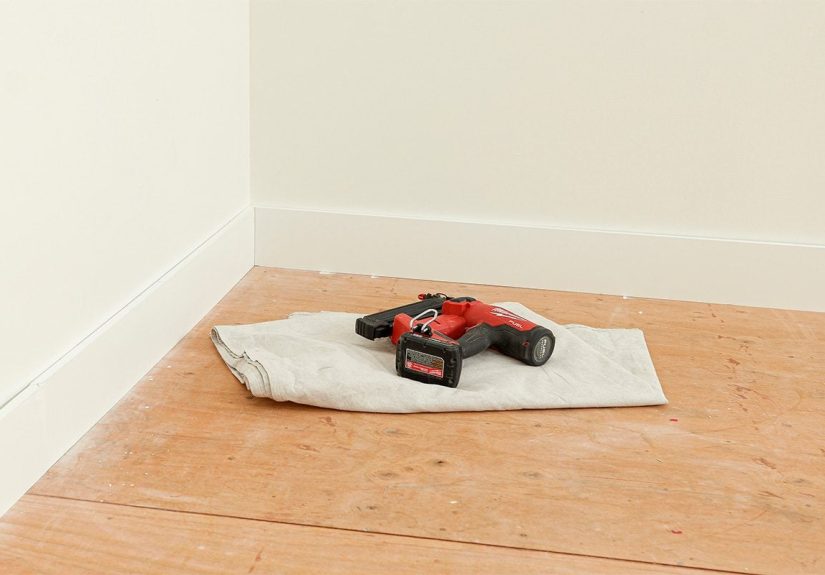
- Finish nailer or hammer and finish nails
- Nail set if hand-nailing
- Wood filler
- Paintable caulk
- Sandpaper
- Pry bar and utility knife if removing old trim
- Paint, primer, and brush for finishing
- Safety glasses and hearing protection
Could you install baseboards without all of this? Maybe. Would it be fun? Absolutely not. The miter saw and nailer do the heavy lifting here, and they’re worth borrowing, renting, or sweet-talking a friend into lending you.
Prep the Room Like a Smart Person Who Enjoys Fewer Problems
Remove old trim carefully
If you’re replacing existing baseboards, score the top edge with a utility knife first to cut through paint or caulk. Then use a pry bar to ease the trim away from the wall. This matters because drywall loves to come off in chunks when it feels disrespected.
Once the old trim is gone, pull leftover nails, scrape off old caulk, and clean the wall surface. The neater this step is, the easier the new installation will be.
Measure every wall, then buy extra
Measure each wall section individually and sketch the room layout if needed. Add extra material for waste, bad cuts, outside corners, and the general fact that humans are not laser-guided saw robots. Buying one extra piece is usually cheaper than driving back to the store while covered in sawdust and regret.
Mark the studs
Use a stud finder and lightly mark stud locations on the wall. Baseboards need solid fastening points, and drywall alone is not your friend here. Studs are usually spaced at regular intervals, but “usually” is not a plan, so verify before you start nailing.
Check if the floor is level
This is the step beginners skip and then blame on the trim. Put a long level along the floor and identify the highest point in the room. If the floor slopes or dips, you may need to keep the top of the baseboard level and deal with the floor gap later. Small gaps can often be hidden with caulk or shoe molding. Bigger ones may require scribing or shimming.
How to Install Baseboards Step by Step
1. Start with the longest, simplest wall
Do yourself a favor and begin on the easiest run in the room, ideally a long wall with simple ends. It helps you build confidence, and it gives you a visible win before the corners start acting dramatic.
Measure carefully, transfer the measurement to the trim, and cut the first board. For a board that ends at a door casing, you’ll usually make a straight cut. For outside corners, you’ll make a miter. For inside corners, you’ll decide whether you want to miter or cope.
2. Understand inside corners before they emotionally damage you
Inside corners are where most DIY baseboard installation goes from “this is manageable” to “why is the wall not ninety degrees?” The truth is, many walls are not perfectly square. That’s why pros often prefer coped joints for inside corners.
A coped joint starts with one board cut square into the corner. The mating board gets a 45-degree cut first, then the profile is trimmed with a coping saw so it fits tightly over the face of the first board. It sounds fancy, but it’s really just a clever way to make imperfect corners look better.
If you’re a total beginner, mitered inside corners can still work, especially in newer homes with straighter walls. But if the joint opens up or looks sloppy, don’t panic. This is exactly why coping exists. Think of it as the upgrade path.
3. Cut outside corners with patience, not optimism
Outside corners usually get two 45-degree cuts that meet at the corner. Dry-fit both pieces before nailing anything. If the angle is slightly off, which is common, trim a hair at a time. This is not the place for boldness. It’s the place for tiny, controlled corrections and the kind of humility woodworking teaches for free.
If the outside corner will take a lot of bumps, a little wood glue on the joint can help strengthen the connection before final fastening.
4. Use scarf joints on long walls
If one wall is longer than your trim stock, don’t butt two square ends together in the middle and hope for the best. Use a scarf joint instead. That means cutting the ends at opposite 45-degree angles so the pieces overlap neatly. It looks better, holds better, and is much less likely to scream “I ran out of board here.”
Place the scarf joint where it will be less noticeable if possible, and dry-fit it before fastening. A bit of wood glue at the joint can make the seam stronger and cleaner.
5. Dry-fit before you nail
This is the part that separates a clean finish from a weekend-long muttering session. Hold each cut piece in place before fastening it. Check the corners, the floor contact, the fit against casing, and the top line along the wall. If something looks off, fix it now. Trim work rewards adjustment before commitment.
6. Nail into studs, not random hope
Once the fit looks good, fasten the baseboard at the stud locations. Put nails near the top and lower portion of the board so it sits tight against the wall. If you’re using a nailer, make sure the fasteners sit just below the surface. If you’re hand-nailing, use a nail set to sink the heads slightly without beating up the trim.
On slightly bowed walls, you may need an extra nail or a bit of adhesive to pull the trim snug. Adhesive can help, but don’t treat it like a substitute for proper fastening. Baseboards still need mechanical hold.
7. Deal with gaps like a grown-up
Small gap at the top edge where the wall waves? Paintable caulk. Tiny nail holes? Wood filler. Small seam in a joint? Wood filler or caulk, depending on the location and finish.
But if there’s a visible gap between the baseboard and floor all the way along a wall, don’t smear half a tube of caulk into it and call it craftsmanship. That’s usually a sign of an uneven floor, and shoe molding or quarter-round is often the cleaner fix. Shoe molding has a slimmer profile and is a little more forgiving. Quarter-round is chunkier and can hide larger gaps.
8. Fill, sand, caulk, and paint
After all the boards are installed, fill the nail holes and let the filler dry. Sand the patches smooth so the surface looks seamless. Then run a thin bead of paintable caulk along the top edge where the trim meets the wall and at any small visible joints. Smooth it lightly. Thin and neat wins every time.
If your trim is pre-primed, you can paint after installation, or you can pre-paint one coat and then touch up after nailing and caulking. Either way, the best-looking job usually comes from combining both approaches: get most of the finish on beforehand, then do final touch-up after installation.
What to Do When the Room Fights Back
Uneven floors
If the top of your baseboard looks level but the bottom gap changes across the room, you have two main options. One is to add shoe molding or quarter-round. The other is to scribe the baseboard so the bottom edge follows the floor more closely. Scribing gives a custom fit, but it takes more time and confidence. For most DIYers, shoe molding is the faster and more forgiving solution.
Wavy walls
If the wall bows away from the trim, try fastening more strategically at stud locations. In some cases, a little adhesive helps. In others, the fix is simply accepting that caulk was invented for a reason. The goal is not a mathematically perfect room. The goal is a visually clean result.
Bad cuts
Everyone makes at least one. The trick is cutting long rather than short whenever possible. You can always remove a little more. You cannot add wood back unless you enjoy very specific forms of sadness.
Common Mistakes That Make Baseboards Look Amateur
- Skipping dry-fit checks
- Forgetting to mark stud locations
- Using butt joints instead of scarf joints on long walls
- Over-caulking every problem into a gummy mess
- Ignoring floor level before installation
- Painting before filling nail holes and sanding
- Assuming every corner is a perfect 90 degrees
- Cutting pieces exactly to theory instead of to the actual room
Trim work is one of those jobs where “close enough” can still look weird from ten feet away. Slow down, dry-fit more than you think you need to, and trust the process more than your first measurement.
Can You Install Baseboards Without a Nail Gun?
Yes. A hammer and finish nails still work. It’s slower, and you’ll want a nail set to sink the heads cleanly, but it’s absolutely doable. The nail gun is faster and usually easier on both the trim and your mood, but it is not the gatekeeper of competent baseboard installation.
Should Baseboards Go in Before or After Flooring?
That depends on the flooring. In many rooms with hardwood or tile, the finished floor goes in first and the baseboard follows. In carpeted rooms, the sequence can be different. What matters most is planning for the final floor height so your trim lands where it should and your transitions look intentional.
The Final Word on DIY Baseboard Installation
Installing baseboards is one of the most satisfying finishing projects in a home because the payoff is immediate. The room looks sharper. The walls look cleaner. The whole space suddenly has edges like it meant to be there all along.
No, your first inside corner may not be museum quality. Yes, you may spend too long staring at a miter cut like it betrayed you personally. But once you understand the rhythm of measuring, cutting, dry-fitting, fastening, and finishing, baseboard installation stops feeling mysterious and starts feeling repeatable.
So no, you probably do not need to call your dad. You just need a saw, a plan, and enough restraint not to fix structural reality with decorative caulk.
Real-World Experiences: What It’s Actually Like to Install Baseboards Without Calling Your Dad
The first real experience most people have with baseboards is surprise. Not at the cutting or the painting, but at how much a room changes once the trim goes in. A plain room can look oddly unfinished for weeks, and then one afternoon you install baseboard trim and suddenly it looks like someone turned the “done” setting on. That feeling is part of why this project is so popular with first-time DIYers. The visual payoff is huge, even if the process includes a few unflattering moments with a tape measure.
A common experience is realizing that walls and floors are nowhere near as straight as they looked when the room was empty. Plenty of people start the project thinking the challenge will be using the saw. Then they hold up the first board and discover a gap at the floor, a slight belly in the wall, and a corner that is definitely not 90 degrees unless geometry recently gave up. That can feel discouraging for about five minutes. Then the lesson clicks: trim work is not about forcing the room to be perfect. It’s about learning how to cut and fit pieces so the finished view looks clean.
Another very relatable experience is the emotional roller coaster of the first inside corner. The first straight wall gives you confidence. The second piece, meeting an inside corner, humbles you instantly. Many DIYers try a standard miter cut first because it seems obvious. Then the joint opens at the front or back, and suddenly they’re online learning what a coping saw is. Once they try coping, or at least start test-fitting more carefully, the project becomes much less frustrating. The big shift is moving from “I cut it once, therefore it should fit” to “I’m going to sneak up on a perfect fit one small adjustment at a time.”
There is also the experience of learning that finishing matters as much as installation. A lot of beginners think the job ends when the trim is nailed to the wall. It does not. Filling nail holes, sanding the filler smooth, caulking the top edge neatly, and touching up paint are what make the whole thing look professional. Without those steps, even well-cut baseboards can look rough. With them, even a couple of imperfect joints become hard to notice. This is where patience pays off more than raw skill.
One of the most useful real-world lessons is that shoe molding can feel like a cheat code. If the floor waves even a little, shoe molding often saves the day without requiring full-on advanced scribing. People who resisted it at first often end up loving the cleaner finish. The same goes for pre-painting trim. It may sound like extra work, but putting on an initial coat before installation can make final touch-ups much easier.
And finally, there is the satisfaction factor. By the end of the project, most people are not just happy the room looks better. They’re proud that they learned a finish carpentry skill that once seemed off-limits. The best part is not saving a service call. It’s the moment you step back, look at the trim, and realize you solved the corners, handled the weird floor, cleaned up the seams, and made the room feel finished with your own hands. That’s a pretty great return on a weekend.
Conclusion
If you want a room to look polished without taking on a full renovation, learning how to install baseboards is one of the smartest DIY upgrades you can make. Start with good measurements, work one wall at a time, dry-fit everything, and let the finishing work do its job. The result is cleaner lines, better transitions, and a room that looks intentionally complete. Not bad for a project that starts with one board and a little audacity.