Table of Contents >> Show >> Hide
- The Short Answer: China Keeps Flamethrowers for Niche Jobs, Not for Everyday Fighting
- Why Most Armies Got Rid of Flamethrowers in the First Place
- Why China Still Keeps Them
- What Recent Public Evidence Suggests
- Does This Mean China Is Old-Fashioned?
- Are Flamethrowers Legal Under the Laws of War?
- Do Flamethrowers Still Make Sense in Modern War?
- The Bigger Lesson: Old Weapons Survive When Old Problems Survive
- Experiences and Lessons Related to the Topic
- Conclusion
If you hear that China’s army still trains with flamethrowers, your first reaction is probably something like, “Wait, are we in a history documentary or a modern military briefing?” It sounds like a weapon that should be parked next to cavalry sabers, typewriters, and maps with giant red arrows. And yet, public images and reporting suggest the People’s Liberation Army, or PLA, has not completely tossed the flamethrower into the museum gift shop.
That does not mean China is building its future army around backpack fire jets like it is auditioning for a very bad action movie. The smarter answer is much narrower and much more interesting: the PLA appears to keep flamethrowers for a tiny, specialized mission set that modern militaries still struggle withclearing bunkers, caves, tunnels, fortified positions, and other ugly little places where defenders can hide and where bigger weapons are not always practical.
So the real story is not that China is “behind.” It is that even highly modern armies sometimes keep old tools because certain battlefield problems refuse to die. Underground warfare is one of them. Fortified positions are another. And when a military thinks it may someday face mountain hideouts, tunnel networks, or stubborn defenders in hardened spaces, it may decide that an old, nasty, specialized weapon is still worth keeping in very small numbers.
The Short Answer: China Keeps Flamethrowers for Niche Jobs, Not for Everyday Fighting
The best way to understand this is to avoid the Hollywood version. China’s army is not using flamethrowers because generals got nostalgic for World War II. It is using them because flamethrowers still have a grim but specific utility in highly constrained environments.
In open terrain, flamethrowers are mostly a terrible bargain. They are short-range. They expose the operator. They are logistically awkward. They look dramatic, but modern warfare usually prefers weapons that strike farther, more accurately, and with less risk to the user. That is why most militaries retired them decades ago.
But caves, tunnels, trenches, fighting bunkers, and fortified openings change the equation. In those spaces, the military problem is not simply “destroy the enemy.” The problem is “neutralize a hidden defender in a protected space without sending your own troops into the worst possible doorway on earth.” Suddenly, the weapon that seemed antique starts to make ugly tactical sense again.
That appears to be the logic behind China’s continued use. The PLA seems to treat flamethrowers as a specialist engineer or support capability for very particular targets, not as a standard infantry weapon issued to everybody with boots and a bad attitude.
Why Most Armies Got Rid of Flamethrowers in the First Place
To understand why China kept some, it helps to understand why so many others ditched them.
They are dangerous to the operator
Flamethrowers have one major public relations problem and one major battlefield problem. The public relations problem is obvious: they are terrifying. The battlefield problem is even more important: the person carrying one is close to the target, easy to spot, and carrying hazardous fuel. That is not exactly a recipe for a long and peaceful career.
Modern alternatives often work better
As armies modernized, they gained better rocket launchers, grenades, recoilless systems, thermobaric weapons, demolition charges, precision munitions, and direct-fire support. In many cases, those systems can suppress or destroy a fortified position from farther away and with less risk. Once those alternatives matured, flamethrowers started looking less like cutting-edge tools and more like expensive ways to volunteer for danger.
They are awkward in a modern force
Modern armies love flexibility, modularity, and systems that fit neatly into broader combined-arms doctrine. Flamethrowers are none of those things. They are highly specialized, limited in range, and useful only in certain circumstances. That makes them prime candidates for retirement in armies that would rather field one versatile system than several quirky specialists.
So, yes, most armies moved on. But “most” is not “all,” and that is where China becomes interesting.
Why China Still Keeps Them
Caves, bunkers, and tunnels are still real military problems
Underground and fortified warfare is not a relic. It has returned in multiple conflicts around the world, from militant tunnel networks to hardened military facilities to urban underground spaces such as basements, subways, parking structures, and bunkers. Military analysts keep relearning the same frustrating lesson: when defenders go underground, technology does not magically make the problem disappear.
China’s own military thinkers have paid attention to underground warfare. That matters because the PLA does not modernize by throwing old ideas away at random. It studies wars, terrain, infrastructure, and likely future contingencies. If planners think future operations could involve fortified mountain positions, cave systems, urban underground areas, or defensive strongpoints, then keeping a niche tool for that environment starts to look less bizarre.
The PLA appears to keep them in specialized formations
One of the most important details in public reporting is that flamethrowers are not presented as a mainstream infantry staple. They appear tied to specialized detachments and engineer-related roles. That is a huge distinction.
A modern military can keep a weapon in tiny numbers without making it central to doctrine. In fact, that is often exactly what smart militaries do. They keep certain ugly little capabilities on the shelf because the cost of retaining them is lower than the cost of having zero answer when a very specific problem appears.
Think of it as military insurance. Not glamorous insurance, granted. Nobody is putting it on a recruitment poster with confetti. But insurance.
China worries about difficult terrain and hardened positions
China’s strategic geography is not flat, simple, or polite. It includes border regions with rough mountains and rocky terrain, and any serious regional conflict could involve fortified positions, hidden defenders, and infrastructure designed to survive bombardment. If a military expects resistance in caves, bunkers, hillside positions, or built-up strongpoints, it has a reason to keep specialist bunker-clearing tools.
This does not mean flamethrowers would be the PLA’s primary answer. Far from it. Modern artillery, rockets, drones, precision strike systems, and engineering assets would do most of the heavy lifting. But in the final ugly step of clearing a stubborn enclosed position, an old tool may still survive because it solves a very old problem.
They are cheap compared with building a brand-new niche system
Not every capability needs to be futuristic, networked, and wrapped in marketing language that sounds like it came from a defense expo brochure. Sometimes the military version of “if it still works, keep one in the garage” wins the budget debate.
If China can retain limited flamethrower capability without major cost or organizational pain, then the decision becomes easier. It is not about romance. It is about utility per dollar in edge cases.
What Recent Public Evidence Suggests
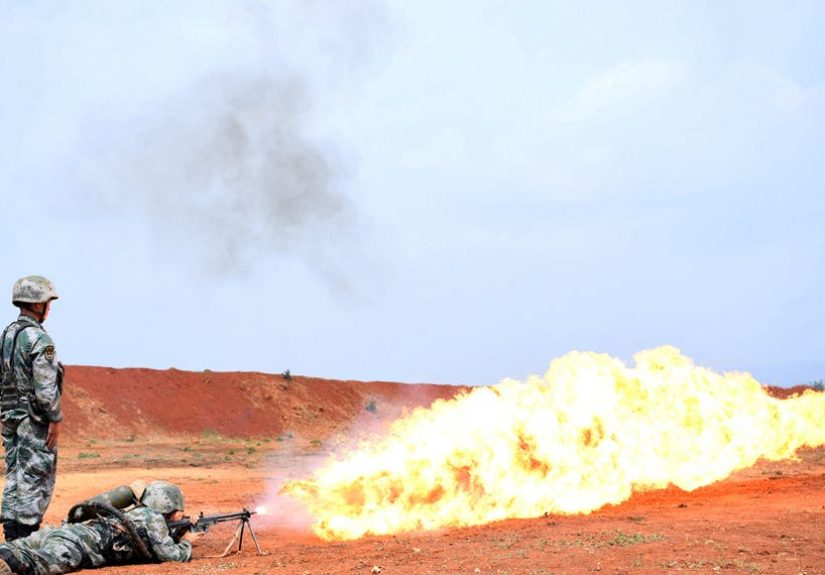
Public imagery and reporting indicate that the PLA has continued to train with flamethrowers in recent years. That is significant because it moves the subject out of the category of “old Cold War leftovers nobody remembers to remove from inventory” and into the category of “still active enough to appear in training coverage.”
There is also a documented report from 2015 in which Chinese forces used a flamethrower during a cave operation in Xinjiang. Whatever one thinks about the politics, that report matters analytically because it shows the kind of environment where China appears to believe the weapon still has utility: enclosed, hardened, difficult terrain where defenders are concealed and dangerous to approach directly.
So when people ask why China is still using flamethrowers, the answer is not speculation floating in a vacuum. There is public evidence of both training and at least one real-world operational use in exactly the sort of terrain where such weapons historically persist.
Does This Mean China Is Old-Fashioned?
Not really. It means China is mixing old and new, which is actually a very modern habit.
Military modernization is not the same thing as deleting everything old. It is about keeping what still fills a real gap. Plenty of cutting-edge militaries retain old weapons, old vehicles, or old concepts because the battlefield does not care about aesthetics. If an ancient-looking tool still solves a niche problem better, cheaper, or faster than a new one, some planner somewhere will keep it in the inventory and then pretend this was elegant all along.
That is probably the cleanest way to read China’s choice. The PLA is not saying the flamethrower is the future. It is saying the future may still contain bunkers, tunnels, caves, and fortified openings. And if that happens, having a specialized answer beats having a philosophical discussion.
Are Flamethrowers Legal Under the Laws of War?
This is where internet debates usually sprint directly into a brick wall.
Many people assume flamethrowers are simply banned outright. The legal reality is more complicated. International rules on incendiary weapons place significant restrictions on how such weapons can be used, especially in relation to civilians and civilian objects. But that is not the same thing as a universal, total, all-scenarios ban on every incendiary weapon ever made.
In plain English: the law of armed conflict does not treat this as a simple yes-or-no cartoon. It is about what kind of weapon is being used, against what target, in what setting, with what precautions, and with what risk to civilians. That does not make incendiary weapons uncontroversial. It makes them legally constrained rather than automatically erased from military inventories worldwide.
So China’s retention of flamethrowers is not, by itself, evidence that it is ignoring the existence of international law. The harder legal and ethical questions arise from how such weapons would be used, against whom, and in what environment.
Do Flamethrowers Still Make Sense in Modern War?
Usually, no. Sometimes, unfortunately, yes.
In most modern combat scenarios, flamethrowers are inferior to other systems. Drones can scout. Engineers can breach. Precision munitions can strike. Thermobaric and explosive options may reach enclosed spaces from safer distances. Urban and underground operations are increasingly supported by sensors, robotics, and specialized demolition techniques.
But war has a rude way of preserving old problems. Defenders still hide in tunnels. Fighters still use caves and bunkers. Armies still face fortified apertures that are dangerous to approach and awkward to destroy cleanly. When that happens, militaries often rediscover that the battlefield has no respect for our belief that history should have moved on.
That is why the flamethrower survives at the edges. Not because it is ideal. Because edge cases are stubborn.
The Bigger Lesson: Old Weapons Survive When Old Problems Survive
The most useful takeaway is broader than China.
Weapons do not disappear just because they look old. They disappear when the problem they solve disappears. Bayonets lasted because close combat never fully vanished. Heavy machine guns lasted because suppressive fire never stopped mattering. Flamethrowers largely vanished because better options replaced them in most roles. But not all roles.
China appears to have concluded that a small residual need still exists. Public evidence suggests the weapon remains alive in training and in specialist units. That makes the flamethrower less a symbol of backwardness and more a reminder that military modernization is rarely neat. It is a messy garage full of drones, sensors, satellite links, and one dusty tool in the corner that everyone swore they would throw away until they needed it again.
That is probably the answer in one sentence: China’s army still uses flamethrowers because the kinds of targets they were built forbunkers, caves, tunnels, and hard-to-clear enclosed positionsstill exist.
Experiences and Lessons Related to the Topic
One useful way to think about this topic is through the lived experience of militaries that have had to fight in enclosed, fortified, or underground environments. Across different eras, soldiers and commanders have repeatedly learned that entering a bunker, tunnel, or cave is one of the most dangerous jobs on the battlefield. Visibility is terrible. Defenders know the layout. Narrow entrances create choke points. Ambushes are easier. Explosives, traps, and crossfire become more deadly. Even when a stronger force controls the skies and has more advanced technology, underground terrain can level the playing field in unpleasant ways.
That recurring experience helps explain why specialist bunker-clearing tools have such a long shelf life. The challenge is psychological as much as physical. Troops facing a hidden defender in a confined space are forced into close-range danger, and commanders naturally look for ways to avoid sending people directly into that trap. Historically, armies experimented with smoke, demolition charges, armored support, direct-fire guns, fuel-air effects, and, yes, flamethrowers. The exact tool changed, but the underlying lesson stayed the same: once a defender disappears into a protected hole in the ground, the fight becomes slower, uglier, and more costly.
That experience also teaches something important about military innovation. New technology does not always eliminate old battlefield dilemmas. Sometimes it just changes the order in which they appear. A force may use drones to locate a bunker, electronic intelligence to map movement around it, and precision strikes to isolate it. But eventually, someone still has to deal with the actual space itself. Is it empty? Is it connected to another chamber? Is it being used as a firing point, storage site, or escape route? This is where a lot of glossy military futurism suddenly runs into dirt, concrete, darkness, and human hesitation.
China’s apparent decision to retain flamethrowers makes more sense when viewed through that lens. It reflects not just a weapon preference, but a recognition that hard terrain creates hard tactical problems. The same lesson appears in military history from island fortifications to tunnel systems to urban warfare. Forces that ignore those lessons often end up paying in time, casualties, or excessive destruction. Forces that prepare for them usually keep some form of specialist capability, even if it looks old-fashioned.
There is another experience-based lesson here too: niche capabilities do not need to be common to matter. A military may rarely use a specialized tool, but “rarely” is not the same as “never.” If a weapon is needed only in one percent of scenarios, it can still be valuable if that one percent includes the most dangerous and politically sensitive missions. Clearing a fortified mountain position, a cave hideout, or a hardened tunnel entrance may be exactly the sort of mission where leaders want every ugly option available, even if they hope never to use it.
In that sense, the flamethrower’s survival says less about nostalgia and more about the battlefield’s stubborn memory. Military organizations keep rediscovering that some environments punish clean theories. Underground warfare is one of those environments. It forces armies to blend old lessons with new systems, caution with aggression, and precision with brute practicality. That is why a weapon many people assume belongs only to the past can still show up in the training of a modern force. Not because history failed to move on, but because some tactical problems never got the memo.
Conclusion
So, why is China’s army still using flamethrowers? Because the PLA seems to believe that, in a very limited set of missions, they still solve a problem that modern war has not eliminated: how to deal with defenders hidden in bunkers, caves, tunnels, and other enclosed fortified spaces.
That does not make the flamethrower a symbol of the future. It makes it a symbol of military pragmatism, however uncomfortable that may be. China’s force is modernizing rapidly, but modernization is not the same as purging every old weapon on principle. If a weapon still fills a niche, some military somewhere will keep it around.
In other words, the flamethrower survives for the same reason cockroaches survive: the environment is not as civilized as we would like.