Table of Contents >> Show >> Hide
The Space Launch System has always inspired two very different reactions. One is awe: this is NASA’s giant deep-space rocket, a machine built to send astronauts beyond low-Earth orbit and back into the neighborhood of the Moon. The other reaction is a long, dramatic sigh usually followed by a spreadsheet. That split personality is exactly what makes Space Launch System progress such a fascinating topic in 2026. SLS is undeniably moving forward, but it is doing so with the elegance of a moon rocket and the pacing of a government construction project that keeps discovering one more thing behind the drywall.
Still, progress is progress, and in the case of SLS, it matters. This rocket is central to NASA’s Artemis campaign, the program designed to return astronauts to deep space, test the systems needed for sustained lunar missions, and eventually support the longer road to Mars. The question is no longer whether SLS exists. It flew Artemis I successfully. The real question now is what kind of progress NASA has made since then, how credible that progress looks, and whether the rocket can move from a rare headline event to a dependable backbone for lunar exploration.
Why SLS Still Matters
NASA is not treating SLS like a flashy side quest. The rocket remains the agency’s heavy-lift centerpiece for sending Orion, crew, and cargo toward the Moon in a single launch. That matters because lunar missions are already complicated enough without adding unnecessary orbital gymnastics. In practical terms, SLS is built for high-energy, deep-space missions, not just scenic laps around Earth. For NASA, that makes it less of a luxury item and more of a foundational transportation system.
There is also a strategic reason SLS continues to matter. The Artemis architecture is not just about planting flags and taking cinematic horizon shots. It is about building a repeatable U.S.-led framework for lunar operations, international partnership, commercial integration, and technology development. A heavy-lift rocket with proven crew-launch capability is a key part of that framework. So even when the conversation gets bogged down in launch dates, battery swaps, and seals that refuse to behave like adults, the bigger purpose remains intact.
Where SLS Stands Right Now
As of March 2026, the clearest sign of SLS progress is that Artemis II is no longer an abstract future mission. It is real hardware, stacked, tested, repaired, and moving toward the pad. Artemis II is scheduled as the first crewed flight of the Space Launch System rocket and Orion spacecraft, carrying four astronauts on an approximately 10-day trip around the Moon and back. In plain English, this is the mission where SLS stops being “the rocket that did one uncrewed test flight” and starts proving it can safely launch people beyond low-Earth orbit.
NASA’s March 2026 flight readiness review gave the mission a “go” to proceed toward launch, with an April 1 target after final closeout work. That is a meaningful milestone, because it came only after teams dealt with a helium-flow issue in the upper stage, rolled the vehicle back to the Vehicle Assembly Building, repaired the problem, replaced batteries, serviced other systems, and revalidated hardware. None of that sounds glamorous, and frankly it shouldn’t. Spaceflight progress is often just engineering for “we found something weird, fixed it, and checked it again until everyone could sleep at night.”
The Hardware Progress That Actually Counts
Booster stacking is done
NASA completed stacking the twin five-segment solid rocket boosters for Artemis II, a major milestone because these are not decorative side accessories. These boosters provide the extra shove that helps send the entire stack skyward. When booster stacking wrapped up, it signaled that the launch campaign had moved well past the conceptual stage and deep into hands-on integration. If you like your space progress tangible, ten stacked booster segments are about as tangible as it gets.
The core stage made it to Kennedy and was integrated
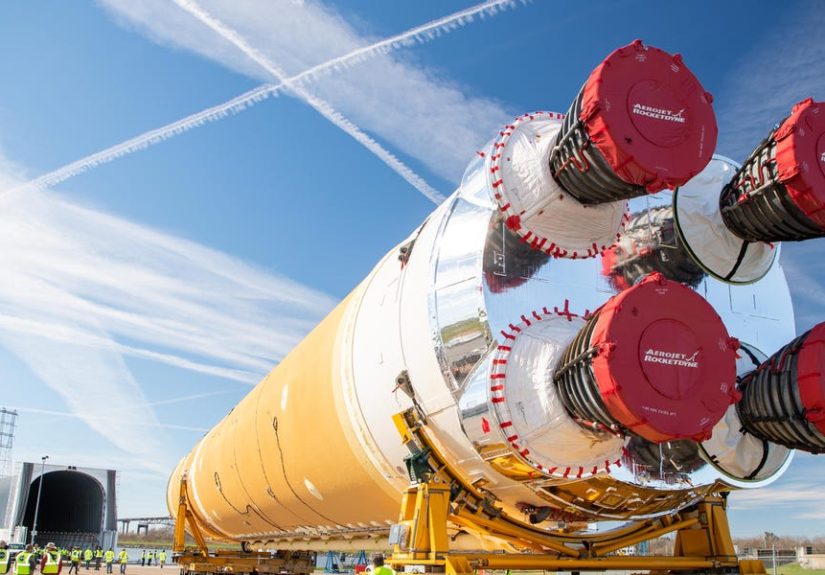
Boeing delivered the Artemis II core stage to Kennedy Space Center in July 2024, and NASA later integrated that core stage with the stacked boosters in March 2025. This matters because the core stage is the structural and propulsion backbone of the rocket, housing the propellant tanks and the four RS-25 engines. Getting that stage delivered, processed, and mated into the vehicle was not a photo-op milestone. It was a real transition from factory work to mission assembly.
The upper stage was integrated too
NASA also integrated the rocket’s upper stage in May 2025. That step helped complete more of the Artemis II launch stack and pushed SLS closer to a flyable configuration. The upper stage may not get the same attention as the towering core stage, but it is essential for pushing Orion out of Earth orbit and onto its lunar trajectory. In other words, without the upper stage, the mission is less “journey around the Moon” and more “very expensive local sightseeing.”
Orion and the engines advanced in parallel
The rocket is only half the story. Lockheed Martin completed assembly and testing of the Orion spacecraft for Artemis II and handed it over to NASA in May 2025. Around the same time, NASA and L3Harris completed RS-25 engine checkout testing at Kennedy, another critical milestone because these engines must function as part of an integrated system, not just as individually impressive pieces of hardware. When you put all of those steps together, SLS progress starts to look less like a slogan and more like a chain of real engineering accomplishments.
Why SLS Progress Still Feels Slow
Now for the part where everyone at the budget hearing adjusts their glasses. SLS is making progress, but it is doing so the hard way. The recent helium-flow problem is a good example. NASA discovered that a seal in a quick disconnect was obstructing helium flow to the upper stage after a wet dress rehearsal, which forced repairs and contributed to launch movement. That came after earlier struggles involving hydrogen leakage and other integration challenges. None of this is unusual in deep-space hardware development, but it is a reminder that SLS is not yet operating with airline-like rhythm. It is still very much in the “measure twice, fix once, review twelve times” stage.
Government watchdogs have been equally blunt. The Government Accountability Office has warned that Artemis ground systems have made progress but still face tight margins, especially because new capabilities for Mobile Launcher 1 took longer than planned for Artemis II and Artemis III support. For later missions, the old plan leaned heavily on Mobile Launcher 2 and the larger Block 1B configuration, both of which have been major schedule headaches. This is where the phrase mission dependency chain becomes space-program code for “one late thing can make five other things late too.”
The Cost Problem Is Not a Side Note
If SLS had one permanent traveling companion, it would be the phrase cost pressure. NASA’s Office of Inspector General projected in 2023 that total Artemis campaign costs would reach $93 billion through fiscal year 2025, with the SLS program accounting for $23.8 billion of that total. That is not pocket change. That is not even “check your couch cushions” money. That is “Congress would like several charts, please” money.
The concern is not just historic development spending. The OIG also projected that a single SLS rocket produced under NASA’s planned Exploration Production and Operations Contract could cost about $2.5 billion, with 10 launches potentially totaling $25 billion over a decade if savings do not materialize. Meanwhile, a separate OIG review estimated that the older Block 1B development path would total nearly $5 billion, including its first planned flight. GAO’s 2025 major-project assessment added more fuel to the debate by noting that Artemis-related programs now account for a large share of NASA’s major cost overruns.
This does not mean SLS has failed. It means that SLS is succeeding inside a financial environment that keeps raising uncomfortable but fair questions. Can NASA afford the rocket at the cadence it wants? Can it reduce recurring costs enough to make a long-term lunar campaign sustainable? Can it keep development from eating the budget that exploration itself needs? Those are not anti-SLS questions. They are the adult questions.
NASA’s Big Course Correction
One of the most important recent developments in Space Launch System progress is not a bolt, tank, or engine. It is a strategic reset. In late February and early March 2026, NASA announced a revised Artemis architecture. Under the updated plan, Artemis III is no longer framed as the first lunar landing mission. Instead, it becomes a 2027 low-Earth-orbit test flight designed to validate operational capabilities such as rendezvous, docking, integrated systems checks, and possibly interactions with commercial lunar landers from SpaceX and Blue Origin. The first Artemis lunar landing is now targeted for Artemis IV in 2028.
This shift matters because it reveals how NASA now sees the fastest path to useful progress. Rather than force a giant leap before every supporting system is truly ready, the agency is choosing a more staged build-up of capability. NASA also said it is moving away from the previous plan to rely on the delayed Exploration Upper Stage and Mobile Launcher 2 in the way once envisioned, while assessing alternative second-stage options and standardizing the SLS approach more closely around proven configurations. In short, NASA looked at the old roadmap, saw too much risk and too much complexity, and decided the moon is still there tomorrow.
So, Is SLS Progress Real?
Yes, absolutely. But it is a specific kind of real. It is not the smooth, commercial-marketing version of progress where every month brings a triumphant render and a dramatic soundtrack. It is the slower, harder, more credible kind. The Artemis II stack has moved through booster assembly, core-stage integration, upper-stage integration, spacecraft delivery, engine testing, wet dress rehearsal work, repair cycles, and flight readiness review. That is real progress.
At the same time, it is also fair to say SLS remains a program defined by narrow schedule margins, huge costs, and dependence on a broader Artemis ecosystem that includes ground systems, Orion, landers, spacesuits, and launch infrastructure. SLS is not a lone hero striding into the Moonlight. It is the lead actor in a very expensive ensemble cast, and several cast members are still learning their lines.
The healthy conclusion is somewhere between boosterish cheerleading and cynical eye-rolling. SLS is neither fantasy hardware nor an unstoppable machine. It is a powerful launch system that has made meaningful progress toward its first crewed mission while forcing NASA to rethink how fast and how affordably a lunar campaign can scale. In that sense, the program is doing something strangely valuable: it is turning grand ambition into measurable, testable, occasionally frustrating reality.
The Human Experience of Watching SLS Progress
Following the Space Launch System over the past several years has been its own kind of experience, and not just for engineers. For space fans, SLS progress feels like living inside a split-screen movie. On one side, there is the enormous emotional pull of seeing a giant American deep-space rocket take shape again after Apollo. On the other side, there is the humbling realization that building one is brutally difficult, alarmingly expensive, and completely uninterested in anyone’s desire for faster headlines.
For engineers and technicians, the experience is probably even more intense. The public tends to see launch dates and dramatic photos, but the lived reality of a program like SLS is painstaking systems work. It is reviewing interface behavior, rechecking tolerances, tracing a seal problem that should have been simple but absolutely is not, and understanding that one overlooked issue can affect crew safety, mission success, and public confidence all at once. That experience is not glamorous, but it is the reason the rocket is trusted when it finally flies.
For taxpayers and policymakers, SLS progress creates a more conflicted experience. It is easy to admire the technological achievement while wincing at the price tag. The rocket inspires national pride and fiscal skepticism in roughly equal measure. That tension is not necessarily bad. In fact, it may be useful. Human spaceflight programs should inspire people, but they should also survive hard questions. The public experience of watching SLS has become an education in how ambition, politics, industrial policy, safety culture, and engineering reality all collide in one very tall vehicle.
There is also a distinctly American quality to the SLS story. The rocket is built across a national network of facilities, suppliers, contractors, and NASA centers. That means progress is not just the story of a launch vehicle. It is the story of factories, test stands, transport logistics, software teams, propulsion specialists, launch crews, and recovery planners. Watching SLS move forward can feel like watching a giant mechanical relay race where every handoff has to work, because the baton is a moon mission and dropping it is frowned upon.
Perhaps the most interesting experience of all is emotional patience. The Artemis era has taught a generation of observers that deep-space exploration is not always cinematic. Sometimes it is slow. Sometimes it is repetitive. Sometimes it sounds like a paragraph about batteries, seals, or umbilical hardware. Yet that is exactly what makes the moments of visible progress so meaningful. When the rocket rolls to the pad, when the engines are checked out, when Orion is integrated, when a readiness review says “go,” those moments land harder because everyone knows what it took to get there.
That may be the real lesson of SLS progress. The public often wants space exploration to feel magical, and it should. But before the magic comes the grind. SLS has given people a front-row seat to that grind, and oddly enough, that makes the program more compelling, not less. It shows that a return to deep space is not built on slogans. It is built on persistence, revision, expertise, and the stubborn refusal to confuse delay with defeat.
Conclusion
The latest chapter of Space Launch System progress is not a fairy tale, but it is far from a failure. NASA has advanced the Artemis II vehicle through major integration milestones, solved recent technical issues well enough to move back toward launch, and reshaped the broader Artemis roadmap to better match engineering reality. At the same time, SLS remains under intense pressure to prove it can deliver crewed lunar capability with greater schedule discipline and a more sustainable cost structure. The next launch will not answer every question, but it will answer the biggest one: whether SLS is ready to move from promise to repeatable performance.