Table of Contents >> Show >> Hide
- 1. Arendelle from Frozen Inspired by Norway’s Fjords & Architecture
- 2. The Sultan’s Palace from Aladdin The Taj Mahal’s Architectural Echo
- 3. Pride Rock from The Lion King Based on Kenya’s Hell’s Gate National Park
- 4. The Kingdom of Corona from Tangled Mont Saint-Michel in France
- 5. The Great Wall in Mulan A Direct Homage to China’s Most Iconic Landmark
- 6. San Fransokyo from Big Hero 6 A Blend of San Francisco & Tokyo
- 7. The Rivera Family’s Town in Coco Inspired by Guanajuato & Oaxaca, Mexico
- 8. Encanto’s Magical Casita Colombia’s Coffee Region & Colorful Architecture
- Why Disney Uses Real Places for Animation
- How Fans Travel to Disney-Inspired Locations
- Extra Section: of Experiences & Insights About Disney Movie Locations
- Conclusion
If you’ve ever watched a Disney movie and thought, “There’s no way that place is real,” get ready for a delightful plot twistmany of Disney’s most iconic animated settings are actually inspired by real destinations around the world. From majestic castles perched on mountain cliffs to bustling markets bursting with color, Disney animators often pull straight from real geography, architecture, and culture to bring their stories to life. And yes, that means some of your favorite fairy-tale towns exist outside of your TV screen.
In this guide, we’ll journey across the globefrom Norway to New Orleans, China to Colombiato uncover the real-life inspirations behind Disney’s magical movie locations. Whether you’re planning a Disney-themed travel bucket list or you simply love fun animation trivia, these destinations will make you see classic films in an entirely new light.
1. Arendelle from Frozen Inspired by Norway’s Fjords & Architecture
“Let it go” may be a mindset, but Arendelle is very much rooted in real Nordic beauty. The towering cliffs, sparkling fjords, and rustic wooden structures were inspired by Norway’s western coastline. Disney’s art team famously traveled to Bergen, Oslo, and the Geirangerfjord to study everything from traditional stave churches to icy lighting conditions. Even the cozy architecture of Arendelle was modeled after Norsk folk-style buildings and the historic Bryggen wharf.
Travelers who visit Norway often feel as if they’ve stepped straight into Elsa and Anna’s homeminus the magical ice palace (but Norway makes up for it with real glaciers, which are basically nature’s special effects department).
2. The Sultan’s Palace from Aladdin The Taj Mahal’s Architectural Echo
If you take the domed splendor of the Taj Mahal, sprinkle in a bit of Middle Eastern architectural flair, and add a dash of Disney exaggeration, you get Agrabah’s iconic palace. While Agrabah itself is an invented location, the palace’s onion-shaped domes closely resemble the Mughal architecture found in India, particularly the Taj Mahal.
Animators blended Indo-Islamic influences with a fictional desert kingdom aesthetic, creating a golden silhouette that fans instantly associate with Aladdin’s adventures. It’s a perfect example of Disney drawing from real places while maintaining a touch of fantasy magic (and a very large parrot for comedic relief).
3. Pride Rock from The Lion King Based on Kenya’s Hell’s Gate National Park
Pride Rock is as iconic as Simba himself, and yesit has a real-world counterpart. Disney animators visited Hell’s Gate National Park in Kenya, capturing the rugged cliffs, wide savannas, and dramatic rock formations that inspired the film’s unforgettable landscape. While Pride Rock is not an exact replica of any single structure in the park, its majestic design is a composite of real Kenyan geological features.
If you ever go on a safari in East Africa, you may find yourself humming “Circle of Life” as you gaze out over vast golden plains. Nature really did the heavy lifting on this one.
4. The Kingdom of Corona from Tangled Mont Saint-Michel in France
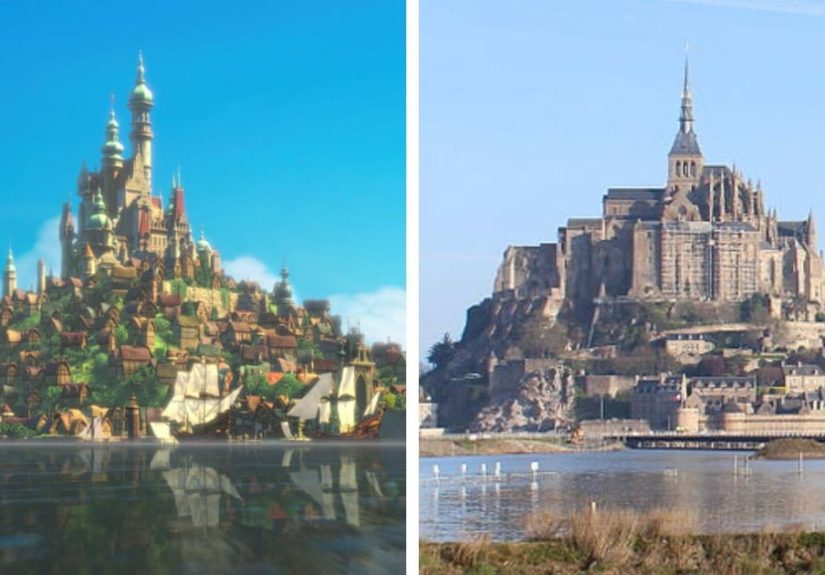
Before you askyes, Disney named a kingdom “Corona” long before 2020. And no, it wasn’t a sign. But the Kingdom of Corona’s layout was undeniably inspired by France’s Mont Saint-Michel, a tidal island crowned with a medieval abbey. The film’s tall central castle, surrounding village, and waterfront environment all reflect the architectural layering of the French landmark.
Fans often spot the resemblance immediately, especially during the lantern festival scene, where Corona’s glowing silhouette looks very much like its real-life counterpart at sunset. Bonus: You won’t find Mother Gothel lurking in Mont Saint-Michel’s gardens, which is definitely a win.
5. The Great Wall in Mulan A Direct Homage to China’s Most Iconic Landmark
Some Disney inspirations are subtle. Others are literally one of the most famous structures in the world. The opening scene of Mulan features the Great Wall of Chinano magical reinterpretation needed. But beyond the wall itself, the animators studied ancient Chinese landscapes, architecture, scroll paintings, and village layouts to craft a world that honored its cultural roots.
The mountains, bamboo forests, and traditional homes seen throughout the film are grounded in authentic Chinese aesthetics. Mulan’s world isn’t just fictitiousit’s a love letter to Chinese history.
6. San Fransokyo from Big Hero 6 A Blend of San Francisco & Tokyo
When you mix California’s steep hills and Golden Gate Bridge with Tokyo’s neon lights and futuristic tech culture, you get the quirky city of San Fransokyo. While this mash-up isn’t a replica of a single place, its DNA comes straight from two iconic cities. Disney created a “what if?” urban fantasy where cable cars coexist with soaring skyscrapers, and cherry blossoms line streets buzzing with robots.
The Golden Gate Bridge redesigncomplete with torii-style elementsis one of the most recognizable architectural hybrids in modern animation.
7. The Rivera Family’s Town in Coco Inspired by Guanajuato & Oaxaca, Mexico
The vibrant streets of Coco draw heavily from several regions in Mexico. The winding alleys, colorful papel picado, and bright house facades echo the look of Guanajuato and Oaxaca. But the film’s most breathtaking visualthe Land of the Deadwas shaped by real Mexican traditions such as Día de los Muertos altars, marigold petals, and folk art sculptures.
Disney worked closely with cultural consultants to ensure authenticity, resulting in some of the studio’s most visually stunning and culturally respectful worldbuilding.
8. Encanto’s Magical Casita Colombia’s Coffee Region & Colorful Architecture
If you’ve seen Encanto, you know that the Madrigal house practically counts as another character. Casita’s design pulls from Colombia’s “coffee triangle” towns like Salento and Filandia, where vibrant multi-story homes feature wooden balconies, courtyard gardens, and saturated tropical color palettes.
Even the surrounding mountains reflect the dramatic Andean landscapes found throughout rural Colombia. It’s the ultimate blend of magic realism and architectural tradition.
Why Disney Uses Real Places for Animation
It’s simple: authenticity creates emotional connection. When viewers see landscapes that feel realeven in fantasy settingsthey immerse deeper into the story. Disney artists regularly travel to research locations, sketch on site, study lighting, interview locals, and absorb cultural details that later show up in their work.
This real-world grounding helps Disney films feel relatable, even when magical powers, anthropomorphic animals, or dancing teapots are involved.
How Fans Travel to Disney-Inspired Locations
Travel agencies now offer themed tours based on Disney settings, and social media is filled with travelers recreating iconic scenes in Norway, France, Mexico, and beyond. Many destinations, thrilled by the boost in tourism, even lean into the connectionNorway’s tourism board famously embraced the “Frozen effect,” and Colombia saw a spike in interest after Encanto.
Exploring these real-life Disney locations adds a new dimension to movie-watching. Suddenly, you’re not just a vieweryou’re part of the animated universe.
Extra Section: of Experiences & Insights About Disney Movie Locations
Visiting real Disney movie locations is a bit like stepping through a screen: the landscapes feel familiar, yet wonderfully new. Travelers often describe an almost childlike excitement when recognizing a place they’ve only seen in animated form. One traveler who visited Norway said she expected to see reindeer wearing saddles and snowmen humming tunesthankfully, reality wasn’t that wild, but the fjords were undeniably “Elsa-level epic.”
Walking through Bergen’s cobbled streets, you can practically picture Anna bounding around singing about open doors and chocolate. The textures, the colors, and even the light behave almost exactly as the animators depicted them. Disney didn’t just imagine Arendelle out of thin airNorway supplied the reference photos in HD.
Meanwhile in France, Mont Saint-Michel gives visitors a dazzling sense of déjà vu. Its structure rises dramatically from the water, just like Corona’s castle in Tangled. Many fans say the lantern scene hits differently after seeing this landmark in real life, especially at dusk when the golden sky wraps the abbey in a warm glow. You half expect Rapunzel to be swinging around tower windows.
Mexico’s influence on Coco offers an emotional experience unlike any other. Families visiting towns like Oaxaca during Día de los Muertos find themselves surrounded by real altars, real marigolds, and real stories of ancestry. Visitors often say they feel like they’ve stepped into the Land of the Deadnot because it’s cartoonishly bright, but because the culture itself is vibrant beyond imagination. Disney didn’t exaggerate the colors; Mexico simply lives in them.
Then there’s Colombia’s Encanto-inspired architecture. Casita is fictional, but the balconies, patterns, and vivid facades you’ll see in the coffee region are unmistakably its inspiration. Some travelers claim that if you stand still long enough, you can “hear the house breathe”which is probably just the creaking of wood in humid climates, but magical nonetheless.
Even fictional mash-up cities like San Fransokyo are grounded in real travel experiences. Fans exploring San Francisco often point out how its steep hills and mix of Victorian homes with tech-driven skyscrapers already feel like a hybrid world. Add Tokyo’s futurism and colorful signage to the mental picture, and San Fransokyo practically draws itself. Travelers who’ve visited both cities say that walking through Shibuya Crossing feels like entering a Big Hero 6 establishing shot.
What makes these experiences so special isn’t just spotting Easter eggsit’s the realization that imagination and reality are much closer neighbors than we think. Disney animators don’t just create fantasy worlds; they amplify the magic already baked into our planet. Every fjord, castle, canyon, and cobblestone street offers inspiration. And when viewers visit these places, they close the loop between art and life.
So whether you’re exploring Colombian mountains, Kenyan savannas, or the alleys of Guanajuato, each real-world Disney destination invites you to live inside a story. And honestly? That kind of travel feels better than any FastPass.
Conclusion
Disney movie locations prove that the real world is every bit as magical as animation. By drawing from real architecture, landscapes, and cultures, Disney brings authenticity and emotional resonance to its stories. Whether you’re a traveler, a movie lover, or both, exploring the real settings behind animated classics provides unforgettable experiencesand a deeper appreciation for the art of storytelling.