Table of Contents >> Show >> Hide
- Step 1: Start With the Meaning of Multiplication
- Step 2: Use Hands-On Objects First
- Step 3: Connect Multiplication to Repeated Addition
- Step 4: Teach Arrays Early and Often
- Step 5: Use Number Lines and Skip Counting
- Step 6: Introduce Multiplication Vocabulary Clearly
- Step 7: Move From Models to Equations
- Step 8: Teach Fact Strategies Before Demanding Speed
- Step 9: Use Word Problems That Feel Real
- Step 10: Make Practice Engaging, Not Endless
- Step 11: Check Understanding and Reteach With Purpose
- Common Mistakes to Avoid When Teaching Multiplication
- Why These 11 Steps Work
- Experiences From Real Classrooms and Real Learning Moments
- Conclusion
- SEO Tags
Teaching third grade multiplication can feel a little like introducing kids to a magic trick. One moment they are adding 4 + 4 + 4, and the next they are writing 3 × 4 and acting like tiny mathematicians in training. The good news is that multiplication does not need to be mysterious, stressful, or powered by a stack of sad flash cards. When it is taught in a logical sequence, kids usually move from “Wait, what does this mean?” to “Oh, I get it” much faster than adults expect.
The secret is not to start with memorization alone. Third graders learn multiplication best when they can see it, build it, talk about it, and then practice it in meaningful ways. That means beginning with concrete models, moving into visual strategies, and only then expecting students to become more fluent. In other words, do not throw them into the multiplication pool with only a pencil and a prayer.
Below are 11 practical steps to help teachers, tutors, and parents teach multiplication in a way that actually sticks.
Step 1: Start With the Meaning of Multiplication
Before students memorize facts, they need to understand what multiplication is. In third grade, multiplication is usually introduced as equal groups. If there are 3 bags with 4 apples in each bag, students can see that the total is 12 apples. That is multiplication in its most kid-friendly form.
Use simple language such as “3 groups of 4” or “4 in each group.” This helps students connect the numbers in an equation to a real situation. When a child understands that 3 × 4 means 3 equal groups with 4 in each group, the equation stops looking like random math punctuation.
Example
Set out 3 plates with 4 crackers on each plate. Ask, “How many crackers are there altogether?” Then write the matching equation: 3 × 4 = 12.
Step 2: Use Hands-On Objects First
Third graders are still very concrete learners. They do better when they can touch the math before they have to picture it in their heads. Counters, cubes, buttons, coins, cereal pieces, and even toy dinosaurs all work beautifully. Yes, dinosaurs. If a child learns multiplication with six tiny T. rexes, that still counts as good teaching.
Give students objects and ask them to build equal groups. Let them physically separate 4 groups of 3, or 2 groups of 6, and then count the total. This step helps multiplication feel like something real instead of something adults invented just to make homework longer.
Hands-on materials are also useful for students who struggle with attention, language, or confidence. When learners can build the problem themselves, they often feel more capable right away.
Step 3: Connect Multiplication to Repeated Addition
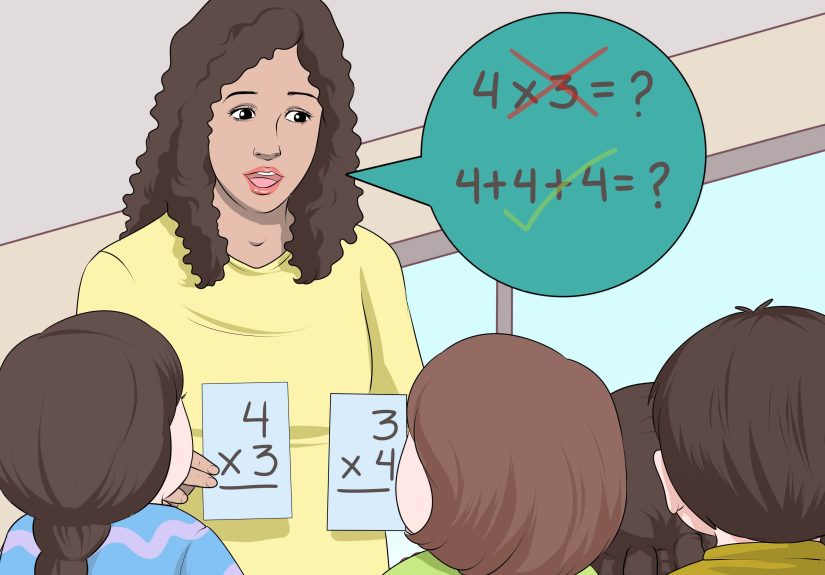
Repeated addition is not the final goal, but it is an excellent bridge. Students already know how to add, so multiplication should be introduced as a faster way to show repeated equal addends. If students see 5 + 5 + 5, they can learn to rewrite it as 3 × 5.
This connection matters because it shows children that multiplication is not brand-new math from another planet. It grows naturally from what they already know. That sense of continuity makes students less likely to panic when they see the multiplication symbol for the first time.
Example
Write 2 + 2 + 2 + 2 on the board. Ask students how many groups there are and how many are in each group. Then show that 4 × 2 = 8 represents the same idea more efficiently.
Step 4: Teach Arrays Early and Often
Arrays are one of the best ways to teach third grade multiplication. An array organizes objects into equal rows and columns, helping students visualize the structure of a multiplication fact. Arrays also prepare students for later ideas such as area models and the distributive property.
Draw dots in rows, use stickers on paper, or build arrays with square tiles. Ask students what they notice. Many will see that 3 rows of 5 and 5 rows of 3 both make 15. Congratulations, they have just started discovering the commutative property without needing to say “commutative property” like tiny college professors.
Example
Draw 4 rows of 3 stars. Then ask students to describe the array, write an equation, and explain the total. Next, rotate the picture and ask whether the product changes.
Step 5: Use Number Lines and Skip Counting
Not every student learns best through groups or arrays. Some kids understand multiplication more clearly when they see jumps on a number line. This shows multiplication as repeated equal jumps forward. It also reinforces skip counting, which is a helpful support for early fact development.
For example, 4 × 3 can be shown as four jumps of 3: 0, 3, 6, 9, 12. This strategy helps students who like movement, sequence, and patterns. It is especially useful when students are not yet ready to recall facts automatically.
Number lines also help students understand that multiplication is not just a picture on a worksheet. It is a pattern in numbers.
Step 6: Introduce Multiplication Vocabulary Clearly
Math vocabulary can trip students up even when they understand the concept. Third graders need repeated exposure to words like groups, each, times, factor, and product. They also need to hear how those words sound in actual math talk.
Instead of dropping vocabulary like a surprise pop quiz, teach it naturally. Say things like, “The factors are 3 and 4, and the product is 12,” while pointing to the equation. Post anchor charts. Use sentence frames. Encourage students to explain their thinking aloud.
This matters even more for students who are developing academic language or learning English. Sometimes a child can solve the problem but freezes because the wording feels unfamiliar. Clear vocabulary instruction removes that extra barrier.
Step 7: Move From Models to Equations
Once students can build and draw multiplication, help them connect those representations to symbols. This is where the teaching sequence becomes powerful: concrete objects become pictures, and pictures become equations.
Do not rush this transition. A student who can draw 5 groups of 2 but cannot yet write 5 × 2 = 10 is still learning something important. The goal is to help students see that the model and the equation tell the same story.
Try This Routine
Give students a three-part task: build it, draw it, write it. For example, build 3 groups of 6 with counters, draw the groups or an array, and then write 3 × 6 = 18. This routine creates strong connections and gives students multiple entry points.
Step 8: Teach Fact Strategies Before Demanding Speed
Fluency matters, but fluency grows best from strategy and understanding. Instead of expecting students to memorize every multiplication fact on command from day one, teach them smart ways to figure out unknown facts.
Students can use:
• doubles to help with facts like 4 × 6
• fives and tens as easier anchor facts
• known facts to solve nearby facts
• arrays to break apart harder problems
For example, if a child knows 5 × 4 = 20, then 6 × 4 can be seen as one more group of 4, which makes 24. That is real mathematical thinking. It is also much more useful than blank panic during a timed test.
When students develop strategies, memorization tends to come more naturally over time. They build confidence because they know they have a way in, even when they do not instantly know the answer.
Step 9: Use Word Problems That Feel Real
Word problems help students apply multiplication in context, but only if the situations are clear and age-appropriate. Third graders do better with simple, concrete scenarios: packs of stickers, rows of chairs, boxes of markers, trays of cookies, and other things that actually sound like they could exist in a child’s world.
Keep the language straightforward at first. Students should focus on the math idea, not spend twenty minutes decoding a story problem that sounds like it was written by a dramatic novelist with too much coffee.
Example
“There are 4 tables in the art room. Each table has 6 paintbrushes. How many paintbrushes are there altogether?”
Ask students to model the situation in more than one way. They might draw equal groups, use an array, write repeated addition, or solve with an equation. The key is helping them connect the language of the problem to the structure of multiplication.
Step 10: Make Practice Engaging, Not Endless
Practice is essential, but mind-numbing practice is not the goal. Students learn more when multiplication practice includes games, partner work, quick discussions, card activities, movement, and short review bursts. Variety keeps motivation higher and reduces the “math = misery” storyline before it has a chance to settle in.
Try multiplication bingo, array matching games, fact sort cards, scavenger hunts with equal groups, or dice games where students build facts from rolled numbers. Even a simple “find someone who solved it differently” activity can make practice more active and more thoughtful.
Good practice should build accuracy and confidence while keeping the task size manageable. Ten strong problems with discussion are often better than fifty silent ones completed with glazed-over eyes.
Step 11: Check Understanding and Reteach With Purpose
Assessment in multiplication should go beyond asking whether students got the answer right. You also want to know how they solved it and whether they truly understand the structure of the problem. A child who guesses 24 for 4 × 6 may be lucky. A child who draws 4 groups of 6 and explains the relationship is showing actual learning.
Use quick checks such as exit tickets, math journals, whiteboard responses, partner explanations, and short one-on-one conferences. Ask questions like:
• How do you know?
• Can you show that another way?
• What does the 4 mean in 4 × 6?
When students are confused, reteach with a different representation instead of simply repeating the same explanation louder. More volume is rarely a math intervention. Some students need counters. Others need arrays. Others need a number line or a story context. The goal is not just repeating the lesson; it is giving the student a better doorway into the idea.
Common Mistakes to Avoid When Teaching Multiplication
Even strong lessons can wobble if a few common mistakes sneak in. One big mistake is pushing memorization before understanding. Another is relying on only one model, such as worksheets full of naked equations with no context. A third is assuming that if a student can chant facts, the student automatically understands multiplication. Sometimes that is true. Sometimes it is just very confident parroting.
It also helps to avoid teaching multiplication as a single narrow procedure. The more students can connect groups, arrays, repeated addition, skip counting, number lines, and equations, the stronger their understanding becomes.
Why These 11 Steps Work
These steps work because they match how children typically build mathematical understanding. Third graders need to move from concrete experiences to visual models and then to abstract symbols. They also need language support, strategic practice, and chances to explain their thinking. When those pieces come together, multiplication becomes more than a chart on the wall. It becomes a pattern students can recognize, reason through, and use with confidence.
That confidence matters. Multiplication is one of the major turning points in elementary math. A child who understands it well is better prepared for division, fractions, area, multi-digit multiplication, and later algebraic thinking. So yes, teaching third grade multiplication is a big deal. No pressure. But also, absolutely manageable.
Experiences From Real Classrooms and Real Learning Moments
One of the most common experiences teachers describe when teaching multiplication is that students often appear to “get it” one day and then seem to forget it the next. That can be frustrating, but it is normal. Multiplication is not just another list of facts to memorize. It is a new way of thinking about quantity, structure, and patterns. Many third graders need repeated exposure across several days or weeks before the idea truly settles in.
In classrooms, a breakthrough often happens when students stop seeing multiplication as a mysterious symbol and start seeing it as a picture. A child who was confused by 4 × 5 may suddenly understand it after arranging counters into four neat groups of five. Another child may not connect with counters at all but lights up when using graph paper to draw arrays. This is why experienced teachers rarely rely on a single method. Different representations reach different learners.
Parents helping at home often notice another pattern: children can solve multiplication when the problem is spoken aloud in a real context, but freeze when the same idea appears on a worksheet. For example, a child may easily answer, “There are 3 boxes with 6 juice pouches in each box,” but hesitate when asked to solve 3 × 6. That gap is important. It shows that understanding may be present even when symbolic fluency is still developing. In those moments, the best support is not to say, “You already know this.” It is to help the child connect the story to the equation.
Teachers also frequently report that math talk changes everything. When students explain how they got an answer, they reveal far more than a correct product ever could. One child might say, “I knew 5 × 5 was 25, so 5 × 6 is one more six.” Another might say, “I counted by sixes.” Another may draw six rows and count all the dots. Those explanations help teachers spot misconceptions and also help classmates hear useful strategies from peers. Sometimes the best multiplication lesson in the room comes from an eight-year-old proudly explaining a shortcut with complete sincerity and slightly wobbly handwriting.
Another real-world experience is that timed drills can produce very mixed results. Some students enjoy the challenge, but many become anxious and start to believe they are “bad at math” when the real issue is speed, not understanding. In strong classrooms, fluency grows through games, repeated strategy use, brief review routines, and meaningful practice. Students build recall over time because they understand the relationships between facts.
Perhaps the most encouraging experience of all is seeing how quickly confidence grows once students realize multiplication is learnable. The child who once counted every object one by one begins grouping. The child who relied only on repeated addition starts using arrays. The child who guessed starts explaining. That change usually does not happen because of one perfect worksheet. It happens because the instruction is patient, clear, varied, and connected. In other words, multiplication success is usually built step by step, just like the 11 steps in this guide.
Conclusion
If you want to teach third grade multiplication well, begin with meaning, use models generously, build vocabulary carefully, and give students time to develop strategies before pushing for speed. Keep the learning active, keep the examples relatable, and keep listening to student thinking. Multiplication should feel like sense-making, not survival.
When children understand equal groups, arrays, number lines, and real-world problem situations, they are not just memorizing facts. They are building a foundation for future math success. And that foundation is worth every counter, every drawing, every math conversation, and every moment spent explaining why 3 groups of 4 is still not the same as 34. Nice try, though.