Table of Contents >> Show >> Hide
Some watches tell time. Some tell a story. And a rare, delightfully overachieving few try to do both while also whispering, “By the way, the moon is waxing, the tide is turning, and Orion is basically clocking in for the night shift.” That is the strange and wonderful appeal of watches that connect time, stars, and tides on your wrist.
At first glance, this category sounds like pure luxury nonsensethe sort of thing invented so collectors can say “astronomical complication” at dinner and feel important. But scratch the polished sapphire surface and there is something much older, more practical, and honestly more human underneath. For thousands of years, people tracked life by the sky above and the water below. Sailors used celestial bodies for navigation. Coastal communities planned work around the tides. Farmers, fishers, and travelers learned that the moon was not just decorative mood lighting for poets. It was a schedule.
Modern watchmaking turns that ancient relationship into wearable mechanics and data. Sometimes it does it with glorious, over-the-top craftsmanship. Sometimes it does it with a smart digital display built for surfers. Either way, the underlying idea is the same: a wristwatch can be more than a timekeeper. It can be a tiny observatory, a micro almanac, and a reminder that time is not only what happens on a spreadsheet. Time is also celestial. Time is tidal. Time is physical.
Why This Kind of Watch Still Fascinates Us
The simplest reason is that these watches make invisible systems visible. Most people know the moon affects the tides, but few could explain exactly why high tide does not politely arrive at the same hour every day. Fewer still think about the difference between ordinary civil time and solar time, or about the fact that “star time” is its own real thing. A well-designed astronomical or tide watch turns those ideas into something you can read at a glance.
That matters because time has never been just one thing. There is the practical time of meetings, alarms, and school pickup. Then there is natural time: sunrise, moonrise, tidal flow, seasonal light, and the shifting map of the night sky. The best watches in this space bring those layers together. They do not replace your phone. They redeem your attention.
There is also the romance factor, and yes, romance is doing some heavy lifting here. A watch that can hint at the moon’s age or forecast a tide feels different from a watch that merely tells you it is 3:17 p.m. One sounds like office life. The other sounds like an invitation to leave the office and go stand somewhere windy.
The Science Behind the Magic
The Moon Is the Quiet Boss of the Tides
If you want to understand tide watches, start with one hugely important number: a lunar day is about 24 hours and 50 minutes. That is why many coastal places experience two high tides and two low tides every 24 hours and 50 minutes, with high tides roughly 12 hours and 25 minutes apart. In other words, the tide is not late. It is following the moon, not your wall calendar.
The reason is beautifully simple. As Earth rotates, the moon’s gravity helps create tidal bulges in the oceans. Because the moon is also moving in orbit, Earth has to rotate a little longer to get the same location back under the moon again. That is the extra 50 minutes. So a tide watch, at its core, is not doing ocean mysticism. It is translating orbital mechanics into something useful.
Moon Phases Matter More Than Most People Think
The moon phase cycle repeats roughly every 29.5 days, moving through the familiar sequence of new moon, crescent, quarter, gibbous, full, and back again. That cycle is not just pretty. It changes how the sun and moon work together on Earth’s waters.
When the sun, Earth, and moon are nearly alignedduring new moon and full moontheir gravitational effects reinforce one another, producing spring tides. Despite the name, spring tides are not seasonal. They happen all year. About a week later, when the sun and moon sit at right angles relative to Earth, their effects partially cancel, producing neap tides, which are more moderate. This is why a serious tide indication is more interesting than a simple “high water soon” guess. The best ones attempt to show not just the daily tide cycle, but also the broader rhythm of the lunar month.
Stars Keep Their Own Time
Now for the part that makes astronomy nerds grin into their coffee: the stars run on sidereal time. In plain English, sidereal time tracks which celestial coordinates are crossing the meridian as Earth rotates. It is the language observatories use to know what is overhead and when.
Then there is the equation of time, one of the great “wait, clocks do what?” concepts in astronomy. It describes the difference between mean solar timethe smooth, averaged time our clocks useand apparent solar time, which follows the actual sun in the sky. Some high-end astronomical watches display this difference because watchmakers are apparently incapable of seeing an elegant cosmic headache without trying to gear-train it.
This is what makes astronomical watches so compelling. They do not just display time. They reveal that time itself has layers, approximations, and celestial negotiations happening behind the curtain.
How Watchmakers Put the Cosmos on a Dial
Moonphase Watches: The Gateway Drug
The moonphase is the most approachable complication in this category and probably the most beloved. It usually displays the visible phase of the moon through a small aperture or rotating disk. On a practical level, it can help people who care about moonlit nights, dark-sky conditions, fishing, boating, or tidal rhythm. On an emotional level, it is just irresistible. A moonphase watch makes even a Tuesday afternoon look like it should have a soundtrack.
Some standard moonphase mechanisms approximate the lunar cycle at 29.5 days, which is close enough for daily wear but can drift over time. Higher-end interpretations improve that accuracy dramatically. For collectors, that precision is catnip. For everyone else, it is a charming reminder that mechanical watchmaking is part science, part art, and part glorious obsession.
Tide Watches: Tool First, Poetry Second
Tide watches come in a few flavors. Some are purpose-built digital models for surfers and coastal athletes. These often use pre-programmed location data and can display tide, sun, and moon information together. Others are mechanical or semi-mechanical interpretations that require the wearer to set the next high tide and then read the cycle from a bezel or subdial.
That means not all tide watches are equally “set it and forget it.” A digital tide watch may be incredibly convenient for someone chasing a surf break. A mechanical tide watch is usually more analog in both operation and attitude. It often works best when paired with a tide table and a bit of user involvement. That is not a flaw. It is the whole point. These watches reward participation.
Astronomical Grand Complications: The Wristwatch as Observatory
Then we reach the summit: watches that track the positions of celestial bodies, moon age, moon phase, sunrise and sunset, dual time, or even tidal behavior in one coordinated display. This is where watchmaking stops being merely impressive and starts getting almost unreasonable in the best possible way.
These pieces are not built because the average person urgently needs portable orbital visualization during lunch. They exist because human beings are wired to admire ingenuity, and because the history of timekeeping has always been tied to navigation and astronomy. When a watch displays the relationship among the Earth, moon, and sun, it is participating in a tradition much older than luxury marketing.
Real Watches That Bring the Idea to Life
If you want proof that this category is not just collector fantasy, the range of modern examples is impressively broad.
Timex offers approachable moonphase watches like the Marlin Moon Phase, which bring lunar display into a classic, everyday format. It is a good reminder that you do not need a six-figure budget to enjoy a little celestial flair.
Nixon has gone hard in the practical direction with models like the High Tide, designed for surf and water sports. Its appeal is straightforward: pre-programmed tide, sun, and moon data, easy access, and beach-ready durability. No one buying this watch is pretending they are captaining an 18th-century frigate. They just want to know when the break gets good.
Freestyle has long lived in this same salty, functional universe. Its tide-focused Shark models reflect the democratic side of the genre: useful, tough, and built for people who actually plan their day around water conditions instead of merely talking about “lifestyle.”
TAG Heuer recently revived the maritime mood with the Carrera Chronograph Seafarer, which uses a tide indicator tied to the lunar cycle. That kind of watch shows how modern brands are rediscovering a complication that feels both old-school and freshly relevant.
Sinn and Wempe represent another fascinating approach, with tide displays that require setting against known local tide data. These watches do not magically know your harbor. You participate by consulting a tide table and aligning the watch accordingly. It is wonderfully hands-on, like navigation homework but cooler.
At the high end, things get gloriously dramatic. Ulysse Nardin’s Blast Moonstruck combines world-time thinking with moon position, moon phase, moon age, and tide indications, including spring and neap tides. It is the kind of watch that makes you want to explain it to strangers, even when they did not ask.
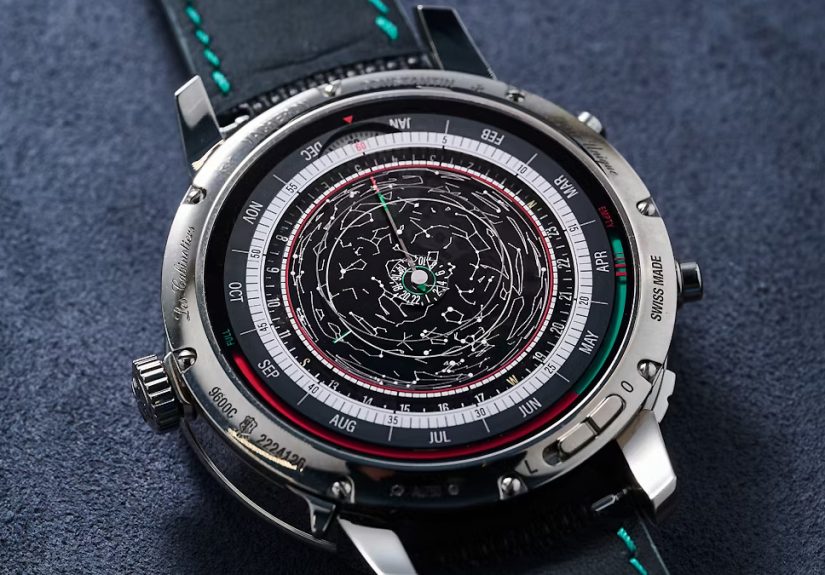
Vacheron Constantin’s Les Cabinotiers Celestia occupies the “more observatory than accessory” end of the spectrum, showing just how far astronomical watchmaking can go when restraint has officially left the building. And Krayon, with its sunrise-sunset complication, proves that celestial watchmaking is not only about the moon. The sun gets billing too, as it should. It has been carrying daylight for a while now.
Who Should Actually Buy One?
Not every watch lover needs stars and tides on the dial. But several kinds of people genuinely benefit from them.
First, there are the obvious candidates: surfers, sailors, coastal anglers, and people whose weekends begin with checking conditions instead of checking brunch reservations. For them, a tide watch can be a real planning tool.
Second, there are outdoor-minded wearers who value sunrise, sunset, moon phase, and night-sky awareness. Hikers, campers, paddlers, and photographers often appreciate that information more than another phone notification.
Third, there are collectors who love the idea of horology as storytelling. They do not just want accurate minutes. They want meaning on the wrist. They want a watch that says something about how the world works.
And finally, there are people who simply enjoy being reminded that they live on a rotating planet under a moving sky beside a breathing ocean. Honestly, that is a healthier category than it sounds.
What to Look for Before You Buy
If you are shopping this niche, start by deciding whether you want data convenience or mechanical theater. A digital tide watch can be more practical for active coastal use. A mechanical moonphase or tide watch may be less automatic but far more soulful.
Pay attention to legibility. A celestial complication is charming only until it becomes a tiny dissertation on the dial. If you cannot read the display without performing interpretive squinting, keep moving.
Think about local relevance too. Tides vary by location. Some watches handle that with pre-programmed data. Others expect manual setting. Neither is wrong, but the best choice depends on whether you want convenience or interaction.
Also consider water resistance, serviceability, case size, and how often the watch needs correction. A moonphase that slowly drifts is not broken; it is simply mechanical reality reminding you that the heavens are complicated and gears are finite.
The Experience of Wearing Time, Stars, and Tides
There is something quietly different about wearing a watch that does more than schedule your day. A plain watch tells you whether you are late. A watch with time, stars, and tides tells you where you are in a larger pattern. That sounds dramatic, and yes, it is a little dramatic, but the feeling is real.
Imagine glancing at your wrist early in the morning and seeing not only the hour, but the moon phase that hung over your roof last night. Maybe the dial hints at sunrise or the coming tide. Instantly, the day feels less like a stack of tasks and more like a chapter in a moving world. The watch is still small. Your mood is just bigger.
On a beach, the experience gets even better. A tide display is not abstract there. It changes where people walk, where they fish, when they paddle out, and how the shoreline looks from one hour to the next. You begin noticing the coast as something alive rather than fixed. The watch does not create that awareness, but it prompts it. It teaches your eye to connect the dial with the horizon.
At night, a moonphase complication has its own kind of charm. It is one thing to know the moon is nearly full because an app says so. It is another to see that little aperture on your wrist reflecting what is actually happening overhead. That moment feels oddly satisfying, like your watch and the sky just nodded at each other. Tiny mechanical validation is still validation.
In everyday city life, these complications can feel almost rebellious. The modern day is full of digital urgency: unread messages, calendar alerts, breaking news, and various platforms begging for attention like caffeinated raccoons. A watch that tracks celestial rhythm offers a different type of information. It is not screaming. It is orienting. It says, “Yes, your meeting matters, but so does the fact that the moon is entering its darker half and the ocean is following along.”
That may be why these watches appeal even to people who live nowhere near salt water. They make time feel physical again. They remind you that clocks were never purely administrative tools. Historically, timekeeping was entangled with navigation, weather, farming, prayer, astronomy, and survival. A celestial or tide watch reconnects with that lineage in a way that feels surprisingly personal.
There is also the simple tactile pleasure of it. Mechanical complications invite curiosity. You set them, read them, learn their quirks, and gradually develop a relationship with them. A tide bezel that needs local adjustment or a moonphase that asks for occasional correction does not feel inconvenient to the right wearer. It feels participatory. The watch becomes less like a gadget and more like an instrument.
And then there is the conversation factor. Most watches get a polite glance. A watch that shows moon age, spring tides, or sunrise and sunset gets questions. Good questions, too. Not “How much did it cost?” but “Wait, what does that do?” That is a much better opening line. It gives you a chance to talk about the moon, the ocean, old navigation traditions, and how absurdly wonderful it is that someone figured out how to put all of this on a wrist.
Ultimately, the experience is not just about information. It is about perspective. Wearing time, stars, and tides on your wrist gently pulls you out of the smallest possible definition of timethe one ruled by deadlines aloneand returns you to the bigger version, the older version, the version written in light, gravity, and motion. And for something strapped between your hand and your sleeve, that is a pretty impressive trick.
Final Thoughts
“Time, stars, and tides, all on your wrist” is not just a catchy promise. It describes one of the most meaningful directions in watchmaking: the attempt to connect human time with natural time. Whether that appears as a modest moonphase, a surfer’s tide tool, or a grand astronomical complication that looks like it belongs in a museum and a spaceship at once, the appeal is the same. These watches make the universe feel legible.
And maybe that is why they endure. In a world where every screen competes to make time feel faster, a good celestial or tide watch does the opposite. It slows your attention just enough to notice the patterns that were always there: the moon changing shape, the tide arriving later, the sun refusing to keep perfect clock time, the stars holding their own schedule overhead. That is not old-fashioned. That is grounding.
So yes, a watch can tell time. But the best ones in this category tell you something better: where you stand inside it.