Table of Contents >> Show >> Hide
- Why a Chair Gets Wobbly in the First Place
- How to Tell What Is Actually Wrong
- The Easiest Fixes First
- How to Fix a Wooden Chair With Loose Joints
- How to Fix Stripped Screw Holes
- How to Fix an Upholstered Chair
- How to Fix a Chair That Rocks Because of the Floor
- When a Wobbly Chair Is Not Worth DIY Repair
- Mistakes to Avoid When Fixing a Wobbly Chair
- Quick Troubleshooting Guide
- Real-Life Experiences With Wobbly Chairs
- Final Thoughts
A wobbly chair has two talents: making you suspicious of furniture and making dinner feel like a trust exercise. One minute you are sitting down with confidence, and the next minute your chair does a tiny, unsettling shimmy like it is warming up for a dance battle.
The good news is that most wobbly chairs are fixable. In many cases, the problem is not dramatic at all. A screw worked loose. A joint dried out. A leg wore unevenly. The floor is slightly off-level. Even upholstered chairs can often be repaired without turning your dining room into a full-blown furniture surgery unit.
This guide explains why chairs wobble, how to diagnose the real cause, and which fixes are worth your time. Whether you have a wooden dining chair, an upholstered side chair, a desk chair, or a once-sturdy hand-me-down that now behaves like a shopping cart with one bad wheel, these easy repair methods can help.
Why a Chair Gets Wobbly in the First Place
Most chair wobble comes from one of a handful of issues. The trick is figuring out whether the problem is in the chair itself or under it.
1. Loose screws, bolts, or hardware
This is the most common and the least dramatic. Hardware loosens over time from everyday use, shifting weight, moving the chair, and plain old gravity doing its thing.
2. Loose wood joints
On wooden chairs, the wobble often comes from failed joinery. Mortise-and-tenon joints, dowels, stretchers, and rails can loosen as glue ages and wood expands and contracts with changes in humidity.
3. Stripped screw holes
If you tighten a screw and it still spins like it has given up on life, the screw hole may be stripped. That means the fastener no longer has enough solid material to grip.
4. Uneven legs or an uneven floor
Sometimes the chair is fine and the floor is the drama queen. Tile, hardwood, old subfloors, rugs, and even floor protectors can create a wobble that has nothing to do with broken furniture.
5. Damaged glides, feet, or casters
Plastic glides wear down. Felt pads compress. Office chair casters loosen or crack. One missing foot can make a chair wobble like it is trying to solve algebra.
6. Cracks in the frame or broken components
If a chair has split wood, bent metal, cracked welds, or broken stretchers, the issue is structural. That usually calls for a more serious repair or replacement.
How to Tell What Is Actually Wrong
Before grabbing glue and hoping for the best, flip the chair upside down and inspect it. A two-minute check can save you from doing the wrong repair.
- Set the chair on a flat surface and press each corner of the seat one at a time.
- Watch which leg lifts or shifts.
- Pick up the chair and gently wiggle the legs, stretchers, and seat frame.
- Check every visible screw, bolt, nut, glide, and caster.
- Look for cracked wood, separated joints, worn pads, or bent metal.
- Test the chair on another floor to rule out an uneven surface.
If the wobble changes depending on where the chair sits, your floor may be the real culprit. If the wobble happens everywhere, the chair itself needs attention.
The Easiest Fixes First
Always start with the simplest repair. Furniture repair gets expensive only when people skip basic checks and immediately enter their “I saw a video once” era.
Tighten all fasteners
Use the correct screwdriver, hex key, or wrench and tighten every accessible fastener. Do not overtighten, especially on older wood or particleboard furniture. Overtightening can strip holes or crack parts that were merely asking for a little help.
Replace missing or worn floor pads
If one felt pad is missing or badly compressed, replace the whole set so the chair sits evenly. This is one of the fastest ways to fix a mild wobble on dining chairs and side chairs.
Adjust leveling feet
Some chairs, stools, and office seating have adjustable feet or glides. Twist them until the chair sits stable on the floor. It is oddly satisfying and takes less time than making coffee.
Check casters and glides
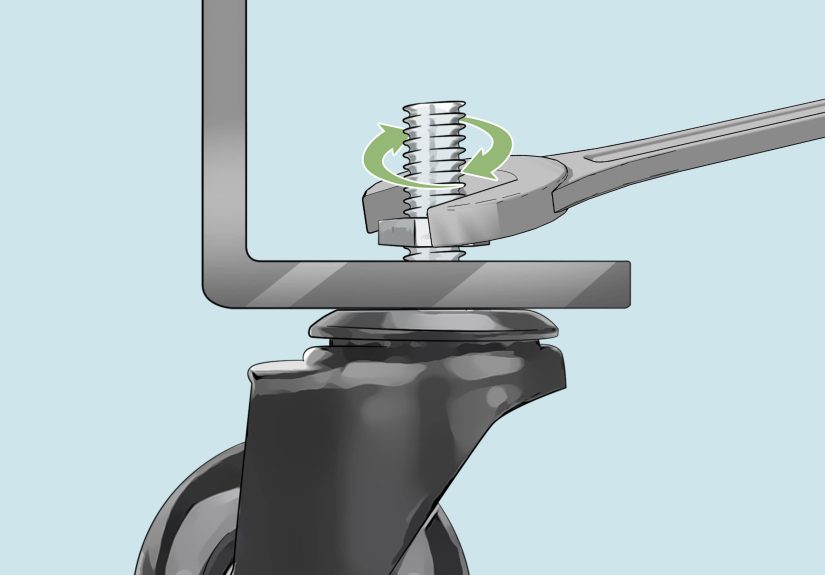
On rolling chairs, inspect each caster. Tighten anything loose and replace broken wheels. On stationary chairs, make sure glides are seated fully and are all the same height.
How to Fix a Wooden Chair With Loose Joints
If the chair wiggles at the joints, simply tightening screws may not solve the problem for long. A lasting repair usually means re-gluing the loose joint correctly.
When a quick fix is enough
If the joint has only a little movement and the chair is low-value utility furniture, a careful glue repair may be enough without complete disassembly. But for a truly strong repair, loose chair joints generally need to come apart, be cleaned, re-glued, and clamped.
What you need
- Wood glue suitable for furniture repair
- Clamps or straps
- Utility knife or scraper
- Sandpaper
- Clean rag
- Optional replacement dowels if the old ones are worn
Step-by-step repair
- Carefully pull the loose joint apart as much as possible without splintering the wood.
- Remove old flaky glue from both mating surfaces. New glue bonds best to clean, bare wood.
- Lightly sand if needed, then wipe away dust.
- Apply glue to both surfaces or into the dowel holes.
- Reassemble the joint and make sure it seats fully.
- Clamp it firmly so the parts stay aligned.
- Wipe away squeeze-out while the glue is still wet.
- Let the chair cure fully before using it, ideally a full day.
If the dowels are damaged, replace them. If the fit is sloppy even after cleaning, that is usually a sign the joint has worn enough that it needs more than just “more glue and optimism.”
Which glue should you use?
For many indoor wooden chairs, standard wood glue works well when the joint surfaces fit tightly and are cleaned back to bare wood. Some formulas cure fast and need clamping, while others offer more working time. If you are working on older or fine furniture, liquid hide glue can be useful because it is a traditional furniture-repair adhesive with a longer open time. For gap-prone repairs, some people use polyurethane glue or epoxy, but those products need more care and are not always the first choice for a clean furniture repair.
One big rule: glue bonds best to bare wood. If the surfaces are painted, sealed, or crusted with old dried adhesive, the repair will only be as strong as the weakest layer in the stack. That is not a repair. That is a future disappointment.
How to Fix Stripped Screw Holes
This is the classic “I tightened it, but it still feels loose” problem. Luckily, stripped screw holes are usually repairable.
For small stripped holes
Remove the screw and fill the hole with glue-coated wooden toothpicks or matchsticks. Snap them off flush, let the glue dry, then reinstall the screw. This gives the screw fresh wood fibers to bite into.
For slightly larger holes
Use a wood plug, golf tee, or small dowel with glue. Once dry, trim flush and drill a pilot hole before driving the screw back in.
For particleboard or badly damaged material
Particleboard is notorious for holding screws poorly once the hole is blown out. In those cases, drilling out the damaged area and gluing in a dowel often gives better holding power than trying to reuse the crumbly original hole.
How to Fix an Upholstered Chair
An upholstered chair looks intimidating because fabric makes everything seem fancier than it is. In reality, many upholstered dining chairs and accent chairs can be repaired from the underside.
Start underneath
Turn the chair over and inspect the seat frame, corner blocks, rails, screws, and legs. Many upholstered seats are attached with screws from below, so you can often remove the seat and access the frame without touching the fabric at all.
If the wobble is in the frame
Repair the wood structure first. Tighten frame screws, re-glue loose joints, and replace stripped fasteners before reattaching the seat. Do not try to solve a structural problem by tugging on the upholstery or stuffing something under the cushion. That is a bandage, not a fix.
If you need to clean while you work
Vacuum the chair first so dirt does not get ground deeper into the fabric. Then check the upholstery cleaning code on the label. Code W usually allows water-based cleaning, S means solvent-based cleaners only, W/S can use either, and X usually means vacuuming or brushing only. In other words, do not soak mystery fabric and hope your chair develops character instead of water rings.
How to Fix a Chair That Rocks Because of the Floor
If the chair is structurally sound but still wobbles in one room, the floor may be uneven.
Easy solutions
- Replace worn felt pads with a matched set
- Add furniture glides of equal thickness
- Use adjustable levelers if the chair design allows
- Move the chair to confirm the issue is the floor, not the chair
A tiny floor difference can feel like a major furniture failure. Dining chairs, patio chairs, and stools often become more stable with something as simple as fresh pads or levelers.
When a Wobbly Chair Is Not Worth DIY Repair
Some chairs are trying to tell you they are done, and honestly, we should respect that.
You may want to skip DIY repair if:
- The wood is split through a load-bearing section
- The metal frame is cracked or bent
- A welded joint has failed
- The chair is antique, valuable, or sentimental and you want a conservation-quality repair
- The wobble comes from several failing joints at once and the whole frame racks side to side
In those cases, a furniture repair professional may be the smarter move. And if the chair feels unsafe enough that nobody volunteers to sit in it, that is not a charming quirk. That is evidence.
Mistakes to Avoid When Fixing a Wobbly Chair
Using glue without cleaning the old joint
Fresh glue over old brittle glue is like painting over dust. It may look productive, but it usually does not hold well.
Skipping clamps
If the joint is not held tightly in alignment while the adhesive sets, the repair can fail early.
Using the wrong adhesive for the job
Fast-setting super glue can help with tiny non-structural fixes, but it is not a magic cure for every loose chair joint. Match the adhesive to the material and the repair.
Driving screws back into damaged holes without reinforcement
If the hole is stripped, the screw needs fresh material to grip. Otherwise, you are just replaying the same problem with extra wrist action.
Ignoring the floor
Do not sand down a chair leg until you are sure the chair is actually uneven everywhere. Floors are sneaky.
Quick Troubleshooting Guide
- Chair wobbles only on tile: Replace pads or add levelers.
- Chair leg moves at the joint: Re-glue and clamp the joint.
- Screw tightens but loosens again: Repair the stripped hole.
- Office chair sways or tilts: Check the base hardware, casters, and adjustment points.
- Upholstered chair feels unstable: Inspect the frame from underneath and remove the seat if necessary.
- Chair creaks and rocks: Look for loose stretchers, rails, or dried-out joints.
Real-Life Experiences With Wobbly Chairs
In real homes, wobbly chair problems almost never start with a dramatic snap. They start quietly. Someone notices that one dining chair feels “a little weird.” Nobody checks it. Then that same chair becomes the one guests politely avoid, like there is an unspoken family rule about it. That is usually how a tiny hardware issue turns into a full repair job.
One of the most common experiences people have is discovering that the chair itself is not broken at all. It just lives on an uneven floor. A chair can feel perfectly solid in the kitchen and wobbly in the dining room, or stable on hardwood and unstable on tile. This surprises people because the wobble feels so mechanical, but in practice, a missing felt pad or a small floor dip is often the whole story.
Another very typical situation happens with upholstered dining chairs. From the outside, they look hard to repair because the fabric makes the chair seem complicated. Then you flip one over and realize the seat is attached with a few screws, the corner blocks are visible, and the wobble is just a loose frame connection underneath. That moment is deeply satisfying. It is the furniture equivalent of finding out your “big tech problem” was an unplugged cable.
Older wooden chairs tell a different story. They may have been repaired once already, sometimes badly. People often find dried glue blobs, mismatched screws, or previous “repairs” that involved brute force and confidence instead of technique. In those cases, the experience of fixing the chair is less about tightening something and more about undoing an old shortcut so the joint can be repaired properly.
There is also the classic stripped screw experience. You tighten a screw. It spins. You tighten it harder. It spins faster, which feels rude. Once people learn the toothpick-and-glue method or the dowel repair for larger holes, it is one of those little DIY victories that suddenly makes a lot of household repairs feel more approachable.
Probably the biggest lesson people learn from wobbly chair repairs is that patience matters more than force. Most failed fixes happen because someone skipped cleaning, skipped clamping, or sat in the chair before the adhesive had fully cured. A chair that took years to loosen up usually will not become trustworthy again in six impatient minutes. Letting glue dry overnight is boring, yes, but boring is often what makes furniture sturdy again.
And once you fix one chair, something funny happens: you start noticing every slightly loose stool, every creaky accent chair, every office chair wheel that sounds suspicious. It is not paranoia. It is furniture awareness. Welcome to the club.
Final Thoughts
If you are wondering, “Why is my chair wobbly?” the answer is usually simpler than you think. Loose hardware, worn joints, stripped holes, missing pads, and uneven floors cause most chair wobble. Start with the basic checks, repair what is actually loose, and save the dramatic measures for truly damaged furniture.
For wooden chairs, a proper re-glue can restore surprising strength. For upholstered chairs, the fix often hides underneath the seat. For floor-related wobble, a pad or leveler may solve everything in minutes. And for the occasional chair that is beyond saving, replacing it is not failure. It is just choosing not to perform emotional carpentry on a lost cause.
Your chair should support your body, not your suspense. Fix the wobble, sit down, and enjoy the rare thrill of furniture doing exactly what it was hired to do.