Table of Contents >> Show >> Hide
- Meet the Bearded Vulture: The Bird That Looks Like a Legend With Anger Issues
- The Bearded Vulture Diet: Yes, It Really Eats Bones
- The Bone-Dropping Trick: When Dinner Needs To Be Smashed First
- The Stomach Acid Is the Real Nightmare
- Is the Bearded Vulture Dangerous to Humans?
- Where Bearded Vultures Live
- Why the Bearded Vulture Is Threatened
- Why This Bird Haunts the Human Imagination
- Fun Facts About the Bearded Vulture
- Experiences Related to the Bearded Vulture: What It Feels Like to Encounter the Bone-Eater
- Conclusion: The Bone-Eating Bird That Deserves Respect
- SEO Tags
Some birds are cute. Some birds sing outside your window like tiny feathered therapists. And then there is the bearded vulture, a mountain-dwelling raptor that looks like it was designed by a medieval nightmare committee and survives by eating bones. Not berries. Not worms. Not polite little seeds from a backyard feeder. Bones.
Also known as the lammergeier or ossifrage, the bearded vulture is one of the strangest birds of prey on Earth. Its scientific name is Gypaetus barbatus, and its reputation is so dramatic it almost sounds fake: a massive, red-eyed vulture with a black facial mask, a bristly “beard,” rusty-orange feathers, and a stomach powerful enough to dissolve skeleton pieces like nature’s most terrifying garbage disposal.
But the bearded vulture is not just a horror-movie extra with wings. It is a highly specialized scavenger, a mountain cleanup expert, and a surprisingly important part of the ecosystem. The more you learn about it, the more your brain goes from “absolutely not” to “wait, this bird is incredible.” Then, five minutes later, you remember it eats bones and stare quietly at the wall.
Meet the Bearded Vulture: The Bird That Looks Like a Legend With Anger Issues
The bearded vulture is a huge raptor found in rugged mountain regions across parts of Europe, Asia, and Africa. It prefers dramatic landscapes: cliffs, rocky slopes, high valleys, and open alpine areas where wind currents can carry its broad wings for long distances. Basically, if a place looks like a wizard should be standing there during a thunderstorm, the bearded vulture might approve.
Adults can have wingspans of roughly 7.5 to more than 9 feet, making them look enormous in flight. Their long, wedge-shaped tails and narrow wings give them a distinctive silhouette, different from the classic circling shape many people associate with vultures. They are built for soaring, scanning, and moving across difficult mountain terrain with calm, unsettling confidence.
Why Does It Look So Creepy?
Part of the bearded vulture’s horror aesthetic comes from its face. It has pale feathers, dark markings around the eyes, and a black “beard” of bristle-like feathers beneath the beak. Its eyes often appear intense, with a reddish ring that makes the bird look as if it has just read your browser history and judged you.
Then there is the color. Many adult bearded vultures appear orange, coppery, or rusty on the head, chest, and belly. That is not always their natural feather color. These birds are known to bathe in iron-rich mud or soil, staining their pale feathers with a reddish-orange hue. Scientists have suggested this behavior may be linked to signaling, status, or feather care, but whatever the exact reason, the result is simple: the bird looks like it rolled through a haunted sunset.
The Bearded Vulture Diet: Yes, It Really Eats Bones
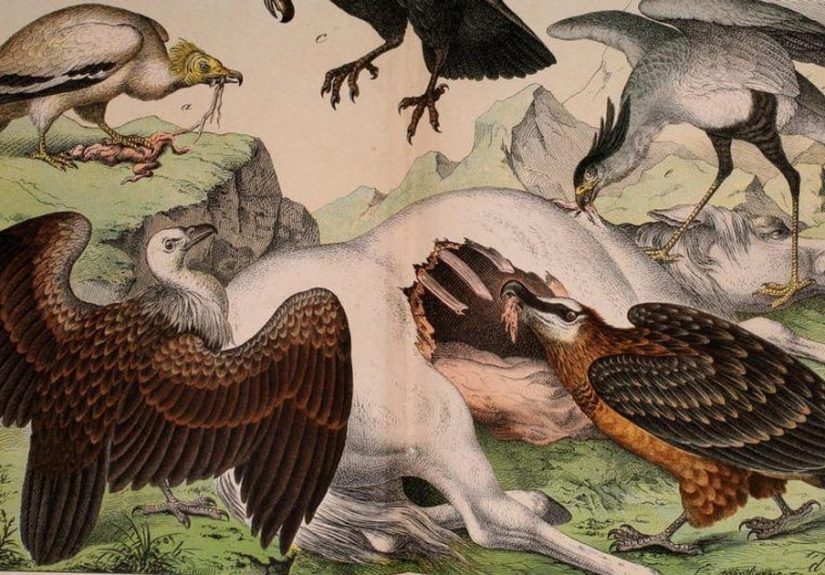
The main keyword here is “bearded vulture diet,” and the answer is wonderfully awful: bones make up most of what this bird eats. While many vultures feed primarily on soft tissue from carcasses, the bearded vulture specializes in what other scavengers often leave behind. When lions, wolves, foxes, eagles, and other scavengers are done with the meat, this bird arrives for the skeleton course.
Depending on the population and food availability, bones and bone marrow can make up around 70 to 90 percent of the bearded vulture’s diet. That is not a snack preference. That is a lifestyle. If most birds are ordering from the “insects and seeds” menu, the bearded vulture is in the corner asking whether the kitchen still has femur.
Why Bones Are Actually Valuable Food
As disturbing as it sounds, bones are packed with nutrition. Bone marrow is rich in fat and energy, and bones themselves contain minerals such as calcium and phosphorus. The problem is that most animals cannot easily access these nutrients. Bones are hard, awkward, and not exactly chew-friendly unless you are a hyena with industrial-strength jaws.
The bearded vulture took a different evolutionary route. It does not need to crush bones with mammal-style teeth, because it has a two-part strategy: gravity and stomach acid. That combination turns the bird into a flying demolition crew with digestive chemistry that deserves its own warning label.
The Bone-Dropping Trick: When Dinner Needs To Be Smashed First
When a bearded vulture finds a bone too large to swallow whole, it does not give up. It carries the bone into the air and drops it onto rocky surfaces below. These bone-smashing sites are sometimes called ossuaries, and experienced birds may use the same rocky areas repeatedly.
The process is not as effortless as it sounds. A young bearded vulture must learn how to choose the right rock, the right height, and the right angle. Drop the bone wrong, and it bounces away like the world’s worst dinner roll. Drop it correctly, and it shatters into pieces small enough to swallow.
Nature’s Most Metal Food Prep Method
Humans have knives, cutting boards, air fryers, and strong opinions about seasoning. The bearded vulture has cliffs. It may release bones from dozens or even hundreds of feet in the air, using gravity as a kitchen appliance. This is both efficient and deeply unfair to anyone who has ever struggled to open a jar of pasta sauce.
Once the bone breaks, the bird lands and eats the fragments. Smaller bones may be swallowed whole. Larger bones are reduced into more manageable pieces through repeated drops. The bearded vulture does not merely eat leftovers; it processes leftovers with aerial engineering.
The Stomach Acid Is the Real Nightmare
Now we arrive at the part that makes the bearded vulture truly unforgettable: its digestive system. This bird’s stomach is extremely acidic, with a pH reported to be less than 1 in scientific literature. That acidity allows it to dissolve bones and extract nutrients from material most animals would consider impossible food.
In practical terms, a bearded vulture can digest bone fragments within about a day. Imagine swallowing something that looks like a prop from a paleontology exhibit and then calmly turning it into usable energy before tomorrow’s lunch. That is not eating. That is alchemy with feathers.
Why It Does Not Need a Bald Head Like Other Vultures
Many vultures have bare or sparsely feathered heads because they feed deep inside carcasses, where feathers would get messy fast. The bearded vulture, however, often arrives after the messy work is finished. It focuses on bones, tendons, skin scraps, and marrow. Since it is not usually plunging its head into fresh gore, it can afford that dramatic feathered face.
This is why the bearded vulture looks less like a typical vulture and more like a cursed eagle who moonlights as a dungeon guard. Its appearance reflects its niche. It is not the first diner at the carcass buffet; it is the final guest who asks for the plate, the fork, and the table legs.
Is the Bearded Vulture Dangerous to Humans?
Despite its terrifying look and its bone-based diet, the bearded vulture is not a monster hunting people from the sky. It is mainly a scavenger. The old name “lammergeier” means “lamb vulture” in German, and it came from the mistaken belief that the bird attacked lambs. In reality, bearded vultures rarely take live prey and are much more interested in carrion.
That said, it is easy to understand why people once feared them. A massive bird with red eyes flying over mountain cliffs while carrying bones is not exactly doing public relations. Before modern wildlife science, many misunderstood predators and scavengers were blamed for more harm than they actually caused.
The Real Role: Cleanup Specialist, Not Villain
Bearded vultures help ecosystems by consuming remains that other animals leave behind. By removing bones and carcass scraps, they contribute to nutrient cycling and reduce waste in wild landscapes. Vultures in general are incredibly valuable because they help clean the environment and can limit the spread of disease from dead animals.
So yes, the bearded vulture may look like it was summoned during a full moon, but ecologically it is doing important work. It is less “evil mountain demon” and more “sanitation worker with a dramatic wardrobe.” Respect the uniform.
Where Bearded Vultures Live
Bearded vultures are birds of high places. They inhabit mountain ranges across parts of southern Europe, eastern and southern Africa, the Middle East, Central Asia, the Himalayas, and surrounding regions. They nest on cliff ledges, often in remote locations where steep terrain provides safety and wide views.
Their home ranges can be large because finding enough food in mountain ecosystems requires covering serious distance. A bearded vulture may soar for miles in search of carcasses, using wind currents and thermal lift to conserve energy. It is not wandering randomly; it is scanning the land like a bone-seeking drone with feathers.
Nesting Habits and Family Life
Bearded vultures usually build large nests on sheltered cliff ledges. The nests may contain sticks, wool, hair, and other materials found in the environment. In some historic nesting areas, old bearded vulture nests have preserved surprising objects, including animal remains and human-made materials, offering researchers a strange archive of mountain life.
Breeding is slow, and young birds take years to mature. This matters for conservation because species with slow reproduction cannot quickly bounce back from population losses. If adult birds are poisoned, shot, or killed by collisions, replacing them is not as simple as “more chicks next spring.” Nature is not running a fast-shipping warehouse.
Why the Bearded Vulture Is Threatened
The bearded vulture is considered near threatened globally, and some regional populations have faced severe declines. Its biggest threats are connected to human activity: poisoning, persecution, habitat disturbance, collisions with power lines, reduced food availability, and changes in traditional livestock practices.
Poisoning is especially serious. In some regions, poisoned bait is used illegally to kill predators such as wolves or foxes. Scavengers then feed on contaminated carcasses and die unintentionally. This is one of the tragic ironies of vulture conservation: birds that clean up death can be killed by the very carcasses they evolved to consume.
Conservation Comebacks
The good news is that bearded vultures have benefited from major conservation programs in parts of Europe. Captive breeding, reintroduction projects, habitat protection, safer feeding programs, and public education have helped restore the species to some mountain regions where it had disappeared or nearly vanished.
These efforts show that even a bird with the aesthetic of a haunted taxidermy prophecy can win public support when people understand its role. Conservation is not only about saving cute animals with big eyes. Sometimes it is about protecting the bone-eating cliff bird because ecosystems need weird specialists too.
Why This Bird Haunts the Human Imagination
The bearded vulture feels unsettling because it combines familiar and unfamiliar traits. It has the majesty of an eagle, the scavenging role of a vulture, the face of a mythological trickster, and the diet of something you would not want to meet in a dark cave. It does not fit neatly into our mental categories.
Humans are used to predators that chase, bite, claw, or ambush. The bearded vulture does something stranger: it waits until life is over, then eats what remains after almost everyone else has given up. That is not just biologically unusual; it is symbolically powerful. It turns the skeleton, the universal sign of death, into breakfast.
The Beauty Under the Horror
Look closely, though, and the horror becomes beauty. The bearded vulture is not grotesque because it is poorly designed; it is fascinating because it is perfectly designed for a rare ecological niche. Its wings suit mountain wind. Its eyes scan vast terrain. Its behavior solves the problem of hard food. Its stomach completes the process.
Every detail that seems eerie at first has a purpose. The beard, the stained feathers, the bone-dropping, the acid digestion, the cliff nesting, the patient scavenging: together they make one of the most remarkable birds alive.
Fun Facts About the Bearded Vulture
1. It Is Sometimes Called the Ossifrage
“Ossifrage” means bone-breaker, which may be the most accurate bird nickname ever created. If songbirds were named this honestly, robins would be called “Lawn Worm Inspectors.”
2. It Can Swallow Surprisingly Large Bone Pieces
The bearded vulture can swallow smaller bones whole and handle fragments that would be impossible for many animals. Its digestive system does the heavy lifting after the bird gets the pieces down.
3. It Uses Gravity Like a Tool
Dropping bones from the sky is not random behavior. It is learned, practiced, and improved over time. Young birds may need repeated attempts before mastering the technique.
4. Its Rusty Color Comes From Mud
The orange tint on adult feathers often comes from bathing in iron-rich soil or mud. In other words, this bird accessorizes with minerals.
5. It Is More Helpful Than Horrifying
Despite the dramatic title, the bearded vulture is not a villain. It is an ecological specialist that recycles nutrients and helps clean mountain landscapes.
Experiences Related to the Bearded Vulture: What It Feels Like to Encounter the Bone-Eater
Imagine standing on a mountain trail where the air is thin enough to make every breath feel important. The rocks are pale, the valley below looks impossibly far away, and the wind moves with that cold, clean sound only high places seem to have. Then a shadow crosses the slope. Not a quick little flutter. A wide, silent, deliberate shadow.
You look up and see a bird gliding without effort. Its wings barely move. It is not flapping in panic or hurrying like a pigeon late for a meeting under a park bench. It is simply there, riding the air as if the mountain belongs to it. The tail is long and wedge-shaped. The body flashes warm orange and dark gray. The head turns slightly, and for one strange second, it feels as if the bird has noticed you.
That is the kind of experience people remember. Seeing a bearded vulture in the wild is not like seeing a common backyard bird. It has scale, silence, and atmosphere. Even before you know what it eats, it looks ancient. Once someone tells you it survives mostly on bones, the encounter becomes permanently installed in your mind like a weird wildlife screensaver.
For hikers, birdwatchers, photographers, and mountain guides, the bearded vulture often becomes a highlight species. It is rare enough to feel special, large enough to impress instantly, and unusual enough to start a conversation that usually begins with, “You are not going to believe what that thing eats.” Spotting one can turn an ordinary hike into a story people repeat for years.
There is also something humbling about watching a bird so perfectly adapted to a harsh environment. Humans enter mountains with boots, maps, snacks, jackets, water bottles, backup batteries, and still complain within an hour. The bearded vulture enters the same landscape with wings, instinct, and a digestive system that treats bones as a reasonable meal plan. It makes our granola bars seem embarrassingly soft.
A photographer hoping to capture the bird might wait for hours near a ridge, scanning the sky until every distant speck becomes suspicious. Most specks turn out to be other birds, drifting leaves, or the imagination getting bored. Then the real shape appears: long wings, diamond-like tail, steady glide. The camera comes up. The heart rate follows. For a moment, the mountain is quiet except for wind and the click of a shutter.
Writers and nature lovers often describe the bearded vulture as both beautiful and macabre. That tension is exactly why it sticks in the memory. It is not simply pretty, and it is not simply scary. It is a living reminder that nature does not care about our categories. A creature can be elegant and unsettling at the same time. It can look like a royal falcon, eat like a bone furnace, and still be one of the most important cleanup specialists in its habitat.
Even learning about the bird from documentaries, zoo education programs, or conservation articles can create a strangely vivid experience. The first time you hear that a bird drops bones from the sky to break them open, your brain pauses. It checks the sentence for errors. Then it accepts the information and immediately files the bearded vulture under “animals I respect but do not fully trust.”
For children, the bearded vulture can be an unforgettable gateway into ecology. It has the drama of a monster, but the truth of a science lesson. Teachers can use it to explain scavengers, food webs, adaptation, digestion, conservation, and why “creepy” animals are often essential. For adults, it offers a similar lesson with slightly more existential dread.
The most powerful experience related to the bearded vulture may be the shift in perception. At first, the bird seems horrifying because it eats bones. Then it becomes fascinating because it can eat bones. Finally, it becomes admirable because its bone-eating role prevents waste and fills a niche few other animals can handle. The nightmare turns into a marvel. The monster becomes a specialist.
And still, let us be honest: if you ever see one gliding overhead while carrying a bone, you will think about it later. Maybe while brushing your teeth. Maybe while trying to sleep. Maybe while eating chicken wings and suddenly feeling judged. The bearded vulture does not need to haunt houses. It haunts facts. Once you know it exists, the world is permanently a little stranger, a little wilder, and a lot more feathered.
Conclusion: The Bone-Eating Bird That Deserves Respect
The bearded vulture is horrifying in the best possible way. It is not horrifying because it is evil, aggressive, or dangerous to people. It is horrifying because it reveals how creative evolution can be when a species finds an opportunity no one else wants. Bones are leftovers to most animals. To the bearded vulture, they are dinner, fuel, and proof that nature has a wonderfully dark sense of humor.
With its enormous wings, iron-stained feathers, cliffside nests, and bone-dissolving stomach, the bearded vulture is one of the most unforgettable birds on Earth. It is a scavenger, a recycler, a mountain specialist, and a conservation priority. It may haunt you for the rest of your life, but honestly, there are worse things to be haunted by than a bird that turns death into ecological usefulness.
Note: This article is an original, publication-ready synthesis based on real bearded vulture biology, behavior, habitat, diet, and conservation information.