Table of Contents >> Show >> Hide
- Why This Elephant Photo Took Off
- Was the Elephant Actually “Hiding”?
- Why Sugarcane Is Such a Tempting Target
- What the Moment Reveals About Elephant Intelligence
- Funny Image, Serious Backdrop
- Why People Relate to This Elephant So Instantly
- What We Should Take Away From the Sugarcane Scene
- Related Experiences: Why This Elephant Moment Feels So Real
- Conclusion
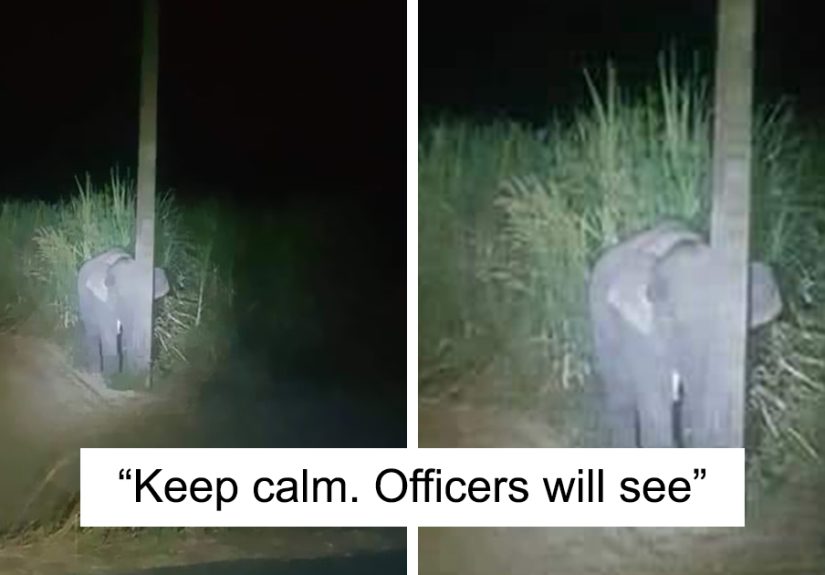
Every once in a while, the internet gifts humanity a perfect image. Not a polished, filtered, studio-lit masterpiece. No, something better: a baby elephant caught snacking on sugarcane and then attempting the world’s least effective disappearing act by standing behind a light pole. It is comedy. It is innocence. It is also, surprisingly, a doorway into a much bigger story about elephant behavior, intelligence, appetite, and the growing tension between wildlife and human spaces.
At first glance, the scene feels like a live-action cartoon. One moment, the young elephant is enjoying a sugary midnight buffet. The next, it seems to realize it has been spotted and responds with the classic strategy known to toddlers everywhere: “If I stand very still, perhaps reality will stop noticing me.” The result is undeniably funny. But the reason people love this moment so much is that it feels weirdly familiar. The elephant looks shy, guilty, clever, and adorably unprepared for consequences. In other words, it looks like all of us when we said “I wasn’t eating the leftovers” with frosting still on our face.
Still, this viral elephant moment is more than cute. It reflects real traits elephants are known for: curiosity, social learning, strong memory, flexible behavior, and a remarkable ability to navigate a world that increasingly overlaps with ours. So let’s talk about why this sugarcane heist charmed millions, what it reveals about elephants, and why the laugh-out-loud image comes with a serious ecological backdrop.
Why This Elephant Photo Took Off
The image works because it combines scale and silliness in the best possible way. Elephants are the largest land mammals on Earth, so there is already a built-in visual joke when one tries to hide behind something as skinny as a utility pole. The contrast is instant and irresistible. A creature that can flatten brush, uproot branches, and tower over most things in its environment suddenly behaves like a kid hiding behind a curtain with both feet sticking out.
But the appeal goes deeper than size. People respond to animals when they seem to reveal emotions or intentions that look familiar. A startled puppy, a smug raccoon, a dramatic cat, and now an embarrassed elephant. We recognize patterns. We fill in the blanks. That does not mean the elephant was literally thinking, “Nobody can see me now.” It does mean the moment hit the sweet spot between animal behavior and human imagination.
In viral culture, that is gold. You get humor, surprise, and a tiny story arc all in one frame: crime, discovery, attempted escape, total failure. Shakespeare would have approved. Or at least laughed.
Was the Elephant Actually “Hiding”?
This is where the fun photo meets real science. Elephants are highly intelligent animals with complex social lives, impressive memory, and strong problem-solving abilities. Researchers and wildlife experts have documented elephant behaviors involving learning, cooperation, emotional sensitivity, and adaptive decision-making. So yes, the baby elephant was likely responding to being noticed. No, we should be careful about turning that into a full courtroom confession with emotional subtitles.
Young elephants are still learning how to move through the world, how to read risk, and how to respond when something startles them. Juveniles in many species experiment with clumsy solutions before experience sharpens their instincts. For a young elephant, darting toward the nearest vertical object and freezing may not be a master class in stealth, but it does fit the broader pattern of youthful, improvised behavior.
There is another wrinkle: elephants do not experience the world the way humans do. Experts note that their sense of smell is extraordinarily important, and their vision is not their strongest tool. Humans tend to think in sight lines. We imagine concealment visually. An elephant may respond more to immediate cover, position, movement, smell, and proximity than to the kind of visual geometry a person would use when playing hide-and-seek. In plain English: the pole did not fool us, but the elephant may not have been evaluating the scene the way a human comedian would.
That said, the image remains hilarious, and science does not ruin the joke. It makes it better. The calf was not being “dumb.” It was being young, reactive, and wonderfully imperfect.
Why Sugarcane Is Such a Tempting Target
Elephants spend a huge portion of their day eating, and they need enormous amounts of plant material to fuel their bodies. Their natural diets include grasses, leaves, bark, roots, shrubs, fruit, and other vegetation. When wild elephants come across cultivated crops, however, they are not exactly indifferent. A farm can offer concentrated, energy-rich food in one convenient place. For an elephant, that is less “random snack” and more “all-you-can-eat buffet with excellent parking.”
Sugarcane is especially tempting because it is dense, sweet, and easy to recognize as a high-value food source. If you are an herbivore built like a moving boulder and you discover a neatly packed patch of sugary stalks, you are not going to write a polite thank-you note and leave. You are going to eat first and worry about public relations later.
This is why elephant crop-raiding is such a persistent issue in many parts of Asia and Africa. As elephant habitat becomes more fragmented by agriculture, roads, development, and settlements, elephants increasingly move through landscapes shaped by people. Farms often sit near elephant routes or in land that once served as habitat or travel corridors. The result is conflict: damaged crops for farmers, danger for communities, and injury or death for elephants.
The sugarcane-pole incident is funny because the elephant is small and the scene looks harmless. But the underlying reality is not always cute. Crop raids can cause major economic loss, especially for families whose harvest is their income, their food supply, or both. Wildlife experts and conservation groups have spent years working on ways to reduce these conflicts using non-lethal tools such as better barriers, warning systems, lights, community response teams, chili deterrents, bee-fence strategies, and smarter land-use planning.
What the Moment Reveals About Elephant Intelligence
Elephants are not just big. They are brainy, social, and behaviorally flexible. That matters when we interpret scenes like this one. A baby elephant trying to duck behind a pole is not funny because it is mindless. It is funny because it seems to be making a decision, however flawed, in real time.
Elephant intelligence has been studied from multiple angles: memory, communication, emotional behavior, social learning, and problem-solving. Experts have described elephants as deeply social animals that depend on relationships for survival. Herd life is not just about companionship; it is how knowledge is passed on. Older elephants help younger ones learn routes, resources, responses to danger, and the social rules of elephant society. In that sense, every young elephant is both a student and a chaos intern.
Researchers have also highlighted how elephants show signs of empathy, cooperation, and strong emotional bonds. They respond to distress, rely on one another, and navigate rich social networks. This makes juvenile behavior especially fascinating. A young elephant is not just acting alone; it is developing within a species known for long childhoods and learned behavior. So a goofy sugarcane theft is also part of a larger developmental story.
Add in their problem-solving ability, and the viral photo becomes even more compelling. Elephants have been observed using tools, navigating obstacles, remembering places and individuals, and adjusting behavior based on experience. Sometimes those smarts help them survive. Sometimes, apparently, those smarts lead them to conclude that a narrow pole is a great tactical option. Intelligence does not cancel out improvisation. Ask any human who has ever tried to fix a computer by hitting refresh seventeen times.
Funny Image, Serious Backdrop
It is easy to stop at “Aww.” It is harder, and more important, to ask why an elephant ended up in a crop field in the first place. The answer is tied to one of the biggest conservation challenges facing Asian elephants: habitat loss and fragmentation. As forests are divided by farms, roads, railways, and development, elephants are forced into closer contact with people. That overlap creates risk for both.
Asian elephants are endangered, and conservation groups have warned for years that shrinking habitat and human-elephant conflict are among their biggest threats. Many elephants now live outside protected areas, which means their daily movement often intersects with villages, fields, and infrastructure. When an elephant enters farmland, it is not staging a prank for the internet. It is usually following food, tradition, movement patterns, or necessity in a landscape that has become harder to navigate safely.
That is why some of the most promising conservation work today focuses on coexistence rather than fantasy-level separation. In many regions, the question is not whether elephants and people will share space. They already do. The real question is how to reduce harm. Solutions can include wildlife corridors, community-based warning systems, safer infrastructure design, strategic crop protection, and practical tools that steer elephants away without injuring them.
So yes, the light-pole elephant is internet-famous for being adorable. But it also symbolizes something much larger: a giant animal trying to make sense of a human-shaped world.
Why People Relate to This Elephant So Instantly
There is a reason the photo spread so quickly. It tells a universal story with no translation required. Everyone understands getting caught. Everyone understands the split-second bad decision that follows getting caught. And everyone understands the hope that maybe, just maybe, if you freeze and commit to the bit, the consequences will wander off.
The elephant’s awkward “hiding” attempt turns a giant wild animal into a mirror for ordinary human behavior. That is powerful. It creates affection, attention, and curiosity. It gets people who might never read a conservation report to stop scrolling and care, even briefly, about an elephant.
That kind of emotional doorway matters. Conservation messaging often struggles to compete with entertainment, outrage, and algorithmic chaos. A memorable animal moment can break through the noise. Once it does, there is an opportunity to add context: elephants are intelligent, elephants are social, elephants need space, and the line between funny wildlife encounter and serious conflict is thinner than it looks.
What We Should Take Away From the Sugarcane Scene
The baby elephant behind the light pole is more than a viral punchline. It is a reminder that elephants are curious, adaptable, emotionally rich animals living in environments increasingly shaped by people. The photo is charming because it captures a real behavioral moment: a young elephant reacting, adjusting, and trying something that almost worked in its own mind and not at all in ours.
It also reminds us that humor and seriousness can coexist. We can laugh at the impossible stealth mission while still recognizing the deeper issue of habitat loss, crop-raiding, and human-elephant conflict. In fact, the laughter may be what opens the door to the lesson.
If the internet insists on making one elephant famous for a failed hiding strategy, that is not the worst thing. But the best version of that attention goes beyond “cute animal content.” It leads to appreciation, understanding, and maybe even support for the kinds of conservation efforts that help elephants stay wild, stay safe, and avoid turning sugarcane farms into after-hours snack bars.
In the end, the image works because it captures something true: even the biggest creatures on Earth can have a small, goofy, very relatable moment. And honestly, if that elephant ever writes a memoir, it should absolutely be called Behind the Pole.
Related Experiences: Why This Elephant Moment Feels So Real
One reason this story sticks with people is that it does not feel like a distant wildlife headline. It feels like an experience. Even if you have never stood near an elephant in your life, you can almost feel the scene. The nighttime air. The beam of a flashlight. The rustle in a field. The split-second realization that the “mysterious shadow” is not a person, not a cow, not a trick of the eyes, but a young elephant enthusiastically helping itself to someone else’s sugarcane.
For farmers and communities who live near elephant habitat, these encounters are often a mix of awe, stress, and routine. There is the immediate tension of protecting crops without escalating danger. There is the practical frustration of seeing a field treated like an open buffet. And there is often a strange emotional contradiction: the animal may be destructive, but it is also magnificent. People can be annoyed, worried, amused, and amazed all at once. That emotional whiplash is part of what makes human-elephant interactions so memorable.
Travelers and wildlife watchers often describe elephants as animals that feel intensely present. You do not just see them; you register them. Their size is obvious, but so is their attention. They seem to assess, remember, and react in a way that feels personal. That is why a small gesture, like a calf pausing behind a pole, lands so strongly. It is not just movement. It feels like a decision, a tiny drama unfolding in real time.
There is also a childhood quality to the whole moment that pulls people in. Many adults who see the image instantly compare it to a child hiding behind a lamp, a couch cushion, or a curtain with their shoes still visible. That association matters because it transforms the elephant from “wild animal on a screen” into “creature having a relatable young-being moment.” It builds affection fast.
Zoos, wildlife documentaries, and educational exhibits have long shaped how people experience elephants from afar. Visitors often come away talking not only about size, but about personality: one elephant seemed bold, another patient, another playful, another stubborn. That language may be informal, but it reflects a real public experience. People do not encounter elephants as blank objects. They experience them as individuals with presence and patterns.
The sugarcane story taps directly into that feeling. It is the kind of moment that makes someone laugh first, then search for more information later. What do elephants eat? Why are they near farms? Are baby elephants always this mischievous? How smart are they really? That progression from delight to curiosity is valuable. It turns a passing reaction into a learning experience.
In that sense, the “light pole incident” is not just a funny wildlife anecdote. It is a shared experience of recognition. People see the elephant, but they also see the bigger themes wrapped inside the image: intelligence, youth, appetite, adaptation, and the uneasy overlap between wild nature and human land. A silly moment becomes a real one. And maybe that is why people keep coming back to it. The elephant is adorable, yes. But it also feels startlingly alive, as if it stepped out of the forest, into a field, into a joke, and straight into our collective memory.
Conclusion
“Elephant caught eating sugarcane hides behind a light pole” sounds like the setup to a joke, but it is really a snapshot of something bigger. The humor is instant, but the meaning lasts longer. The image captures a baby elephant in a deeply relatable moment of panic and improvisation, while also pointing to real truths about elephant intelligence, behavior, food-seeking, and the pressures created when wildlife and agriculture overlap.
That is what makes the story so memorable. It is sweet without being shallow, funny without being empty, and viral without being meaningless. The little elephant behind the pole may not have been invisible, but it did manage something more impressive: it made millions of people stop, smile, and pay attention to an animal worth understanding.