Table of Contents >> Show >> Hide
- What Does “Pre-Clovis” Actually Mean?
- 1. White Sands, New Mexico: Footprints That Rewrote the Timeline
- 2. Cooper’s Ferry, Idaho: A River Route Into Ancient America
- 3. Gault Site, Texas: A Long-Running Human Workshop
- 4. Buttermilk Creek Complex, Texas: Thousands of Tools Beneath Clovis
- 5. Page-Ladson, Florida: Mastodon Evidence Underwater
- 6. Paisley Caves, Oregon: Ancient DNA and a Very Un glamorous Clue
- 7. Meadowcroft Rockshelter, Pennsylvania: A Deep Record in the East
- 8. Cactus Hill, Virginia: Pre-Clovis Layers in Sandy Soil
- What These Sites Tell Us About the First Americans
- Experience Notes: How to Think About Pre-Clovis Sites Like a Curious Traveler
- Conclusion
For much of the 20th century, the story of the first Americans was often told with a very tidy opening scene: the Clovis people crossed into North America, brought their beautifully fluted stone points, hunted Ice Age animals, and basically kicked off the human chapter of the Americas around 13,000 years ago. It was neat. It was memorable. It also turned out to be about as complete as a history book missing the first three chapters.
Today, the “Clovis First” model has been heavily revised. Archaeologists now recognize that people were present in the Americas before the classic Clovis toolkit appeared. The evidence does not come from one mysterious artifact sitting dramatically in a spotlight. It comes from footprints, hearths, stone tools, cut-marked bones, ancient DNA, plant remains, and layers of sediment that stubbornly refuse to fit the old timeline.
That does not mean every pre-Clovis claim is equally strong. Archaeology is not a reality show where the loudest contestant wins. Dates must be tested, sediments must be understood, and artifacts must be proven to be human-made rather than naturally broken rocks pretending to be celebrities. Still, several ancient archaeological sites now provide serious evidence that people lived in North and South America before the Clovis culture became widespread.
What Does “Pre-Clovis” Actually Mean?
“Pre-Clovis” refers to human activity in the Americas before the Clovis culture, which is best known for its distinctive fluted projectile points and generally dates to roughly 13,300 to 13,000 calendar years ago. Clovis remains incredibly important. It was widespread, recognizable, and archaeologically impressive. But it was not necessarily the beginning of the human story in the Americas.
The shift away from Clovis First matters because it changes how researchers think people arrived, traveled, adapted, and survived during the late Ice Age. If humans were already far south, deep inland, or walking around New Mexico thousands of years before Clovis, then migration was not a single-file parade through one newly opened ice-free corridor. It was likely more complicated, involving coastal routes, inland rivers, changing climates, and groups who were excellent at improvising without leaving us a helpful travel diary.
1. White Sands, New Mexico: Footprints That Rewrote the Timeline
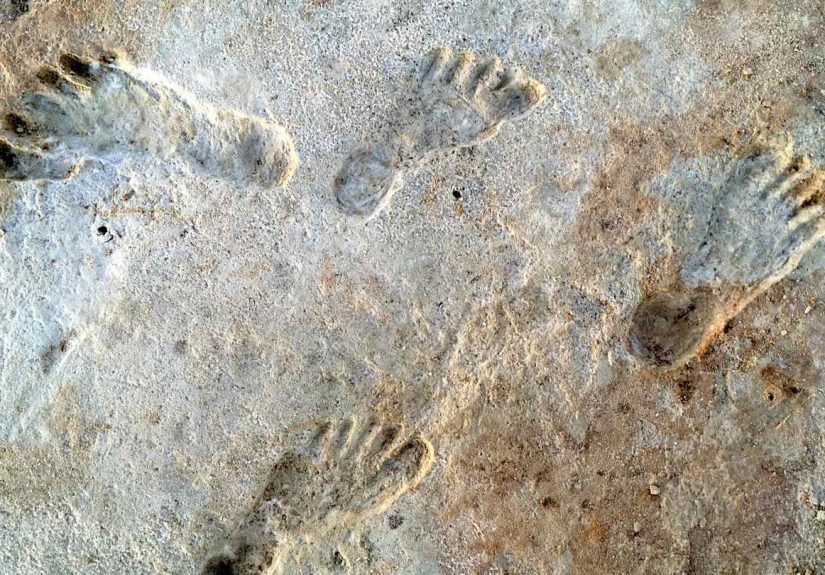
White Sands National Park may be famous for dazzling gypsum dunes, but its oldest headline act is not the scenery. It is a series of fossilized human footprints preserved in ancient lakebed sediments. These tracks have been dated to about 21,000 to 23,000 years ago, placing people in North America during the Last Glacial Maximum, when huge ice sheets covered much of the continent.
This evidence is powerful because footprints are wonderfully direct. A stone flake can be debated. A footprint is harder to shrug off. Someone walked there. In fact, many of the tracks appear to have been made by young people, giving us a rare human moment from deep prehistory: ancient teenagers moving across a muddy lakeshore while mammoths, giant ground sloths, and other Ice Age animals shared the landscape.
White Sands is one of the strongest challenges to older migration models. If people were already in New Mexico more than 20,000 years ago, then human arrival in the Americas must have begun far earlier than the classic Clovis timeline allowed.
2. Cooper’s Ferry, Idaho: A River Route Into Ancient America
Cooper’s Ferry, located in western Idaho near the Salmon River, has yielded stone tools, animal bone fragments, and hearth-related evidence suggesting repeated human occupation between roughly 16,560 and 15,280 years ago. That makes it one of the most important pre-Clovis sites in North America.
What makes Cooper’s Ferry especially fascinating is its location. Idaho is not exactly the first place most people imagine when discussing ancient coastal migration. Yet the site may support the idea that early peoples traveled along the Pacific coast and then moved inland through river systems. In other words, the first Americans may have used the continent’s waterways like prehistoric highways, minus the gas stations and questionable roadside coffee.
The tools found at Cooper’s Ferry are not classic Clovis points. They include stemmed stone technologies that may connect to older tool traditions around the North Pacific. That does not prove a simple one-way migration map, but it does suggest early cultural diversity long before Clovis became famous.
3. Gault Site, Texas: A Long-Running Human Workshop
The Gault Site in central Texas is one of the richest archaeological sites in North America. It contains evidence from multiple periods, including Clovis and possibly older pre-Clovis layers. Researchers have reported stone artifacts from deposits that may date back more than 16,000 years, making Gault a key piece in the puzzle of early human occupation.
Gault is especially valuable because it was not a quick stopover. The site appears to have been used repeatedly over a very long span of time. Its location offered good stone for toolmaking, water, and access to resources. Basically, it had the Ice Age version of “great neighborhood, convenient commute.”
The site also helps show that early peoples were not simply wandering randomly across a blank continent. They returned to useful places, understood raw materials, and developed local knowledge over generations. Gault reminds us that pre-Clovis archaeology is not just about being older than Clovis; it is about seeing early communities as skilled, observant, and deeply connected to their landscapes.
4. Buttermilk Creek Complex, Texas: Thousands of Tools Beneath Clovis
Not far from Gault, the Buttermilk Creek Complex at the Debra L. Friedkin site has produced one of the largest reported pre-Clovis artifact collections in North America. Researchers identified more than 15,000 stone artifacts from layers beneath Clovis deposits, with dates extending to about 15,500 years ago.
The importance of Buttermilk Creek is not only its age. It is the sheer volume of material. A few flakes can lead to arguments. Thousands of artifacts demand a longer conversation. The assemblage includes blades, scrapers, choppers, and toolmaking debris, suggesting that people were not merely passing through. They were working stone, maintaining tools, and carrying out daily tasks.
Some researchers have debated the site’s formation and whether artifacts may have shifted in the sediments. That caution is useful. Science should keep its eyebrows raised. Even so, Buttermilk Creek remains a major pre-Clovis site because it offers a detailed look at technology below the Clovis horizon in central Texas.
5. Page-Ladson, Florida: Mastodon Evidence Underwater
The Page-Ladson site in Florida’s Aucilla River is one of those discoveries that sounds like it was designed for an archaeology adventure movie. It is underwater, it involves mastodon remains, and it has stone tools dated to around 14,550 years ago. No fedora required, though diving gear helps.
Researchers found artifacts in a well-dated stratigraphic context, along with mastodon bones that show signs of human interaction. This matters because it places people in the American Southeast before Clovis and shows that they were living alongside now-extinct megafauna.
Page-Ladson also expands the map. Pre-Clovis evidence is not limited to the West or the Pacific corridor. Florida, with its drowned ancient landscapes and preserved river sediments, shows that early peoples reached diverse environments. They adapted to wetlands, river systems, and animal communities very different from the dry plains often associated with Clovis hunters.
6. Paisley Caves, Oregon: Ancient DNA and a Very Un glamorous Clue
Paisley Caves in south-central Oregon is famous for one of archaeology’s least glamorous but most scientifically useful finds: coprolites, or preserved ancient feces. Yes, history sometimes arrives not with a golden crown but with fossilized bathroom evidence. Archaeologists are nothing if not brave.
DNA and radiocarbon analyses of coprolites from Paisley Caves indicate human presence more than 14,000 years ago, before the earliest Clovis sites. The caves have also produced Western Stemmed projectile points and other artifacts, helping researchers understand that early North America may have included different tool traditions at roughly the same time.
Paisley Caves has faced questions about contamination and site disturbance, as any major pre-Clovis claim should. Later studies strengthened the case by using careful dating, independent testing, and contextual analysis. The site is now widely discussed as one of the strongest pieces of evidence for pre-Clovis occupation in the American West.
7. Meadowcroft Rockshelter, Pennsylvania: A Deep Record in the East
Meadowcroft Rockshelter in southwestern Pennsylvania has long been one of the most debated and intriguing early sites in North America. Excavations uncovered a long sequence of human activity, with some claims extending back as far as 16,000 to 19,000 years ago. The site is often described as one of the oldest known places of human habitation in North America.
Why the debate? Dating ancient deposits is not as simple as checking a calendar hanging on a cave wall. Researchers must examine charcoal, sediment layers, possible contamination, and the relationship between artifacts and dated materials. Critics have questioned some of the earliest dates, while supporters point to careful excavation and a deep cultural sequence.
Even with debate, Meadowcroft remains essential because it pushes attention toward eastern North America. It suggests that early peoples may have spread into varied landscapes sooner than old models expected. The site also reminds readers that archaeology is not a courtroom drama with one final gavel bang. Sometimes the best answer is: “The evidence is important, and the discussion continues.”
8. Cactus Hill, Virginia: Pre-Clovis Layers in Sandy Soil
Cactus Hill in southeastern Virginia is another eastern site that has played a major role in pre-Clovis debates. Archaeologists have reported pre-Clovis deposits with charcoal dated to more than 15,000 years ago, located below later Clovis material. That stratigraphic order is exactly what researchers hope to see: older material under younger material, like a well-behaved archaeological layer cake.
The site is located on a sandy terrace near the Nottoway River. Sandy sites can be tricky because artifacts may move more easily than in compact sediments. For that reason, Cactus Hill has received both attention and scrutiny. Still, its reported pre-Clovis component makes it one of the most discussed early sites in the Mid-Atlantic region.
Cactus Hill matters because it broadens the pre-Clovis picture beyond famous western and southern finds. If people were present in Virginia before Clovis, then early migration and settlement were geographically widespread. The Americas were not waiting empty for one cultural tradition to arrive; they were already being explored, used, and understood by earlier Indigenous ancestors.
What These Sites Tell Us About the First Americans
Together, these eight ancient archaeological sites do not tell a simple story. That is exactly why they are exciting. White Sands offers footprints far older than expected. Cooper’s Ferry hints at coastal and riverine movement. Texas sites reveal deep toolmaking traditions. Page-Ladson places people in a drowned Florida landscape with mastodons. Paisley Caves preserves biological evidence. Meadowcroft and Cactus Hill keep the eastern United States firmly in the conversation.
The big lesson is that the peopling of the Americas was likely a process, not a single event. People may have arrived in waves, followed different routes, adapted to different environments, and developed technologies that varied by region. Clovis was important, but it was not the opening credits. It was more like the blockbuster sequel that got all the merchandise.
These discoveries also show why archaeology changes. New dating methods, better excavation techniques, ancient DNA analysis, underwater research, and microscopic sediment studies can all revise what scholars thought they knew. The past is not changing, of course. Our ability to read it is.
Experience Notes: How to Think About Pre-Clovis Sites Like a Curious Traveler
Reading about pre-Clovis archaeology is one thing. Imagining the places themselves makes the story much more alive. Picture standing at White Sands, where the bright dunes roll across the horizon like powdered moonlight. Now remove the modern boardwalks, the camera phones, and the parking lot. Replace them with a cooler, wetter Ice Age basin, shallow water, mud, and the tracks of animals that no longer exist. Suddenly, those ancient footprints stop being “data” and become a moment. A person stepped there. A child hurried there. A group crossed that place while the world was colder, stranger, and full of enormous neighbors.
Or imagine Cooper’s Ferry in Idaho. A river bends through the landscape, and people return to it because rivers are useful. They carry fish, water, travel routes, animals, stone, and stories. A visitor today might see scenery; an early traveler saw a survival map. That is one of the best ways to understand ancient sites: try to see resources before scenery. Ask what the place offered. Shelter? Water? Toolstone? Food? A route through difficult country? Archaeology becomes easier to understand when the land is treated as an active partner rather than a backdrop.
At Page-Ladson, the experience is even stranger because the old landscape is underwater. What looks like a river today once included dry or marshy ground where people and mastodons moved through the same environment. Sites like this remind us that sea levels, rivers, shorelines, and wetlands have changed dramatically since the Ice Age. Many early coastal sites may now be drowned offshore, which is deeply inconvenient for archaeologists and very on-brand for the ocean.
Paisley Caves offers a different kind of lesson: small evidence can carry huge meaning. Not every discovery is a temple, a tomb, or a dramatic stone monument. Sometimes the clue is microscopic DNA, plant residue, a fleck of charcoal, or a fragment found in the right layer. The experience of studying pre-Clovis archaeology is therefore an exercise in humility. The earliest Americans did not build billboards announcing their arrival. They left traces, and researchers must listen carefully.
For readers, the best approach is healthy curiosity. Be excited, but do not swallow every headline whole. A good pre-Clovis claim needs secure dating, clear human-made artifacts, reliable context, and a convincing explanation of site formation. When those pieces come together, the reward is enormous: a deeper, richer, and more human story of the Americas.
Conclusion
The Clovis people remain one of the most important archaeological cultures in North America, but they no longer stand alone at the beginning of the story. Sites such as White Sands, Cooper’s Ferry, Page-Ladson, Paisley Caves, Buttermilk Creek, Gault, Meadowcroft, and Cactus Hill show that people were present across the Americas before Clovis technology became widespread.
Some sites are stronger than others. Some dates remain debated. That is not a weakness; it is how careful science works. The larger pattern, however, is clear: the first chapters of human life in the Americas are older, more complex, and more geographically diverse than the old Clovis First model allowed. The past, as it turns out, had been quietly rolling its eyes at our tidy timelines for decades.
Note: This article uses cautious wording for debated archaeological sites and avoids unnecessary source-link clutter so it can be published cleanly on the web.