Table of Contents >> Show >> Hide
- Why the Lost Colony of Roanoke Still Fascinates America
- Enter the First Dare Stone
- How One Stone Became a Rockslide
- Why People Wanted the Dare Stones to Be Real
- The Saturday Evening Post Investigation
- Were All the Dare Stones Fake?
- What the Dare Stones Claimed Happened to Roanoke
- The Real Clues: Croatoan, Maps, and Archaeology
- Why the Hoax Worked So Well
- The Dare Stones and the Business of Mystery
- Lessons From the Dare Stones Hoax
- Are the Dare Stones Still Worth Studying?
- Experience and Reflection: Visiting the Story Behind the Stones
- Conclusion: The Stones That Spoke Too Clearly
Every great mystery attracts two kinds of people: patient researchers with notebooks, and wildly confident people holding “evidence” they found behind a shrub. The Lost Colony of Roanoke has had more than its fair share of both. For more than four centuries, historians, archaeologists, treasure hunters, novelists, television producers, and enthusiastic dinner-party explainers have tried to answer one haunting question: what happened to the English colonists who vanished from Roanoke Island?
Then, in the late 1930s, a set of carved rocks seemed to do the impossible. Known as the Dare Stones, these inscribed stones claimed to tell the fate of Eleanor Dare, her daughter Virginia Dare, and the rest of the Lost Colony. The stones appeared to turn America’s oldest colonial mystery into a tragic but tidy story of survival, migration, betrayal, and death. For a brief, breathless moment, the case seemed closed.
There was just one problem: history is rarely that convenient. And when a mystery is “solved” by a sudden pile of dramatically worded rocks, it is wise to keep one eyebrow raised.
Why the Lost Colony of Roanoke Still Fascinates America
To understand why the Dare Stones caused such a sensation, we first need to revisit the original mystery. In 1587, English governor John White led a group of men, women, and children to Roanoke Island, off the coast of what is now North Carolina. This was not just a military outpost. It included families, including White’s daughter, Eleanor Dare, and her husband, Ananias Dare.
That same year, Eleanor gave birth to Virginia Dare, remembered as the first English child born in the Americas. Her birth quickly became wrapped in symbolism. Virginia Dare was not only a baby; she became a national myth in diapers, a tiny emblem of English hopes in the New World.
Supplies were limited, tensions in the region were complicated, and the colony was vulnerable. John White returned to England for help, but war with Spain delayed his return. When he finally reached Roanoke again in 1590, the settlement was deserted. The houses had been dismantled. The colonists were gone. There were no bodies, no obvious signs of a massacre, and no clear written explanation.
The most famous clue was the word “CROATOAN” carved into a post or tree. White had previously arranged with the colonists that they would leave a sign if they moved. A cross was supposed to indicate distress, but White found no such mark. That detail matters. It suggests the colonists may have relocated voluntarily, possibly toward Croatoan Island, now associated with Hatteras Island.
Unfortunately, storms and circumstances prevented White from investigating further. The colonists disappeared into history, and the phrase “Lost Colony” was born. For centuries, theories multiplied like weeds after rain: massacre, starvation, assimilation into Native communities, relocation inland, Spanish attack, or some combination of events. The mystery remained open, which made it irresistible.
Enter the First Dare Stone
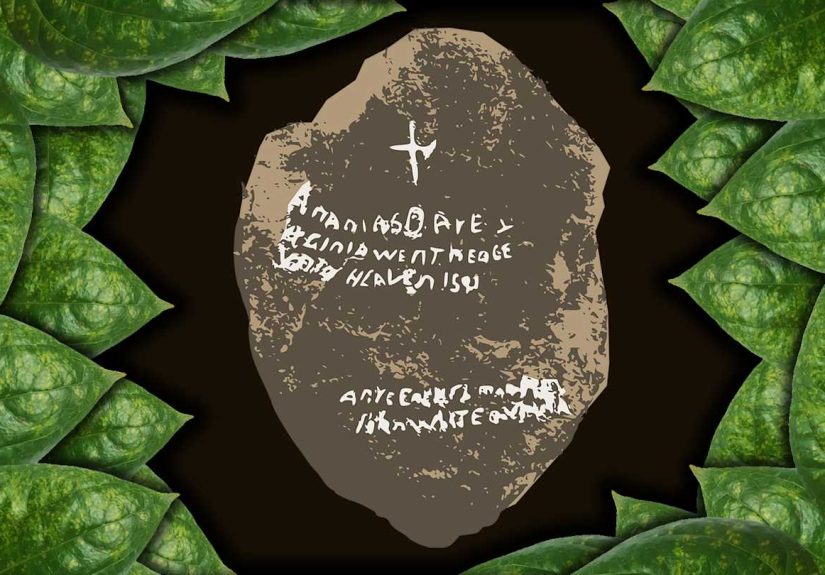
In 1937, a man named Louis E. Hammond arrived with a strange object and an even stranger story. He claimed to have found an inscribed stone near the Chowan River in North Carolina while traveling. The stone appeared to contain a message from Eleanor Dare to her father, John White.
If authentic, the stone was explosive. It suggested that the Roanoke colonists had not simply vanished. According to the inscription, they had survived for a time after leaving the island, endured violence and suffering, and left behind a tragic record. The first stone seemed like the historical equivalent of a message in a bottle, except the bottle was a rock and the message was conveniently dramatic enough to make newspaper editors sweat with excitement.
The stone eventually came to the attention of Haywood J. Pearce Jr. and his father, Haywood J. Pearce Sr., associated with Brenau College in Gainesville, Georgia, now Brenau University. They examined the artifact and became deeply interested in the possibility that it was genuine. The timing was perfect. The late 1930s saw renewed public interest in Roanoke, helped by commemorations, tourism, and the popular outdoor drama The Lost Colony.
America loves a historical puzzle, especially one with a missing baby, a carved clue, and enough uncertainty to power several documentaries. The Dare Stone arrived like a thunderclap.
How One Stone Became a Rockslide
The first stone might have remained a curiosity, debated quietly by historians and geologists. Instead, a reward was offered for more stones. That decision, while understandable, opened the door to one of the most chaotic chapters in American historical fraud.
Soon, more stones began appearing. Then more. Then even more. The story expanded from one lonely message into a full-blown stone diary of the Lost Colony’s supposed journey. The inscriptions described the colonists moving inland, suffering attacks, losing loved ones, and leaving behind messages across the Southeast. The narrative was emotionally powerful, neatly serialized, and suspiciously convenient.
In total, 48 Dare Stones became associated with Brenau’s collection. Most of the later stones were connected to discoveries in Georgia and nearby areas, and many were linked to a Georgia stonecutter named Bill Eberhardt. That occupational detail is the kind historians notice. When a large number of mysterious carved stones are found by or near someone who knows how to carve stone, the room gets quiet.
The Reward Problem
Rewards can be useful in historical investigations, but they can also create incentives for creative dishonesty. Offer money for missing artifacts, and some people will search harder. Others may suddenly discover that their backyard has been producing Elizabethan documents since breakfast.
The Dare Stones illustrate this problem perfectly. Once money and fame entered the picture, the number of “discoveries” increased. Instead of strengthening the case, the abundance of stones made the entire affair look increasingly suspicious. Authentic historical evidence usually emerges unevenly, with gaps, contradictions, and stubborn silences. The Dare Stones, by contrast, began to resemble a historical screenplay written on rocks.
Why People Wanted the Dare Stones to Be Real
The Dare Stones were not persuasive only because of their inscriptions. They were persuasive because they satisfied a cultural craving. The Lost Colony mystery had haunted Americans for generations. The stones promised closure. They gave names, dates, emotions, and a plot. They transformed a blank space in history into a tragic family letter.
That is powerful storytelling. Eleanor Dare, already a figure of historical sympathy, became the imagined author of desperate messages to her father. Virginia Dare, long mythologized as the first English child born in the New World, became part of an even sadder legend. The stones turned archaeology into melodrama, and melodrama travels fast.
In the late 1930s and early 1940s, newspapers were eager for sensational stories. A “solution” to the Lost Colony was not merely an academic matter; it was front-page material. The public did not just want facts. It wanted a story with a beginning, middle, and end. The Dare Stones supplied one with remarkable efficiency.
Too remarkable, as it turned out.
The Saturday Evening Post Investigation
By 1940, skepticism was growing. The story had become too big to ignore and too strange to accept without serious investigation. The Saturday Evening Post assigned journalist Boyden Sparkes to look into the stones. Sparkes did what good investigators do: he followed the people, the money, the inconsistencies, and the awkward little details that refuse to behave.
His 1941 report helped collapse public confidence in the Dare Stones. Questions surrounded Louis E. Hammond, the man who had produced the first stone, because he seemed to vanish from the record after introducing it. The later stones were even more vulnerable. Many appeared connected to the same circle of people. Several had suspicious discovery stories. The language, carving style, and circumstances raised doubts.
The most damaging attention fell on Bill Eberhardt. Reports connected him to many of the later stones, and the story eventually became tangled with accusations involving money and fraud. One notorious episode involved a stone that reportedly mocked the whole affair with a phrase suggesting “historical hoaxes.” At that point, subtlety had left the building wearing a fake mustache.
Were All the Dare Stones Fake?
The safest answer is this: most of the Dare Stones are widely regarded as hoaxes, while the first stone remains debated but unproven.
That distinction is important. The later stones, especially those linked to Eberhardt and the reward-driven wave of discoveries, are generally dismissed by historians. Their origins, style, and circumstances are too problematic. They look less like Elizabethan evidence and more like Depression-era opportunism carved into quartz and soapstone.
The first stone, however, occupies a more complicated space. It was not conclusively proven to be genuine, but it was also not as easily tied to the later frauds. Some researchers have argued that its weathering, language, and physical characteristics deserve further study. Others remain skeptical, pointing out that a lack of proof against forgery is not the same thing as proof of authenticity.
In historical work, “maybe” is not a verdict. It is a waiting room.
What the Dare Stones Claimed Happened to Roanoke
The larger Dare Stones narrative claimed that the colonists left Roanoke and traveled inland. The inscriptions described suffering, conflict, deaths, and survival over a number of years. They placed Eleanor Dare at the center of the story, turning her into a witness who recorded the colony’s fate for her father.
From a storytelling perspective, the stones were brilliant. They provided what the real record lacked: emotional detail. Real history often frustrates us because it is incomplete. People leave traces, but not always explanations. A broken pot, a map correction, a carved word, and scattered artifacts do not speak in complete paragraphs.
The Dare Stones did. That was part of their appealand part of the problem. Their narrative was almost too satisfying. They seemed designed not merely to preserve history, but to satisfy modern curiosity. The stones gave the public the exact kind of closure it wanted: tragic, personal, dramatic, and easy to summarize.
The Real Clues: Croatoan, Maps, and Archaeology
While the Dare Stones remain famous, modern scholarship tends to focus on more grounded evidence. The “CROATOAN” carving remains one of the strongest original clues. John White himself appeared to interpret it as a sign that the colonists had relocated rather than been destroyed. The absence of a distress symbol supports that possibility.
Archaeologists have also investigated sites beyond Roanoke Island. Some research has focused on Hatteras Island and the possibility that colonists joined or lived near the Croatoan people. Other work has explored inland locations, including areas connected to John White’s maps and possible English artifacts. The First Colony Foundation and other researchers have studied sites that may indicate movement or contact beyond the original settlement.
None of this has produced a single, universally accepted answer. But it is the kind of evidence historians prefer: material remains, documentary context, geographic logic, and careful interpretation. It may be less flashy than a carved confession from Eleanor Dare, but it is more reliable than a suspiciously talkative rock.
Why the Hoax Worked So Well
The Dare Stones hoax worked because it understood human psychology. People do not merely want the truth; they want the truth to feel complete. The Lost Colony is unsettling because it refuses to become a neat story. It has a beginning, but no clear ending. The Dare Stones offered an ending, and that made them emotionally persuasive.
They also arrived during a period when the tools of authentication were less advanced than today. Scholars could examine language, carving, and stone weathering, but the process was slow and imperfect. Meanwhile, newspapers could spread excitement much faster than experts could slow it down. In other words, the hoax had a publicity department, and skepticism was still looking for parking.
Another reason the hoax endured is that it was tied to famous names. Eleanor Dare and Virginia Dare were already loaded with symbolic meaning. A random colonial stone might have attracted mild interest. A message from Eleanor Dare about the fate of Virginia Dare? That was historical dynamite.
The Dare Stones and the Business of Mystery
Mysteries are not just puzzles; they are industries. The Lost Colony has supported books, plays, museum exhibits, documentaries, tourism, academic careers, local legends, and more than a few wild theories. The Dare Stones fit neatly into that ecosystem. They were artifacts, but they were also content.
That does not mean everyone involved acted dishonestly. Some people sincerely believed the stones might be real. Others were likely caught up in the excitement. But the case shows how quickly hope can outrun evidence. Once a discovery becomes famous, reputations attach themselves to it. Institutions, collectors, journalists, and researchers may all feel pressure to defend, explain, or profit from the story.
The Dare Stones became more than objects. They became a test of credibility.
Lessons From the Dare Stones Hoax
The Dare Stones teach a lesson that applies far beyond Roanoke: extraordinary claims need extraordinary patience. A dramatic artifact is not automatically false, but drama should make us more careful, not less. The more perfectly a discovery answers a famous question, the more carefully it should be tested.
Good historical research is slow because the past is stubborn. It does not rearrange itself for our convenience. Real evidence often produces partial answers. It points, suggests, complicates, and sometimes contradicts. Hoaxes, by contrast, often over-explain. They give us exactly what we want, which is precisely why they can be dangerous.
The Dare Stones also remind us that skepticism is not cynicism. Skepticism is respect for the truth. It is the discipline of saying, “This is fascinating, but how do we know?” Without that question, history becomes a costume party where anyone with a chisel can dress as the past.
Are the Dare Stones Still Worth Studying?
Yes, but perhaps not for the reason their promoters hoped. The stones may not solve the Lost Colony mystery, but they reveal a great deal about American memory, media, mythmaking, and the hunger for historical closure.
They show how Virginia Dare became more than a person; she became a symbol. They show how the Roanoke mystery has been shaped by nationalism, romance, tourism, race, archaeology, and entertainment. They show how artifacts can become famous before they become verified. Most of all, they show how easily a good story can impersonate good evidence.
In that sense, the Dare Stones are historically valuable even if most are not authentic Elizabethan artifacts. They are artifacts of the 1930s and 1940s: objects from an era hungry for mystery, spectacle, and national origin stories. They tell us less about Eleanor Dare’s final days and more about modern America’s desire to hear her speak.
Experience and Reflection: Visiting the Story Behind the Stones
Encountering the Dare Stones story feels a bit like walking into a museum exhibit where every label ends with a question mark. That uncertainty is the point. The best way to experience this topic is not to treat it as a solved case, but as a layered mystery with several competing voices. There is the voice of John White, returning too late. There is the silent voice of the missing colonists. There is the carved voice attributed to Eleanor Dare. And then there is the loud, suspiciously theatrical voice of the hoax itself.
For readers, students, or history lovers, the Dare Stones offer a surprisingly useful exercise in critical thinking. Imagine standing in front of one of the stones. The inscription looks old. The story is moving. The names are famous. Your brain wants to believe. That is exactly when the historian’s habits need to wake up, stretch, and ask for coffee. Who found it? Where was it found? Can the location be verified? Who benefits if it is accepted? Does the language match the period? Does the physical evidence support the claim? Are there independent sources?
This is why the Dare Stones make such a compelling classroom or travel-history topic. They are not just about Roanoke. They are about how evidence works. They reveal the difference between a clue and a conclusion. A clue invites investigation; a conclusion demands support. The Dare Stones tried to leap straight from clue to conclusion, and that leap is where the trouble began.
Anyone exploring the story of Roanoke in North Carolina can feel the power of place. The Outer Banks landscape itself encourages imagination: shifting sand, maritime forests, wide water, and weather that can change a plan in minutes. It becomes easier to understand how a small 16th-century colony could become isolated, vulnerable, and difficult to trace. The environment does not give up answers easily. It hides, erases, and rearranges evidence.
At the same time, the Dare Stones warn visitors not to confuse atmosphere with proof. A foggy coastline may feel mysterious, but fog is not a footnote. A dramatic inscription may feel authentic, but emotion is not evidence. The responsible way to enjoy the story is to hold wonder and caution together. That balance makes the mystery richer, not poorer.
There is also a modern lesson here for anyone living in the age of viral claims. The Dare Stones were, in a way, pre-internet clickbait. They had everything: a famous mystery, emotional stakes, shocking revelations, and a steady stream of updates. Today, the same pattern appears in viral posts, sensational documentaries, and “case closed” headlines. The tools have changed, but the temptation is the same. We still love answers that arrive dramatically, especially when they confirm what we already hoped was true.
The most rewarding experience with the Dare Stones is therefore not deciding instantly whether the first stone is real or fake. It is learning to sit with uncertainty. The Lost Colony may never be solved in the clean, cinematic way people want. But the search itself has value. It pushes archaeologists to examine overlooked places, historians to re-read old documents, and readers to think harder about how stories become accepted as truth.
In the end, the Dare Stones did not truly solve the mystery of Roanoke. Instead, they created a second mystery: how did so many people come so close to believing that a pile of carved stones had finally spoken for the dead? That question may be just as revealing as the original one.
Conclusion: The Stones That Spoke Too Clearly
The Dare Stones remain one of the strangest episodes in the long history of the Lost Colony of Roanoke. They promised a solution, offered a heartbreaking narrative, and briefly convinced many people that Eleanor Dare had left behind a carved testimony of survival and loss. But as investigators dug deeper, the story cracked.
Most of the stones are now treated as hoaxes, and the first stone remains an unresolved curiosity rather than a confirmed artifact. The real mystery of Roanoke continues through archaeology, documentary research, and careful debate. That may be less dramatic than a sudden stone confession, but it is much closer to how real history works.
The Dare Stones are unforgettable not because they solved the Lost Colony, but because they show how badly people wanted the Lost Colony to be solved. They remind us that the past does not owe us a perfect ending. Sometimes, the most honest answer is still: we do not know yet.