Table of Contents >> Show >> Hide
- Why John Cleese Said No
- What the Scene Represents Now
- Life of Brian Was Built for This Kind of Fight
- Why the Story Spread So Fast
- The Problem With Updating Comedy for the Stage
- Why Life of Brian Still Has Such Staying Power
- So Was Cleese Right to Keep the Scene?
- The Bigger Lesson for Comedy
- Related Experiences: What This Kind of Comedy Debate Feels Like in Real Life
- Conclusion
Some comedy stories arrive dressed like breaking news but behave more like a philosophy exam with punchlines. That is exactly what happened when John Cleese said he would not cut the so-called “Loretta” scene from his planned Life of Brian stage show, even after telling an audience that actors at a New York table read had urged him to remove it. Instantly, the story became bigger than one scene, one play, or one aging comedy legend with a famously low tolerance for fashionable scolding. It became a fresh round in a very old fight: Who gets to decide whether a joke is too offensive to survive?
Cleese, never exactly known for whispering his opinions into a napkin, framed the issue as a case of artistic independence. Critics and activists, meanwhile, saw the controversy as something else entirely: a reminder that material once treated as cheeky and subversive can now feel blunt, dated, or hurtful. And hovering over all of it was Monty Python’s Life of Brian, a film that has spent decades proving a simple rule of satire: if it is sharp enough to matter, somebody will eventually try to confiscate the knife.
That is why this moment landed with such force. On the surface, it was about whether a specific scene should stay in a stage adaptation. Underneath, it was about legacy, revision, free expression, cultural memory, and the awkward reality that comedy ages like milk, wine, and fireworks all at once. Some jokes get richer. Some go sour. Some still explode the second you light them.
Why John Cleese Said No
The headline-grabbing part of the story was not just that Cleese refused to cut the scene. It was how he described the situation. He said that during a table reading of the latest draft in New York, several actors, including highly respected stage performers, strongly recommended removing the “Loretta” sequence. Cleese’s response was essentially: thank you for the input, but absolutely not.
That choice matters because it shows he did listen. He did not present himself as some unreachable comic monk floating above criticism in a cloud of old reviews and residual royalties. He brought the material into a room, heard how performers reacted, and still decided to keep it. In his mind, that was not stubbornness for its own sake. It was authorship. To Cleese, cutting the scene would not be a minor editorial tweak. It would mean surrendering part of the structure, logic, and comic intention of the original work.
This is where the story becomes more interesting than the usual “comedian versus cancel culture” food fight. Cleese did not merely refuse because he enjoys provocation. He argued that the scene still works in context and that its dramatic movement matters. In other words, he treated the joke not as an isolated line item on a cultural sensitivity spreadsheet, but as part of a larger comic argument. Whether you agree with him or not, that is a more serious defense than the standard “people are too easily offended now” routine that usually gets rolled out like a dusty prop.
What the Scene Represents Now
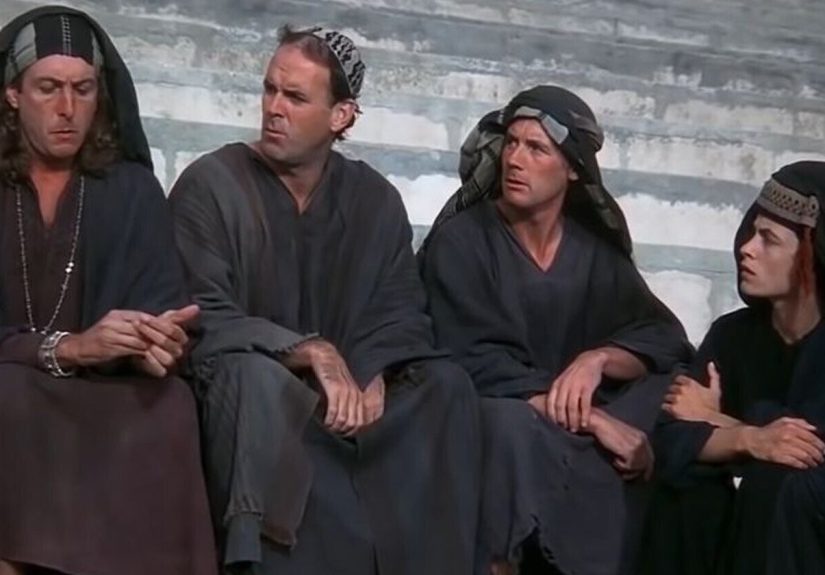
The “Loretta” scene has become a modern flashpoint because audiences do not watch old comedy in the same way they once did. The original sequence involves a male character saying he wants to be called Loretta and declaring a desire to have babies, while others argue about biology, rights, and language in typically absurd Python fashion. For some viewers today, the scene reads as a dated joke built on gender identity and reproductive impossibility. For others, it plays less as cruelty than as an argument about how societies negotiate identity, inclusion, and practical reality.
That split explains why the scene continues to generate more heat than runtime. It is not just about whether the material is funny. It is about what, exactly, the joke is targeting. Is the humor aimed at a trans identity? At political rhetoric? At men who grandly declare rights without considering reality? At groups trying to solve impossible questions through committee debate? Monty Python often worked by letting several targets get hit at once, which makes retrospective moral bookkeeping a bit like trying to catch confetti with chopsticks.
Cleese has suggested that the scene moves from surprise toward a form of acceptance rather than simple rejection. His critics, however, argue that whatever the intention, the punchlines still depend on ideas that can alienate trans viewers in the present day. That tension is why the debate refuses to die. Comedy is often defended on the grounds of intent, while offense is often experienced through effect. The two do not always shake hands before leaving the room.
Life of Brian Was Built for This Kind of Fight
If the uproar feels familiar, that is because Life of Brian has been offending polite certainty since 1979. The film was controversial upon release, protested by religious groups, and banned in some places. That history is not a side note; it is part of the film’s identity. Life of Brian was never designed to be a safe little heirloom kept in velvet. It was designed to jab at institutions, factions, self-importance, and the human tendency to form a queue the second somebody looks vaguely messianic.
Importantly, the film’s strongest defenders have long argued that it does not mock Jesus so much as the people around him. That distinction matters. The movie follows Brian Cohen, a man born next door to Christ and repeatedly mistaken for something grander than he is. The satire is directed less at faith itself than at fanaticism, opportunism, slogan-heavy politics, and the comic fragility of organized certainty. One of the film’s enduring pleasures is how often its characters are less interested in truth than in winning an argument, owning a faction, or sounding important in public. Welcome to every decade since.
That is part of why the movie still feels weirdly current. Its jokes about splinter groups, ideological hair-splitting, and mass confusion do not belong to one era. They belong to any era where people mistake volume for wisdom and identity performance for moral clarity. If you stripped away the robes and sandals, half the arguments in Life of Brian could be reposted by lunchtime on social media.
Why the Story Spread So Fast
Because John Cleese is involved, no cultural disagreement ever remains a local weather event. It becomes a full media climate system. He has spent years criticizing what he sees as a fearful, overcorrected culture around comedy, and that means any claim about changing his old material is instantly combustible. The idea that Cleese might trim a controversial scene for modern sensitivities was always going to pull clicks, fury, applause, suspicion, and the digital equivalent of people climbing onto chairs to shout their opinions with soup on their ties.
Then came the correction: he said the earlier reporting had misrepresented him. Instead of announcing a cut, he was recounting advice he had received and rejecting it. That reversal gave the story extra velocity because it fed two modern obsessions at once: outrage over offense and outrage over inaccurate outrage. We no longer just argue about art. We also argue about who described the argument incorrectly. The meta-debate now arrives before the popcorn.
It also helped that the subject sat neatly inside several overlapping culture-war boxes: transgender representation, the limits of satire, legacy artists railing against “woke” pressure, and the question of whether adapting old work for new audiences requires renovation or courage. Once a story fits that many boxes, the internet does not discuss it. It weaponizes it.
The Problem With Updating Comedy for the Stage
Every stage adaptation of a beloved screen work faces the same ugly little puzzle: do you preserve the original as faithfully as possible, or do you revise it to reflect the audience now sitting in front of you? There is no universally noble answer. Sometimes revision is smart dramaturgy. Sometimes it is panic wearing reading glasses. Sometimes strict fidelity honors the material. Sometimes it just mummifies it.
With a comedy as iconic as Life of Brian, the challenge gets harder. Fans do not just want the story; they want the rhythm, the edge, the insolence, the timing, and the thrill of hearing something slightly unacceptable said with total conviction. Sanding down that energy can leave the adaptation feeling like tribute-band rebellion, all costume and no electricity. On the other hand, pretending audiences have not changed at all can make a production feel stubborn in the least artistic way possible.
Cleese clearly chose the preservation side of that equation. He appears to believe that once you start removing pieces because they may provoke backlash, you risk collapsing the comic ecosystem that made the work matter in the first place. His stance is less “this joke is untouchable because I wrote it” than “this joke belongs to a structure, and if you pull one beam, you may discover you have removed part of the roof.”
His detractors would answer that some beams deserve to be replaced. They would argue that stage adaptation is exactly the right moment to rethink what still lands, what now distracts, and what may do more cultural damage than comic good. That is not censorship by default. Sometimes it is editing. But there is the rub: to one camp, editing looks responsible; to the other, it looks like fear with a headset mic.
Why Life of Brian Still Has Such Staying Power
Even people who dislike this particular scene often admit that Life of Brian remains one of the sharpest satires of mass behavior ever put on film. The movie’s brilliance lies in how calmly it lets absurdity expose itself. Political groups spend more energy fighting each other than challenging actual power. Crowds mishear public speech and turn confusion into doctrine. Authorities are ridiculous, rebels are ridiculous, followers are ridiculous, and poor Brian is mostly just trying not to be turned into a symbol before lunch.
That is why the film’s reputation has endured even as individual moments have aged unevenly. The core comic engine is still potent: people desperately want certainty, leadership, purity, and slogans, and they will attach those desires to the nearest available body. The joke lands because it is not limited to ancient Judea, British television comedy, or the 1970s. It speaks to a recurring human problem. We are forever inventing new ways to worship confidence and misunderstand nuance.
Roger Ebert’s old point about the film remains useful here: it is more about spectacle, institutions, and the machinery of belief than about sacred insult for its own sake. That may be one reason the film still attracts both love and fury. People sense that the targets are bigger than a single religion, a single identity, or a single political tribe. Life of Brian pokes at the universal human appetite for solemn nonsense. Nobody likes seeing their favorite nonsense itemized in public.
So Was Cleese Right to Keep the Scene?
Artistically, there is a coherent case for his decision. Writers are not required to revise their work every time public values shift, and a stage adaptation does not have to function as a retroactive apology tour. If Cleese believes the scene still expresses something meaningful about argument, language, and group response, he is within his rights to preserve it. A comedy stripped of everything potentially abrasive may end up so polite it can be safely stored in a dentist’s waiting room.
But there is also a coherent case against him. Audiences are not obligated to receive old material on the author’s preferred terms, and “that was the intention” is not a magic phrase that cancels discomfort. If viewers find the scene exclusionary or stale, they are free to say so, skip the show, or criticize the production. That is not censorship either. That is the marketplace of ideas doing its noisy little tap dance.
The healthiest reading is probably the least glamorous one: this is a real artistic dispute, not a cartoon. Cleese is not automatically heroic because he refused to cut the scene. His critics are not automatically philistines because they objected. One side is defending the integrity of a classic satire. The other is questioning whether one part of that satire still punches where it should. Both questions are legitimate. The difficult part is that the internet prefers duel pistols to difficult parts.
The Bigger Lesson for Comedy
The enduring value of this episode may have less to do with John Cleese personally than with what it reveals about comedy in public life. Old material is no longer merely archived; it is continuously re-auditioned. Every revival, clip, quote, or adaptation asks whether a joke survives contact with a changed audience. That process is uncomfortable, but it is also evidence that comedy still matters. Nobody stages moral battles over jokes that no longer have voltage.
What Cleese’s refusal really dramatizes is the modern split between preservation and reinterpretation. One side fears that constant revision will leave us with culture that is technically acceptable and spiritually dead. The other fears that refusing revision disguises indifference as principle. Both fears are understandable. Both can become ridiculous. And somewhere between them sits the ideal outcome: artists make the work they believe in, audiences answer honestly, and nobody pretends a disagreement over a comedy scene is the end of civilization.
That may be the most Life of Brian lesson of all. People gather, choose sides, argue loudly, claim moral urgency, misunderstand one another, and transform a messy, human dispute into a giant banner for their preferred worldview. The scene stays, the fight continues, and comedy once again proves it can still do the rudest thing possible: force people to reveal themselves while they are busy explaining why everybody else is wrong.
Related Experiences: What This Kind of Comedy Debate Feels Like in Real Life
One reason the John Cleese story resonated so widely is that many people have lived through smaller versions of the same experience. Maybe not with a world-famous satire and a legendary comedian, but with a school play, a sketch show, a family movie night, a stand-up set, or a clip that gets passed around until everyone has an opinion and nobody is discussing the same thing anymore. That feeling is familiar: you laugh, then hesitate, then start wondering whether your laugh means the same thing it would have meant ten years ago.
For longtime comedy fans, the experience is often mixed rather than simple. They revisit an old film they loved and discover that some parts still feel electric while others feel awkward in ways they never noticed before. That does not always cancel the pleasure. Sometimes it makes the pleasure more complicated. You admire the craft, timing, and nerve of the work while also noticing that a line or scene lands differently now. It can feel a bit like running into a brilliant old teacher who is still brilliant but says one thing at lunch that makes the whole table go silent.
For performers, the experience can be even sharper. A joke on the page may look playful, but in a rehearsal room it suddenly reveals its weight. Actors hear where the laugh sits, where the discomfort starts, and where the energy changes. That is probably why table reads matter so much. They are not just about checking whether lines are funny. They are about discovering what the room experiences together in real time. Sometimes the room says, “This still works.” Sometimes it says, “This works, but differently.” Sometimes it says, “This may not be doing what you think it is doing.”
For audiences, there is also the odd experience of watching a cultural argument form before the work even appears. People begin debating clips, headlines, snippets, and summaries. By the time the full piece arrives, many have already chosen a side. That can make the real experience thinner than it should be. Instead of encountering art, they arrive with a verdict preloaded. The John Cleese controversy tapped into exactly that pattern. Plenty of people responded not to a production they had seen, but to an idea of what the production represented.
And then there is the most human experience of all: recognizing that comedy can reveal generational differences without anyone being entirely foolish. Older viewers may experience a scene as irreverent, structurally clever, and intellectually mischievous. Younger viewers may experience the same scene as tonally clumsy or socially blunt. Both responses can be sincere. Both can coexist. The friction comes when either side insists the other is too stupid, too sensitive, too cynical, or too old to understand what is happening.
That is why stories like this linger. They are not just about one joke. They are about how people experience change itself. Comedy becomes the testing ground. We learn what we still share, what we now reject, and how willing we are to sit with disagreement without immediately turning it into a bonfire. In that sense, the Cleese debate is not only about preserving a scene from Life of Brian. It is about the uncomfortable, revealing experience of living in a culture that keeps rewatching itself and arguing over what, exactly, it just saw.
Conclusion
John Cleese’s refusal to cut the “Loretta” scene is not just a spicy entertainment headline. It is a compact case study in how classic comedy survives, collides, and mutates in public life. Life of Brian has always provoked arguments because it was built to puncture certainty. Decades later, it is still doing the job, just with new targets, new sensitivities, and faster headlines. Cleese chose preservation over revision, and that choice says as much about his view of authorship as it does about the scene itself.
Whether readers see that decision as brave, stubborn, shortsighted, principled, or gloriously on-brand, the controversy proves one thing beyond dispute: satire still matters when it can make people laugh, flinch, debate, and revisit what they think comedy is for. A harmless joke fades. A live one keeps starting conversations long after the credits should have rolled.