Table of Contents >> Show >> Hide
- Why an External Flash Beats a Built-In Pop-Up
- Flash Basics in 90 Seconds: Two Exposures Happening at Once
- Step 1: Mount the Flash and Make Sure It’s Speaking the Same Language
- TTL vs Manual Flash: Which One Should You Use?
- Bounce Flash: The “Make It Look Natural” Superpower
- Four Starter Setups With Real Numbers
- Off-Camera Flash Without the Headache
- Advanced Features Worth Knowing (So You Don’t Panic When You See the Menu)
- Flash Troubleshooting: Fix the Usual Suspects
- A 30-Minute Practice Plan (That Actually Works)
- Conclusion
- of Real-World Flash Experiences (Collected Field Notes)
- The wedding reception lesson: the ceiling is your best friend (until it isn’t)
- The corporate headshot lesson: consistency beats creativity (during production)
- The outdoor portrait lesson: fill flash should be invisible
- The battery lesson: your flash is a tiny gym that hates cardio
- The confidence lesson: practice removes the mystery
- SEO Tags
An external flash (aka a “speedlight”) is the easiest way to stop your photos from looking like they were lit by a startled raccoon holding a flashlight. Used well, flash doesn’t scream “FLASH!”it whispers “wow, that light looks nice.”
This guide walks you through on-camera and off-camera flash in plain English, with practical settings, troubleshooting, and a few battle-tested tricks that’ll make your photos look intentional (even if you’re improvising like a contestant on a cooking show who forgot the main ingredient).
Why an External Flash Beats a Built-In Pop-Up
Built-in pop-up flashes are convenient, but they’re small, harsh, and stuck pointing straight forwardlike a tiny spotlight determined to flatten every face it meets. An external flash gives you:
- More power (so you can bounce light and still have enough juice)
- A swivel/tilt head (so light can come from the ceiling/wall instead of your camera’s forehead)
- Faster recycle times (less waiting, more shooting)
- Better control over exposure, direction, and softness
Flash Basics in 90 Seconds: Two Exposures Happening at Once
Flash photography clicks when you realize you’re juggling two exposures:
- Ambient exposure (room light, sunset, street lamps) controlled mostly by shutter speed, aperture, and ISO
- Flash exposure (your speedlight burst) controlled by flash power (or TTL), distance, aperture, and ISO
Here’s the cheat code: Shutter speed mainly affects ambient (until you hit sync limits), while aperture and ISO affect both ambient and flash. Flash power (or TTL compensation) changes the flash part.
Step 1: Mount the Flash and Make Sure It’s Speaking the Same Language
On-camera setup checklist
- Slide the flash into the camera hot shoe and lock it down (wobbly flash = wobbly results).
- Turn on the camera, then the flash.
- Set flash mode to TTL (auto) or Manual (you choose power).
- Take a test shot and confirm the flash fires (yes, this is where we all learn batteries exist).
Camera settings to start with (indoor)
- Mode: Manual (M) on the camera (you control ambient cleanly)
- Shutter: 1/125s (safe, sharp, and usually below sync speed)
- Aperture: f/2.8 to f/5.6 (depending on depth of field you want)
- ISO: 400–1600 (modern cameras handle this well, and it reduces flash strain)
If you’re in Aperture Priority (Av/A), many cameras will drag the shutter in dim light, which can blur backgrounds. Manual mode keeps things predictable.
TTL vs Manual Flash: Which One Should You Use?
TTL (Through-The-Lens metering)
TTL is the “automatic transmission” of flash. The camera/flash system fires a quick pre-flash, measures the scene, then decides flash power. It’s fantastic for events, moving subjects, and changing distancesbasically anytime life refuses to stand still for your lighting plan.
Best TTL tool: Flash Exposure Compensation (FEC). If faces look too bright, dial FEC down (e.g., -0.7). If bounce looks weak, bump it up (+0.7 to +1.3).
Manual flash
Manual flash is the “I like my coffee black and my exposures consistent” option. You set power (like 1/16, 1/8, 1/4) and it stays there until you change it.
Manual shines in portraits, product photography, and any setup where your subject distance doesn’t change muchbecause consistency makes editing easier and results repeatable.
A practical hybrid: TTL to find it, Manual to lock it
A popular workflow is using TTL to get close quickly, then switching to manual to keep the same output shot-to-shot. It’s like letting the GPS get you out of town, then driving the scenic route yourself.
Bounce Flash: The “Make It Look Natural” Superpower
If you only learn one flash trick, learn this: don’t point the flash at people (unless you’re going for “deer in headlights” editorial).
Instead, aim the flash head at a nearby white or neutral ceiling or wall. The light spreads, softens, and comes from a larger surfacemore like window light, less like a paparazzi ambush.
How to bounce (quick steps)
- Rotate/tilt the flash head toward the ceiling at about 60–90 degrees.
- Angle slightly behind you or to the side for better direction (so the light isn’t straight-on).
- Use TTL with a little positive FEC (+0.3 to +1.0) because bounce eats power.
- Watch for color casts: bouncing off green walls makes people look mildly seasick.
When bounce fails (dark ceilings, tall venues, wood paneling)
If the ceiling is too high, too dark, or too colorful, bounce turns into “flash yelling into the void.” In those cases:
- Use a small softbox or bounce diffuser (portable and consistent)
- Go off-camera with an umbrella or softbox
- Use flash as subtle fill (lower power, keep ambient doing most of the work)
Four Starter Setups With Real Numbers
These aren’t magic spells, but they’re solid starting points. Adjust based on your room size, ceiling height, and the laws of physics (which, unfortunately, do not care about your artistic vision).
1) Indoor portraits in a normal living room (bounce, TTL)
- Camera: M mode, 1/125s, f/3.2, ISO 800
- Flash: TTL, bounce to ceiling, FEC +0.7
- Why it works: ISO 800 keeps the flash from working at full blast, recycle time stays fast, and bounce gives soft light.
2) Event candids (run-and-gun bounce, TTL)
- Camera: 1/160s, f/2.8, ISO 1600
- Flash: TTL, bounce when possible, FEC 0 to +0.7
- Tip: If backgrounds go dark, slow the shutter (to 1/80–1/125) or raise ISO. That brightens ambient without blasting people.
3) Outdoor fill flash at sunset (keep it subtle)
- Camera: Start by exposing for the sky: 1/250s, f/4, ISO 100 (example)
- Flash: TTL, FEC -0.7 (gentle fill), or manual at 1/32 to 1/16 depending on distance
- Goal: Lift face shadows without making it look like night-vision.
If you need faster than your camera’s normal flash sync speed, you may need High-Speed Sync (HSS)more on that below.
4) Simple product photo (off-camera, manual)
- Camera: 1/160s, f/8, ISO 100
- Flash: Manual 1/16 power in a softbox, placed 45 degrees to the product
- Why it works: f/8 boosts sharpness and depth, low ISO keeps quality clean, manual flash stays consistent for multiple angles.
Off-Camera Flash Without the Headache
Off-camera flash is where images start looking “professional,” mostly because the light is no longer glued to the camera. You can create dimension, shape, and drama by moving the flash.
What you need (minimal kit)
- A speedlight
- A trigger system (radio triggers are the most reliable)
- A light stand
- A modifier (umbrella or small softbox)
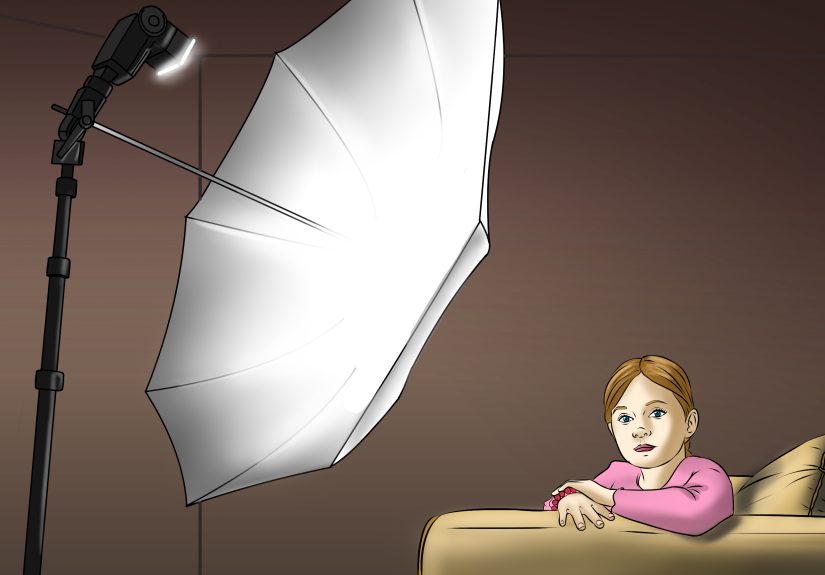
Your first off-camera setup: “fake window light”
- Put the flash on a stand, about 45 degrees to your subject, slightly above eye level.
- Add an umbrella or softbox.
- Set camera to: 1/160s, f/4, ISO 400.
- Set flash to manual 1/16 power and take a test shot.
- Too bright? Drop to 1/32. Too dark? Go to 1/8 or raise ISO.
Think of the flash like a movable window: closer = softer and brighter; farther = harder and dimmer.
Multiple flashes and groups (when you get ambitious)
Many radio systems let you control groups (A/B/C, etc.) from the camera. A common progression:
- Key light: main light shaping the face
- Fill: softer, weaker light to lift shadows
- Rim/hair light: adds separation from background
Advanced Features Worth Knowing (So You Don’t Panic When You See the Menu)
High-Speed Sync (HSS)
Normal flash sync speeds are often around 1/160–1/250s (varies by camera). HSS lets you use faster shutter speedsgreat for bright outdoor portraits at wide apertures (like f/1.8). The tradeoff: HSS reduces flash power and eats battery faster.
Rear-curtain sync (motion with a sharp subject)
Rear-curtain sync fires the flash at the end of the exposure. If you’re using slower shutters to capture ambient and motion trails (dancing, cars, sparklers), rear-curtain tends to make motion look more naturalblur trails behind the subject, not in front.
Gels and white balance (fixing “orange room syndrome”)
Indoor lighting can be warm (tungsten) while flash is closer to daylight. A simple CTO gel on the flash plus setting your camera white balance to match the room can make everything look coherent instead of “two different planets of color.”
Flash Troubleshooting: Fix the Usual Suspects
Problem: Harsh shadows and shiny foreheads
- Bounce the flash (ceiling/wall).
- Use a larger modifier (small softbox beats a tiny plastic cap).
- Move the light off-camera for better angles.
Problem: Subject is bright, background is black
- Increase ISO or slow shutter speed to bring up ambient.
- Lower flash power / reduce FEC so flash isn’t overpowering the scene.
Problem: Underexposed bounce flash
- Raise ISO (often the fastest fix).
- Open aperture (if depth of field allows).
- Add positive FEC in TTL, or raise manual power.
- Remember bounce distance is longer than direct distancelight travels up and back.
Problem: Weird color casts
- Don’t bounce off colored walls/ceilings.
- Use gels to match ambient, then correct in-camera/RAW.
Problem: Misfires off-camera
- Use radio triggers (optical can fail in bright sun or around obstacles).
- Check channel/group settings.
- Replace batteries (flash problems are often battery problems wearing a trench coat).
A 30-Minute Practice Plan (That Actually Works)
- 10 minutes: Direct flash vs bounce flash in the same room. Compare shadows and skin texture.
- 10 minutes: TTL with FEC. Take three shots at FEC 0, -1, +1 and observe changes.
- 10 minutes: Manual power ladder. Shoot at 1/64, 1/32, 1/16, 1/8 from the same distance.
This short drill teaches you what flash power “feels like,” so you stop guessing and start steering.
Conclusion
Using an external flash is less about blasting light and more about shaping it. Start with bounce flash, understand the two-exposure idea (ambient + flash), and use TTL with flash exposure compensation until you’re comfortable. When you want consistency and control, switch to manual. Add off-camera flash when you’re ready to make your light directional and dimensional.
Most importantly: practice in one room with one subject and one flash. Flash photography rewards repetitionunlike your flash, which will not reward you for firing at full power every time.
of Real-World Flash Experiences (Collected Field Notes)
Photographers tend to learn flash in the same three stages: (1) fear, (2) overconfidence, (3) enlightenment. The “fear” stage usually begins after the first batch of indoor photos looks like a crime documentary reenactment. The “overconfidence” stage arrives when bounce flash works once and you start thinking you’re basically a lighting wizard. Enlightenment is realizing you’re still going to mess upjust with better intentions.
The wedding reception lesson: the ceiling is your best friend (until it isn’t)
In a typical reception hall with a normal ceiling, bounce flash is a cheat code: point up, add a little FEC, and suddenly people look like they’re lit by a soft chandelier rather than a paparazzi ambush. But the moment you walk into a venue with a dark wooden ceiling or a warehouse vibe with beams 40 feet up, bounce becomes “sending photons on a long hike and hoping they come back.” The fix most event shooters land on is simple: raise ISO, use a small modifier, and keep flash as fill while ambient does the heavy lifting.
The corporate headshot lesson: consistency beats creativity (during production)
For headshots, many photographers discover that manual flash feels like relief. Set the light, lock power, and the exposure stays stable as you shoot a dozen people in a row. TTL can still work, but it may react to dark suits, white shirts, shiny foreheads, or reflective glasses like it’s trying to solve a math problem under stress. A common approach is to use TTL to get close, then switch to manual and keep the same look for everyonebecause nobody wants the marketing director to be lit dramatically while the CEO looks like they’re under a desk lamp.
The outdoor portrait lesson: fill flash should be invisible
Outside, the “aha” moment is learning that good fill flash often looks like no flash at all. The goal is to gently lift shadows under eyes and hats while keeping the scene believable. Many shooters start too strong, creating that unmistakable “lit-from-camera” look. Dialing down FEC (like -0.7) or using low manual power can make the light feel naturallike the sun decided to be slightly nicer for once.
The battery lesson: your flash is a tiny gym that hates cardio
Full-power pops are exhausting: recycle time slows, batteries drain, and overheating warnings appear right when the best moment happens. The experience most people share is learning to “work smarter”: raise ISO a bit, open aperture if you can, and bounce efficiently. It’s not lazinessit’s logistics. Your flash will thank you by being ready when you need it.
The confidence lesson: practice removes the mystery
The biggest shared takeaway is that flash stops being scary when you practice with one setup until it’s boring. Once you understand how shutter controls ambient and flash power controls the burst, you can walk into almost any scene and make a plan. And if your plan fails, you’ll at least fail quicklyand with better lighting.