Table of Contents >> Show >> Hide
- What Is the Null Space of a Matrix?
- Why the Null Space Matters
- How to Find the Null Space of a Matrix in 5 Steps
- Complete Example: Finding the Null Space
- How to Check Your Answer
- Common Mistakes When Finding the Null Space
- What If the Null Space Only Contains the Zero Vector?
- Quick Shortcut: Use Rank and Free Variables
- Practical Experience: What Learning the Null Space Really Feels Like
- Conclusion
- SEO Tags
Finding the null space of a matrix sounds like the kind of thing that should require a secret handshake, a dusty chalkboard, and at least one dramatic sigh. Luckily, it is much friendlier than it looks. The null space of a matrix is simply the set of all vectors that get sent to the zero vector when multiplied by that matrix. In math language, for a matrix A, the null space is the collection of all vectors x that satisfy Ax = 0.
That little equation, Ax = 0, is the whole party. Once you understand how to solve it, you know how to find the null space of a matrix. The process is built around row reduction, pivot variables, free variables, and writing the final answer as a span of basis vectors. Yes, those words may sound like they came from a math textbook after three cups of coffee, but by the end of this guide, they will feel much more manageable.
In this article, we will break the method into five clear steps, walk through a complete example, explain common mistakes, and add practical study experience so you can recognize what is actually happening instead of just copying symbols until the page gives up.
What Is the Null Space of a Matrix?
The null space of a matrix A, often written as Nul(A) or Null(A), is the solution set of the homogeneous matrix equation:
If A is an m × n matrix, then the vector x must have n entries. That means the null space lives in Rⁿ, not necessarily in the same space as the output. For example, if A has 4 columns, every vector in its null space will have 4 components.
Conceptually, the null space tells you which input vectors the matrix “flattens” to zero. If the only vector that works is the zero vector, the matrix has a trivial null space. If there are nonzero vectors in the null space, then the matrix has directions that collapse completely under multiplication. In plain English: the matrix has a blind spot.
Why the Null Space Matters
The null space is not just a homework decoration. It shows up in linear systems, computer graphics, data science, engineering, differential equations, optimization, and machine learning. When a system has infinitely many solutions, the null space explains the “extra movement” you can add without changing the output. When columns of a matrix are linearly dependent, the null space reveals the exact relationship among them.
The dimension of the null space is called the nullity. A useful relationship is:
This is often called the rank-nullity idea. In practical terms, every non-pivot column creates one free variable, and every free variable usually contributes one basis vector to the null space.
How to Find the Null Space of a Matrix in 5 Steps
Step 1: Write the Homogeneous Equation Ax = 0
Start with your matrix A and set up the equation Ax = 0. This means you are not solving for a random right-hand side like b. You are solving for the zero vector.
Suppose your matrix has four columns. Then your unknown vector should look like this:
The number of variables always matches the number of columns. This is one of the most common places students trip. Rows tell you how many equations you have; columns tell you how many unknowns you have.
Step 2: Row Reduce the Matrix
Next, row reduce A to echelon form or, even better, reduced row echelon form. You do not need to augment with a zero column if you remember that the right side stays zero during row operations. Since this is a homogeneous system, row operations preserve the solution set.
Reduced row echelon form is especially helpful because it makes the pivot variables and free variables easy to spot. The pivots are the leading 1s in the nonzero rows. Columns containing pivots correspond to pivot variables. Columns without pivots correspond to free variables.
Think of the pivots as the variables that get instructions. The free variables are the ones that get to wander around the mathematical playground wearing sunglasses.
Step 3: Identify Pivot Variables and Free Variables
After row reduction, inspect the columns. A pivot column has a leading entry. A non-pivot column does not. The variables attached to non-pivot columns become parameters, often written as s, t, u, and so on.
For example, if columns 1 and 3 are pivot columns, then x1 and x3 are pivot variables. If columns 2 and 4 are non-pivot columns, then x2 and x4 are free variables.
The number of free variables tells you the dimension of the null space. If there are two free variables, the null space has dimension 2. If there are no free variables, the null space contains only the zero vector.
Step 4: Solve for Pivot Variables in Terms of Free Variables
Now translate the reduced matrix back into equations. Solve the pivot variables using the free variables as parameters. This step turns the row-reduced matrix into a general solution.
For instance, if your reduced equations are:
then you solve:
Let the free variables be:
Then:
This gives the general solution vector:
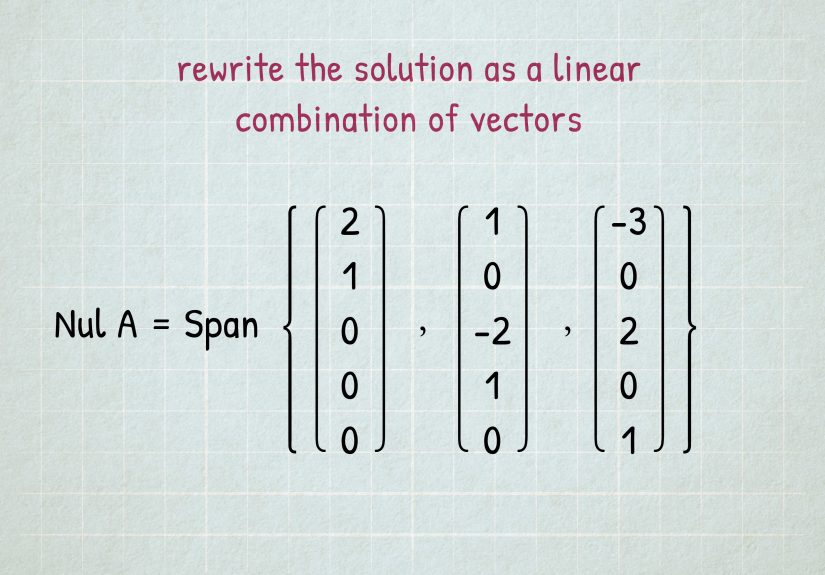
Step 5: Write the Null Space as a Span of Basis Vectors
The final step is to separate the parameters and write the solution as a linear combination of vectors. This is how you express the null space clearly.
Therefore:
Those vectors form a basis for the null space. They are the building blocks of every solution to Ax = 0. Any vector in the null space can be created by choosing values for s and t.
Complete Example: Finding the Null Space
Let’s work through a full example. Suppose:
We want to find all vectors x such that Ax = 0. Since the matrix has 4 columns, our unknown vector has 4 entries:
Row reducing A gives:
Now identify the pivot columns. Column 1 and column 3 contain pivots, so x1 and x3 are pivot variables. Columns 2 and 4 do not contain pivots, so x2 and x4 are free variables.
Translate the reduced matrix into equations:
Solve for the pivot variables:
Let:
Substitute:
So the full solution is:
Split it by parameters:
Therefore, the null space is:
That is the final answer. The nullity is 2 because there are two basis vectors, or equivalently, two free variables.
How to Check Your Answer
A good null space answer should pass a simple test: multiply the original matrix by each basis vector. If the result is the zero vector every time, your basis vectors are in the null space.
Using the example above, check the vector [-2, 1, 0, 0]ᵀ:
Then check [-1, 0, 1, 1]ᵀ:
If both work, you are in good shape. If one does not work, do not panic. Most errors come from a small sign mistake, a copied number, or a free variable that accidentally got treated like a pivot variable. In other words, your math did not betray you; it just needs a quick audit.
Common Mistakes When Finding the Null Space
Mistake 1: Using the Wrong Number of Variables
Always create one variable for each column of the matrix. A 3 × 5 matrix has 5 variables, not 3. The null space lives in a space determined by the number of columns.
Mistake 2: Forgetting That the Right Side Is Zero
The null space comes from Ax = 0, not Ax = b. If the right-hand side is not zero, you are solving a different problem.
Mistake 3: Confusing Pivot Columns With Free Columns
Pivot columns contain leading entries in the row-reduced matrix. Free variables come from the columns without pivots. Mixing these up changes the entire answer.
Mistake 4: Stopping Before Writing the Span
A parametric vector is useful, but many instructors expect the null space as a span of basis vectors. Do not leave the answer half-dressed. Separate the parameters and write the final span.
Mistake 5: Checking With the Reduced Matrix Only
The reduced matrix is great for solving, but when checking your final basis vectors, multiply them by the original matrix. That confirms the vectors truly belong to the null space of the matrix you started with.
What If the Null Space Only Contains the Zero Vector?
Sometimes the row-reduced matrix has a pivot in every column. In that case, there are no free variables. The only solution to Ax = 0 is the zero vector.
For example, if a square matrix row reduces to the identity matrix, then:
This is called the trivial null space. It means the columns of the matrix are linearly independent. There are no hidden nonzero combinations of columns that produce zero.
Quick Shortcut: Use Rank and Free Variables
If you only need the dimension of the null space, you may not need to write out every basis vector. Use:
The rank is the number of pivot columns. So if a matrix has 6 columns and rank 4, then:
That tells you the null space has dimension 2. However, if the problem asks you to “find the null space,” you usually need the actual basis vectors, not just the number 2.
Practical Experience: What Learning the Null Space Really Feels Like
Learning how to find the null space of a matrix often feels strange at first because the answer is not always a single vector. Many students expect math problems to end with one clean number, like x = 7, preferably circled with confidence. The null space does not always behave that way. It may be a line, a plane, a higher-dimensional subspace, or just the zero vector sitting alone like it arrived early to a party.
One of the best experiences when studying null spaces is the moment you realize free variables are not a problem. They are the point. At first, free variables look like unfinished business. You may wonder, “Wait, why am I allowed to just call this variable s?” The reason is that a free variable can be any real number. Instead of one solution, you have a whole family of solutions. Parameters are simply a clean way to describe that family.
Another useful experience is practicing with matrices that have different shapes. A tall matrix, such as a 5 × 3 matrix, may or may not have free variables. A wide matrix, such as a 3 × 5 matrix, must have at least some free variables because there are more columns than rows, meaning not every variable can receive a pivot. This is where the null space starts to feel less like a procedure and more like a picture. Wide matrices often have room for nonzero vectors to hide in the null space.
It also helps to check answers by substitution. This habit builds mathematical confidence quickly. After finding your basis vectors, multiply the original matrix by each one. If the output is zero, you have strong evidence that your work is correct. If the output is not zero, look for arithmetic errors before assuming the whole method failed. In real study sessions, the villain is often a tiny negative sign wearing a fake mustache.
A practical tip is to write pivot variables on one side and free variables on the other. Do not try to do everything mentally. For example, write x2 = s and x4 = t clearly before substituting. This keeps the solution organized and prevents you from accidentally giving a free variable two different personalities.
Students also improve faster when they say the meaning out loud: “The null space is all inputs that become zero.” That sentence is simple, but it keeps the procedure connected to the concept. Without the concept, row reduction can feel like moving numbers around a tiny spreadsheet. With the concept, each pivot and free variable tells you something about how the matrix transforms space.
Finally, it is worth practicing the same matrix twice: once by hand and once with a calculator or software that gives RREF. The goal is not to let technology do the thinking forever. The goal is to compare results and catch mistakes. Once the row reduction becomes reliable, the rest of the null space process becomes much easier.
Conclusion
To find the null space of a matrix, solve the homogeneous equation Ax = 0. Row reduce the matrix, identify pivot and free variables, express pivot variables in terms of the free variables, and write the final answer as a span of basis vectors. The method is systematic, but it also has a clear meaning: you are finding every input vector that the matrix sends to zero.
The most important habit is organization. Track the number of columns, label your variables carefully, separate parameters cleanly, and check your basis vectors with the original matrix. Once you do that, the null space stops looking like a mysterious cave of symbols and starts looking like what it really is: a beautifully structured solution set.