Table of Contents >> Show >> Hide
- What Is a Ghostwriting Agreement?
- Why a Ghostwriting Contract Matters
- Key Elements of a Ghostwriting Agreement
- 1. Names and Roles of the Parties
- 2. Project Description and Deliverables
- 3. Timeline, Milestones, and Deadlines
- 4. Fees, Payment Schedule, and Expenses
- 5. Copyright Ownership and Rights Transfer
- 6. Credit, Byline, and Public Acknowledgment
- 7. Confidentiality and Non-Disclosure
- 8. Client Responsibilities
- 9. Writer Responsibilities
- 10. Revisions and Approval Process
- 11. Warranties and Originality
- 12. AI Use and Technology Tools
- 13. Indemnification and Liability Limits
- 14. Termination and Kill Fees
- 15. Dispute Resolution, Governing Law, and Signatures
- Sample Ghostwriting Agreement Structure
- Common Mistakes to Avoid
- Practical Examples of Strong Contract Language
- Extra Experience: What Real Ghostwriting Projects Teach You
- Conclusion
- SEO Tags
Hiring a ghostwriter can feel a little like inviting someone into your brain, handing them a flashlight, and saying, “Please organize this into a book, article, speech, or brand story that makes me sound brilliant.” That is exciting. It is also exactly why a ghostwriting agreement matters.
A clear ghostwriting contract protects both sides: the client who wants ownership, confidentiality, and reliable delivery, and the writer who needs fair payment, a defined scope, and protection from endless “tiny edits” that somehow become a second manuscript wearing a fake mustache.
This guide explains how to draft a ghostwriting agreement, what clauses to include, where people often make expensive mistakes, and how to make the document practical instead of painfully legalistic. It is written for authors, entrepreneurs, executives, content teams, publishers, coaches, and freelance writers who want a professional agreement before the first draft begins.
Note: This article is for general information only. A ghostwriting agreement can create real legal and financial obligations, so parties should consult a qualified attorney for advice about their specific situation.
What Is a Ghostwriting Agreement?
A ghostwriting agreement is a written contract between a client and a writer who creates content that will usually be published under the client’s name, company name, or chosen pen name. The agreement defines what the ghostwriter will write, how much the client will pay, who owns the copyright, whether the ghostwriter receives credit, what information must stay confidential, and what happens if the project changes or ends early.
Ghostwriting can cover books, memoirs, business books, speeches, op-eds, blog posts, LinkedIn articles, email newsletters, white papers, video scripts, online courses, and even social media content. The more personal, valuable, or public-facing the content is, the more important the agreement becomes.
A handshake may feel friendly, but a signed agreement is friendlier in the long run. It gives everyone a shared map. Without one, the client may assume they own everything immediately, while the writer may believe rights transfer only after final payment. That small misunderstanding can become a very large headache with invoices attached.
Why a Ghostwriting Contract Matters
A ghostwriting project is not just “writing words.” It often involves interviews, research, outlines, revisions, strategy, tone development, source review, fact-checking, publishing plans, and sometimes deeply personal or confidential material. A strong contract keeps those moving parts from becoming a blender with no lid.
It Prevents Scope Creep
Scope creep happens when the project quietly expands beyond the original deal. A “short leadership article” becomes a 12-part thought-leadership campaign. A “light edit” becomes a rewrite. A memoir proposal becomes therapy, genealogy, and detective work in one package. A contract should define the scope in plain language so both parties know where the fence is.
It Clarifies Ownership
In the United States, copyright ownership does not automatically transfer just because a client pays for writing. A contract should clearly state whether the work is treated as work made for hire where legally available, whether rights are assigned to the client, and when that transfer occurs. This is one of the most important parts of any ghostwriting agreement.
It Protects Confidential Information
Ghostwriters may hear business strategies, private family stories, unpublished ideas, personal histories, health details, financial information, client lists, or sensitive brand plans. A confidentiality clause tells the writer what must remain private and tells the client what the writer may safely discuss, if anything, in a portfolio or case study.
Key Elements of a Ghostwriting Agreement
1. Names and Roles of the Parties
Start with the basics: the legal names of the client and ghostwriter, business entities if applicable, mailing addresses, and contact information. Identify who is the “Client” and who is the “Writer” or “Ghostwriter.” If the client is a company, name the person authorized to approve drafts and request revisions.
This sounds obvious, but ghostwriting projects often involve assistants, agents, editors, marketing teams, spouses, business partners, or publishers. The agreement should say who has final approval authority. Otherwise, the writer may receive competing feedback from five people who all believe they are the captain of the ship.
2. Project Description and Deliverables
The project description should be specific. Instead of saying “Writer will write a book,” say “Writer will ghostwrite a nonfiction business manuscript of approximately 55,000 to 65,000 words based on interviews, client-provided materials, and mutually approved chapter outlines.”
List the deliverables. These may include a project brief, interview summaries, chapter outline, sample chapter, full manuscript draft, revised manuscript, book proposal, blog series, speech draft, or social media excerpts. Include format requirements such as Microsoft Word, Google Docs, PDF, or content management system submission.
If research is included, define the depth. “Light online research” is very different from “writer will conduct ten expert interviews, review academic studies, and verify source citations.” Specificity is not boring; it is how professionals avoid arguments in month three.
3. Timeline, Milestones, and Deadlines
A good ghostwriting agreement should include a realistic schedule. Break large projects into milestones: discovery call, outline, sample chapter, first batch of chapters, full draft, revision round, and final delivery. Each milestone should have a due date or a time window.
The timeline should also explain what happens when the client delays feedback, interview availability, document delivery, or approval. For example, the agreement may say that deadlines shift by the number of days the client is late providing required materials. That keeps the writer from being blamed for a delay caused by missing input.
4. Fees, Payment Schedule, and Expenses
Payment terms should be crystal clear. Common ghostwriting pricing models include a flat project fee, per-word fee, hourly rate, retainer, milestone-based fee, or a hybrid structure. For books and long-form projects, milestone payments are often cleaner than one giant payment at the end.
A practical structure might require 25% on signing, 25% after outline approval, 25% after delivery of the first full draft, and 25% on final delivery. For shorter work, the writer may request 50% upfront and 50% on completion. The contract should state due dates, accepted payment methods, late fees if any, and whether payment is required before rights transfer.
Expenses should not be left floating in space. If the writer must pay for transcription, travel, books, database access, editing software, or expert interviews, the agreement should say whether those costs are included in the fee or reimbursed separately with prior written approval.
5. Copyright Ownership and Rights Transfer
This is the clause nobody should copy from a random internet template without thinking. The agreement should state who owns the final work, when ownership transfers, and what rights the writer keeps, if any.
Many ghostwriting agreements say the client owns all rights in the finished work after full payment. Some use work-made-for-hire language, but not every commissioned writing project automatically qualifies as work made for hire under U.S. copyright law. Because of that, many agreements include both a work-made-for-hire statement and a backup assignment clause transferring all copyright rights to the client.
A strong ownership clause should address drafts, notes, outlines, unused ideas, interview transcripts, research files, and final deliverables. The client may own the final approved manuscript, while the writer may retain ownership of pre-existing methods, templates, general writing know-how, and tools.
6. Credit, Byline, and Public Acknowledgment
Ghostwriting does not always mean total secrecy. Some ghostwriters remain completely anonymous. Others receive acknowledgment inside a book, a “with” credit, an editorial credit, or permission to mention the project privately to future clients.
The agreement should answer these questions: Will the ghostwriter be credited? If yes, where and how? Can the ghostwriter list the work in a portfolio? Can the ghostwriter say they worked with the client after publication? Can the client remove credit later?
For example, the contract might say, “Client may, but is not required to, acknowledge Writer in the acknowledgments section. Writer may not publicly identify Client or the project without Client’s prior written consent.” That one sentence can prevent a future awkward dance on LinkedIn.
7. Confidentiality and Non-Disclosure
A confidentiality clause should define confidential information broadly enough to protect the client but not so broadly that the writer cannot function. It may include interviews, recordings, notes, unpublished drafts, business plans, financial data, private stories, trade secrets, client materials, and personal information.
The clause should also include practical exceptions. Information is usually not confidential if it is already public, independently developed by the writer, received from another lawful source, or required to be disclosed by law. The agreement should state how long confidentiality lasts. For highly sensitive memoirs or business projects, it may last indefinitely.
8. Client Responsibilities
Ghostwriting is collaborative, even when only one name appears on the cover. The client should agree to provide timely information, participate in interviews, review drafts, answer questions, approve outlines, and ensure that factual claims about their life, business, credentials, or experiences are accurate.
This section is especially important for memoirs, business books, medical stories, financial content, and professional advice content. The ghostwriter can shape the narrative, but the client is usually the source of truth for personal experience and professional claims.
9. Writer Responsibilities
The writer’s responsibilities should include producing original work, following the approved scope, meeting agreed deadlines, maintaining confidentiality, and making agreed revisions. If interviews, research, citations, or style matching are included, say so.
The agreement may also state that the writer will not knowingly include plagiarized material, defamatory statements, or third-party copyrighted material without permission. However, the writer should avoid accepting unlimited responsibility for facts, claims, or materials supplied by the client.
10. Revisions and Approval Process
Revisions are where ghostwriting projects either become polished gems or endless haunted houses. The contract should state how many revision rounds are included, what counts as a revision, and how long the client has to request changes.
A typical clause may include two rounds of revisions after each major deliverable. It should distinguish between normal revisions and major changes. If the client approves an outline and later decides to change the entire angle, audience, structure, or genre, that should trigger a change order or additional fee.
Include a “deemed accepted” provision if appropriate. For example, if the client does not provide feedback within 14 days, the deliverable may be considered accepted, or the timeline may pause. This keeps the project from disappearing into the fog.
11. Warranties and Originality
Warranties are promises. The writer may promise that the work is original to the best of their knowledge and does not intentionally infringe another person’s copyright. The client may promise that materials, stories, facts, claims, and instructions they provide are accurate and that they have permission to use third-party materials.
This clause is important because ghostwriting often depends on client-provided content. If a client hands the writer a chapter copied from another book and says, “Just freshen this up,” the agreement should protect the writer from responsibility for that material.
12. AI Use and Technology Tools
Modern ghostwriting agreements should address artificial intelligence tools. The contract can say whether the writer may use AI for brainstorming, transcription cleanup, outlining, research organization, or drafting. It can also prohibit AI-generated draft text unless the client gives written approval.
The clause should cover confidentiality too. If the project contains private information, the writer should not upload sensitive client materials into tools that may store or train on that data unless the client approves and the tool’s terms are suitable. A clean AI clause protects originality, privacy, and expectations.
13. Indemnification and Liability Limits
Indemnification means one party may have to protect the other from certain claims, losses, or expenses. In a ghostwriting agreement, the client may indemnify the writer for claims based on client-provided facts, personal stories, instructions, or materials. The writer may indemnify the client for claims caused by the writer’s intentional plagiarism or unauthorized use of third-party material.
This section should be balanced. Writers should be careful with broad clauses that make them responsible for anything that happens after publication, especially when the client controls final approval, marketing, cover claims, endorsements, and distribution.
14. Termination and Kill Fees
Not every project reaches the finish line. The agreement should explain how either party may terminate the contract, how much notice is required, what payment is owed for completed work, and what happens to rights in drafts that have not been fully paid for.
A kill fee is a payment owed if the client cancels after the writer has reserved time or completed part of the work. For example, if a client cancels after the outline and three chapters are complete, the writer should not be paid in compliments and “exposure,” which remain famously difficult to deposit at the bank.
15. Dispute Resolution, Governing Law, and Signatures
The agreement should state which state’s law governs the contract and how disputes will be handled. Options may include informal negotiation, mediation, arbitration, or court. The best choice depends on budget, location, project size, and legal advice.
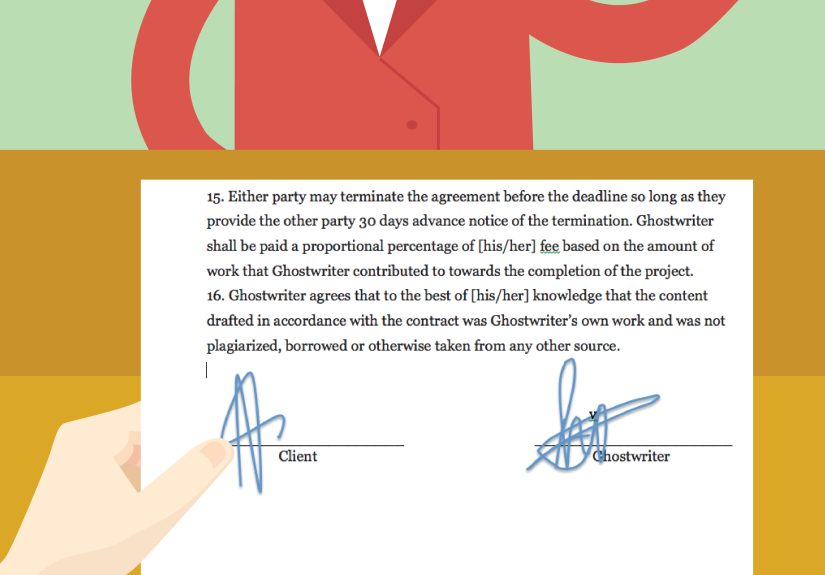
Finally, both parties should sign and date the agreement before work begins. Electronic signatures are common in business practice, but the agreement should still be complete, readable, and stored safely by both sides.
Sample Ghostwriting Agreement Structure
A clean ghostwriting agreement does not need to be dramatic. It simply needs to be complete. A practical structure may look like this:
- Introduction and identification of parties
- Project description and deliverables
- Timeline and milestones
- Fees, payment schedule, and expenses
- Copyright ownership and rights transfer
- Credit, anonymity, and portfolio use
- Confidentiality and non-disclosure
- Client responsibilities
- Writer responsibilities
- Revisions and approval process
- Warranties, originality, and fact responsibility
- AI use and technology tools
- Indemnification and limitation of liability
- Termination and kill fees
- Dispute resolution and governing law
- Signatures
The goal is not to make the contract intimidating. The goal is to make the working relationship calmer. A clear agreement is like noise-canceling headphones for business misunderstandings.
Common Mistakes to Avoid
Using Vague Language
Words like “reasonable,” “complete,” “final,” and “professional” can mean different things to different people. Use measurable terms where possible: word count range, number of interviews, number of revision rounds, payment dates, and delivery format.
Forgetting Draft Ownership
Many agreements mention the final manuscript but forget outlines, drafts, notes, recordings, and research documents. Decide who owns or may use those materials. This matters if the project stops halfway.
Ignoring Approval Authority
If a CEO hires a ghostwriter but three executives want to edit the voice, the contract should identify one final decision-maker. Too many approvers can turn a crisp draft into committee soup.
Skipping Payment Triggers
Do not simply say “payment due on completion.” Define completion. Is it delivery of the draft, acceptance by the client, final revision, publication, or something else? Payment triggers should be objective.
Copying a Template Without Adapting It
Templates are useful starting points, not magic spells. A memoir, a CEO speech, a medical article, and a celebrity autobiography all carry different risks. The agreement should match the project.
Practical Examples of Strong Contract Language
The following examples are simplified for educational purposes. They are not legal advice, but they show the type of clarity a ghostwriting agreement should aim for.
Scope Example
“Writer will ghostwrite a nonfiction manuscript of approximately 60,000 words based on up to twelve recorded interviews with Client, Client-provided source materials, and a mutually approved chapter outline. Services include one outline, one complete manuscript draft, and two rounds of revisions.”
Payment Example
“Client will pay Writer a total project fee of $30,000, payable in four installments: $7,500 upon signing, $7,500 upon outline approval, $7,500 upon delivery of the first full draft, and $7,500 upon delivery of the final revised manuscript.”
Credit Example
“Writer will not receive public credit unless Client agrees in writing. Writer may not identify Client or the project in marketing materials, portfolio materials, interviews, or social media without Client’s prior written consent.”
Revision Example
“The project fee includes two rounds of revisions. Revisions must be requested within fourteen days after delivery. Changes that alter the approved outline, target audience, genre, or central argument may require a written change order and additional fees.”
Extra Experience: What Real Ghostwriting Projects Teach You
The biggest lesson from ghostwriting agreements is that the contract is not just a legal document. It is a project management tool. The best agreements reflect the way writing actually happens: discovery, messy ideas, clarification, structure, drafting, revision, and final polish. When the agreement follows that workflow, both parties feel guided instead of trapped.
One common experience is that clients often underestimate how much preparation a ghostwriter needs. A client may say, “I already have everything in my head,” which is usually true and also not very useful until that knowledge is organized. A strong agreement should require interviews, source materials, and timely feedback because the writer cannot extract a polished book from silence. Even the best ghostwriter is not a mind reader, although many develop suspiciously good detective skills.
Another practical lesson is that voice development takes time. Clients sometimes expect the first draft to sound exactly like them, only better, funnier, sharper, and ready for a standing ovation. In reality, tone matching improves through samples, feedback, and revision. That is why many professional ghostwriters include a sample chapter or pilot piece early in the process. It gives both sides a chance to align before the writer produces 50,000 words in the wrong emotional temperature.
Payment structure also matters more than people think. A project with one final payment can create stress for both sides. The writer carries too much risk, while the client may feel nervous about paying before seeing progress. Milestone billing solves that problem. It turns a large project into smaller, reviewable stages. Each stage creates accountability, and accountability is much more attractive than chasing invoices with increasingly polite emails.
Confidentiality deserves special attention. In memoir and executive ghostwriting, the writer may learn information that is not just private but emotionally sensitive. Family conflicts, business failures, health struggles, legal concerns, and personal regrets may all enter the conversation. A confidentiality clause reassures the client, but it also helps the writer by setting clear boundaries. The writer knows what can be discussed with editors, assistants, subcontractors, or no one at all.
Revisions are another area where experience teaches caution. Clients may use the word “revision” to mean anything from correcting a sentence to replacing the entire concept. The agreement should define revision rounds and explain what happens when the client changes direction after approving earlier work. This is not about being difficult. It is about being fair. A writer should happily improve the agreed manuscript; they should not be expected to write a completely new one for free because inspiration arrived late wearing sunglasses.
Finally, the best ghostwriting relationships are built on honesty. The client should be honest about goals, audience, deadlines, budget, sensitive issues, and publishing plans. The writer should be honest about availability, expertise, process, and limitations. A contract cannot replace trust, but it can protect trust from confusion. When the agreement is clear, everyone can focus on the real work: turning ideas into words that sound effortless, even when everyone involved knows they absolutely were not.
Conclusion
A ghostwriting agreement is the foundation of a successful writing partnership. It defines the scope, schedule, payment terms, ownership rights, confidentiality duties, credit rules, revision process, and exit plan before anyone gets buried under drafts and expectations.
The best ghostwriting contracts are clear, balanced, and specific. They protect the client’s voice and ownership while respecting the writer’s time, creativity, and professional boundaries. Whether the project is a memoir, business book, speech, article series, or brand content package, the agreement should answer the questions people are most likely to argue about later.
In short: write the contract before writing the manuscript. Your future self, your ghostwriter, your inbox, and possibly your blood pressure will all be grateful.