Table of Contents >> Show >> Hide
- Why ankle mobility matters (and why “dorsiflexion” is not a dinosaur)
- Quick ankle anatomy: the parts doing the work
- Safety first: when to stretch, when to pause, and when to get help
- The best ankle stretches for flexibility
- 1) Wall calf stretch (straight knee) targets the upper calf
- 2) Wall calf stretch (bent knee) targets the deeper soleus
- 3) Seated towel stretch a friendly option for stiff mornings
- 4) Ankle dorsiflexion/plantarflexion range-of-motion (ROM)
- 5) Ankle circles smooth, controlled motion
- 6) The ankle alphabet mobility that feels like a weird party trick
- 7) Plantar fascia / arch roll for the bottom-of-foot crew
- 8) Knee-to-wall dorsiflexion mobilization “Can your ankle bend?” check + stretch
- Ankle strengthening exercises (because flexibility without control is just flopping)
- 1) Calf raises the classic that earns its fame
- 2) Isometric heel lift holds strength without motion
- 3) Tibialis raises for the front of the shin (dorsiflexion strength)
- 4) Resistance band eversion strengthen the “anti-roll” team
- 5) Resistance band inversion balance the system
- 6) Heel walks and toe walks real-life strength for real-life walking
- Balance and proprioception: the secret sauce for fewer “oops” moments
- Put it together: simple routines for different goals
- Common ankle issuesand what to tweak
- FAQ: quick answers you’ll actually use
- Conclusion
- Experiences: What ankle work feels like in real life (and why people stick with it)
Your ankles are the unsung heroes of daily life. They quietly handle walking, running, squatting, climbing stairs, dancing at weddings, and that awkward moment when you step off a curb that definitely moved when you weren’t looking. If your ankles feel stiff, wobbly, or “creaky,” it’s not just annoyingit can change how your knees, hips, and back move, too. Improving ankle flexibility and strength can make everything from workouts to grocery runs feel smoother and safer.
This guide covers ankle stretches for flexibility, ankle strengthening exercises for stability, and simple balance drills for better control. You’ll also get a few quick routines you can actually stick withbecause a plan that lives in your brain is nice, but a plan that lives in your calendar is magic.
Why ankle mobility matters (and why “dorsiflexion” is not a dinosaur)
The ankle has two headline movements: dorsiflexion (bringing the top of your foot toward your shin) and plantarflexion (pointing your toes away). Dorsiflexion is a big deal for walking and running mechanics, squats, lunges, stair control, and balance. When it’s limited, your body often “borrows” motion from somewhere elsesometimes from your knees, hips, or low backwhich can raise the risk of discomfort or overuse problems.
Meanwhile, strength matters because ankles don’t just bendthey control bend. Strong calves, shins, and side-of-ankle muscles help you absorb force and resist rolling the ankle. Add balance training (proprioception), and you teach your body to react faster when the ground is uneven or your foot lands a little off.
Quick ankle anatomy: the parts doing the work
You don’t need a medical degree to stretch well, but it helps to know what you’re targeting:
- Calves (gastrocnemius & soleus): key for plantarflexion, jumping, and push-off while walking.
- Front shin (tibialis anterior): helps lift the foot (dorsiflexion) so you don’t trip and improves control when you lower your foot.
- Outer ankle muscles (peroneals): help resist rolling outward and support side-to-side stability.
- Inner ankle support (posterior tibial region): helps support the arch and control inward motion.
- Plantar fascia/foot intrinsics: the “underfoot” team that helps the arch and foot mechanics cooperate with your ankle.
Safety first: when to stretch, when to pause, and when to get help
Most ankle mobility work should feel like a gentle-to-moderate stretch or muscle effortnot a sharp, zinging pain. If you’re coming off an ankle sprain, the general progression is: regain comfortable range of motion first, then add strengthening, then balance/proprioception, then higher-level jumping/cutting if your sport needs it.
Stop and check in with a clinician if you have:
- Inability to bear weight, severe swelling, deformity, or worsening pain
- Numbness/tingling that doesn’t quickly improve
- Redness, warmth, fever, or pain that feels “not like a normal strain”
- Repeated sprains or a sense the ankle “gives way”
If you’re rehabbing an ankle sprain, start with pain-free range-of-motion drills (often non-weight-bearing), then slowly progress. Don’t “stretch through” sharp painyour ligaments are not impressed by your bravery.
The best ankle stretches for flexibility
A useful rule: do a tiny warm-up first (30–90 seconds of easy walking, marching in place, or gentle ankle circles). Then stretch. Holding a stretch for about 20–30 seconds is a classic approach. Repeat 2–4 times per side, and keep your breathing calmno dramatic hostage negotiations with your calves.
1) Wall calf stretch (straight knee) targets the upper calf
- Stand facing a wall, hands on the wall for support.
- Step one leg back and keep that back knee mostly straight, heel down.
- Lean your hips forward until you feel a stretch in the back calf/Achilles area.
- Hold 20–30 seconds. Switch sides.
Common mistake: letting the back heel pop up. Keep it glued down like it owes you money.
2) Wall calf stretch (bent knee) targets the deeper soleus
- Same setup as above, but bend the back knee slightly while keeping the heel down.
- You should feel the stretch lower in the calf, closer to the Achilles.
- Hold 20–30 seconds. Switch sides.
Why it matters: the soleus is heavily involved in walking and endurance activities. Tightness here often shows up as “my ankles won’t bend” during squats or downhill walking.
3) Seated towel stretch a friendly option for stiff mornings
- Sit with your leg extended.
- Loop a towel around the ball of your foot.
- Gently pull the towel toward you until you feel a calf/Achilles stretch.
- Hold 20–30 seconds. Repeat.
Tip: keep your knee straight for more upper calf; add a slight knee bend to bias the soleus.
4) Ankle dorsiflexion/plantarflexion range-of-motion (ROM)
This is the “keep it moving” drillespecially helpful after sitting a long time or during early sprain recovery (when appropriate).
- Sit comfortably with your foot off the ground.
- Slowly point your toes away (plantarflex), then pull them toward your shin (dorsiflex).
- Move through a comfortable rangeno forcing.
- Do 10–20 reps.
5) Ankle circles smooth, controlled motion
- Sit or stand with support.
- Make slow circles with your ankle, like you’re stirring a pot that costs $200 and belongs to someone you respect.
- Do 8–12 circles each direction.
6) The ankle alphabet mobility that feels like a weird party trick
- Sit and lift your foot slightly off the floor.
- Use your big toe as a “pen” to trace the alphabet in the air.
- Keep movements slow and pain-free.
Why it works: you’ll naturally move through multiple directions (not just up/down), which can help restore coordination and circulation.
7) Plantar fascia / arch roll for the bottom-of-foot crew
- Sit with your foot on a golf ball, tennis ball, or a frozen water bottle (wrapped).
- Roll under the arch with gentle pressure for about 1–2 minutes.
- Avoid aggressive pressure if you’re very sorethis is a massage, not a medieval punishment.
8) Knee-to-wall dorsiflexion mobilization “Can your ankle bend?” check + stretch
- Face a wall in a half-kneeling or standing lunge position.
- Keep your heel down and try to move your knee toward the wall over your toes.
- Go only as far as you can without the heel lifting or pain spiking.
- Do 8–12 slow reps per side.
What to feel: a stretch in the Achilles/calf and a “bend” sensation at the front of the ankle. If you feel pinching in the front, reduce the range and slow down.
Ankle strengthening exercises (because flexibility without control is just flopping)
Stretching helps range of motion; strengthening helps you own that range. Aim for 2–3 strength sessions per week. Start with bodyweight and light resistance, then progress slowly. If you’re rehabbing an injury, follow your clinician’s guidance.
1) Calf raises the classic that earns its fame
- Stand tall holding a chair or wall for balance.
- Rise up onto the balls of your feet, pause, then lower slowly.
- Do 2 sets of 8–12 reps.
Progressions: single-leg calf raises; slow 3-second lowers; do them on a step for extra range (only if pain-free).
2) Isometric heel lift holds strength without motion
- Rise onto the balls of your feet (both legs), then hold at the top.
- Hold 10–30 seconds, rest, repeat 3–5 times.
Why it’s useful: isometrics can build stability with less joint irritation, which can be helpful during certain recovery phases.
3) Tibialis raises for the front of the shin (dorsiflexion strength)
- Stand with your back against a wall, feet a few inches forward.
- Keep heels down and lift your toes toward your shins.
- Lower slowly. Do 2 sets of 10–15 reps.
Feeling: the front of the shin working. That’s the point.
4) Resistance band eversion strengthen the “anti-roll” team
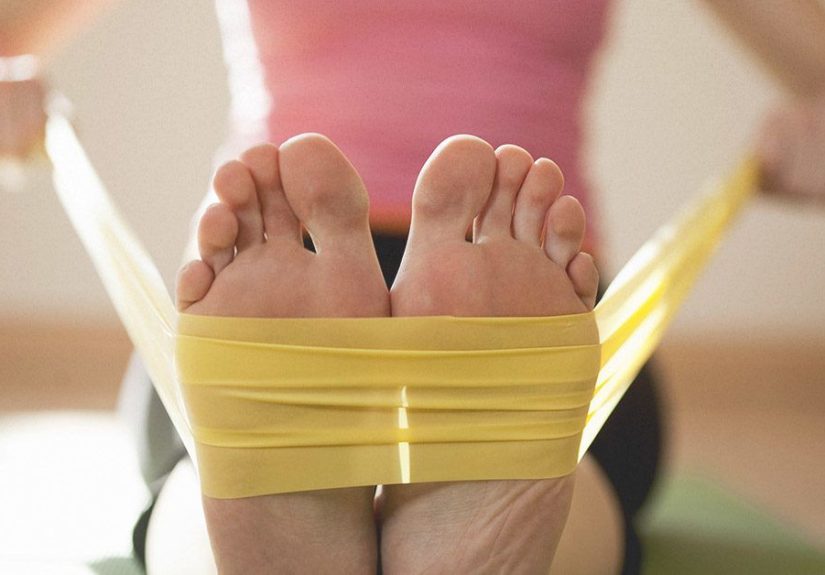
- Sit with your leg extended and loop a resistance band around the forefoot.
- Anchor the other end so the band pulls your foot inward.
- Move your foot outward against the band (eversion), then return slowly.
- Do 2 sets of 10–15 reps per side.
5) Resistance band inversion balance the system
- Same setup, but anchor the band so it pulls your foot outward.
- Move your foot inward against resistance (inversion), return slowly.
- Do 2 sets of 10–15 reps.
6) Heel walks and toe walks real-life strength for real-life walking
- Heel walk: lift toes up and walk 10–20 steps on heels.
- Toe walk: rise onto toes and walk 10–20 steps.
- Do 2–3 rounds.
Why it helps: you’re training the ankle and foot muscles in a practical, upright patternwithout needing a gym or a complicated setup.
Balance and proprioception: the secret sauce for fewer “oops” moments
Proprioception is your body’s ability to sense position and react quickly. It’s a major part of ankle stability, especially after sprains. Balance training often starts simple and gets “spicy” as you improve.
1) Single-leg stand (basic)
- Stand near a wall or counter for safety.
- Lift one foot and balance on the other for 20–30 seconds.
- Repeat 2–3 times per side.
2) Single-leg stand (level up)
- Turn your head slowly side to side while balancing.
- Do gentle reach taps forward/side/back with the free foot.
- Try a softer surface (like a folded towel) once basic balance is solid.
3) Ball toss balance (if you want coordination too)
- Stand on one leg near a wall.
- Toss a ball lightly to a partner or the wall and catch it.
- Keep it controlledthis is training, not dodgeball tryouts.
Put it together: simple routines for different goals
Routine A: Daily “I sit a lot” ankle reset (5 minutes)
- Ankle dorsiflexion/plantarflexion ROM: 15 reps
- Ankle circles: 10 each direction
- Knee-to-wall mobilization: 10 reps each side
- Wall calf stretch (straight knee): 2 x 25 seconds each side
- Wall calf stretch (bent knee): 2 x 25 seconds each side
Routine B: Strength + stability (10–15 minutes, 2–3x/week)
- Calf raises: 2 x 10–12
- Tibialis raises: 2 x 12–15
- Band eversion: 2 x 12–15
- Band inversion: 2 x 12–15
- Single-leg stand: 2 x 20–30 seconds per side
Routine C: Runner or hiker ankles (10 minutes, 3x/week)
- Knee-to-wall mobilization: 10 reps each side
- Toe walks + heel walks: 2 rounds of 15–20 steps
- Single-leg balance with reach taps: 2 rounds each side
- Calf raises with slow lowers: 2 x 8–10
- Quick calf stretch (straight knee): 1–2 holds of 25–30 seconds
Common ankle issuesand what to tweak
“My ankles won’t bend in squats.”
Limited dorsiflexion is a frequent culprit. Try knee-to-wall mobilizations, both calf stretches (straight and bent knee), and check whether your heels lift early. Also look at footwear: very stiff shoes can hide mobility limits, while very soft shoes can demand more control. You want mobility and strengthnot just a workaround.
“My ankle feels weak or wobbly after a sprain.”
This is where strengthening plus proprioception shines. Range of motion first, then band work (inversion/eversion), then balance progressions. If the ankle “gives way” repeatedly, a physical therapist can help assess stability and guide progression safely.
“My calves are always tight.”
Stretching helps, but don’t forget strength and endurance. Calf raises, slow eccentrics, and regular movement breaks can help your calves tolerate daily demands. If you only stretch, you might feel looser for an hourand then your calves will return to their usual job of being stubborn.
FAQ: quick answers you’ll actually use
How often should I do ankle stretches?
Mobility work can be daily, especially gentle ROM drills. Longer static stretches are often comfortable after activity or after your muscles are warm. Strength training is typically 2–3 times per week.
Should stretching hurt?
No. A mild-to-moderate stretch sensation is fine. Sharp pain, pinching, or pain that lingers and worsens is a “back off” signal.
Do I need equipment?
Not much: a wall, a towel, and (optionally) a resistance band and a small ball. Your ankles are delightfully low-maintenance.
Conclusion
Better ankles aren’t built with one magic stretchthey’re built with a small, repeatable mix of mobility, strength, and balance. Start with the basics: loosen the calves and restore comfortable dorsiflexion, strengthen the ankle in multiple directions, and practice single-leg stability so your body reacts faster when life gets uneven. Do that consistently, and you’ll likely notice steadier steps, smoother squats, and fewer surprise “who put that crack in the sidewalk?” moments.
Experiences: What ankle work feels like in real life (and why people stick with it)
When people start doing ankle stretches and strengthening regularly, the first “experience” is usually not dramatic. It’s more like realizing you’ve been living with the volume turned down on your movementand someone quietly hands you the remote. The changes show up in tiny moments: you walk downstairs and don’t cling to the railing, you squat to pick something up without your heels lifting, or you step off a curb and your ankle doesn’t wobble like a shopping cart with one bad wheel.
A common early win is the morning feeling. If your first steps out of bed are stiff, a short routineankle pumps, circles, and a gentle towel stretchoften makes walking feel less “rusty.” People who sit for school, gaming, or desk work often notice that their ankles feel “stuck” after long sessions. The knee-to-wall mobilization tends to feel weird at first (in a “Wow, that’s tight” way), but within a couple of weeks, many notice their ankles bend more smoothly when they squat or climb stairs. It’s not that your body suddenly becomes flexible like a gymnastit’s that you reclaim a normal range your joints were designed to have.
For runners and hikers, the experience is often about control. Improving dorsiflexion can make downhill sections feel steadier and can help the stride feel less choppy. People frequently describe calf raises and tibialis raises as “small exercises that shouldn’t be hard,” right up until they do them slowly and realize those muscles have been freeloading for years. The good news is that progress comes quickly when the exercises are consistent. Many notice that their feet land more quietly and that their balance improvesespecially if they add single-leg stands while brushing teeth or waiting for the microwave to finish its important countdown ceremony.
Post-sprain experiences are different: confidence matters. After an ankle sprain, people often say the ankle feels “fine” until it doesn’tlike when turning quickly, walking on uneven grass, or playing a sport with cutting and jumping. Balance drills (like single-leg stands and reach taps) can feel surprisingly challenging at first because they train the ankle-brain connection, not just the muscles. Over time, people often report that the ankle feels less unpredictable, and they’re less worried about it rolling again. That confidence can be just as valuable as the physical improvements, because it changes how you move: you stop guarding the ankle, and movement becomes more natural.
Another common experience: realizing ankle work helps the rest of the body. When ankles move better, knees often track more comfortably in squats and lunges, and people sometimes feel less strain in the lower back during everyday bending and lifting. It’s not a guarantee, but it makes sense: if the ankle can’t do its share of motion, other joints have to “make up for it.” Once the ankle joins the group project again, the workload spreads out more evenly.
The biggest reason people keep ankle routines is simplicity. You don’t need a full workout to make a difference. A five-minute daily reset plus two short strength sessions per week is realistic for most schedules. And because the improvements show up in daily lifestairs, squats, walking on uneven groundthe payoff feels practical. It’s the kind of training that doesn’t just make you “fit”; it makes you harder to knock off balance. In a world full of unpredictable sidewalks, that’s a pretty great superpower.