Table of Contents >> Show >> Hide
- Why You Need to Cite a YouTube Video
- Information You Need Before Citing a YouTube Video
- Way 1: How to Cite a YouTube Video in APA Style
- Way 2: How to Cite a YouTube Video in MLA Style
- Way 3: How to Cite a YouTube Video in Chicago Style
- APA vs. MLA vs. Chicago: What Is the Difference?
- How to Cite a YouTube Channel
- How to Cite a YouTube Video With No Author
- How to Cite a YouTube Video With a Timestamp
- Common Mistakes When Citing YouTube Videos
- Best Practices for Citing YouTube in Academic Writing
- Experience Section: What I Learned From Citing YouTube Videos in Real Writing Projects
- Conclusion
YouTube has become the world’s unofficial classroom, archive, debate stage, comedy club, music library, and “I swear this will only take five minutes” rabbit hole. One minute you are watching a professor explain quantum physics with a whiteboard; the next, you are learning how to fix a dishwasher from a person in Ohio who sounds more trustworthy than your appliance manual. But when that video becomes part of an essay, research paper, blog post, or presentation, one tiny problem appears: how do you cite a YouTube video correctly?
The good news is that citing YouTube is not as scary as it looks. The bad news is that APA, MLA, and Chicago styles each want the information arranged differently, because apparently citation styles enjoy keeping students humble. Still, they all care about the same basic ingredients: who uploaded or created the video, what the video is called, when it was published, where it appeared, and how readers can find it.
This guide breaks down the three most common ways to cite a YouTube video: APA, MLA, and Chicago. You will learn the correct format, see practical examples, understand how in-text citations work, and avoid the little mistakes that can make a bibliography look like it was assembled during a power outage.
Why You Need to Cite a YouTube Video
A YouTube video may feel casual, but it can still be a serious source. Lectures, interviews, documentaries, tutorials, speeches, news clips, explainer videos, and recorded conference talks often contain useful information. If you use ideas, quotes, data, demonstrations, or commentary from a video, citing it gives credit to the original creator and helps readers verify your source.
Proper citation also protects your work from accidental plagiarism. Even if the video is public, free, and watched by millions of people, the content still belongs to someone. Citing it says, “I did not magically invent this idea while eating cereal at 1 a.m.; here is where it came from.” Academic honesty: stylish and surprisingly easy.
Information You Need Before Citing a YouTube Video
Before choosing APA, MLA, or Chicago style, gather the basic details from the YouTube page. Most of them appear directly under the video title or in the video description.
Collect These Citation Details
- Creator or uploader: This may be a person, organization, brand, university, news outlet, or YouTube channel.
- Video title: Copy the title accurately, but apply the capitalization rules required by your citation style.
- Publication date: Use the upload date shown on YouTube.
- Platform name: Usually YouTube.
- URL: Use the direct video link.
- Timestamp: Use this if you quote or refer to a specific moment in the video.
A timestamp is especially useful when a video is long. If you are citing a 90-minute lecture and the important idea appears at 42:18, your reader will appreciate the shortcut. Nobody wants to hunt for one sentence inside a video longer than a superhero movie.
Way 1: How to Cite a YouTube Video in APA Style
APA style is commonly used in psychology, education, social sciences, health sciences, and many research-heavy courses. APA focuses on the author and date because it cares deeply about when information was published. In fast-moving fields, that makes sense. A 2009 video about social media strategy, for example, may now feel like a museum exhibit featuring flip phones and optimism.
APA Reference List Format
Use this general format for a YouTube video in APA style:
If the uploader’s real name and channel name are both available, APA may include the channel name in brackets. If the channel name is the only available author, use that. APA treats the account that uploaded the video as the author because that is the source readers can locate.
APA Example
In APA, the video title is written in sentence case. That means only the first word, the first word after a colon or dash, and proper nouns are capitalized. The word “Video” appears in square brackets after the title to describe the source type.
APA In-Text Citation
For a general reference to the video, use the uploader and year:
If you quote or refer to a specific moment, include a timestamp:
That timestamp tells the reader exactly where the cited information appears. It is the citation equivalent of dropping a pin on a map instead of saying, “It is somewhere in North America.”
Way 2: How to Cite a YouTube Video in MLA Style
MLA style is widely used in literature, language, composition, media studies, and humanities courses. MLA cares about authorship, titles, containers, and access. For YouTube videos, the “container” is YouTube itself, because it is the platform where the video lives.
MLA Works Cited Format
Use this general format for a YouTube video in MLA style:
If the creator and uploader are the same or if only the channel name is available, you can begin with the title or the channel name, depending on what is most relevant to your discussion. MLA allows some flexibility because online videos can be created, uploaded, hosted, or reposted by different people.
MLA Example With a Channel Name
MLA Example With a Different Uploader
MLA places video titles in quotation marks and italicizes the platform name when formatted in a paper. Dates use the day-month-year style. The month is usually abbreviated, such as “Mar.” or “Sept.”
MLA In-Text Citation
MLA in-text citations usually use the first element of the Works Cited entry. If the entry begins with a channel name, cite the channel name:
If you cite a specific time in the video, include the timestamp:
MLA does not require page numbers for videos because videos do not have pages. Unless someone prints out the transcript, staples it together, and starts pretending YouTube has chapters, timestamps are the better locator.
Way 3: How to Cite a YouTube Video in Chicago Style
Chicago style is often used in history, publishing, arts, and some social science writing. It has two major systems: notes and bibliography, and author-date. For YouTube videos, many students use the notes and bibliography system, especially when writing history or humanities papers.
Chicago Notes and Bibliography Format
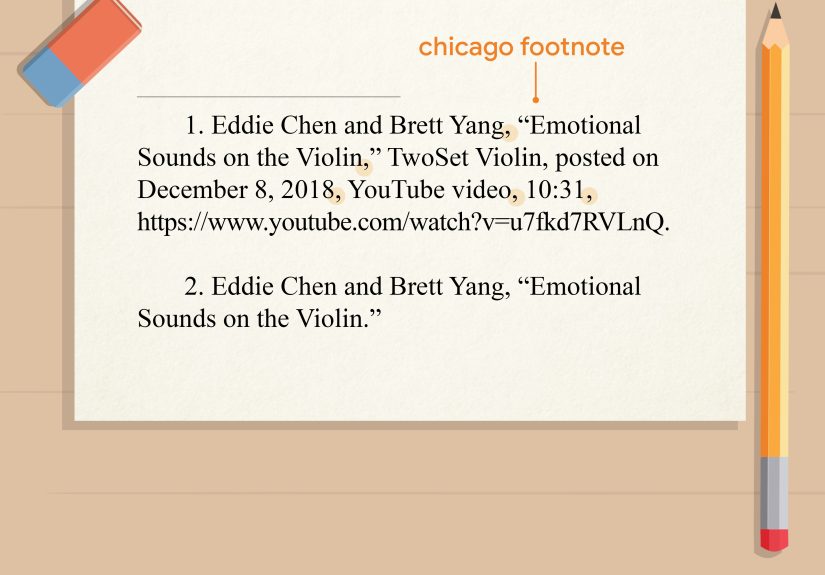
A Chicago-style note for a YouTube video may look like this:
The bibliography entry usually looks like this:
Chicago Example
Chicago style is especially helpful when you want to provide detailed notes. A footnote can include context, comments, or a timestamp without interrupting the main paragraph. It is like giving your reader a helpful side road instead of forcing them through a traffic jam of parentheses.
APA vs. MLA vs. Chicago: What Is the Difference?
APA, MLA, and Chicago all cite the same YouTube video, but each style arranges the details differently. APA emphasizes the uploader and publication date. MLA emphasizes the creator, title, platform, uploader, and date. Chicago often uses footnotes and gives writers more room to explain the source.
Quick Comparison Table
| Style | Best For | Key Feature | Example In-Text or Note |
|---|---|---|---|
| APA | Social sciences, education, psychology, health | Author-date format | (CrashCourse, 2020) |
| MLA | Humanities, literature, language, media studies | Creator-title-container format | (CrashCourse 02:15) |
| Chicago | History, publishing, arts, humanities | Footnotes or bibliography entries | 1. CrashCourse, “The History of the Internet”… |
How to Cite a YouTube Channel
Sometimes you are not citing one video. You may want to cite an entire YouTube channel, especially if your paper analyzes a creator’s overall content, educational strategy, branding, or publishing pattern. In that case, do not cite a single video unless your argument depends on that specific video.
APA Channel Format
Because YouTube channels change over time, APA commonly includes a retrieval date for channel pages. A video has a fixed publication date, but a channel is always updating, which makes it more like a living document with thumbnails.
MLA Channel Format
MLA may use an access date when the source is likely to change. For a channel, that is sensible because today’s homepage may not look the same next month.
How to Cite a YouTube Video With No Author
If no personal author is listed, use the channel or organization that uploaded the video. YouTube content often comes from brands, universities, nonprofits, broadcasters, and educational channels rather than individual creators. The uploader is usually enough for the citation.
If you cannot identify a creator beyond the channel name, do not panic. Citation is about helping readers find the source. Use the most reliable identifying information available. In other words, do not invent an author. Your bibliography is not a creative writing workshop.
How to Cite a YouTube Video With a Timestamp
Timestamps are useful when you quote spoken words, refer to a chart shown on screen, describe a visual moment, or analyze a specific scene. They are not always required for general references, but they improve precision.
Timestamp Examples
When in doubt, add the timestamp. It makes life easier for your reader, your teacher, and your future self when you revisit the source three weeks later and wonder where that brilliant quote went.
Common Mistakes When Citing YouTube Videos
Using YouTube as the Author
YouTube is usually the platform, not the author. The author is typically the uploader, creator, organization, or channel. Citing YouTube as the author is like citing “Library” as the author of every book in the building. Technically nearby, but not quite right.
Forgetting the Upload Date
The upload date matters because it shows when the video became available. This is especially important for news, science, technology, and social commentary, where information can age quickly.
Copying the Title Incorrectly
Video titles should be copied accurately, but each citation style has its own capitalization rules. APA uses sentence case. MLA and Chicago generally use title case. Small detail? Yes. Important? Also yes. Citation styles are powered by tiny details and caffeine.
Ignoring the Difference Between Creator and Uploader
Sometimes the person who appears in a video is not the person or organization that uploaded it. For example, a university may upload a lecture by a guest speaker. In that case, your citation may need to identify both the speaker and the uploader, depending on the style and the purpose of your citation.
Leaving Out the URL
A citation without a URL makes your reader work too hard. Include the direct link so the video can be found easily. Make sure the link leads to the exact video, not merely the channel homepage.
Best Practices for Citing YouTube in Academic Writing
Choose the citation style required by your teacher, editor, department, or publication. If no style is assigned, pick the one that fits your subject area. APA is a strong choice for research in social sciences. MLA works well for humanities and media analysis. Chicago is ideal for history and writing that benefits from footnotes.
Use YouTube videos carefully. A video can be helpful, but not every video is equally reliable. Check who created it, whether the creator has expertise, whether the information is current, and whether the video provides evidence. A video titled “Ancient Aliens Built My Garage” may be entertaining, but it may not survive peer review.
When using a video as evidence, explain why it matters. Do not simply drop a citation into a paragraph and run away. Introduce the source, connect it to your point, and make clear how it supports your argument.
Experience Section: What I Learned From Citing YouTube Videos in Real Writing Projects
Citing YouTube videos sounds simple until you actually sit down with a real assignment, three open browser tabs, a half-finished Works Cited page, and a teacher who has written “check formatting” in red ink with the emotional force of a courtroom objection. The first lesson is that the video page gives you most of what you need, but not always in the order your citation style wants it. YouTube is designed for watching, not for making your bibliography look elegant.
In real writing projects, the trickiest part is usually deciding who counts as the author. If a professor gives a lecture uploaded by a university channel, should the author be the professor or the university? If a news network posts an interview, should the citation begin with the reporter, the guest, or the channel? The practical answer is to think about what your paper is discussing. If your analysis focuses on the speaker’s argument, identify the speaker in your sentence and make the citation clear. If your paper simply uses the video as a source hosted by a channel, the uploader may be enough.
Another lesson: timestamps save everyone. I once watched a long educational video, found one perfect sentence, wrote it into a draft, and forgot to record the time. Later, I had to rewatch the video like a detective searching for a missing clue. Since then, I treat timestamps like seat belts: not glamorous, but extremely useful when things get messy. Whenever you quote, paraphrase, or describe a specific moment, write down the exact time immediately.
It also helps to create citations while you are researching, not after the paper is finished. Waiting until the end may feel efficient, but it usually turns into a scavenger hunt. The video title changed? The channel name looks different? The URL you copied leads to a playlist instead of the exact video? Congratulations, your bibliography now has side quests. A simple research note with title, channel, date, URL, and timestamp can prevent a surprising amount of frustration.
The final experience-based tip is to respect the style guide but prioritize clarity. Citation styles can look picky, but their purpose is practical: help readers find the source and understand how you used it. If the creator, uploader, and platform are clear, your citation is already doing most of its job. Formatting matters, but the goal is not to worship punctuation. The goal is to make your research transparent, credible, and easy to verify. That is the real reason to cite a YouTube video well.
Conclusion
Learning how to cite a YouTube video is easier once you understand the logic behind the three major styles. APA wants the uploader, date, title, video label, platform, and URL. MLA focuses on the creator, title, container, uploader, date, and URL. Chicago often uses footnotes and bibliography entries to provide full source details without crowding the main text.
The most important rule is simple: give readers enough information to find the exact video you used. Include the creator or uploader, video title, upload date, platform, URL, and timestamp when needed. Whether you are writing a research paper, blog article, media analysis, or class presentation, a clean YouTube citation shows that your work is credible, careful, and not held together with copy-paste tape.
Note: Always follow your instructor’s, editor’s, or institution’s preferred citation rules. Citation styles may have small variations, and your assignment guidelines should come first.