Table of Contents >> Show >> Hide
- 1. Megan Fox and Michael Bay Transformers
- 2. Katherine Heigl and Judd Apatow Knocked Up
- 3. George Clooney and David O. Russell Three Kings
- 4. Lily Tomlin and David O. Russell I Heart Huckabees
- 5. Julia Roberts and Steven Spielberg Hook
- 6. Faye Dunaway and Roman Polanski Chinatown
- 7. Val Kilmer and John Frankenheimer The Island of Dr. Moreau
- 8. Gene Hackman and Wes Anderson The Royal Tenenbaums
- 9. Bruce Willis and Kevin Smith Cop Out
- 10. Edward Norton and Tony Kaye American History X
- 11. Shelley Duvall and Stanley Kubrick The Shining
- 12. Tippi Hedren and Alfred Hitchcock The Birds and Marnie
- 13. Burt Reynolds and Paul Thomas Anderson Boogie Nights
- 14. Bill Murray and Harold Ramis Groundhog Day
- 15. Mike Myers and Penelope Spheeris Wayne’s World
- Why Actor-Director Feuds Happen So Often
- Experience Section: What These Feuds Teach Anyone Working With Creative People
- Conclusion
Hollywood loves a happy ending, preferably one with a sunset, a swelling orchestra, and nobody throwing a chair in the general direction of the craft-services table. But behind the camera, filmmaking can be less “movie magic” and more “group project with a $90 million budget and 200 exhausted adults.” Actors want freedom. Directors want control. Studios want the film yesterday. Everyone wants coffee.
That is how some of cinema’s most memorable movies were created in the middle of creative storms. Some actor-director feuds came from clashing artistic visions. Others came from ego, pressure, poor communication, or behavior that would make any HR department spontaneously combust. In several cases, the finished film became a classic. In others, the drama behind the scenes was more famous than the movie itself.
Below are 15 documented examples of actors and directors who reportedly clashed, argued, criticized each other, or simply swore off future collaboration. Not every pair literally said “I hated you,” but the working relationship was rough enough to earn a permanent seat in Hollywood feud history.
1. Megan Fox and Michael Bay Transformers
Megan Fox became a breakout star in Michael Bay’s Transformers franchise, but the partnership did not exactly roll out smoothly. Fox publicly criticized Bay’s directing style, and the situation exploded after she compared his on-set behavior to a dictator-like presence. The comment became one of the most infamous actor-director controversies of the late 2000s.
Fox did not return for Transformers: Dark of the Moon, and Rosie Huntington-Whiteley replaced her as the franchise’s female lead. What makes this clash so memorable is that it combined blockbuster pressure, tabloid culture, and the old Hollywood rule: never insult the person controlling the explosions.
2. Katherine Heigl and Judd Apatow Knocked Up
Katherine Heigl’s issue with Knocked Up was not that the movie failed. Quite the opposite: it was a hit that boosted her film career. The problem came later, when she criticized the comedy’s gender dynamics and said she had difficulty with the way women were portrayed.
Judd Apatow and co-star Seth Rogen later expressed disappointment, and the comments followed Heigl for years. This was not a screaming-on-set feud; it was a post-release cold front. Still, it became a classic example of what happens when an actor loves the opportunity but dislikes the finished message. Hollywood prefers gratitude with a side of silence. Heigl served honesty with extra hot sauce.
3. George Clooney and David O. Russell Three Kings
George Clooney and David O. Russell’s conflict on Three Kings is one of the most famous modern on-set blowups. Reports over the years have described a tense production that allegedly escalated into a physical confrontation after Clooney objected to Russell’s treatment of people on set.
The irony is that Three Kings turned out to be smart, sharp, and widely admired. But Clooney later made it clear that the experience was miserable enough that he had no interest in repeating it. The lesson? A great movie can survive chaos, but the Christmas cards probably will not.
4. Lily Tomlin and David O. Russell I Heart Huckabees
David O. Russell appears twice on this list because, apparently, subtle workplace tension was not his preferred genre. During I Heart Huckabees, a heated argument between Russell and Lily Tomlin became infamous after behind-the-scenes footage circulated online. The clip showed a volcanic exchange that made a normal bad day at work look like a spa retreat.
Tomlin and Russell later reconciled, and both continued respected careers. Still, the incident remains a case study in creative pressure boiling over. It also proves that even philosophical comedies about meaning and existence can produce a very practical question: “Should someone call lunch early?”
5. Julia Roberts and Steven Spielberg Hook
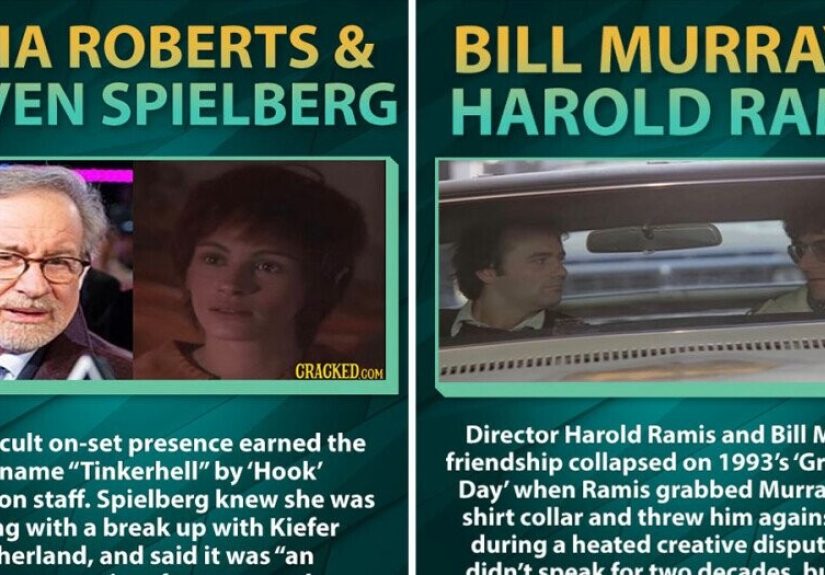
Hook had everything: Peter Pan nostalgia, Robin Williams, Dustin Hoffman, enormous sets, and a production that reportedly tested everyone’s patience. Julia Roberts, playing Tinker Bell, was going through intense public scrutiny at the time, and reports from the set painted the shoot as difficult.
Spielberg later spoke about the collaboration in less-than-glowing terms, while Roberts pushed back against rumors that she behaved badly. The movie still has loyal fans, but the Roberts-Spielberg pairing became a reminder that even beloved artists can meet at exactly the wrong moment. Sometimes Neverland needs a better call sheet.
6. Faye Dunaway and Roman Polanski Chinatown
Chinatown is now considered one of the greatest films ever made, but its elegance did not mean the set was peaceful. Faye Dunaway and Roman Polanski reportedly clashed repeatedly, with one famous story involving Polanski pulling a stray hair from Dunaway’s head because it interfered with a shot.
Dunaway was known for intensity, and Polanski was known for exacting control. Put those two forces in the same room and you get cinematic brilliance with the emotional comfort level of a dentist’s waiting room. The result was a masterpiece, but the collaboration was anything but easy.
7. Val Kilmer and John Frankenheimer The Island of Dr. Moreau
If troubled productions had a museum, The Island of Dr. Moreau would get its own wing, gift shop, and emergency exit. Val Kilmer joined a production already in chaos, with the original director replaced by John Frankenheimer. The new director and Kilmer did not bond over smoothies and shared vision.
Frankenheimer later made his dislike of working with Kilmer very public. The film became notorious for behind-the-scenes disorder, clashing personalities, and a final product that felt like the set had escaped into the movie. For Hollywood feud watchers, it remains a tropical storm with a screenplay.
8. Gene Hackman and Wes Anderson The Royal Tenenbaums
Wes Anderson wrote Royal Tenenbaum with Gene Hackman in mind, which sounds flattering until the actor actually arrived and reportedly made life difficult for the young director. Cast members have described Hackman as tough on Anderson, and Anderson later acknowledged friction during the production.
The strange part is that Hackman gave one of his most beloved late-career performances. That is the Hollywood paradox: an actor can be perfect for a role and still make the director age four years before lunch. The Royal Tenenbaums benefited from Hackman’s sharp edges, but Anderson probably did not frame the experience in needlepoint.
9. Bruce Willis and Kevin Smith Cop Out
Kevin Smith had admired Bruce Willis before directing him in Cop Out. Afterward, Smith described the experience in brutally disappointed terms, saying the collaboration was emotionally draining. Years later, after Willis’s health diagnosis became public, Smith apologized for his old complaints and expressed regret.
This feud is more complicated in hindsight, which is worth saying clearly. At the time, Smith framed it as a nightmare collaboration. Later, he softened his stance. The story now works less as a simple “bad actor” tale and more as a reminder that public judgments can age badly when fuller human context arrives.
10. Edward Norton and Tony Kaye American History X
American History X earned Edward Norton an Oscar nomination, but director Tony Kaye famously battled over the film’s final cut. The dispute involved Norton, the studio, and Kaye’s belief that his vision had been overtaken. Kaye tried to distance himself from the released version, even seeking an unusual replacement credit.
The conflict became nearly as legendary as the movie. Norton was praised for his performance, while Kaye’s career suffered from the fallout. In creative terms, this was not just a disagreement over a scene; it was a war over authorship. In Hollywood, final cut is not a technical detail. It is the crown jewels.
11. Shelley Duvall and Stanley Kubrick The Shining
Shelley Duvall’s performance in The Shining is unforgettable, but the filming process was famously exhausting. Stanley Kubrick’s perfectionism pushed scenes through repeated takes, and Duvall later described the experience as extremely difficult.
Modern viewers often debate how to evaluate Kubrick’s methods. Some admire the results; others question the cost to performers. What is clear is that Duvall carried an enormous emotional burden during the production. Her work remains powerful not because suffering is romantic, but because she was a gifted actor who delivered under punishing pressure.
12. Tippi Hedren and Alfred Hitchcock The Birds and Marnie
Tippi Hedren’s relationship with Alfred Hitchcock began as a star-making opportunity and ended in lasting bitterness. Hedren later alleged that Hitchcock behaved inappropriately, controlled aspects of her career, and made her working life deeply uncomfortable after she rejected his advances.
Her story has become an important part of discussions about power in Hollywood. Hitchcock remains a towering film figure, but Hedren’s account complicates the old myth of the all-powerful genius director. Talent does not cancel responsibility, and a great shot does not excuse a damaging workplace.
13. Burt Reynolds and Paul Thomas Anderson Boogie Nights
Burt Reynolds received some of the best reviews of his career for Boogie Nights, but he did not enjoy the experience. Reynolds later said he disliked working with Paul Thomas Anderson and reportedly turned down a role in Anderson’s follow-up film, Magnolia.
The clash is fascinating because Anderson was a young director with a bold style, while Reynolds was an old-school star with strong instincts and pride. Their creative chemistry produced a terrific performance, but not a lasting friendship. Sometimes the camera captures gold while the people standing behind it are mentally packing their bags.
14. Bill Murray and Harold Ramis Groundhog Day
Bill Murray and Harold Ramis had been comedy collaborators for years before Groundhog Day. During that film, however, their relationship reportedly broke down over tone, script choices, and Murray’s personal struggles at the time.
The movie became a classic, but the friendship suffered for decades. That makes Groundhog Day one of the strangest entries on this list: a warm, funny, spiritually thoughtful film born from a painful creative fracture. It is a movie about repeating the same day until you become a better person, made by people who needed many years to repair one relationship.
15. Mike Myers and Penelope Spheeris Wayne’s World
Wayne’s World became a surprise comedy phenomenon, but director Penelope Spheeris later described friction with Mike Myers during production. Reports over the years have suggested arguments over jokes, tone, and creative control. Spheeris did not return for the sequel, despite directing the original hit.
The pair later appeared to bury the hatchet publicly, which is excellent news for anyone who believes “party on” should apply to interpersonal healing. Still, the story shows how success does not always protect a director’s place in a franchise, especially when a star’s influence grows faster than a catchphrase.
Why Actor-Director Feuds Happen So Often
Actor-director conflicts are not random lightning strikes. They usually grow from predictable conditions: exhaustion, artistic disagreement, unclear authority, public pressure, and money. Lots of money. A movie set is a temporary city where every minute costs something, every decision affects dozens of departments, and every personality arrives with its own weather system.
Creative Vision Can Become Creative Collision
Actors often protect the emotional truth of a character. Directors protect the whole film. Those goals should support each other, but they can collide when an actor believes the director is flattening the performance or when a director feels the actor is pulling the movie off course.
That is why disputes over editing, tone, and character choices become so intense. Edward Norton and Tony Kaye’s conflict over American History X was not just about screen time. It was about who had the right to define the movie’s meaning. Once a disagreement reaches that level, it stops being a note and becomes a duel with better lighting.
Ego Is Not Always the Villain, But It Is Usually in the Room
Hollywood rewards confidence. Unfortunately, confidence and ego wear similar sunglasses. A director needs enough belief to guide hundreds of people. An actor needs enough belief to be vulnerable in front of a camera while a boom operator hovers nearby like a confused fishing enthusiast.
Problems begin when confidence hardens into control. A director who cannot listen may crush good ideas. An actor who cannot adapt may drag the production into endless negotiation. The best collaborations turn ego into energy. The worst turn it into a weather warning.
Experience Section: What These Feuds Teach Anyone Working With Creative People
The most useful lesson from these actor-director clashes is not “famous people are dramatic,” although, yes, please place that on a decorative pillow. The real lesson is that creative work needs structure, respect, and communication. Whether you are making a movie, building a website, running a school project, or planning a family event that somehow has the emotional stakes of a courtroom drama, collaboration can fall apart when people stop feeling heard.
One experience many creative teams share is the “silent disagreement” phase. Nobody argues at first. Everyone nods politely. The director thinks the actor understands the scene. The actor thinks the director will eventually see the problem. The crew thinks lunch is late. Then, after days of tiny frustrations, someone finally explodes over something small, like a line reading, a costume choice, or a sandwich that has too much mustard. The mustard is never really the mustard.
Another common experience is the clash between process and result. Some directors believe pressure creates greatness. Some actors work best when they feel safe enough to take risks. If those methods are incompatible, the set becomes a tug-of-war. The final performance may still be brilliant, but the human cost can be too high. Modern audiences are more willing to ask whether a masterpiece needed to be made through misery. That question matters.
There is also the problem of public storytelling. After a feud, each side remembers the conflict differently. One person calls it passion. Another calls it cruelty. One says the argument saved the film. Another says it damaged trust forever. The truth may sit somewhere in the messy middle, wearing sunglasses and refusing interviews.
For writers, filmmakers, managers, and creators, the practical takeaway is simple: define roles early, give feedback respectfully, and separate the work from the person. “This scene is not working” is useful. “You are impossible” is a grenade with shoes. Good leaders know when to push and when to protect. Good collaborators know when to challenge and when to commit.
These famous feuds are entertaining because they involve celebrities, legendary films, and enough backstage tension to power a streaming documentary. But they are also familiar. Anyone who has worked in a group knows the feeling of competing visions, bruised pride, and the dangerous sentence, “Can I be honest for a second?” The difference is that most of us do not have our worst meeting preserved forever in Hollywood history.
In the end, the best actor-director relationships are built on trust. When trust exists, disagreement can sharpen the art. When trust disappears, even a good scene can feel like a battlefield. The movies on this list prove both things at once: conflict can sometimes produce unforgettable work, but that does not mean conflict should be the business model.
Conclusion
Hollywood feuds are tempting to treat as gossip, but they often reveal something deeper about filmmaking. Movies are collaborative art made under pressure, and pressure exposes every crack in a working relationship. Megan Fox and Michael Bay showed how public criticism can rupture a blockbuster partnership. George Clooney and David O. Russell proved that even acclaimed films can leave scorched earth behind. Shelley Duvall and Tippi Hedren remind us to ask serious questions about power, safety, and respect on set.
Some of these actor-director conflicts ended with apologies or reconciliation. Others remained cold forever. What they share is a strange Hollywood truth: sometimes the same tension that makes a set miserable can help create a performance audiences never forget. That does not make the misery noble. It just makes the story more complicated, which is exactly why people keep watching, reading, and whispering, “Wait, they hated working together?”