Table of Contents >> Show >> Hide
- Why Classic Digital Watches Make Such Good Donors
- The Big Appeal: Keeping the Soul, Replacing the Brain
- Sensor Watch Helped Turn a Curiosity Into a Category
- Why These Projects Are Harder Than They Look
- More Than One Project, More Than One Era
- Why the Trend Resonates So Deeply
- What Great Wristwatch PCB Swaps Usually Get Right
- The Experience of Living With a PCB-Swapped Watch
- Final Thoughts
Some trends arrive with a marching band. Others sneak in through the side door, carrying a soldering iron and smelling faintly of flux. Wristwatch PCB swaps belong to the second category. They are not loud, not mainstream, and definitely not the sort of thing your average mall kiosk is ready to explain. But in the maker world, they have become one of the most charming little revolutions in wearable tech.
The basic idea is deliciously nerdy: take a classic digital watch case, keep the parts people already love, and replace the brain inside with a custom printed circuit board. Suddenly, a humble retro wristwatch is no longer just a clock. It becomes a programmable gadget, a sensor platform, a personal experiment in ultra-low-power design, and sometimes a tiny act of rebellion against disposable consumer electronics.
That is what makes the phrase “Wristwatch PCB swaps must be in the air” so perfect. It captures a moment when multiple builders looked at the same familiar object and thought, “What if this thing stayed charming, but got a much smarter soul?” Once you see one of these projects, you start noticing them everywhere. It is a bit like buying a yellow car and then discovering the roads are apparently full of yellow cars. Except in this version, the cars are watches, and the drivers are dangerously comfortable around tweezers.
Why Classic Digital Watches Make Such Good Donors
If you are going to perform a PCB swap, you need a host that is worth the trouble. That is why classic digital watches, especially Casio-style models, keep showing up in these projects. They are simple, slim, lightweight, instantly recognizable, and engineered around long battery life. That combination is not easy to beat.
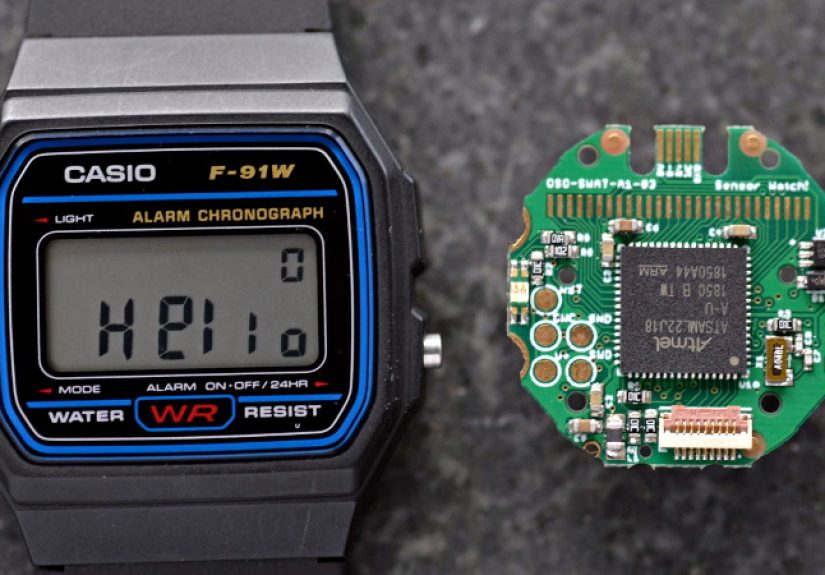
The Casio F-91W in particular has become the poster child for this movement, and it is easy to see why. Its design has endured for decades because it gets the basics so right: easy-to-read time, day, and date; a familiar button layout; a compact case; and a battery life that makes modern smartwatches look like needy houseplants. In an age of glowing rectangles begging for nightly charging, a watch that quietly does its job for years feels almost suspiciously mature.
From a hardware perspective, these old-school watches offer something makers adore: constraints. The case is tiny. The power budget is stingy. The display is unusual. The controls are minimal. Nothing about the project is forgiving. And that is exactly why it is fun. A successful watch PCB swap is not just an electronics project. It is an exercise in discipline.
The Big Appeal: Keeping the Soul, Replacing the Brain
The most compelling part of a wristwatch PCB swap is philosophical, not electrical. Builders are not throwing away the identity of the watch. They are preserving it. The familiar case, the nostalgic look, the tactile button presses, and sometimes even the original LCD remain part of the experience. What changes is the intelligence behind the curtain.
That means a watch can look wonderfully old while doing something very new. It can run custom firmware, display alternate watch faces, log environmental data, or support sensor add-ons without becoming an oversized slab strapped to your arm. In other words, it can become smarter without becoming smug.
This is where projects like Sensor Watch made people sit up and pay attention. Instead of treating the classic digital watch as obsolete, they treated it as an ideal chassis. That reframing mattered. Suddenly the old watch was not a relic. It was a platform.
Sensor Watch Helped Turn a Curiosity Into a Category
One of the clearest examples of the trend is Sensor Watch, a replacement board designed for the classic Casio F-91W form factor. The concept is elegant: swap the original internals for a custom board powered by a modern ultra-low-power microcontroller, keep the familiar wristwatch character, and open the door to custom software and sensor expansion.
What makes Sensor Watch especially clever is that it does not try to win the smartwatch arms race. It does not chase giant touchscreens, app stores, or a battery-draining parade of wireless features. Instead, it leans into what classic watches already do well: clarity, endurance, and restraint. That restraint is not a limitation. It is the entire point.
Its approach to expansion is also part of the charm. Rather than stuffing every imaginable feature onto the main board, the project embraces tiny add-on sensor boards connected through a compact interface. That allows a builder to tailor the watch to a purpose instead of turning it into a bloated gadget trying to be your phone, gym coach, weather station, and therapist all at once.
In the maker community, that modularity feels refreshing. One person wants temperature data. Another wants motion sensing. Someone else just wants to write a delightfully unnecessary custom watch face because they can. All of these are valid uses. That is the beauty of a hackable wristwatch platform: practicality and whimsy are allowed to share the same wrist.
Why These Projects Are Harder Than They Look
Looking at a finished PCB-swapped watch can fool you into thinking the job is mostly about miniaturization. It is not. Shrinking the board is only one part of the challenge. The real difficulty is that every subsystem has to coexist inside a brutally constrained environment.
1. Power Budget Is King
Wearable electronics are ruled by battery realities, and wristwatches are especially unforgiving. There is no room for waste. A design that would feel efficient in a desktop gadget can be embarrassingly thirsty on the wrist. That is why ultra-low-power microcontrollers, careful sleep modes, lean firmware, and sensible displays matter so much in these builds.
The most successful watch swap projects understand that battery life is not a feature added at the end. It is an architectural decision made from the first sketch. Every sensor choice, every polling interval, every display behavior, and every extra flourish has a power cost. In a watch, those costs add up fast. The board either sips energy like a polite guest, or it drains the coin cell like a teenager discovering the thermostat.
2. Mechanical Fit Is a Tiny Nightmare
Watches are not roomy. They are not “maker-space roomy,” not “we can revise the enclosure later roomy,” and certainly not “let’s just add another connector” roomy. A replacement PCB has to align with buttons, contacts, display geometry, mounting points, and case tolerances that were never designed for your custom masterpiece.
This is why flex boards and clever connector layouts show up so often in watch swaps. The electronic design has to obey the mechanical packaging, not the other way around. On a desk, a PCB can spread out and enjoy its life. In a wristwatch, it has to suck in its stomach and behave.
3. Displays Are Delightfully Difficult
Segment LCDs are one reason these projects feel magical and one reason they can become maddening. Driving a familiar watch display is part of what preserves the classic look, but that also means the designer must understand segment mapping, timing, control logic, and compatibility. That is real work.
And yet it is worth it. A custom board that still talks to a classic segmented display has a special kind of elegance. It feels less like a gadget with a retro costume and more like a genuine continuation of the original watch’s design language.
4. Inputs Are Few, So Interface Design Matters
Most classic digital watches give you only a handful of buttons. That means the user interface has to be thoughtful. Good watch firmware is not just functional; it is disciplined. One short press, one long press, one mode cycle, one field select. Every action has to earn its place.
This is where the best projects shine. They do not try to cram a smartphone into three buttons. They respect the limitations and create interactions that feel native to the watch itself. The result is software that is compact, intuitive, and unexpectedly satisfying.
More Than One Project, More Than One Era
Part of what makes the PCB-swap trend so interesting is that it is not a one-off novelty. It is part of a longer conversation between wearable computing and classic watch design. Years ago, Texas Instruments’ eZ430-Chronos showed that a watch could be both a development platform and a low-power, sensor-equipped device. More recently, projects like Sensor Watch refined the idea by fitting modern brains into beloved retro shells.
And the trend has kept evolving. Newer projects have pushed beyond simple replacement boards into more feature-rich territory, including Bluetooth-enabled drop-in upgrades that keep the vintage look while adding apps, phone syncing, and fresh lighting tricks. That does not mean every watch swap has to become a mini smartwatch. It simply proves the category is alive enough to support different philosophies.
Some builders want purity: classic display, classic battery behavior, minimal functions, no nonsense. Others want controlled ambition: a little wireless connectivity, a few sensors, maybe a custom display. The common thread is not a specific feature list. It is the desire to upgrade without erasing identity.
Why the Trend Resonates So Deeply
There is a reason wristwatch PCB swaps keep grabbing attention beyond the hardcore electronics crowd. They hit several emotional notes at once.
- Nostalgia: People already know and love the look of these watches.
- Repair culture: Swapping internals feels more respectful than tossing the whole object.
- Customization: The watch becomes personal in a way off-the-shelf products rarely are.
- Technical elegance: Low-power engineering, segment displays, and tiny packaging are catnip for serious builders.
- Restraint: These projects often reject feature overload in favor of focused usefulness.
In a strange way, watch PCB swaps are a reaction against excess. They ask a very modern question: what if wearable tech got better by becoming more thoughtful, not more attention-hungry? That idea has legs. Or, more accurately, it has straps.
What Great Wristwatch PCB Swaps Usually Get Right
The best projects in this space tend to share a few principles. First, they respect battery life. Second, they respect the case and display. Third, they keep the interface simple. Fourth, they design for openness, whether through documentation, modular accessories, or community firmware. And finally, they understand that a watch does not need to do everything to be deeply satisfying.
That last point may be the most important. A good wristwatch PCB swap is not impressive because it shouts. It is impressive because it fits so much intention into so little space. It is a tiny system that makes a series of smart compromises. That is engineering at its best.
The Experience of Living With a PCB-Swapped Watch
What does it actually feel like to wear one of these things, or even to build one? That experience is part of the magic, and it deserves more than a footnote.
First, there is the strange delight of seeing something familiar behave in a new way. At a glance, the watch still looks like the kind of digital timepiece you have seen for years. It is humble, almost anonymous. Then you press a button and it reveals a custom watch face, a sensor reading, a personalized utility, or a behavior that clearly never came from a factory assembly line. That moment is wonderful because it combines recognition and surprise. It is like discovering your quiet neighbor plays synthesizer in a space-funk band on weekends.
Second, there is the tactile pleasure of the hardware itself. A PCB-swapped watch still feels like a watch, not a shrunken phone. It is light. It disappears on the wrist. It does not demand a charger every evening or beg for your attention with a flood of notifications. You interact with it deliberately. The buttons have purpose. The display is sparse but legible. The whole object encourages a calmer kind of relationship with technology.
Building one can be equally memorable. There is usually a moment of doubt somewhere in the process, often when the parts seem laughably small and the case seems even smaller. You line up the board, study the contacts, check the fit, second-guess the fit, and then check the fit again because humility is healthy in electronics. When it finally comes together and the display wakes up, the feeling is hard to overstate. It is not just relief. It is the satisfaction of having negotiated with physics and lost only a reasonable amount of pride.
There is also a more subtle emotional payoff. A PCB-swapped watch often feels more personal than a mass-market wearable because it reflects decisions. Someone chose the board layout. Someone mapped the display. Someone decided which features were worth the power budget. Someone wrote firmware that fits a tiny set of buttons and a tinier display. Even if you did not design the board yourself, wearing one connects you to that design intent in a way off-the-shelf gadgets rarely do.
And then there is the social experience. These watches are conversation starters for exactly the right kind of people. Most folks will glance at one and think, “Nice retro watch.” A few will notice something unusual. A smaller handful will light up and ask dangerous questions like, “Wait, is that a replacement board?” That is when you know you have found your people.
Over time, the watch can become a quiet companion rather than a buzzing distraction. It tells time, of course, but it also reminds you that thoughtful engineering still matters. It proves that old design language can support new ideas. It demonstrates that hacking does not always mean making something louder, bigger, or flashier. Sometimes it means making something smarter while preserving the charm that made you care about it in the first place.
That is why the experience sticks. A wristwatch PCB swap is not merely a hardware modification. It is a small philosophy you can wear: keep what works, improve what matters, and never underestimate the emotional power of a well-behaved little machine.
Final Thoughts
Wristwatch PCB swaps may still live in a niche corner of the hardware world, but they are no passing gimmick. They sit at the intersection of nostalgia, open hardware, low-power engineering, and personal expression. They respect the past without getting trapped in it. They modernize a classic object without smothering it in unnecessary complexity.
That is why they feel so compelling right now. In a market crowded with devices that want to do everything, these projects ask a better question: what would happen if we made one familiar thing wonderfully, thoughtfully different? The answer is already on a lot of wrists. And yes, it really does seem like wristwatch PCB swaps must be in the air.