Table of Contents >> Show >> Hide
- What Is a Paid Vacation Day?
- Why Paid Vacation Matters More Than People Admit
- The U.S. Legal Basics
- How Paid Vacation Is Usually Structured
- What Workers Typically Receive
- Common Paid Vacation Questions Employees Ask
- State Law Differences You Should Not Ignore
- How to Read a Paid Vacation Policy Like a Pro
- Best Practices for Employers
- Examples of How Paid Vacation Works in Real Life
- Experiences Related to Paid Vacation Day Fundamentals
- Conclusion
Paid vacation sounds simple on paper: you stop working, your paycheck keeps showing up, and your out-of-office message gets to sound more relaxed than you feel while packing. But in real life, paid vacation days are one of the most misunderstood parts of compensation. Some workers assume vacation is legally guaranteed. Others think “unlimited PTO” means limitless beach time. And many people discover the fine print only when they try to book a trip, carry over unused days, or leave a job.
If you want the short version, here it is: paid vacation in the United States is usually a company benefit, not a federal entitlement. That means the details live in employer policies, offer letters, handbooks, union agreements, and state laws. So the fundamentals matter. A lot.
This guide explains how paid vacation days work, what employees should look for, what employers should spell out, and why a policy that seems crystal clear in HR language can still create chaos when real humans, real schedules, and real life get involved.
What Is a Paid Vacation Day?
A paid vacation day is time away from work that an employee can take while still receiving regular pay. In plain English, it is a day off that does not require you to choose between rest and rent.
Vacation time is often separate from sick leave, holidays, bereavement leave, and family or medical leave. In other workplaces, those categories are bundled into a single paid time off bank, often called PTO. That distinction matters because separate vacation leave and a general PTO policy can create very different rules for accrual, carryover, and payout.
Think of paid vacation as part benefit, part scheduling tool, and part culture signal. A company that offers meaningful vacation time is not just handing out days off. It is telling employees something about workload expectations, trust, retention, and whether “work-life balance” is a genuine value or just a decorative phrase in a careers page banner.
Why Paid Vacation Matters More Than People Admit
For employees
Paid vacation gives workers time to rest, handle personal responsibilities, travel, reconnect with family, or simply sit on a couch and stare into the middle distance without a Slack notification ruining the moment. That recovery matters. Time away from work can help people recharge, reduce stress, and return with better focus. The catch is that many workers do not use all the time they are offered, often because they worry about workload, staffing, or looking less committed.
For employers
For employers, vacation is not just a nice perk wrapped in beach imagery. It can help with recruitment, retention, morale, and burnout prevention. It also shapes how fairly employees believe they are treated. A murky paid vacation policy can create resentment faster than a broken office coffee machine, and that is saying something.
Well-designed vacation benefits can also support business continuity. Yes, really. When managers require planning, cross-training, and documentation before time off, the organization becomes less fragile. If everything falls apart because one employee takes four days off, the problem is not the vacation policy. The problem is the system.
The U.S. Legal Basics
Here is the first fundamental: federal law generally does not require private employers to provide paid vacation days. That surprises a lot of people. In the U.S., vacation is typically a voluntary employer-provided benefit unless another rule, contract, or special circumstance applies.
That does not mean employers can make things up as they go. Once a company offers paid vacation, its policy can create enforceable obligations. In many states, earned vacation may be treated as wages or compensation. That is where things get interesting, and a little less relaxing.
Another common source of confusion is the Family and Medical Leave Act, or FMLA. FMLA provides eligible employees with unpaid, job-protected leave for qualifying family and medical reasons. It is not the same thing as paid vacation. However, accrued paid leave may sometimes run at the same time as FMLA leave if the employer’s rules and the law allow it.
There are also special rules in certain contexts, such as some federal contract work. So while the baseline rule is “paid vacation is not federally required,” the real answer always depends on where you work, how your employer structures leave, and what state law says about earned vacation and final pay.
How Paid Vacation Is Usually Structured
1. Accrual
Many employers use an accrual system. That means workers earn vacation gradually over time, often by pay period, by month, or by hours worked. A policy might say an employee earns 10 days per year, but the fine print usually means those days are earned little by little rather than dropped from the sky on January 1.
Accrual systems are popular because they reward continued service and reduce the risk of someone taking a full year of vacation in February and resigning in March. Employers like predictability. Finance teams like math. And math, unfortunately, always gets invited into PTO policy design.
2. Frontloading
Some employers frontload vacation, giving employees a bank of days at the start of the year or at the anniversary of hire. This feels generous and simple, and for employees it often is. But the policy still needs answers to important questions: What happens if a new hire leaves early? Can the company deduct unearned days from a final paycheck? Are partial-year employees prorated?
3. Separate buckets vs. one PTO bank
Employers often choose between separate categories of leave or a single PTO bank. Separate buckets mean vacation, sick time, and personal days each have their own rules. A combined PTO policy merges them into one flexible pool. Combined PTO can feel easier for employees because it allows more choice. It can also be easier administratively. On the other hand, it can create compliance issues if state or local paid sick leave laws require tracking leave for specific reasons or under specific accrual rules.
4. Caps, carryover, and “use-it-or-lose-it” rules
This is where paid vacation day fundamentals stop being cozy and start being very state-specific. Some employers cap how much vacation an employee can accumulate. Others allow carryover into the next year. Some impose deadlines to use time by year-end. In certain states, a traditional “use-it-or-lose-it” rule may be allowed under defined conditions. In others, earned vacation cannot simply vanish because the calendar got dramatic.
That is why employees should never assume that a friend’s policy at another company works the same way. Paid vacation law in the U.S. is not a single national rulebook. It is more like a patchwork quilt sewn by HR, payroll, and fifty different legal moods.
What Workers Typically Receive
Paid vacation is common in the United States, but it is not universal. Access varies by industry, employer size, work status, and pay level. In broad terms, full-time workers, higher-paid workers, and employees at larger employers are more likely to have vacation benefits than part-time workers, lower-wage workers, and employees at smaller businesses.
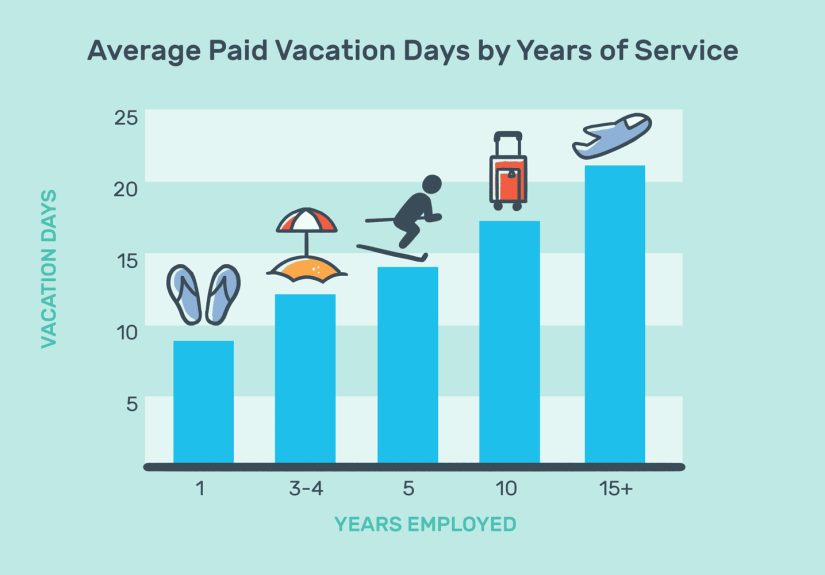
Typical vacation time also tends to increase with length of service. That is why a new employee may start with a modest number of days, while someone with 10 years at the same employer has a much larger bank. This “tenure ladder” is one of the oldest vacation design choices around. Employers use it to reward loyalty. Employees sometimes call it “the long scenic route to a decent break.” Both descriptions are fair.
Benchmarks matter, but they are only a starting point. A policy is not automatically competitive because it matches a national average. A technology company competing for senior talent may need a different approach than a retail chain, manufacturer, or regional nonprofit. The best paid vacation policy is not the most glamorous one on paper. It is the one employees can actually use without guilt, confusion, or scheduling warfare.
Common Paid Vacation Questions Employees Ask
Can my manager deny my vacation request?
Usually, yes, depending on the policy and business needs. Paid vacation is generally paid time you may request, not guaranteed time you can take whenever the travel app offers suspiciously low airfare. Employers often require advance notice, manager approval, blackout dates, or coordination with team coverage.
What happens to unused vacation when I leave?
That depends on state law and employer policy. In some states, unused earned vacation must be paid out at separation. In others, a written policy may limit or condition payout. This is one of the biggest reasons employees should read the handbook before resigning with dramatic confidence.
Can unused days roll over into next year?
Sometimes. Some employers allow partial carryover. Some allow unlimited carryover up to a cap. Some require employees to use time by a set deadline. Whether that kind of rule is valid can depend heavily on state law.
Do part-time employees get paid vacation?
Sometimes, but not always. Some employers exclude part-time workers, while others offer prorated PTO based on hours worked. Again, policy design matters.
What about “unlimited PTO”?
Unlimited PTO sounds like freedom wearing sunglasses, but it only works if people are actually able to use it. In practice, unlimited PTO can be generous, restrictive, or mostly symbolic depending on manager behavior, staffing, culture, and documentation. A policy is not flexible just because the adjective says so.
State Law Differences You Should Not Ignore
When it comes to paid vacation, state law can shape three major issues: forfeiture, carryover, and payout at separation.
For example, some states treat earned vacation as wages once accrued, which can make forfeiture rules much harder for employers to enforce. California is famously strict in this area and generally does not allow a true use-it-or-lose-it rule for earned vacation, though reasonable accrual caps may be allowed. Colorado and Montana also protect earned vacation in important ways. Illinois takes a more nuanced approach, allowing certain use-it-or-lose-it rules if employees had notice and a reasonable opportunity to use the leave, while still protecting vacation already earned under the governing rule.
The lesson is simple: the phrase paid vacation policy may sound universal, but the legal consequences are local. Employers operating in more than one state need to review policies carefully. Employees changing jobs or moving states should assume nothing.
How to Read a Paid Vacation Policy Like a Pro
If you are an employee reviewing a handbook, focus on these questions:
- How is vacation earned? By pay period, month, year, or hours worked?
- When can it be used? Immediately, after a waiting period, or only after accrual?
- Does unused time carry over? If yes, how much?
- Is there an accrual cap? If you stop earning once you hit the cap, that matters.
- What happens at separation? Is unused accrued vacation paid out?
- Are there blackout dates or approval rules? A vacation bank is less useful if every popular week is off-limits.
- Does state law override any policy language? Sometimes the handbook is not the final word.
If you are an employer, the same list applies in reverse. Every one of those issues should be written clearly. A vague leave policy invites inconsistent decisions, employee frustration, payroll problems, and legal risk. In other words, ambiguity is not a management style.
Best Practices for Employers
A strong paid vacation policy is clear, consistent, and realistic. It should explain eligibility, accrual, usage, approval, carryover, payout, and any state-specific exceptions. It should also be usable in real life. Policies that look generous but punish people socially for taking time off do not build trust. They build cynicism.
Smart employers also train managers on vacation administration. The written policy may be solid, but if one manager approves every request and another acts like a two-day trip is a betrayal of the mission, employees will experience the policy as unfair. Consistent application matters as much as clean drafting.
And finally, good employers encourage people to actually use their time off. This is not charity. It is sensible workforce management. People are not laptops. You cannot improve performance forever by leaving them plugged in.
Examples of How Paid Vacation Works in Real Life
Example 1: The traditional accrual model
Jordan earns 10 vacation days per year and accrues them each pay period. By June, Jordan has earned roughly half the annual amount and can request a week off. If Jordan leaves in August, the employer checks policy and state law to determine whether unused accrued time must be paid out.
Example 2: The frontloaded model
Mia receives 15 days at the start of each calendar year. The policy says employees who leave before earning the full year may owe back unearned advanced time where permitted by law. That sounds simple until payroll, final wages, and state deduction rules enter the chat.
Example 3: Unlimited PTO
Sam works at a company with flexible PTO. Technically there is no hard cap, but requests still require manager approval and staffing coverage. Sam learns quickly that the policy works well only when team expectations, leadership behavior, and workload all support taking leave without penalty.
Experiences Related to Paid Vacation Day Fundamentals
Talk to enough employees and managers, and a pattern shows up fast: the most memorable paid vacation experiences are rarely about the number of days alone. They are about whether time off felt safe to take. One employee may have only 12 days a year but use all of them happily because the team plans ahead, the manager models healthy boundaries, and nobody sends “quick question” messages from the beach. Another employee may have a flashy flexible PTO policy and still avoid taking leave because work piles up, approval feels political, and absence quietly damages reputation.
Many workers describe the same turning point. They used to treat vacation like a luxury item, something to save for a perfect trip that never came. Then burnout hit. Suddenly, one long weekend with no laptop felt less like indulgence and more like maintenance. After that, paid vacation stopped being a perk and started looking like what it really is: part of staying functional.
Managers have their own lessons. New supervisors often believe approving time off is mostly about calendars. Veteran supervisors know it is also about fairness, coverage, and trust. If one high performer never takes vacation, that can seem admirable for about five minutes. Then it becomes a risk. Knowledge gets hoarded, resentment builds, and the person everyone depends on becomes the person most likely to snap, quit, or disappear for a week and leave everyone else panicking.
There are also the cautionary tales. Employees who did not understand accrual assumed they had more time than they really did. Workers who ignored a carryover deadline lost days they thought were safe. People resigned without checking payout rules and were shocked by the final paycheck. On the employer side, small businesses often learn the hard way that a casual vacation practice becomes a legal and payroll problem once a dispute begins. “We have always handled it informally” is not a strong compliance strategy.
Then there are the good experiences, and they are worth copying. Teams that publish vacation calendars early. Employers that remind people to use their time before they hit accrual caps. Leaders who take time off themselves and truly unplug. Companies that cross-train staff so one absence does not feel like an evacuation drill. Workers who plan reentry well, leave clean handoffs, and return without 947 unread messages waiting like a tiny digital ambush.
The human side of paid vacation day fundamentals is this: people use time off best when the rules are clear and the culture is supportive. The legal language matters. The payroll setup matters. The state law matters. But the lived experience matters, too. A vacation policy succeeds when employees understand it, trust it, and can actually use it without feeling guilty. That is the difference between a benefit that looks good in a handbook and one that genuinely improves life at work.
Conclusion
Paid vacation day fundamentals come down to a few core truths. In the U.S., paid vacation is usually an employer-provided benefit rather than a universal federal right. The details depend on policy design, state law, and workplace culture. Employees should understand how vacation is earned, used, carried over, and paid out. Employers should draft clear rules, apply them consistently, and create a culture where taking time off is normal instead of suspicious.
At its best, paid vacation is not just about getting away from work. It is about making work sustainable. And that is a benefit both employees and employers can appreciate, even if only one of them is currently shopping for a beach umbrella.