Table of Contents >> Show >> Hide
- What Is the Golf Card Game?
- What You Need to Play
- How to Set Up Six-Card Golf
- How to Play Golf Step by Step
- How Scoring Works in Golf
- Popular Golf Card Game Variations
- Strategy Tips for Winning Golf
- Common Mistakes New Players Make
- A Quick Sample Round
- Why Golf Is Such a Great Family Card Game
- Experiences That Make Golf Card Game So Memorable
- Final Thoughts
- SEO Tags
If someone invited “Golf” to game night and you showed up wearing a polo shirt and asking where the cart path starts, I have terrific news: no sunscreen is required. The Golf card game is a fast, clever, low-score-wins game played with a standard deck of cards, and it is one of those rare family favorites that is easy to learn, quick to set up, and just chaotic enough to make everyone dramatically suspicious of one innocent-looking Queen.
At its core, Golf is about keeping your score as low as possible over several rounds, which are often called “holes.” The most common version is six-card Golf, and that is the version this guide will teach first. Once you know it, you can branch out into four-card Golf, eight-card Golf, or nine-card Golf without feeling like you need a law degree in household game rules.
What Is the Golf Card Game?
Golf is a draw-and-discard card game in which players try to build the lowest total score instead of the highest. That flip in logic is part of what makes the game so fun. In most rounds, you are not trying to collect powerful cards. You are trying to dodge them like they are awkward small talk at a wedding buffet.
The game is popular because it blends luck, memory, and timing. You know part of your layout, you guess at the rest, and every turn forces a small decision: do you take the safe card, gamble on the unknown draw, or hold your breath and replace a mystery card that might already be helping you?
What You Need to Play
Players
Two to four players works best for the standard six-card version, though larger groups can play if you add more decks.
Cards
You can play with one standard 52-card deck for a small group. Some tables add jokers; some remove them. That is where Golf starts showing off its famous house-rule personality.
Scorekeeping
You will also want a pen and paper or a score app, because Golf is usually played over nine rounds or sometimes eighteen rounds, just like actual golf. The lowest total score at the end wins.
How to Set Up Six-Card Golf
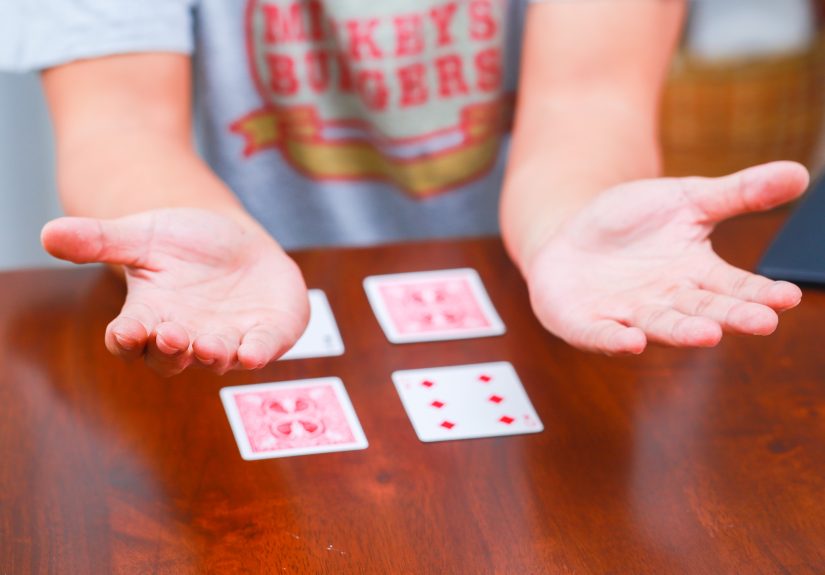
In the most common six-card setup, each player is dealt six cards face down. Those cards are arranged in a 2-by-3 grid in front of the player. The remaining cards become the stock pile, and the top card is flipped face up to begin the discard pile.
Before the round really gets moving, each player turns two cards face up in their own grid. Those two revealed cards are your first clues. The other four stay face down, and you do not get to peek at them just because curiosity is having a moment.
A typical table setup looks like this:
- Top row: 3 face-down cards
- Bottom row: 3 face-down cards
- Flip any 2 cards face up
- Place stock pile in the center
- Start a discard pile next to it
How to Play Golf Step by Step
1. The player left of the dealer goes first
Play usually moves clockwise. On your turn, you choose one of two places to draw from:
- the top card of the stock pile
- the top card of the discard pile
2. Decide whether to keep the card
If you draw from the stock pile, you may either keep the card and swap it into your grid, or discard it. If you draw from the discard pile, you usually must play that card into your grid. In other words, taking from the discard pile is not a sightseeing tour. You picked it up, so now it has a job.
3. Swap with one card in your grid
If you keep the drawn card, replace any one card in your 2-by-3 layout. The card you remove is placed face up on the discard pile. If you replace a face-down card, you do not look at it first. The new card you place into that spot stays face up.
This is where the game gets deliciously annoying. Sometimes you toss away a mystery card and discover later that it was a King worth zero. Sometimes you heroically replace a terrible card and accidentally reveal something even worse. Golf is very committed to humble life lessons.
4. Keep building low columns
In six-card Golf, the biggest tactical goal is often to create matching pairs in the same column. If the top and bottom cards in one column match in rank, that whole column scores zero. A pair of 4s becomes zero. A pair of Kings also becomes zero. Even a pair of 2s, in the common minus-two scoring version, usually zeroes out that column instead of doubling the bonus.
5. End the round
In many common versions, the round ends when one player has all six cards face up. In some households, every other player then gets one final turn. In other households, the round stops immediately. This is one of the most common Golf house rules, so agree on it before you start unless you enjoy dramatic legal arguments over snack bowls.
How Scoring Works in Golf
Scoring is where Golf develops a tiny identity crisis, because different groups score a few cards differently. The safest move is to agree on your scoring before the first deal. Here is the most common six-card scoring system used in many U.S. guides:
- Ace = 1 point
- 2 = minus 2 points in many common versions
- 3 through 10 = face value
- Jack = 10 points
- Queen = 10 points
- King = 0 points
- Matching pair in the same column = 0 points for that column
Some groups use jokers as -2, some use -3, and some use -5. Some groups remove jokers entirely and make 2s the only negative card. Translation: if you walk into a new game night and hear, “We play a slightly different version,” know that “slightly” is doing very heavy lifting.
Example of scoring a layout
Imagine your final six cards are arranged in three columns like this:
- Column 1: 4 and 4
- Column 2: King and 7
- Column 3: Queen and Ace
Column 1 scores 0 because it is a matching pair. Column 2 scores 7 because the King is worth 0. Column 3 scores 11 because Queen is 10 and Ace is 1. Total score: 18.
Popular Golf Card Game Variations
Four-Card Golf
This version is often played in a 2-by-2 square. Players usually peek at two cards at the start, then try to lower their score through draws and swaps. Four-card Golf often uses knocking: instead of waiting until every card is face up, a player can knock to trigger the end of the round, and the other players get one final turn.
Eight-Card Golf
Eight-card Golf is similar to six-card Golf, but players use a 4-by-2 layout. The rhythm feels familiar, but there are more chances to build pairs and more opportunities to ruin your own plan in spectacular fashion.
Nine-Card Golf
Often called Crazy Nines, this version uses a 3-by-3 layout. In many rulesets, you flip three cards face up to begin. Instead of matching pairs in a column, you usually want three of a kind in a column to score zero. It is a little longer, a little messier, and a lot of fun if your group enjoys extra strategy.
Strategy Tips for Winning Golf
Memorize your early information
The two cards you reveal at the beginning are more important than they look. If one is a King, protect it. If one is a Queen, start plotting her exit like she just arrived with six suitcases and no return ticket.
Use the discard pile as public information
The discard pile tells a story. If low cards are flowing past you, your opponents may be chasing pairs instead of simply dumping high cards. Pay attention to what disappears quickly.
Do not fall in love with mystery cards
Players often become emotionally attached to face-down cards for absolutely no good reason. Just because a card is unknown does not mean it is secretly amazing. Sometimes your mystery card is a King. Sometimes it is a Queen with a grudge.
Pairs are often better than pretty numbers
In six-card Golf, a matching column can erase points entirely. That means pairing a mid-value card can be stronger than protecting two separate “okay” cards. Zero is a beautiful number.
Know when to end the round
If your version allows a final turn for everyone else, flipping your last face-down card is a timing move. End too early and you may lock in a mediocre score. Wait too long and your opponents may quietly build better columns while you hunt for the perfect card that never arrives.
Common Mistakes New Players Make
- Forgetting the goal: lowest score wins, not highest.
- Ignoring columns: in six-card Golf, columns matter a lot.
- Drawing from discard without a plan: if you take it, you usually must use it.
- Not agreeing on house rules first: this is how friendships get tested over jokers.
- Panicking about one bad card: one ugly card is survivable; three ugly cards are a lifestyle.
A Quick Sample Round
Let’s say you begin with two revealed cards: a Queen and a 5. Not ideal, but not tragic. On your first turn, the top discard is a King. You should probably take it and replace the Queen immediately, because turning a 10-point problem into a 0-point card is the kind of math teachers dream about.
Next round, you draw from the stock and pull a 5. Now things get interesting. If your other visible card is already a 5 in one half of a column, you can complete a matching pair and zero out that column. That is usually a better move than tucking the 5 somewhere random and pretending future-you will solve it.
That is the heart of Golf: tiny decisions, incomplete information, and the occasional moment when a bad hand becomes a beautiful low score because you stayed flexible.
Why Golf Is Such a Great Family Card Game
Golf works for mixed ages because the core rules are simple, but the choices still feel meaningful. Kids can learn the basics quickly. Adults stay engaged because memory and timing actually matter. Grandparents often become terrifyingly good at it, which is humbling but also weirdly inspiring.
It also scales well for casual play. You can run one quick round while waiting for dinner, or keep score across nine full holes and turn game night into a tiny championship. It is portable, affordable, and requires no batteries, charging cable, or software update. That alone deserves applause.
Experiences That Make Golf Card Game So Memorable
One of the best things about Golf is that the experience of playing it feels bigger than the rules on paper. On paper, it is a simple draw-and-replace game with low scoring. Around an actual table, it becomes a tiny theater production starring hope, denial, and at least one person saying, “No, no, no, that card was supposed to save me.”
A typical round has a great emotional arc. At the start, everybody is calm. People flip two cards, make a few polite observations, and pretend they are making measured, strategic decisions. Then someone draws a King from the discard pile, replaces a Queen, and suddenly the table energy changes. Now everyone is watching everyone else. The discard pile becomes gossip. Every card is suspicious. The whole game starts feeling like a polite poker face contest, except half the players are absolutely not polite about it.
Golf also creates the kind of shared memories that other simple card games sometimes miss. There is always that one round where a player is convinced a face-down card must be good because “it has been lucky all night,” only to reveal a Jack and lose by eleven points. There is always that one dramatic finish where someone ends the round feeling brilliant, then scoring reveals they forgot a lonely Queen hiding in plain sight. And there is always the legendary comeback: the player who spent three holes getting roasted by everybody else, then quietly strings together low rounds and wins the whole game by two points. Golf loves plot twists.
It is also a great conversation game. Because turns are fast, nobody sits around forever waiting to do something. People can chat, snack, joke, and still stay in the action. That makes it especially good for family gatherings, vacations, and low-pressure game nights where not everybody wants a rules-heavy strategy marathon. You can teach it in a few minutes, start playing immediately, and let the group discover the tension on its own.
Another memorable part of the experience is the way house rules become family history. One family insists jokers are -2. Another swears they are -5 because “that is how Grandma played.” Another group allows knocking only in four-card Golf, while somebody’s uncle believes knocking should be legal in every version because “it keeps people honest,” which sounds wise until he says it while obviously bluffing with two Queens and a 9.
That flexibility is part of the charm. Golf does not feel fragile. It feels lived in. The game can be serious, silly, competitive, relaxed, or just loud enough to make the neighbors wonder why someone shouted, “A pair of 7s never looked so beautiful!” It is easy to bring to the table, but the experience rarely feels disposable. That is why so many people keep returning to it. The rules are simple. The moments are not.
Final Thoughts
If you want a card game that is easy to learn, full of replay value, and sneaky in the strategy department, Golf deserves a permanent spot in your game-night rotation. Start with six-card Golf, agree on your scoring rules before the first deal, and do yourself one favor: never underestimate a player who looks relaxed while quietly building matching columns.
That person is dangerous.
Once you learn the basics, Golf becomes one of those games you can teach in five minutes and keep playing for years. No clubs. No tees. No polite whispers. Just cards, laughter, suspiciously lucky Kings, and the glorious pursuit of the lowest score.