Table of Contents >> Show >> Hide
- Why the Right Budgie Cage Matters
- How to Choose a Cage for a Budgie: 12 Steps
- Step 1: Start With the Right Minimum Size
- Step 2: Choose Width Over Height
- Step 3: Check the Bar Spacing Carefully
- Step 4: Pick a Safe Cage Material
- Step 5: Choose a Rectangular Cage, Not a Round One
- Step 6: Look for Secure Doors and Latches
- Step 7: Choose a Cage That Is Easy to Clean
- Step 8: Make Sure There Is Room for Perches
- Step 9: Leave Space for Toys and Enrichment
- Step 10: Consider Food and Water Access
- Step 11: Think About Cage Placement Before You Buy
- Step 12: Buy for the Bird You Haveand the Routine You Can Maintain
- Quick Budgie Cage Buying Checklist
- Common Mistakes to Avoid When Choosing a Budgie Cage
- Extra Experience: Real-Life Lessons From Choosing a Budgie Cage
- Conclusion
Choosing a cage for a budgie sounds simple until you stand in front of a wall of shiny bird mansions and realize half of them look like tiny Victorian hotels, while the other half look like something designed by a committee of confused giraffes. But your budgie does not need a chandelier, a fake castle turret, or a cage so tall it requires an elevator. Your budgie needs space, safety, cleanability, and a setup that supports real bird behavior: flying short distances, climbing, chewing, stretching, playing, resting, and occasionally judging you from a perch with the confidence of a tiny feathered landlord.
Budgies, also called parakeets in the United States, are small parrots with big personalities. They are active, intelligent, social, and surprisingly athletic. A good budgie cage is not just a container; it is your bird’s home base. Even if your budgie gets daily out-of-cage time, the cage still needs to be roomy, secure, easy to clean, and thoughtfully arranged. The wrong cage can create stress, limit movement, increase mess, and even cause injuries. The right cage gives your bird a safer, healthier, happier lifeand saves you from buying three “almost right” cages before finally admitting the first one was basically a decorative breadbox.
This guide breaks the process into 12 practical steps so you can choose a budgie cage with confidence, common sense, and fewer panic-searches at midnight.
Why the Right Budgie Cage Matters
A budgie cage affects almost everything about daily care: exercise, sleep, hygiene, enrichment, social behavior, and safety. Budgies are not built to sit still all day like tiny ornaments with opinions. They hop, flutter, climb, investigate, chew, and explore. A cramped or poorly designed cage can make these natural behaviors harder. A cage with unsafe bar spacing or questionable materials can become dangerous. A cage that is difficult to clean can turn routine care into a full-body workout with feathers.
Before choosing a cage, remember one golden rule: bigger is usually better, but only if the cage is safe. A giant cage with bars spaced too widely is not an upgrade; it is a hazard wearing a price tag.
How to Choose a Cage for a Budgie: 12 Steps
Step 1: Start With the Right Minimum Size
For one budgie, many bird-care recommendations begin around 18 inches long, 18 inches deep, and 18 to 24 inches high as a minimum range. However, minimum does not mean ideal. It means “your budgie can live here,” not “your budgie will write a five-star review.” A better everyday choice is often a wider flight-style cage around 30 inches long, 18 inches deep, and 18 inches high, or larger if your space and budget allow.
For two budgies, look for something closer to 30 inches long by 18 inches deep by 18 inches high at minimum, with larger flight cages being much better. For more than two budgies, you need significantly more space. When in doubt, size upas long as the bar spacing remains safe.
Think of the cage as a studio apartment for a highly energetic roommate who can fly. The goal is not to fit the bird into the cage; it is to fit the bird, perches, food cups, water, toys, and open movement space into the cage without turning it into a cluttered garage sale.
Step 2: Choose Width Over Height
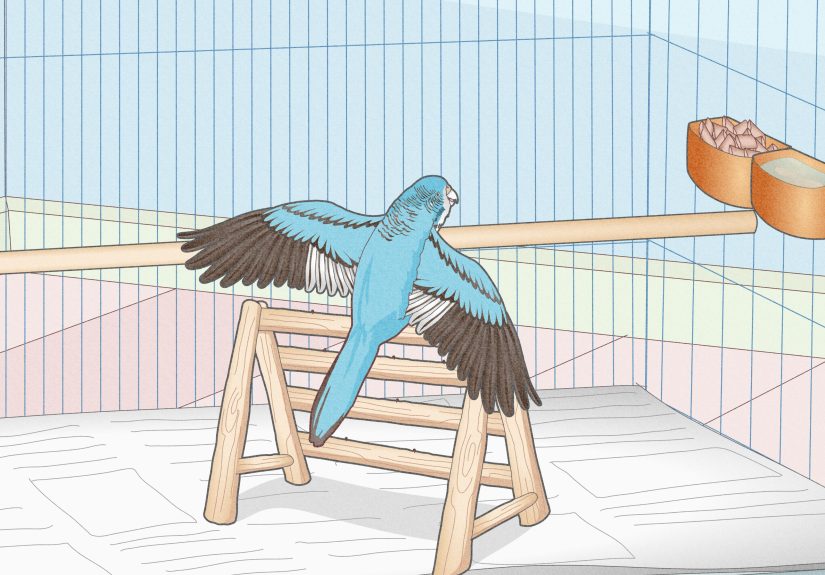
Budgies fly side to side more than they fly straight up like tiny helicopters. That means a long, wide cage is usually better than a tall, narrow one. Those slim tower cages may look elegant in a corner, but they often give birds very little useful flying room. A budgie benefits more from horizontal space where it can flutter between perches, stretch its wings, and move naturally.
Look for rectangular cages with good length. A flight cage is often the best style because it prioritizes usable width. Height still matters, but it should not be the cage’s main selling point. A cage that is 32 inches long and moderately tall is usually more practical than a cage that is 18 inches long and dramatically vertical. Your budgie is not training for a pole-vaulting competition.
Step 3: Check the Bar Spacing Carefully
Bar spacing is one of the most important safety details when choosing a budgie cage. For budgies, the spacing should generally be 1/2 inch or smaller. Many owners prefer 3/8 inch to 1/2 inch because it gives climbing grip while reducing the risk of a head, wing, or foot becoming trapped.
Never assume a cage is safe just because it is sold for “small birds.” Some cages marketed for birds have spacing that is too wide for budgies. Measure the widest gap between bars, including decorative areas, corners, doors, and curved sections. A cage may look fine on the front but have wider spacing near the top or around feeder doors. Budgies are curious, flexible, and determined. If there is a suspicious gap, they will find it, test it, and make you question every life choice that led to that moment.
Step 4: Pick a Safe Cage Material
Choose a cage made from bird-safe, nontoxic materials. Stainless steel is excellent but expensive. Powder-coated metal from a reputable manufacturer is a common and practical choice. Avoid cages made with galvanized wire, hardware cloth, chicken wire, peeling paint, rust, or unknown metal coatings. Birds explore with their beaks, and unsafe metals or paint chips can create serious health risks.
If a cage smells strongly of chemicals, has sharp edges, shows flaking paint, or feels flimsy, keep shopping. A cheap cage is not a bargain if it bends, rusts, chips, or becomes unsafe after a few cleanings. Budgies may be small, but they chew, climb, and interact with the cage constantly. The material needs to handle daily bird life, not just look cute in product photos.
Step 5: Choose a Rectangular Cage, Not a Round One
Round cages may look charming, but they are usually not ideal for budgies. Birds often feel more secure when they have corners or defined areas where they can rest. Rectangular cages also make it easier to arrange perches, toys, food dishes, and open flight paths. They fit better against walls, are easier to clean, and usually provide more usable interior space.
Round cages can also create awkward bar angles, especially near domed tops, where feet or necks may get caught if bars narrow or converge. For most budgie owners, a simple rectangular cage is safer, easier, and more functional. In bird housing, boring geometry wins. Your high school math teacher would be thrilled.
Step 6: Look for Secure Doors and Latches
Budgies are small, clever, and occasionally suspiciously talented at opening things. Choose a cage with secure latches on the main door and feeder doors. Sliding doors can be risky if they are light enough for a bird to lift. Spring-loaded or locking mechanisms are often safer, as long as they are easy for you to use during daily care.
Also check the size and placement of doors. A main door should be large enough for your hand, perches, toys, and cleaning tools to move in and out comfortably. Tiny doors turn cage maintenance into a magic trick, except nobody claps and the millet falls on the floor.
Feeder access doors are convenient, but make sure they close firmly. Loose feeder doors can become escape routes. A budgie on an unsupervised adventure may look adorable, but it can quickly become dangerous if windows, fans, other pets, or household hazards are nearby.
Step 7: Choose a Cage That Is Easy to Clean
A good budgie cage should have a removable bottom tray, a grate if you choose to use one, and smooth surfaces that can be wiped easily. Daily cleaning should not require dismantling half the structure. Paper liners such as plain paper, paper towels, or newspaper can make cleanup easier and allow you to monitor droppings for changes.
Avoid cages with excessive decorative scrollwork, tiny crevices, or complicated bases that trap seed hulls and droppings. Budgies are charming, but they are also professional confetti machines. Seed hulls, feathers, toy bits, and shredded paper will travel. A cage that is easy to clean encourages better hygiene and makes you more likely to keep a consistent routine.
Before buying, imagine washing the cage on a busy school or work morning. If the thought makes your soul leave your body, choose a simpler model.
Step 8: Make Sure There Is Room for Perches
Perches are not just furniture. They support foot health, movement, sleep, and confidence. A good cage should have enough space for several perches at different heights without blocking all flight room. Natural wood perches of varied diameters are often better than identical plastic dowels because they encourage natural foot movement.
For budgies, perch diameter often falls around 3/8 inch to 3/4 inch, depending on the bird’s size and grip. The feet should wrap comfortably around the perch without being forced too flat or too tightly curled. Avoid relying on sandpaper perch covers. They are often too abrasive and can irritate feet.
Place perches so your budgie can move between them easily. Do not place a perch directly over food or water bowls unless you enjoy cleaning “surprises” out of breakfast. Leave open space in the center or along the length of the cage for movement.
Step 9: Leave Space for Toys and Enrichment
Budgies need toys, but the cage should not look like a toy store exploded. Choose a cage large enough to include chew toys, swings, foraging activities, and shreddable items while still leaving room to move. Safe toy materials may include untreated wood, sturdy acrylic, paper, seagrass, and bird-safe natural fibers. Always check for loose threads, sharp clips, tiny parts, or anything your bird could swallow.
Rotate toys instead of stuffing every toy inside at once. A few well-chosen toys are better than a cluttered jungle. Budgies enjoy variety, but they also need clear pathways. If your bird has to file a flight plan to cross the cage, remove a few accessories.
Foraging toys are especially useful because they encourage natural searching and problem-solving. Even simple ideas, like hiding a small treat in folded paper or offering leafy greens clipped to the bars, can make the cage more interesting.
Step 10: Consider Food and Water Access
A practical budgie cage should have safe, easy-to-clean food and water dishes. Stainless steel bowls are durable and hygienic. Plastic cups are common but may scratch over time and hold residue, so they need regular inspection and cleaning.
Make sure dishes are positioned where your bird can reach them comfortably but not directly under sleeping perches. Food and water should be easy for you to remove and replace without creating an escape opportunity. External feeder doors can be convenient, but only if they latch securely.
If you feed pellets, seeds, fresh vegetables, and occasional treats, you may want separate dishes to keep foods clean and organized. A cage with enough interior space makes this much easier. Nobody wants a broccoli leaf floating in the water bowl like a sad little pond lily.
Step 11: Think About Cage Placement Before You Buy
Measure the area where the cage will go before buying. Choose a location that is social but not chaotic. Budgies often enjoy being near family activity, but the cage should not sit in the middle of constant noise, drafts, direct sun, or household traffic.
Avoid kitchens because cooking fumes, smoke, aerosol sprays, and overheated nonstick cookware can be dangerous for birds. Keep the cage away from vents, candles, strong cleaners, speakers, open windows, ceiling fans, and areas accessible to cats or dogs. A wall or corner can help a budgie feel more secure because it reduces exposure on all sides.
Place the cage at a comfortable height. A cage sitting low on the floor can make a bird feel vulnerable. A stable stand or sturdy table is usually better. Make sure the cage does not wobble. Budgies are brave, but nobody wants their living room to feel like a carnival ride.
Step 12: Buy for the Bird You Haveand the Routine You Can Maintain
The best budgie cage is one that fits your bird’s needs and your real daily routine. If your budgie spends many hours inside the cage, choose the largest safe flight cage you can reasonably fit. If you plan to keep two budgies, buy for two from the beginning. If you travel, also purchase a separate secure carrier rather than using the main cage for transportation.
Do not buy a cage only because it is pretty, discounted, or labeled “deluxe.” Ask practical questions: Can my bird stretch and move? Are the bars safe? Is the material nontoxic? Can I clean it easily? Are the doors secure? Is there room for perches, toys, and food without crowding?
A cage is a long-term investment. Spending more on the right cage once is usually better than replacing a bad cage later. Your budgie will not care about fancy packaging, but it will care about space, safety, and comfort.
Quick Budgie Cage Buying Checklist
- Choose a wide rectangular cage, preferably a flight-style cage.
- Use 1/2-inch bar spacing or smaller.
- Look for safe materials such as stainless steel or quality powder-coated metal.
- Avoid galvanized wire, rust, peeling paint, sharp edges, and flimsy construction.
- Make sure doors and feeder openings latch securely.
- Choose a cage with removable trays and easy cleaning access.
- Leave room for perches, toys, food, water, and open movement.
- Place the cage away from kitchens, drafts, direct harsh sunlight, and predators.
Common Mistakes to Avoid When Choosing a Budgie Cage
Buying a Cage That Is Too Small
Small cages are often marketed as starter cages, but budgies do not stay in “starter mode.” A cage that barely fits two perches and a food cup is not enough for a healthy daily setup. Start with the best cage you can manage.
Choosing a Tall Cage Instead of a Wide One
Tall, narrow cages waste space for budgies. Your bird needs usable horizontal room, not a skyscraper with feathers.
Ignoring Bar Spacing
This is one of the most serious mistakes. Wide spacing can lead to escape or injury. Always measure before buying.
Overcrowding the Interior
Perches and toys are important, but too many accessories can block movement. Keep the setup interesting but breathable.
Putting the Cage in the Wrong Room
Even a great cage becomes a poor choice if it sits near fumes, drafts, predators, or constant stress. Location matters as much as the cage itself.
Extra Experience: Real-Life Lessons From Choosing a Budgie Cage
One of the most useful lessons about choosing a budgie cage is that product photos can be wildly misleading. A cage can look enormous online because a photographer placed it in a perfectly lit white room next to a suspiciously tiny plant. Then it arrives, and suddenly you realize your budgie would have to reverse carefully to turn around. Always read the actual dimensions, not just the words “large,” “deluxe,” or “spacious.” Those words are marketing confetti. Measurements are truth.
Another real-world tip: bring a tape measure to the store or keep one nearby when shopping online. Measure bar spacing, interior length, door size, and the space where the cage will sit. I have seen many new owners focus only on cage height because tall cages look impressive. But once perches and toys are installed, the bird still has very little room to move sideways. A wide cage may look less dramatic, but it often functions much better for a budgie.
Cleaning is another detail people underestimate. A cage with a removable tray sounds basic until you own one without it. Then every cleaning session becomes a negotiation involving awkward angles, seed hulls, and regret. Choose a cage that lets you change liners quickly, remove bowls easily, and wipe corners without needing the flexibility of a circus performer. You will clean the cage constantly, so convenience is not laziness; it is long-term survival.
Door design also matters more than expected. A large front door makes it easier to adjust perches, add toys, and handle your bird gently when needed. Small doors may look fine until you try to move a natural branch perch inside and discover you are now solving a wooden puzzle. Secure latches are just as important. Budgies can learn routines and may test weak doors, especially if they see you opening them every day.
It is also wise to set up the cage before bringing the budgie home. Install perches, bowls, toys, and liners in advance. Then step back and check whether the center still has open space. Many first-time owners decorate the cage like a holiday tree, then realize the bird has nowhere to fly. A good setup has variety, but it also has breathing room.
Finally, remember that your first arrangement probably will not be perfect. Watch how your budgie uses the cage. Does it avoid a certain perch? Does it sleep in one corner? Does it struggle to reach food? Does one toy seem scary while another becomes the greatest invention in bird history? Adjust slowly. The best cage setup is not just bought; it is refined. Your budgie will show you what works, usually with chirps, hops, dramatic side-eye, and the occasional decision to ignore the expensive toy in favor of a piece of plain paper.
Conclusion
Choosing a cage for a budgie is about balancing space, safety, and daily practicality. Start with a wide rectangular cage, keep bar spacing at 1/2 inch or smaller, choose bird-safe materials, and make sure the cage is easy to clean. Add varied perches, safe toys, secure dishes, and enough open room for movement. Then place the cage in a calm, social, hazard-free area of your home.
A good budgie cage does not need to be fancy. It needs to be safe, roomy, clean, and thoughtfully arranged. When you choose well, your budgie gets a home that supports natural behaviorand you get fewer messes, fewer worries, and more happy chirping from a tiny bird who now owns the room emotionally, if not legally.