Table of Contents >> Show >> Hide
- Why This Workplace Story Went Viral
- The Real Issue: Approved Time Off Should Mean Something
- What the Employee’s Sick Call Revealed
- Why Canceling PTO Can Damage Trust
- Bad Management Often Hides Behind “We’re Short-Staffed”
- The Legal Side: Sick Leave and PTO Are Complicated
- Why Employees Sometimes Choose “Malicious Compliance”
- What Good Managers Would Have Done Differently
- What Employees Can Learn From This Story
- What Employers Should Learn Before the Next Collapse
- Why This Story Is Bigger Than One Boss
- Experience-Based Lessons: When a Day Off Becomes a Test of Workplace Culture
- Conclusion
There are two kinds of bosses in this world: the kind who understand that employees are human beings with weddings, families, appointments, exhaustion, and lives outside the break roomand the kind who look at an approved day off and think, “What if I ruined this?” Unfortunately, the internet has collected enough workplace stories to prove that the second kind is not an urban legend. They are real. They have clipboards. They say things like “we’re short-staffed” as if the employee personally caused the scheduling crisis with a scented candle and a calendar app.
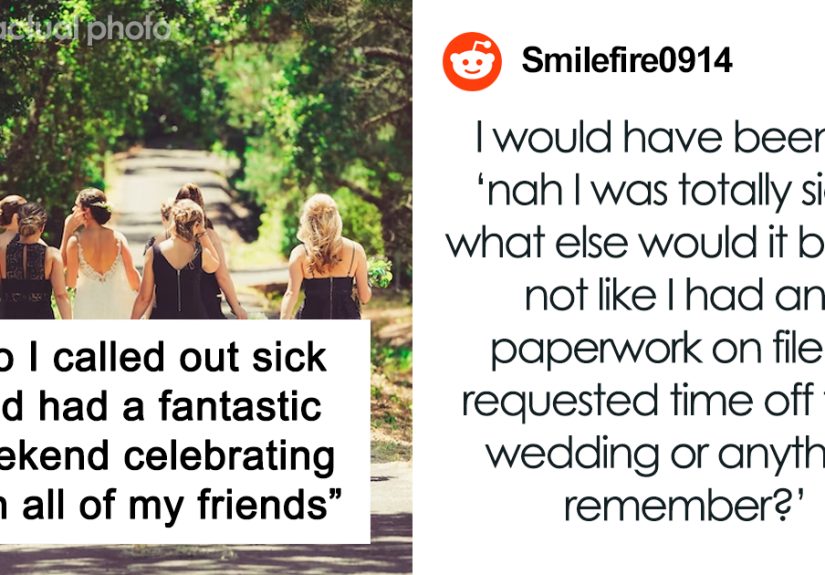
The story behind “Boss Tries To Cancel Employee’s Day Off, So She Calls In Sick For Three, And The Whole Place Falls Apart” hits a nerve because it is not just about one day off. It is about respect, planning, burnout, and what happens when management treats approved leave like a suggestion written in pencil. In the story, an employee had requested time off months in advance for a wedding. The time off was approved. Then, close to the date, her boss tried to take it back. Instead of missing an important personal event because of someone else’s poor staffing plan, she called in sick for three days. The workplace, apparently held together by her labor and a few prayers, fell into chaos.
Funny? Yes. Petty? Maybe. Relatable? Extremely. But underneath the internet drama is a serious workplace lesson: when companies depend too heavily on one person, ignore boundaries, and casually revoke approved time off, they are not showing strength. They are revealing a cracked system with a manager standing on top yelling, “Why is everything shaking?”
Why This Workplace Story Went Viral
Stories like this spread fast because they combine three irresistible ingredients: an unreasonable boss, a fed-up employee, and consequences arriving with the elegance of a piano falling from a cartoon window. People do not just enjoy the drama; they recognize the pattern. Many workers have had a manager approve a vacation day, then suddenly act shocked when the employee actually plans to use it. Others have watched bosses treat personal time as a luxury instead of a necessary part of staying healthy and functional.
The viral appeal also comes from the power reversal. Usually, employees are expected to absorb the damage when managers fail to plan. Someone quits? Cover it. Someone gets sick? Cover it. The schedule is understaffed? Cover it. The moon is in retrograde and the printer is making whale noises? Somehow, cover that too. But in this story, the employee refused to sacrifice a major life event for a workplace that did not respect its own approval process. Suddenly, the employer had to deal with the result of relying too much on one person.
That is the twist people love: the worker did not destroy the workplace. The workplace had already been built badly. Her absence simply turned on the lights.
The Real Issue: Approved Time Off Should Mean Something
When an employee requests a day off months in advance and receives approval, that approval becomes part of their personal planning. They may buy tickets, book hotels, commit to family events, arrange childcare, pay deposits, or agree to be in a wedding party. Canceling that day at the last minute is not a minor inconvenience. It can create financial, emotional, and logistical problems.
From a management perspective, emergencies happen. A business may face unexpected demand, illness, turnover, or scheduling gaps. But good managers do not solve those problems by treating employees’ lives as the company’s emergency reserve fund. Approved leave should be honored except in truly extraordinary circumstances, and even then, managers should communicate respectfully, offer options, and understand that “no” may be a valid answer.
Too often, bad managers confuse authority with control. They think being in charge means they can rewrite expectations whenever work gets uncomfortable. In reality, leadership is about planning ahead, building backup systems, and making sure one employee’s absence does not cause the entire operation to collapse like a folding chair at a family barbecue.
What the Employee’s Sick Call Revealed
The most revealing part of the story is not that the employee called in sick. It is that the workplace reportedly fell apart when she was gone. That suggests a deeper operational problem. A healthy workplace should be able to survive a short absence, especially when time off was requested in advance. If one worker being gone for three days causes chaos, the company does not have a “disloyal employee” problem. It has a staffing, training, documentation, and management problem.
Many businesses quietly depend on a few reliable employees to keep everything running. These are the people who know where the forms are, how to calm angry customers, which drawer contains the emergency supplies, how to fix the software glitch, and which coworker must not be given the aux cord. They are valuable, but they are often taken for granted. Instead of rewarding their reliability, weak managers pile on more responsibility until the person becomes a human load-bearing wall.
Then, when that employee takes a day off, management is stunned. The schedule fails. Customers complain. Coworkers do not know what to do. The manager discovers, in real time, that “she’s just one employee” was a dangerous lie.
Why Canceling PTO Can Damage Trust
Paid time off is not just a perk. It is part of the employment relationship. Workers trade their time, energy, skill, patience, and sometimes their last functioning brain cell for compensation and benefits. When a company offers PTO, employees reasonably expect to use it. If managers approve time off and later revoke it casually, they send a clear message: “Your plans matter only when they are convenient for us.”
That message can damage trust quickly. Employees may become less willing to help during busy periods, less motivated to go the extra mile, and more likely to look for work elsewhere. A manager might “win” one scheduling battle but lose the employee’s loyalty in the process. And loyalty, once turned into resentment, is not easily repaired with a pizza party and a motivational poster about teamwork.
Respecting time off is also part of preventing burnout. Workers need real breaks to recover, handle personal responsibilities, and return with enough energy to do their jobs well. When employees feel guilty for taking leaveor fear their approved time off will disappearthey may delay rest until stress turns into illness, disengagement, or resignation.
Bad Management Often Hides Behind “We’re Short-Staffed”
“We’re short-staffed” may be true, but it should not be used as a magic spell to erase employee boundaries. Chronic understaffing is a management problem. If a workplace is always one absence away from disaster, leadership needs to examine hiring, scheduling, cross-training, compensation, workload, and retention. Blaming the employee who requested time off properly is like blaming the smoke alarm for the fire.
Short staffing becomes especially toxic when it is predictable. If weekends are always busy, holiday seasons always spike, and certain employees are always needed, managers should plan for that reality. A manager who waits until the last minute and then pressures an employee to cancel personal plans is not managing. They are improvising badly and hoping someone else pays the price.
Good staffing plans include backup coverage, written procedures, trained substitutes, and realistic expectations. Great managers also know which employees carry invisible knowledge and make sure that knowledge is shared. No business should rely on one person to be present at all times unless that person is the owner, the security code, and the coffee machine combined.
The Legal Side: Sick Leave and PTO Are Complicated
In the United States, leave laws vary widely depending on location, employer size, job type, and company policy. There is no universal federal law requiring private employers to provide paid sick leave for every worker. However, some states and cities have their own paid sick leave laws, and federal protections may apply in certain medical or family situations. The Family and Medical Leave Act, for example, can provide eligible employees with unpaid, job-protected leave for qualifying reasons.
That means employees should understand their workplace policy, local laws, and documentation rules. Some employers require advance notice for planned PTO. Some require a doctor’s note after a certain number of sick days. Others combine vacation and sick leave into one PTO bank. The details matter.
Still, legality is only one piece of the puzzle. Something can be technically allowed and still be terrible management. Canceling approved leave at the last minute may not always violate the law, but it can violate trust, morale, and common sense. And common sense, while not always listed in the employee handbook, remains highly recommended.
Why Employees Sometimes Choose “Malicious Compliance”
The employee in this story did not physically chain the office doors shut or replace the scheduling software with a potato. She simply used sick time after her boss tried to revoke approved leave. Online readers often label this kind of response “malicious compliance,” though the phrase can mean different things. In workplace stories, it usually describes an employee following the rules in a way that exposes how unreasonable the rulesor the managerreally are.
Malicious compliance often happens when employees feel powerless. They may have tried being reasonable. They may have communicated early. They may have followed every procedure. But when management still behaves unfairly, workers sometimes stop bending over backward. They do only what is required, protect themselves, and let the system experience its own consequences.
That reaction may feel satisfying, but it also signals a damaged workplace culture. Employees who trust their managers usually do not look for loopholes or revenge. They communicate, collaborate, and solve problems. Employees who feel exploited become defensive. They preserve energy. They document everything. They stop volunteering. The workplace may still function, but the spirit has left the building and is probably updating its résumé.
What Good Managers Would Have Done Differently
A good manager would have treated the approved day off as a fixed commitment and planned around it. If a real emergency came up, they would have had a respectful conversation instead of issuing a command. The difference matters. “I know we approved your time off, and I want to honor that. We have a staffing issue, so I’m checking whether there is any flexibilitybut I understand if there isn’t” is very different from “You can’t go anymore.”
Good managers also build redundancy into the team. They cross-train employees so no one person becomes irreplaceable in a dangerous way. They document routine processes. They keep schedules visible. They avoid punishing reliable workers by making them the permanent solution to every emergency.
Most importantly, good managers understand that employees remember how they are treated during moments of conflict. A boss who protects someone’s approved time off earns trust. A boss who tries to take it away teaches the employee a different lesson: protect yourself, because management will not.
What Employees Can Learn From This Story
Employees can take a few practical lessons from this situation. First, always request important time off in writing. Use the official system if your workplace has one. Save approvals, emails, screenshots, or calendar confirmations. Documentation is not paranoia; it is workplace sunscreen. You hope you do not need it, but when things get hot, you will be glad it is there.
Second, be clear when the time off is non-negotiable. You do not need to overexplain every personal detail, but you can say, “I have already made commitments based on the approved leave and will not be available.” This keeps the focus on availability rather than debate.
Third, know your company policy. Understand how PTO, sick leave, call-outs, and documentation work. If your workplace has HR, it may help to ask questions before conflict happens. If the situation involves health, family leave, or retaliation concerns, employees may need to seek guidance from official labor resources or a qualified professional.
Finally, pay attention to patterns. One messy scheduling issue may be a bad week. Repeated disrespect for approved leave is a culture problem. When a workplace consistently treats your time as disposable, it may be telling you exactly how much it values you.
What Employers Should Learn Before the Next Collapse
Employers should see this story as a warning wrapped in comedy. If your business cannot function when one person is absent, the answer is not to trap that person at work forever. The answer is to fix the system.
Start with cross-training. Every key task should have more than one person who can handle it. Next, create clear procedures so employees are not relying on memory, gossip, or “ask Madison, she knows.” Then review staffing levels honestly. If the schedule only works when everyone is available all the time, it does not work.
Employers should also train managers on leave policies and communication. Many workplace conflicts become worse because managers speak carelessly. A respectful conversation can preserve trust even when the answer is complicated. A rude demand can turn a solvable staffing gap into a resignation letter with fireworks.
Finally, employers should encourage real rest. Workers who can take time off without guilt are more likely to return focused, loyal, and productive. A company that brags about “family culture” but panics when employees attend actual family events may need to revisit the brochure.
Why This Story Is Bigger Than One Boss
This story resonates because it reflects a broader shift in how people think about work. Employees are increasingly questioning the idea that being a “good worker” means being endlessly available. They are more willing to set boundaries, protect personal time, and challenge managers who treat sacrifice as an expectation.
At the same time, many managers are under pressure too. They may be dealing with lean staffing, high turnover, demanding customers, and leadership that wants more results with fewer resources. But pressure does not excuse disrespect. In fact, pressure is exactly when leadership skills matter most.
The best workplaces do not depend on guilt. They depend on planning, communication, fairness, and mutual respect. When those ingredients are missing, employees may still show up physically, but emotionally they are already halfway out the door.
Experience-Based Lessons: When a Day Off Becomes a Test of Workplace Culture
Anyone who has worked in a busy restaurant, retail store, clinic, warehouse, office, call center, or small business knows that time-off requests can reveal the true personality of a workplace. Some companies handle them smoothly. The schedule is updated, coverage is arranged, and everyone moves on with the calm confidence of adults who know calendars exist. Other workplaces act as if an employee requesting a day off has personally betrayed the kingdom.
One common experience is the “approved but not really approved” problem. The employee submits the request early, receives verbal approval, and assumes everything is settled. Then, days before the event, a manager says, “I never approved that,” or “I need you after all.” This is why written confirmation matters. A screenshot of an approved request can turn a vague argument into a clear timeline. It may not make a bad boss kinder, but it makes the facts harder to bury.
Another familiar situation is the guilt trip. Instead of saying, “We made a scheduling mistake,” the manager says, “You’re really putting the team in a tough spot.” That sentence is sneaky because it shifts responsibility from management to the employee. But if the employee requested the time properly and received approval, the team was put in a tough spot by poor planning, not by someone attending a wedding, visiting family, or taking a needed break.
Many workers also learn that being dependable can backfire. The employee who always says yes becomes the first person managers pressure when things go wrong. They cover shifts, stay late, train new hires, fix mistakes, and answer texts on days off. At first, they may feel valued. Over time, they may realize they are not being rewarded; they are being used as a backup plan with shoes. The lesson is not to become unreliable. The lesson is to set limits before reliability turns into exploitation.
For managers, the experience-based lesson is simple: do not punish your strongest employees for being strong. If one person knows everything, teach others. If one person always covers emergencies, rotate the burden. If one person’s absence causes panic, thank themand then immediately build a system that does not require them to be available forever.
For employees, the practical lesson is to communicate early, document clearly, and avoid turning every request into a personal confession. A simple statement such as, “I am unavailable on those dates due to a prior commitment, and my time off was approved on this date,” is often stronger than a long explanation. The more you argue about whether your reason is “good enough,” the more room a bad manager has to judge it.
It is also worth remembering that not every conflict needs a dramatic response. Sometimes a calm email to HR, a policy review, or a direct conversation can solve the issue. But when a workplace repeatedly ignores boundaries, employees should take that pattern seriously. A job that cannot respect planned time off may also struggle to respect workload limits, health needs, family responsibilities, and basic dignity.
The funniest part of the viral story is that the boss’s plan failed so spectacularly. The most useful part is what it teaches: employees are not machines, PTO is not decorative, and “we need you” sounds a lot better when it comes with respect. If a business truly depends on someone, it should treat that person like an asset, not an appliance. Because when the appliance walks out for three days, suddenly everyone learns how dark the kitchen can get.
Conclusion
The story of a boss trying to cancel an employee’s approved day off is entertaining because it delivers instant workplace karma. But it is also a reminder that time off is not a tiny favor from management. It is part of a healthy employment relationship. When companies approve leave, they should honor it. When managers face staffing problems, they should solve them through planning, not pressure. And when a workplace collapses because one person is gone, the real question is not “How could she do this?” It is “Why was the whole place built on one employee in the first place?”
Respecting time off does more than prevent viral embarrassment. It builds trust, reduces burnout, strengthens retention, and creates a workplace where employees do not have to choose between their lives and their jobs. In other words, it keeps the place running even when someone takes the day offwhich, for the record, is how functioning workplaces are supposed to work.