Table of Contents >> Show >> Hide
- Why the ESP-01 Becomes a Breadboard Headache So Fast
- What a Good ESP-01 Adapter Actually Fixes
- What Features Should You Look For?
- Build One or Buy One?
- Real-World Uses Where an Adapter Makes the ESP-01 Feel Worth It Again
- Common Mistakes Even an Adapter Will Not Save You From
- Is the ESP-01 Still Worth Using Today?
- Final Thoughts
- Bench Notes: Real Experience With an ESP-01 Adapter
- SEO Tags
If you have ever tried to drop an ESP-01 onto a breadboard like it was just another friendly little module, you already know the punchline: it does not fit the way your optimism thinks it should. The ESP-01 is tiny, capable, cheap, and weirdly talented for its size, which is exactly why makers still love it. It is also the sort of hardware that can make a perfectly pleasant afternoon of prototyping feel like a negotiation with a gremlin.
That is where a good ESP-01 adapter earns its keep. Not because it looks fancy. Not because it gives your project a “pro” vibe. And definitely not because it makes you feel emotionally supported, although some days that would be nice too. A proper adapter solves three very real problems at once: the ESP-01’s awkward breadboard geometry, its picky 3.3V power needs, and its boot/programming behavior that punishes sloppy wiring with eerie silence and mysterious failures.
In other words, the adapter is not just a convenience accessory. It is the peace treaty between your breadboard and your Wi-Fi module.
Why the ESP-01 Becomes a Breadboard Headache So Fast
The form factor is small, but the trouble is full size
The ESP-01 uses an 8-pin, 2-by-4 header layout that was never designed to be naturally comfortable on a standard solderless breadboard. Sure, you can force it into a prototype setup with jumper wires, bent headers, or improvised pin gymnastics. But once you do, the neat little circuit in your head turns into a spider web of wires that looks less like embedded development and more like a hardware crime scene.
The biggest mechanical problem is access. Even when you manage to mount the module, you often lose the working room around it. Pins get crowded. The breadboard center gap stops being helpful. Every jumper wire you add feels like it is one accidental sleeve swipe away from launching your project into another troubleshooting session. An adapter fixes that by breaking the ESP-01 out into a breadboard-friendly footprint that actually respects the spacing of a normal prototyping board.
The power requirements are not “close enough” friendly
The ESP-01 runs on 3.3V, not 5V, and that distinction is not one of those fun engineering details you can ignore until later. This module is happiest with a clean, stable 3.3V supply and enough current headroom to survive Wi-Fi activity without browning out. That matters because many beginners assume a random USB-to-serial board or weak breadboard supply will be good enough for everything. Sometimes it is good enough for a few seconds. Sometimes it is good enough to fool you. And sometimes it is good enough to make you question your life choices.
A solid adapter board often includes a regulator, decoupling capacitors, and a more robust way to feed power into the ESP-01. That means fewer mystery resets, fewer failed uploads, and far less dramatic blinking from the module’s LEDs. In hardware, stability is romance.
The boot pins have opinions, and they are not shy
The ESP-01 is also famous for its startup behavior. To boot normally, certain pins must be in the right state when the module resets. To enter programming mode, GPIO0 has to be pulled low during reset. If that sounds manageable, it is. If that sounds easy to do with a loose nest of dupont wires on a crowded breadboard, that is where reality starts laughing.
This is why many adapter designs include clearly labeled pull-ups, a reset button, a flash button, or even automatic boot circuitry. Suddenly, what used to require a tiny ritual of wire moving and button pressing becomes predictable. And in electronics, predictable is beautiful.
What a Good ESP-01 Adapter Actually Fixes
1. It makes the module physically breadboard-friendly
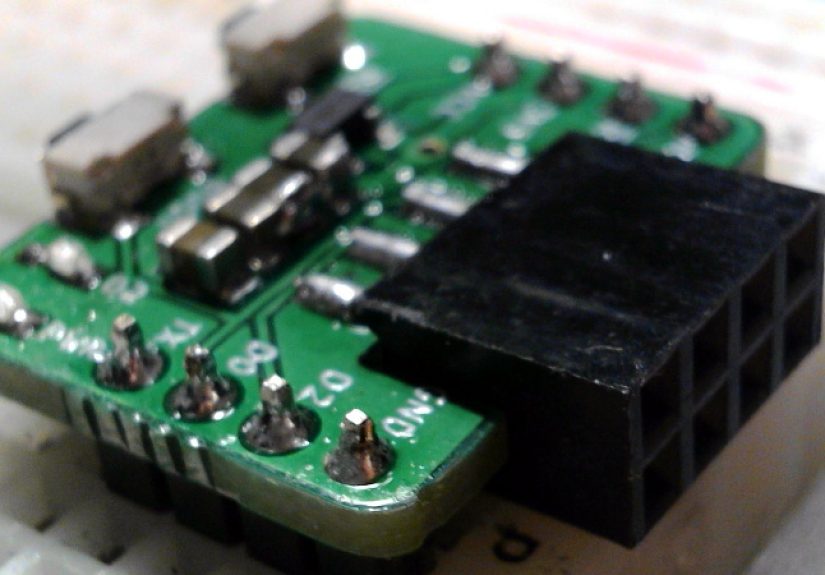
The first job of the adapter is simple: turn the ESP-01 into something that can sit on a breadboard without hogging all the useful space or requiring a tiny copper yoga routine. The best adapters widen the pin spacing so the module can straddle the breadboard’s center channel, leaving you room on both sides for power rails, signal lines, resistors, and the other pieces your project actually needs.
This sounds basic because it is basic, but basic matters. A module that sits cleanly on the board is easier to wire, easier to inspect, and much easier to debug. Bad geometry creates bad habits. Good geometry saves weekends.
2. It handles the 3.3V drama like an adult
A worthwhile adapter should either accept a known-safe 3.3V supply or include onboard regulation from a 5V input. This is especially handy if the rest of your bench setup is built around USB power. Better still, the smarter adapter boards include the capacitors and routing discipline needed to keep the ESP-01 from throwing a miniature tantrum every time the Wi-Fi radio wakes up.
That does not mean every adapter is magical. Some ultra-cheap boards still cut corners. But in general, once the regulator and filtering are on the adapter instead of being scattered across your breadboard, your setup becomes more repeatable. And “repeatable” is a word that makes experienced builders smile like they just found a labeled container of the right screws.
3. It makes programming less annoying
Some ESP-01 adapters are nothing more than breakouts. Others go further and include a USB-to-UART chip such as a CH340G, plus buttons or switches for flash mode. Those boards can be genuinely useful because they reduce setup time and reduce wiring mistakes. You insert the module, connect USB, select the correct mode, and start working instead of rebuilding your wiring every time you want to upload firmware.
If you are flashing often, this kind of adapter feels less like a luxury and more like a sanity-preservation plan. The more you prototype, the more you appreciate hardware that does not ask you to prove your devotion before every upload.
4. It labels the pins so future-you can stop guessing
One of the sneaky benefits of a decent adapter is silkscreen. Clear labels for VCC, GND, TX, RX, GPIO0, GPIO2, EN/CH_PD, and RST sound boring until you are tracing a problem at midnight and trying to remember whether the wire you moved five minutes ago was strategic or chaotic. Good labeling reduces errors and shortens the “what on earth did I do?” phase of debugging.
What Features Should You Look For?
If you are shopping for or designing an adapter, here is what separates a merely functional board from one that actually improves your life:
- Breadboard-friendly spacing: It should straddle the center gap cleanly and leave room for surrounding connections.
- Reliable 3.3V regulation: Prefer boards that handle power properly instead of assuming your serial adapter can do all the heavy lifting.
- Decoupling capacitors near the module: This helps tame Wi-Fi current bursts and random instability.
- Flash and reset controls: Buttons, jumpers, or switches make reprogramming much easier.
- USB-to-UART support: CH340G, CP2102, or FTDI-style support can turn the adapter into a one-cable workflow.
- Readable pin labels: Your future troubleshooting self would like a word.
- Antenna clearance: Avoid adapter layouts that bury the antenna near metal, dense wiring, or large ground-heavy structures.
In short, the best ESP-01 adapter is the one that removes friction without creating new surprises.
Build One or Buy One?
Both options make sense.
Buy one if you want to get moving quickly. Commercial adapters are cheap, common, and often good enough for everyday prototyping. Many include voltage regulation and USB programming support, which is great if your goal is to build projects rather than turn your workbench into a side quest about board layout.
Build one if you enjoy custom hardware or need features the cheap boards do not provide. A homebrew adapter can be tailored to your exact workflow. You can choose the regulator, add larger capacitors, include headers where you want them, and route the board so the ESP-01 sits exactly how you prefer. You can also add your own LEDs, buttons, or screw terminals. In other words, you can build the adapter your past self kept wishing somebody sold.
For many hobbyists, the sweet spot is using a bought adapter first, then designing a better one once they know what annoys them most.
Real-World Uses Where an Adapter Makes the ESP-01 Feel Worth It Again
Quick sensor prototypes
The ESP-01 is still a nice option for lightweight Wi-Fi sensor experiments where you do not need a forest of GPIO pins. Add a temperature sensor, a reed switch, or a simple status LED, and it can still punch above its weight. The adapter makes that sort of rapid test setup much less painful.
Serial-to-Wi-Fi bridges
If your project is mostly about getting serial data onto a network, the ESP-01 remains surprisingly useful. With the right firmware, it can bridge older microcontrollers into Wi-Fi territory without requiring a more expensive board. The adapter simplifies development and lets you swap modules quickly if one goes sideways.
Tiny embedded enclosures
Once development is done, you may not even keep the full adapter in the final design. But during prototyping, the adapter helps you get the firmware stable and the wiring sorted out. That means when it is time to shrink things down, you are starting from a working system instead of a collection of suspicious assumptions.
Common Mistakes Even an Adapter Will Not Save You From
Adapters are helpful, not supernatural. You can still ruin your afternoon in several classic ways.
- Feeding 5V directly into the wrong pin: The adapter may regulate power on one input, but that does not mean every pin is suddenly 5V-safe.
- Ignoring boot pin states: An adapter can make boot mode easier, but if your external circuit drags a critical pin the wrong way at startup, you may still get failures.
- Assuming every USB board is identical: Some are solid. Some are merely enthusiastic. Check how the board handles flash mode and voltage levels.
- Crowding the antenna area: If you wrap the module in wiring, metal, or a cramped enclosure, Wi-Fi performance may suffer.
- Buying the cheapest board and expecting premium behavior: Bargains are wonderful until they turn into detective work.
Is the ESP-01 Still Worth Using Today?
Yes, with a footnote.
If you need a lot of GPIO, native USB, or a friendlier out-of-the-box experience, there are more convenient ESP8266 and ESP32 boards available. But the ESP-01 still earns its place in small, low-cost, focused Wi-Fi builds. It is compact. It is proven. It is widely supported. And with the right adapter, it stops behaving like an awkward relic and starts feeling like a practical little networked module again.
That is the whole point of the adapter, really. It does not turn the ESP-01 into something else. It turns the ESP-01 into the version of itself you were hoping for all along.
Final Thoughts
The phrase “ESP-01 breadboard woes” exists for a reason. The module is capable, but its raw form asks too much from casual prototyping. A good adapter solves the physical mismatch, cleans up the power situation, and makes programming less fiddly. That translates to faster testing, cleaner builds, and far fewer moments where you stare at a blinking blue LED like it just insulted your soldering.
If you love the ESP-01’s size and price but hate the ritual required to use it, the adapter is not optional fluff. It is the missing layer that makes the module practical on a real bench. In the glorious battle between tiny Wi-Fi chip and ordinary breadboard, the adapter is the referee, the translator, and occasionally the therapist.
Bench Notes: Real Experience With an ESP-01 Adapter
The first time I worked with an ESP-01 on a breadboard, I made the classic beginner mistake: I assumed “small module” meant “simple module.” What I actually had was a tiny Wi-Fi board with strong opinions, a suspicious relationship with power rails, and a talent for turning one innocent upload attempt into forty-five minutes of muttering. I had jumper wires everywhere, the USB-to-serial board hanging off the side like it had lost the will to live, and a breadboard layout that looked less engineered than negotiated.
At first, the symptoms were wonderfully misleading. Sometimes the red power LED would come on and everything looked normal. Sometimes the blue LED flickered just enough to convince me the module was alive, but the upload failed. Other times it would flash once, then do nothing useful at all. That is the cruel genius of a badly set up ESP-01: it often fails in ways that feel almost successful. You do not get a dramatic pop or smoke cloud. You get hope. Incorrect hope.
Adding an adapter changed the whole experience more than I expected. The first improvement was mechanical. Suddenly the module sat on the breadboard like it belonged there. I was not trying to reach between wires with tweezers, and I was no longer one coffee tremor away from knocking loose the reset line. That alone made debugging easier because I could actually see the circuit. Hidden wiring mistakes love messy layouts; adapters take away their hiding places.
The second improvement was power stability. Once I moved to an adapter with proper 3.3V regulation and decent filtering, the random resets dropped off dramatically. That was the moment the ESP-01 stopped feeling haunted. I had been blaming firmware, baud rates, drivers, and the alignment of the stars when the real culprit was a supply setup that looked okay but was not robust enough when Wi-Fi activity kicked in. A stable adapter turned a moody little board into something I could test repeatedly without bargaining with it.
The third improvement was workflow. I cannot overstate how much nicer it is to have a flash button, a reset button, or a programming switch built into the setup. Before that, I was manually repositioning wires to force bootloader mode and then switching them back to run the program. It worked in the same sense that camping in the rain technically counts as lodging. Once the adapter handled that boot logic more cleanly, uploads became routine instead of ceremonial.
What really sold me, though, was confidence. With the adapter in place, I could swap sensors, change firmware, test serial output, and reboot the board without wondering whether the hardware itself was lying to me. The ESP-01 did not become a different module, but it became much easier to trust. And trust is everything in prototyping. If you cannot trust the platform, every bug looks like a hardware problem and every hardware problem looks like black magic.
So yes, my experience with an ESP-01 adapter was deeply practical, mildly humbling, and weirdly emotional. It turns out that what I wanted was not a more powerful board. I just wanted the original one to stop acting like a raccoon in a toolbox. The adapter did exactly that.