Table of Contents >> Show >> Hide
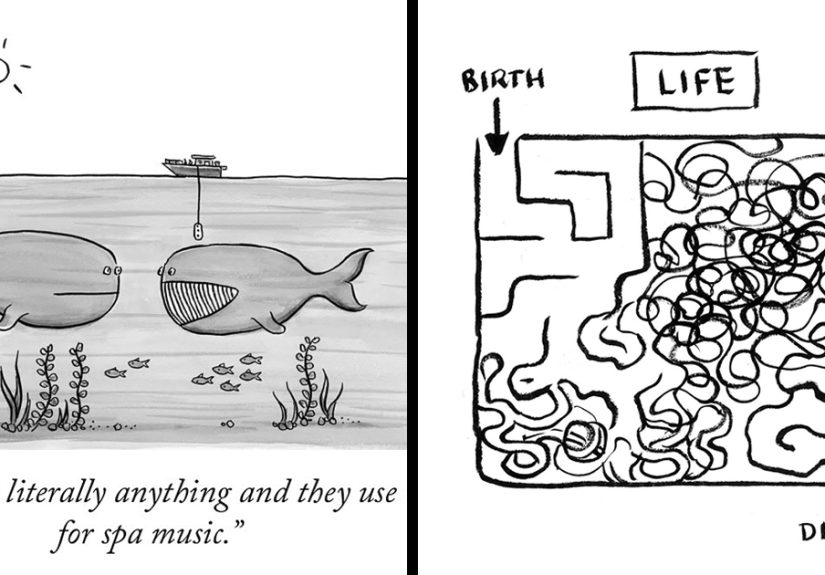
Some comics ask for a chuckle. Sarah Morrissette’s comics ask for a chuckle, a wince, and the uncomfortable realization that the joke is definitely about us. That is a neat little trick, and it is exactly why her work lands. In the collection often described as 30 Clever Comics That Poke Fun At Our Society, Morrissette uses the classic single-panel format to do what the best social satire always does: make modern life look both absurd and painfully familiar.
Morrissette’s cartoons do not need a sprawling plot, a cinematic reveal, or a cast of twenty-five people yelling in matching speech bubbles. She works in the compact, ruthless world of the gag cartoon, where one image, one line, and one perfectly timed idea can expose an entire social habit. That economy matters. When a joke is compressed to its cleanest form, there is nowhere for weak thinking to hide. Either the insight hits, or it does not. In Morrissette’s case, it usually hits like a coffee-fueled truth bomb in sensible shoes.
What makes these comics especially fun is that they are not merely random silly scenes. They are social X-rays. They poke at the way we work, shop, panic, age, parent, self-optimize, overshare, doomscroll, and pretend we are totally fine while holding together our lives with caffeine, digital calendars, and denial. Her humor is sharp, but it is not joyless. That balance is important. Satire without warmth can feel smug. Warmth without bite can feel toothless. Morrissette tends to split the difference beautifully.
Why Sarah Morrissette’s Cartoon Voice Feels So Fresh
Part of the appeal comes from the artist herself. Morrissette has spoken about growing up partly off the grid and turning to drawing early because it was one of the cheapest, most available forms of entertainment. That background matters because her comics still feel handmade in the best possible way. Even when the subject is modern nonsense like technology dependence or productivity obsession, the point of view behind the joke feels observant rather than algorithmic. She looks at people the way a good satirist should: with curiosity first, judgment second, and comic timing always.
She has also described her creative process in a way that explains why the work feels so immediate. Rather than chasing “big ideas” in an abstract sense, she pulls material from conversations, passing observations, strange details, and those little sparks that appear while walking or biking. That method shows up on the page. Her cartoons often feel like they were born from a tiny everyday absurdity that suddenly widened into a comment on the whole culture. One second you are looking at a silly image, and the next second you are thinking, “Oh no, that is my office, my family group chat, my phone addiction, my entire generation.”
That is the secret sauce of good single-panel social humor. It does not need a lecture. It only needs one accurate exaggeration. American cartoon traditions from magazine gag cartoons to editorial satire have long relied on this principle, and Morrissette fits comfortably into that lineage while sounding entirely like herself. Her work has a crisp modern sensibility, but it also respects the old-school discipline of the form: get in, land the idea, leave the reader laughing a little too hard.
What These 30 Comics Are Really Mocking
Although the title promises thirty clever comics, what the collection really offers is thirty different angles on the same larger target: contemporary society’s endless ability to make ordinary life ridiculous. Morrissette’s cartoons tend to orbit several recurring themes, and that is where their social bite becomes most visible.
Productivity Culture and the Religion of Being Busy
One of the easiest targets in modern life is our bizarre devotion to optimization. We track our sleep, our steps, our calories, our moods, our focus blocks, and probably our blinking if an app developer can figure out how to monetize it. Morrissette’s humor thrives in this territory because the culture has already done half the work for her. The language of modern productivity is so inflated, so self-serious, and so wildly detached from human reality that all a cartoonist has to do is tilt it five degrees further to reveal the madness.
That is why cartoons touching on work, routine, and self-improvement hit such a nerve. Titles from her broader cartoon catalog, like Work Sweet Work or pieces riffing on step-counting and modern efficiency, suggest a world where people have been trained to treat exhaustion as a personality trait. Her satire reminds us that somewhere along the way, “doing your best” became “treating every moment like a quarterly report.” Very inspiring. Very bleak. Very funny.
Technology as Both Savior and Menace
Another favorite Morrissette playground is the digital mess we have built around ourselves. Not technology in the grand, science-fiction sense, but technology in its most embarrassing daily forms: family tech support, smart assistants, pointless devices, digital clutter, and the creeping sense that our machines now require more emotional labor than some relatives.
Look at titles such as Tech Support Grandson, Useless Appliances, or Siri Meets Alexa, and you can already hear the comic engine revving. The joke is rarely just “phones are silly.” It is that people have accepted layers of inconvenience, surveillance, confusion, and dependency as though that were a perfectly reasonable price for asking a speaker to set a timer. Morrissette gets mileage from that contradiction. We keep buying convenience, and somehow life gets more complicated. Congratulations to us all.
Consumerism and the Great Marketplace of Nonsense
Modern society is also a machine for inventing needs no one had ten minutes earlier. This is prime cartoon territory. Morrissette often seems drawn to the absurd rituals of buying, branding, wellness, and lifestyle aspiration. In her world, products are never just products. They are emotional promises wrapped in nice typography and sold with the confidence of a motivational speaker who owns a ring light.
That is why titles like Anti Aging Cream at Funeral or Hospital Gown Designer feel so rich with possibility. They expose a culture that tries to market dignity, youth, control, and comfort back to people who were doing just fine before the sales pitch. Her cartoons laugh at the way consumer culture inserts itself into every vulnerable corner of life. Nothing is too sacred to be branded. Not aging. Not illness. Not insecurity. Not even the basic human wish to sit down without being sold a lifestyle.
The Workplace as an Ongoing Social Experiment
Office culture has become one of the great comedy gold mines of the century because it combines bureaucracy, fake friendliness, dead language, invisible anxiety, and fluorescent lighting. It is basically a cartoon already. Morrissette understands that the modern workplace is not funny because people are lazy or evil. It is funny because so many systems designed to look rational are actually theater. Workers perform enthusiasm. Managers perform clarity. Corporate messaging performs humanity. Meanwhile, everyone is one calendar invite away from becoming a houseplant.
In comics that touch on jobs, meetings, ambition, or routine, the humor works because it reflects something millions of people know but rarely say out loud: a lot of professional life is organized nonsense delivered in polished vocabulary. When satire catches that, readers laugh with the slightly haunted energy of people who have definitely sat through that meeting.
Aging, Mortality, and the Panic of Staying Relevant
Morrissette’s cartoons also have a knack for poking at one of society’s oldest anxieties: time. People want to age gracefully, but they also want to defeat aging, disguise aging, optimize aging, and post about aging in flattering lighting. It is exhausting just typing it.
Her humor around funerals, worry, health, and vanity does not reduce mortality to a cheap gag. Instead, it highlights the ridiculous social packaging around it. We are terrified of decline, so we hide that fear in products, euphemisms, routines, and cheerful little lies. The joke, then, is not death itself. The joke is everything society builds to pretend death, weakness, and vulnerability are optional upgrades we forgot to click.
Family, Relationships, and Everyday Emotional Theater
Many of these comics also work because they understand the family as a perfectly normal institution made entirely of strange people. Parents, children, spouses, relatives, and household roles all make appearances in the larger Morrissette universe. The comedy comes from recognizable power dynamics: the person who always fixes the devices, the person who refuses to read instructions, the person who is trying to stay calm while clearly not calm, the person who thinks one passive-aggressive sentence counts as communication.
That is where her satire softens into something almost affectionate. She pokes fun at people, but she does not write them off. The result is humor that feels more observant than cruel. Even when the cartoon exposes selfishness, vanity, laziness, or fear, it does so with the understanding that these flaws are not exotic. They are the furniture of ordinary life.
Why This Collection Works in 2026
A collection like this feels especially timely because society keeps getting more efficient at producing absurdity. We live in an era that packages anxiety as lifestyle, turns identity into branding, treats burnout as hustle, and confuses constant connectivity with meaningful connection. That is a buffet for any cartoonist with decent instincts and a functioning eyebrow.
What makes Morrissette stand out is that she does not overcomplicate the critique. She trusts the old cartoon principle that one strong image can do more than a thousand online arguments. A single panel can capture the vanity of modern wellness culture, the emptiness of corporate slogans, or the surreal dependency between humans and their gadgets with more elegance than a ten-part think piece. Not to insult think pieces. Some of them are lovely. But a great cartoon can sometimes sneak past your defenses faster than prose can.
There is also something refreshing about satire that is not trying to sound like a sermon. Morrissette’s comics are clever, but they are not desperate to prove their cleverness. They are content to let the reader do the final bit of mental work. That makes the humor feel collaborative. The cartoon offers the setup, and the audience completes the indictment.
The Human Experience Behind This Kind of Social Satire
What gives a collection like 30 Clever Comics That Poke Fun At Our Society its staying power is not just the craft of the jokes. It is the emotional experience of recognition. Readers do not laugh only because the panels are witty. They laugh because the panels recreate the strange texture of modern living in a way that feels eerily accurate. The experience of reading this kind of satire is often a chain reaction. First comes amusement. Then recognition. Then the tiny sting of self-awareness. Then, if the cartoon is especially sharp, a weird sense of relief that somebody else noticed the same nonsense.
Think about how many parts of daily life now feel both normal and faintly ridiculous. People apologize to chatbots. They ignore beautiful weather to check notifications. They spend money on gadgets designed to solve problems created by other gadgets. They sit through meetings about culture while silently updating résumés. They buy storage systems for things they do not need, productivity tools for schedules that are already impossible, and wellness products that mostly increase the stress they promise to cure. Satire works here because reality is already overachieving.
Morrissette’s kind of social humor also captures a less obvious experience: the feeling of performing competence in a world that never stops moving the goalposts. Everyone is expected to look informed, efficient, emotionally balanced, digitally fluent, physically healthy, and professionally upbeat, preferably before lunch. That pressure creates a lot of private absurdity. People improvise their way through it with forced confidence, fake jargon, and whatever expression says, “Yes, of course I understand this app update,” while the soul quietly exits through a side door.
There is another layer, too. These comics reflect the experience of living among contradictions. Society tells people to unplug, but only after they answer messages. It tells them to age naturally, but not visibly. It tells them to be authentic, but marketable. To rest, but optimize. To connect, but curate. To care, but not care too much. That contradiction-filled atmosphere is exactly why single-panel satire still matters. A good cartoon can hold two opposing truths at once: that modern life is often ridiculous, and that most people are doing their best inside it.
That is why readers often come away from comics like these feeling lighter rather than merely mocked. The laughter provides a tiny release valve. It says, in effect, “Yes, this is ridiculous. No, you are not the only one who noticed.” In a culture overloaded with commentary, outrage, and relentless seriousness, that is no small gift. Sometimes the most useful social analysis is not a manifesto. Sometimes it is one weird drawing, one precise caption, and one moment of laughter that clears the air.
Final Thoughts
Sarah Morrissette’s thirty clever comics succeed because they understand an essential truth about satire: people rarely need help identifying chaos, but they do appreciate seeing it arranged neatly inside a joke. Her panels take the clutter of modern life and distill it into memorable, funny, slightly alarming snapshots. They poke at work culture, tech dependence, consumerism, family dynamics, aging panic, and all the little rituals society invents to keep people busy, anxious, and oddly proud of both.
Most importantly, these comics do not just mock society from a distance. They place readers right inside the mess. That is what makes them sting a little, and that is exactly what makes them good. Morrissette is not drawing aliens. She is drawing us, with our notifications, our vanity, our coping mechanisms, our impossible calendars, and our heroic ability to act normal while everything gets increasingly absurd. Which, honestly, may be the funniest joke of all.