Table of Contents >> Show >> Hide
- Why Brown Widow Identification Can Be Tricky
- 1. Check the Egg Sac First
- 2. Look Under the Abdomen for the Hourglass
- 3. Study the Body Pattern, Legs, Web, and Hiding Spot
- Common Mistakes People Make
- What to Do If You Find a Brown Widow
- Final Takeaway
- Real-World Experiences: What Spotting a Brown Widow Usually Feels Like
- SEO Tags
Spotting a spider under a patio chair can trigger one of two reactions: calm curiosity or a full-body interpretive dance. If the spider in question might be a brown widow, a little knowledge goes a long way. The brown widow spider is often mistaken for a black widow, a harmless house spider, or that one mystery bug everyone swears is “definitely dangerous.” In reality, brown widows can be identified with a few clear clues if you know where to look.
That matters because brown widows do live around homes, garages, porches, planters, and outdoor furniture. They are not aggressive, and they usually bite only when trapped against skin, but they are still widow spiders. In other words, this is not the moment for blind confidence and bare hands. The good news is that you do not need to become an arachnologist overnight. You just need three reliable ways to identify a brown widow spider: check the egg sac, look at the underside marking, and study the spider’s body pattern and favorite hangouts.
Note: This article is for identification and general safety education, not medical diagnosis. If a suspected widow spider bite causes severe pain, muscle cramps, trouble breathing, vomiting, or sweating, seek medical care right away.
Why Brown Widow Identification Can Be Tricky
Brown widows are sneaky from an identification standpoint. Unlike the classic black widow image most people carry around in their heads, brown widows are not always dramatic and glossy black. Their color can range from light tan to medium brown to darker brownish-gray. Many have mottled markings, bands on the legs, and decorative-looking patterns on the top of the abdomen. In short, they do not scream “widow” the way a textbook black widow does.
That is why people often misidentify them. A brown widow can resemble an immature black widow, and at a quick glance it may look like just another cobweb spider living rent-free under your eaves. But if you slow down and use the three methods below, the picture gets much clearer.
1. Check the Egg Sac First
If you remember only one thing from this article, make it this: the egg sac is often the easiest way to identify a brown widow spider. It is the giveaway feature that makes spider experts nod wisely instead of squinting into the void.
What a Brown Widow Egg Sac Looks Like
Brown widow egg sacs are round and pale, usually cream, tan, or light brown, but the key detail is the surface. Instead of being smooth, the sac is covered with little pointed silk projections. It looks spiky, tufted, or slightly like a tiny sea mine. Some people compare it to a burr, a sandspur, or a puffball that had a stressful day.
That texture matters because black widow egg sacs are usually smooth. If you find a widow-like spider near an egg sac with obvious spikes, knobs, or little silk points sticking out, your odds of having a brown widow go way up.
Where You Might See the Egg Sac
Brown widows often place egg sacs in their messy, irregular webs in protected spots around homes. Common places include:
- under patio or porch furniture
- inside or under empty flowerpots
- beneath eaves and railings
- inside mailboxes or storage areas
- around garbage cans and plastic handles
- in garages, sheds, and cluttered corners
If you find one of these spiky sacs attached to a tangled web in a sheltered outdoor area, do not poke it, squeeze it, or audition for a nature documentary with your fingers. Take a clear photo from a safe distance instead.
Why This Clue Is So Useful
Adult brown widows vary in color, and immature widow spiders can confuse almost anyone. The egg sac is far more consistent. It is the brown widow’s calling card. If the spider is hiding but the egg sac is in plain view, the egg sac may identify the resident better than the spider itself.
2. Look Under the Abdomen for the Hourglass
The second major clue is on the underside of the female spider’s abdomen. Yes, this sounds inconvenient, because spiders rarely volunteer for belly inspections. But when they hang upside down in a web, the ventral marking may be surprisingly visible.
The Brown Widow’s Hourglass Is Usually Orange or Yellow-Orange
Female brown widows have an hourglass marking on the underside of the abdomen, but unlike the classic adult black widow, the color is usually orange, yellow-orange, or orangish-yellow rather than bright red. That color difference is one of the most useful ways to separate a brown widow from an adult female black widow.
This is where many people get tripped up. They hear “widow spider” and expect a shiny black body with a vivid red hourglass. Brown widows do not follow that dress code. Their underside marking still says “widow,” but in softer, more pumpkin-spice-adjacent tones.
What If the Marking Is Hard to See?
Do not flip objects recklessly or disturb a spider just to confirm the underside. If the spider is in a web and you can see the belly naturally, great. If not, rely on the other clues. Good identification is about building a case from several features, not forcing one dramatic reveal.
Brown Widow vs. Black Widow
Here is the simplest comparison:
- Brown widow: usually mottled brown, tan, or gray; orange to yellow-orange hourglass; banded legs; spiky egg sac.
- Adult black widow: shiny black body; bright red hourglass; smoother overall look; smooth egg sac.
One caution, though: immature black widows can be brownish or patterned, which is why people confuse them with brown widows. That is another reason the egg sac and overall body pattern matter so much.
3. Study the Body Pattern, Legs, Web, and Hiding Spot
The third way to identify a brown widow is less about one perfect feature and more about reading the whole scene. Think of it as spider detective work, but with less jazz music and more patio furniture.
Body Color and Pattern
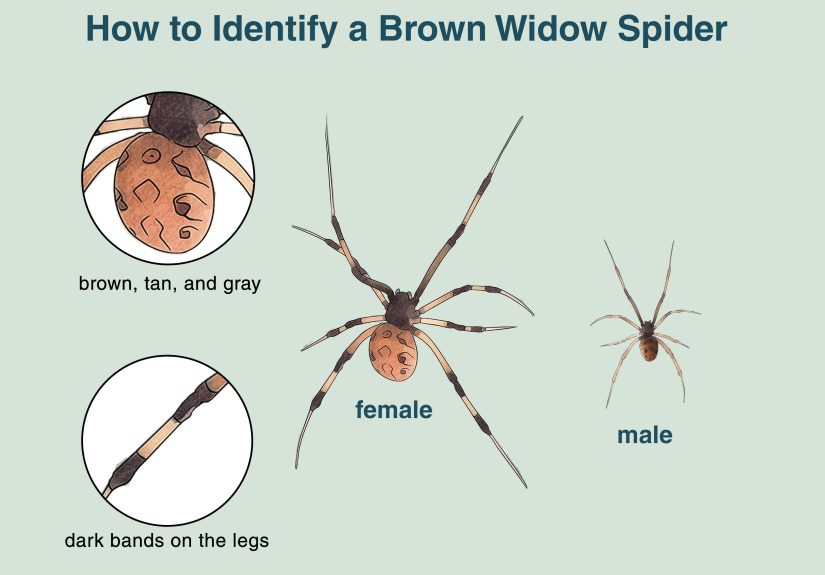
Brown widows usually have a mottled, patterned appearance rather than a uniform dark body. The top of the abdomen may show a mix of tan, brown, gray, black, and sometimes pale or orange-toned markings. Some have a stripe or geometric-looking pattern on the back, which fits the species name Latrodectus geometricus.
The legs are often banded, with darker sections alternating with lighter brown or tan coloring. This gives the spider a more patterned, less polished appearance than a classic adult black widow.
Mature females are the most noticeable and the most relevant for identification around homes. Males are much smaller and less often recognized.
The Web Is Messy, Not Neat
Brown widows build irregular, tangled cobwebs rather than the neat circular orb webs people often associate with “garden spiders.” If you see a spider sitting in a chaotic, sticky-looking tangle in a protected corner, you are in widow territory more than orb-weaver territory.
These webs are usually built in sheltered places rather than out in the open. Brown widows like structure, shade, and a bit of privacy. If a spider seems to have chosen a location that says, “Please do not disturb my suburban fortress,” it fits the pattern.
Favorite Hiding Spots Around Homes
Brown widows are commonly found in human-made spaces. They like dry, protected spots near buildings and yard items. Places that often host them include:
- undersides of outdoor chairs and tables
- empty nursery pots and buckets
- mailboxes and entry corners
- garbage can handles and recessed grips
- stacked equipment, sheds, and garages
- behind shutters, along fences, and beneath railings
If you see a mottled widow-like spider with banded legs in one of these protected spots, especially near a spiky egg sac, the identification is getting very strong.
Common Mistakes People Make
Mistaking a Brown Widow for a Brown Recluse
This happens all the time, mostly because “brown spider” is not exactly a narrow category. But a brown widow is not a brown recluse. Brown recluses have a very different look: a violin-shaped marking on the cephalothorax, a more uniform brown body, and no widow-style hourglass. They also do not make the same kind of tangled widow web, and they do not produce the signature spiky egg sac of a brown widow.
Mistaking It for an Immature Black Widow
This is a more understandable mix-up. Young black widows can be tan, gray, or patterned before becoming the glossy black adults many people recognize. When in doubt, the spiky egg sac strongly favors brown widow. The orange-yellow underside marking and banded legs also point in that direction.
Assuming Every Spider Near the House Is Dangerous
Most spiders around homes are harmless and helpful predators. A web alone does not mean you have a medically important spider. The point is not to panic at every eight-legged neighbor. The point is to notice the specific widow clues before making assumptions.
What to Do If You Find a Brown Widow
First, do not handle it. Brown widows are generally shy and prefer retreat over confrontation, but they can bite if trapped against skin. Wear gloves if you are moving stored items, garden pots, firewood, or outdoor furniture in areas where widow spiders may hide.
If you need to remove a spider or egg sac, the safest first step is often physical removal with care. Many extension sources recommend vacuuming spiders, webs, and egg sacs from porches, garages, and other structures, then sealing and disposing of the vacuum contents promptly. Reducing clutter and sheltered hiding spots also helps prevent repeat visitors.
For bites, wash the area with soap and water, use a cold pack, and monitor symptoms. Seek medical attention right away if there is severe or worsening pain, muscle cramping, sweating, trouble breathing, nausea, or symptoms spreading beyond the bite area. Widow bites can produce systemic symptoms, and it is better to be cautious than heroic.
Final Takeaway
If you want to identify a brown widow spider without turning your backyard into a crime lab, focus on these three signs:
- Look for the spiky egg sac. This is often the clearest clue.
- Check for an orange or yellow-orange hourglass on the underside.
- Notice the mottled body, banded legs, messy web, and protected hiding spots around structures.
Put those clues together and brown widow identification becomes much easier. You do not need perfect eyesight, nerves of steel, or a spider-themed superhero origin story. You just need to know what features actually matter.
Real-World Experiences: What Spotting a Brown Widow Usually Feels Like
Most people do not identify a brown widow in a dramatic wilderness moment. It usually starts with something gloriously ordinary. You pick up a flowerpot. You reach under a patio chair. You grab a garbage can by the handle. Then you notice a messy little web in a tucked-away corner and a spider that looks just unusual enough to make you pause. That pause is the whole game. People who correctly identify brown widows often do not have expert knowledge at first; they simply stop long enough to notice details.
A common experience is seeing the egg sac before the spider. Homeowners describe finding what looks like a tiny beige burr hanging in a web under outdoor furniture or inside an empty planter. At first glance, it does not even look like part of a spider setup. Then they see the second sac, and maybe the third, and suddenly the area feels less like a porch and more like a very small gated community. Once someone learns that brown widow egg sacs are spiky, they tend to remember it forever. It is one of those identification lessons that sticks because the feature is so oddly specific.
Another familiar experience is confusion with black widows. People expect danger to come dressed in shiny black with a bright red warning label. So when they see a tan or mottled spider with banded legs, they often dismiss it as harmless. Then they spot the orange underside marking or compare photos later and realize they were looking at a brown widow all along. That delayed recognition is extremely common. Brown widows do not fit the cartoon version of a widow spider, which is why careful observation matters more than assumptions.
Gardeners and people who spend time in garages, sheds, or storage spaces often become the accidental experts in their households. They start noticing patterns: the spider prefers dry, protected corners; the web is messy rather than symmetrical; the egg sacs appear where objects sit undisturbed for a while. Over time, the experience becomes less about fear and more about pattern recognition. You stop thinking, “What terrifying creature is this?” and start thinking, “That web under the chair and that spiky sac are a very familiar combination.”
There is also a practical emotional side to the experience. Finding a possible brown widow can be unsettling, especially around kids, pets, porches, and mailboxes. But people usually feel more in control once they know what to look for. Identification turns panic into process: take a photo, avoid contact, check the egg sac, note the underside marking if visible, and remove clutter carefully. That shift matters. It is hard to make good decisions when every spider feels like an emergency.
In the end, real-life experience with brown widows usually teaches the same lesson: the spider is easier to identify when you slow down. The clues are there. The egg sac is spiky. The underside marking is orange-toned. The body is mottled, the legs are banded, and the web shows up in sheltered human spaces. Once you have seen that combination a few times, you stop guessing. And that is the most useful experience of all.