Table of Contents >> Show >> Hide
- 1. Axolotls Can Regrow Body Parts Like Nature’s Repair Shop
- 2. Octopuses Can Change Color and Texture in a Blink
- 3. Mantis Shrimp Can See a World Humans Can’t Imagine
- 4. Pistol Shrimp Can Shoot Bubble Bullets
- 5. The Immortal Jellyfish Can Reverse Its Life Cycle
- 6. Tardigrades Can Survive Conditions That Would End Almost Anything
- 7. Wood Frogs Can Freeze Solid and Come Back to Life
- 8. Geckos Can Walk on Walls and Ceilings
- 9. Electric Eels Can Generate Powerful Shocks
- 10. Platypuses Can Sense Electricity Underwater
- 11. Bats Can Navigate With Sound
- 12. Sea Turtles and Migratory Animals Can Sense Earth’s Magnetic Field
- 13. Pit Vipers Can Detect Heat Like Living Infrared Sensors
- 14. Male Seahorses Can Get Pregnant and Give Birth
- Why These Weird Animal Abilities Matter
- Experience Section: What Watching Animal Superpowers Teaches Us
- Conclusion
Humans like to brag. We invented pizza delivery, Wi-Fi, jazz, and tiny spoons for espresso foam. Impressive? Absolutely. But step outside our species for two minutes and the animal kingdom starts showing off like a talent show with no judges and no shame. Some animals can freeze solid and wake up fine. Some can generate electricity. Some can see colors we cannot imagine, smell underwater, walk on ceilings, or casually change their skin texture like they are choosing a new phone wallpaper.
This guide explores 14 weird things animals can do that you can’t, all based on real biology rather than cartoon nonsense. These unusual animal abilities are not random party tricks. They are survival tools shaped by evolution: ways to hunt, hide, migrate, reproduce, recover, and stay alive in environments that would make most humans immediately request customer support.
So buckle up. The following creatures are not superheroes. They are better than that. They are real.
1. Axolotls Can Regrow Body Parts Like Nature’s Repair Shop
If you lose your phone charger, you panic. If an axolotl loses a limb, it starts rebuilding. This smiling Mexican salamander is famous for its extraordinary regeneration. Axolotls can regrow legs, tail tissue, spinal cord tissue, and even parts of organs with a precision that makes human wound healing look like duct tape on a spaceship.
What makes this especially strange is that the new tissue is not a messy replacement. The axolotl can rebuild bones, nerves, muscles, skin, and blood vessels in the right places. Scientists study axolotls because their bodies seem to know how to return damaged tissue to a growth-ready state without forming heavy scars the way humans often do.
Humans can heal cuts and repair some tissues, but if we lose an arm, the best we can do is modern medicine, prosthetics, and a lot of paperwork. Axolotls simply begin construction.
2. Octopuses Can Change Color and Texture in a Blink
An octopus does not need a disguise kit. It is the disguise kit. Many octopuses can change their skin color using pigment-filled cells called chromatophores. These cells expand or contract, allowing the animal to shift patterns and colors with astonishing speed.
Even weirder, octopuses and other cephalopods can change skin texture by controlling tiny muscular bumps called papillae. One moment the animal looks smooth; the next it resembles rock, coral, algae, or a suspicious underwater blanket with opinions.
This camouflage helps octopuses hide from predators and ambush prey. Humans, meanwhile, put on a green jacket and call it “blending in.” The octopus is operating on an entirely different level of stealth.
3. Mantis Shrimp Can See a World Humans Can’t Imagine
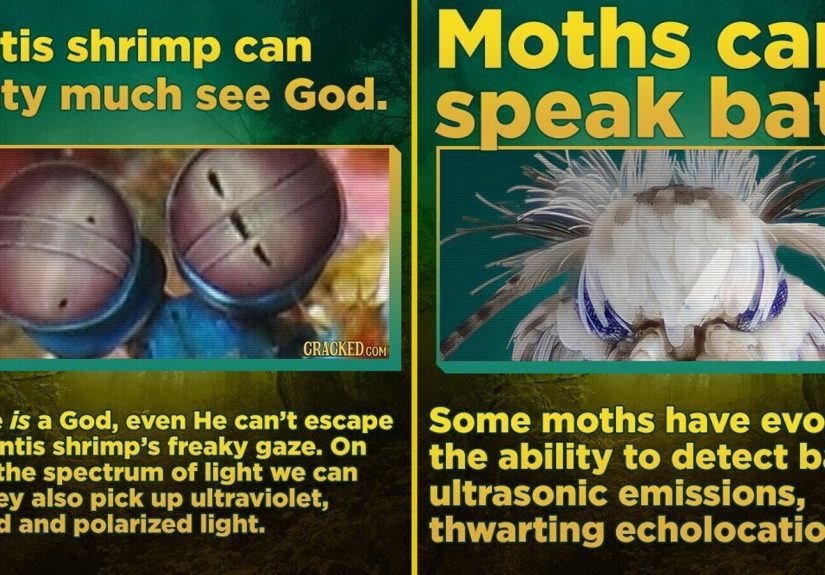
The mantis shrimp looks like someone designed a seafood creature after drinking neon paint. Its eyes are even more outrageous. Humans have three types of color receptors, which let us see a rich range of colors. Mantis shrimp have a far more complex visual system and can detect ultraviolet light and polarized light, including circularly polarized light.
That means a mantis shrimp may perceive signals and patterns that are completely invisible to us. Their world is not just “more colorful.” It is structured differently. Imagine trying to explain a rainbow to someone who has only seen gray, then realize the mantis shrimp may be doing that to us.
In the animal kingdom, vision is not one-size-fits-all. The mantis shrimp proves that reality depends partly on the eyes doing the looking.
4. Pistol Shrimp Can Shoot Bubble Bullets
The pistol shrimp is tiny, but it carries one of nature’s strangest weapons: an oversized claw that snaps shut so fast it creates a cavitation bubble. When that bubble collapses, it produces a loud snap and a shockwave powerful enough to stun small prey.
This is not a metaphorical “bubble bullet.” It is a real physics trick. The rapid movement of the claw creates a low-pressure bubble in the water. When the bubble implodes, energy is released in a violent burst. Some snapping shrimp are among the loudest animals in the ocean, which is a bold achievement for something that looks like it should be garnish.
Humans need machines to create underwater shockwaves. The pistol shrimp does it with one claw and zero concern for workplace safety.
5. The Immortal Jellyfish Can Reverse Its Life Cycle
The immortal jellyfish, Turritopsis dohrnii, has a name that sounds like a fantasy villain but belongs to a small jellyfish with an astonishing survival trick. Under stress, it can revert from its adult medusa stage back to an earlier polyp-like stage, essentially moving backward in its life cycle.
This does not mean every individual jellyfish lives forever. Predators, disease, and bad luck still exist. But biologically, the ability to reverse development is mind-bending. Most animals grow older in one direction. This jellyfish found the “undo” button.
Humans can moisturize, exercise, and pretend birthdays are optional. We cannot turn back into toddlers and restart development. The immortal jellyfish wins this round.
6. Tardigrades Can Survive Conditions That Would End Almost Anything
Tardigrades, also called water bears, are microscopic animals that look like wrinkly space potatoes with legs. Their superpower is extreme survival. When conditions become brutal, many tardigrades enter cryptobiosis, a state in which their metabolism slows dramatically.
In this dried-out, curled-up form called a tun, tardigrades can endure dehydration, freezing, intense radiation, extreme pressure, and even exposure to the vacuum of space in scientific experiments. Add water when conditions improve, and some can revive as if they merely took the universe’s weirdest nap.
Humans become uncomfortable when the office thermostat is two degrees off. Tardigrades look at outer space and say, “Fine, but I’m not paying extra for checked luggage.”
7. Wood Frogs Can Freeze Solid and Come Back to Life
The wood frog has mastered winter survival in a way that sounds impossible. During freezing weather, it can allow much of its body water to freeze. Its heart stops beating. It stops breathing. Blood flow pauses. By ordinary standards, this frog appears very much not alive.
But when spring arrives, the frog thaws and resumes activity. Its body uses natural cryoprotectants, including glucose, to help protect cells from ice damage. This adaptation lets wood frogs survive cold climates where many amphibians would fail.
If a human froze solid, the story would not end with a cheerful hop to a breeding pond. Wood frogs treat suspended animation like a seasonal subscription plan.
8. Geckos Can Walk on Walls and Ceilings
Geckos do not need glue, suction cups, or tiny climbing shoes. Their feet are covered with microscopic hair-like structures that interact with surfaces through van der Waals forces, weak molecular attractions that become powerful when multiplied across thousands of contact points.
This lets geckos scamper up walls, across ceilings, and over surfaces that would leave humans flailing. Even more impressive, geckos can attach and detach their feet quickly, which is why they move so smoothly instead of getting stuck like a sticker on a laptop.
Spider-Man needed a radioactive spider. Geckos came factory-equipped.
9. Electric Eels Can Generate Powerful Shocks
Electric eels are not true eels, but they are truly electric. Their bodies contain specialized cells called electrocytes, arranged in a way that functions like a biological battery. When activated together, these cells can produce strong electric discharges used for hunting and defense.
Some electric eels can generate shocks of hundreds of volts, and certain species have been measured at even higher levels. They also use weaker electric signals to navigate and detect objects in murky water, where vision is limited.
Humans need outlets, wires, and a warning label. Electric eels bring their own power grid.
10. Platypuses Can Sense Electricity Underwater
The platypus already looks like an animal assembled from spare parts: duck-like bill, beaver-like tail, webbed feet, egg-laying mammal status, and venomous spurs in males. But one of its strangest abilities is electroreception.
When a platypus dives, it closes its eyes, ears, and nostrils. Instead of relying on sight or smell, it uses receptors in its bill to detect tiny electrical signals produced by the muscle movements of prey. In dark freshwater environments, this is a huge advantage.
You may feel “electric chemistry” on a good date, but the platypus can literally sense bioelectric signals while hunting underwater. That is not romance. That is biology showing off.
11. Bats Can Navigate With Sound
Many bats use echolocation, producing high-frequency sounds and listening for returning echoes. These echoes reveal the position, size, shape, and movement of objects around them, including flying insects.
This ability lets insect-eating bats hunt in darkness with remarkable precision. They are not blind, despite the old saying, but echolocation gives them an acoustic map of the world that humans cannot naturally create.
We use radar, sonar, and parking sensors. Bats built the original version into their bodies. Somewhere, a bat is probably very unimpressed by your backup camera.
12. Sea Turtles and Migratory Animals Can Sense Earth’s Magnetic Field
Imagine crossing an ocean without Google Maps, road signs, airport lounges, or a dramatic travel vlog. Sea turtles, salmon, birds, and several other animals can use Earth’s magnetic field as navigational information during long-distance migrations.
This ability, called magnetoreception, may help animals determine direction or even approximate location. For sea turtles, magnetic cues can help guide long journeys through open ocean and support their return to important regions.
Humans get lost inside parking garages. Migratory animals read invisible planetary signals. That is both humbling and mildly offensive.
13. Pit Vipers Can Detect Heat Like Living Infrared Sensors
Some snakes, including pit vipers, have specialized heat-sensing organs located between the eyes and nostrils. These pit organs detect infrared radiation from warm-blooded prey, helping the snake strike accurately even in darkness.
This is not the same as ordinary vision. It is a thermal sense, allowing the snake to perceive heat differences in its environment. For a nocturnal hunter, that is a serious advantage.
Humans can buy infrared cameras. Pit vipers come with one built into their face. Nature clearly has a premium hardware department.
14. Male Seahorses Can Get Pregnant and Give Birth
Seahorses turn the usual reproductive script upside down. In seahorses and their close relatives, the female deposits eggs into a specialized pouch on the male. The male fertilizes and carries the developing young, then gives birth when they are ready.
The male’s brood pouch helps protect the embryos and regulate their environment. Depending on the species, a male seahorse may release dozens, hundreds, or even thousands of tiny young.
Human fathers can be supportive, loving, exhausted, and excellent at assembling cribs incorrectly. But male pregnancy and live birth? Seahorses own that department.
Why These Weird Animal Abilities Matter
These bizarre animal talents are entertaining, but they are also scientifically valuable. Animal adaptations teach researchers about robotics, medicine, materials science, navigation, sensory biology, and climate survival. Gecko feet inspire adhesive technology. Axolotl regeneration informs studies of healing. Octopus skin inspires flexible materials. Tardigrades help scientists understand protection from radiation, dehydration, and extreme environments.
The deeper lesson is that evolution solves problems in ways humans might never invent from scratch. A shrimp that fires bubbles, a frog that freezes, and a mole that smells underwater all represent biological creativity on a spectacular scale.
Experience Section: What Watching Animal Superpowers Teaches Us
Reading about weird animal abilities is fun, but the topic becomes even more memorable when you connect it to real experiences. Anyone who has watched a gecko sprint across a wall understands the feeling: first curiosity, then disbelief, then the quiet realization that your own body is painfully limited. A gecko makes gravity look negotiable. You stand there holding a broom, wondering why your hands are so underqualified.
Visiting an aquarium can create the same kind of wonder. Watch an octopus for a few minutes and it becomes clear that camouflage is not just hiding. It is decision-making written across the skin. The animal studies its surroundings, adjusts color, shifts posture, and seems to melt into the background. It can make you rethink what intelligence looks like. It is not always a face making eye contact. Sometimes it is an arm exploring a shell while the rest of the body pretends to be a rock.
Then there are bats. If you have ever walked outside at dusk and seen bats flicker through the air, you have seen echolocation in action without hearing most of it. Their flight can look chaotic until you understand that they are tracking insects through sound. What appears like random zigzagging is actually precision hunting. Humans often assume darkness limits activity, but for bats, night is full of information.
Animal abilities also change how we think about resilience. The wood frog is a perfect example. It does not escape winter by staying warm. It survives by letting the cold happen in a controlled way. That is a strange and powerful idea. Sometimes survival is not about resisting every hard condition. Sometimes it is about adapting so deeply that the impossible becomes routine.
The same feeling appears when learning about tardigrades. They are tiny, almost invisible to the naked eye, yet they can survive conditions that would destroy larger, stronger animals. Their resilience is a reminder that toughness is not always loud. It can be microscopic, quiet, and curled into a tun, waiting for water and better days.
These animals also make everyday human life feel funnier. We complain about slow internet while sea turtles navigate across oceans using magnetic cues. We struggle to find matching socks while mantis shrimp detect forms of light we cannot even picture. We buy expensive skincare while immortal jellyfish casually reverse part of their life cycle. Nature has a sense of humor, and apparently it enjoys making humans look like interns.
But the goal is not to feel inferior. The goal is to feel amazed. Humans have culture, language, tools, memory, art, and curiosity. Animals have bodies shaped by millions of years of problem-solving. When we study them, we are not just collecting fun facts. We are learning new ways to imagine what life can do.
The next time you see a bird migrating overhead, a lizard on a wall, a frog near a pond, or even a tiny insect in the grass, remember this: the animal kingdom is full of hidden technology. No batteries included. No software update required.
Conclusion
The weirdest animal abilities are not magic. They are biology pushed to astonishing extremes. Axolotls regenerate. Octopuses transform. Tardigrades survive space-like punishment. Wood frogs freeze and return. Electric eels shock, bats echolocate, snakes sense heat, and seahorse fathers give birth. These creatures remind us that Earth is not just full of life; it is full of astonishing solutions to survival problems.
Humans may not be able to do these things naturally, but we can do something equally important: study, protect, and learn from the species that can. The more we understand unusual animal abilities, the more we understand nature’s creativityand maybe, eventually, our own future technologies.
Note: This article is designed for educational web publication and is based on established animal biology, zoology, and natural science references. It avoids unsupported myths and focuses on real animal adaptations.