Table of Contents >> Show >> Hide
- 1. The Coconut “Horses” in Monty Python and the Holy Grail
- 2. Otto the Inflatable Autopilot in Airplane!
- 3. The Gopher in Caddyshack
- 4. The “Goes to 11” Amplifier in This Is Spinal Tap
- 5. Milton’s Red Stapler in Office Space
- 6. The Mirthmobile in Wayne’s World
- 7. The Mutt Cutts Van in Dumb and Dumber
- 8. Pee-wee Herman’s Bicycle in Pee-wee’s Big Adventure
- 9. The Rug in The Big Lebowski
- 10. Ron Burgundy’s Jazz Flute in Anchorman
- 11. The Leg Lamp in A Christmas Story
- 12. The “Vote for Pedro” Shirt in Napoleon Dynamite
- 13. The Opti-Grab in The Jerk
- 14. Derek Zoolander’s Tiny Phone in Zoolander
- 15. The Faux Ferrari in Ferris Bueller’s Day Off
- Why Comedy Props Become More Famous Than Expected
- Real-World Experiences: What These Comedy Props Teach Fans, Collectors, and Writers
- Conclusion
Great comedy does not always arrive wearing a tuxedo and delivering a perfect punchline. Sometimes it rolls in covered with shag carpeting, clacks two coconut halves together, or sits quietly on a desk looking suspiciously like a red stapler with career trauma. The best comedy movie props are more than background objects. They are tiny machines of character, timing, and visual absurdity.
In film, a prop can do what dialogue cannot. It can reveal a hero’s personality before they speak, turn a low-budget problem into a legendary joke, or become so famous that fans buy replicas for decades. The origins of iconic comedy movie props often begin in practical production decisions: no money for horses, no real Ferrari to destroy, no existing red stapler on the office-supply market. Hollywood, being Hollywood, looks at those problems and says, “Fantastic. Let’s make it weird.”
Below are the stories behind 15 unforgettable comedy movie props, from cult classics to blockbuster favorites. Each one proves that sometimes the smallest object in a scene can steal the whole movie, tiptoe out the theater door, and become pop culture furniture forever.
1. The Coconut “Horses” in Monty Python and the Holy Grail
A budget problem that became a comedy masterpiece
The coconut shells in Monty Python and the Holy Grail may be the greatest case of “we cannot afford that” turning into “thank goodness we could not afford that.” The filmmakers wanted a medieval quest, but real horses were expensive, complicated, and apparently not as funny as grown men pretending to gallop while a squire clacked shells behind them.
Terry Gilliam later explained that the production did not have the money for horses, so the team built the gag around coconut shells instead. What could have looked cheap became brilliantly absurd. The joke works because nobody in the movie treats it as a joke at first. King Arthur behaves with total dignity while the soundtrack of his noble ride is basically kitchen percussion. It is comedy alchemy: scarcity plus confidence equals legend.
2. Otto the Inflatable Autopilot in Airplane!
The pun that became a rubber co-star
Airplane! is a master class in literal-minded comedy. If someone says “autopilot,” the movie asks, “What if auto-pilot was named Otto Pilot?” Enter Otto, the inflatable dummy who saves the day with the stiff expression of a department-store mannequin having a very stressful Monday.
The origin of Otto fits the Zucker-Abrahams-Zucker style perfectly: take a phrase everyone understands, make it physical, then let serious actors react as though this is standard aviation procedure. Otto is not merely a prop. He is the movie’s entire comic philosophy with a valve attached. In a film packed with verbal jokes, he proves that one ridiculous object can land harder than a runway punchline.
3. The Gopher in Caddyshack
A puppet that tunneled into comedy history
The Caddyshack gopher feels like it has been smirking at golf courses since the invention of plaid pants. In reality, the character became famous through puppetry and production tinkering. Puppeteer Pat Brymer helped manipulate the mischievous rodent, turning a simple golf-course nuisance into Bill Murray’s tiny underground nemesis.
The prop worked because it gave the chaotic movie a cartoonish through-line. While the human characters chase status, money, romance, and personal dignity, the gopher simply enjoys being a fuzzy agent of destruction. Its origin reminds us that comedy props do not need realism. They need attitude. The Caddyshack gopher has enough attitude to fill a country club locker room.
4. The “Goes to 11” Amplifier in This Is Spinal Tap
One extra number, infinite cultural mileage
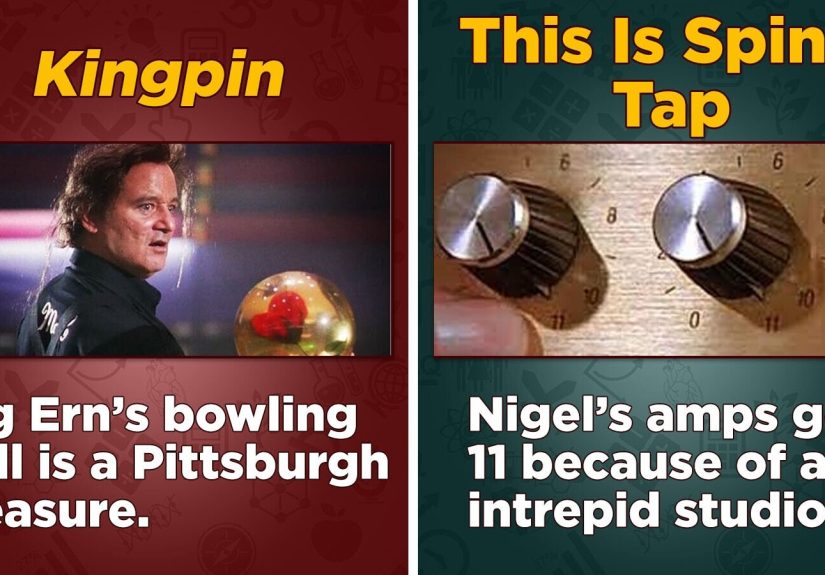
The amplifier in This Is Spinal Tap is a perfect prop because the joke is visible before it is explained. Most amps go to 10. Nigel Tufnel’s amp goes to 11. That is it. That is the entire joke. And somehow, that tiny extra numeral became one of the most durable comedy ideas ever filmed.
Director Rob Reiner has said the team knew they needed physical gags such as the amp and the Stonehenge prop, and the dialogue around them was largely improvised. The result is beautiful stupidity delivered with absolute sincerity. The amp’s origin shows how comedy thrives when characters misunderstand the world with total confidence. Nigel believes 11 is louder because, mathematically speaking, it is one louder. Who are we to argue with rock science?
5. Milton’s Red Stapler in Office Space
The office supply that became a workplace icon
Few props have understood workplace rage as deeply as Milton’s red stapler in Office Space. The joke is partly visual: a bright red object sitting in a gray cubicle wasteland like a tiny emergency flare for the soul. At the time of filming, Swingline did not make that model in red, so the prop team painted it.
The funniest twist came later. Fans wanted the red stapler so badly that Swingline eventually produced one for real. That means Office Space did not merely satirize office culture; it changed the office-supply aisle. The prop’s origin is a dream for SEO writers, film nerds, and anyone who has ever whispered, “I believe you have my stapler,” while guarding their desk like a dragon with toner cartridges.
6. The Mirthmobile in Wayne’s World
An AMC Pacer with flame decals and pure basement energy
Garth’s Mirthmobile from Wayne’s World began as a 1976 AMC Pacer, already a car with the aerodynamic confidence of a fishbowl. The production transformed it into a rolling personality test: baby-blue paint, orange flames, mismatched wheels, and a famous licorice dispenser inside.
The Mirthmobile is funny because it is not cool in the traditional sense. It is cool because Wayne and Garth think it is cool. That distinction matters. Comedy props often succeed when they reveal what a character values. To everyone else, the Pacer might be questionable transportation. To Wayne and Garth, it is a concert hall, clubhouse, and spiritual vehicle for “Bohemian Rhapsody.” Party on, indeed.
7. The Mutt Cutts Van in Dumb and Dumber
A dog-grooming van that became a furry road-trip legend
The Mutt Cutts van from Dumb and Dumber is what happens when a vehicle wakes up and decides subtlety is for cowards. Based on a Ford Econoline-style van and covered in shaggy material, the “Shaggin’ Wagon” was designed to look like a giant dog on wheels, complete with ears, nose, tongue, and tail.
Its origin is rooted in character logic. Harry Dunne is a dog groomer, so of course his van should be a mobile canine billboard. But the prop goes further than advertising. It announces the movie’s entire comic universe: cheerful, impractical, slightly alarming, and impossible to ignore at traffic lights. It is one of the best comedy movie vehicles because it is both transportation and punchline.
8. Pee-wee Herman’s Bicycle in Pee-wee’s Big Adventure
The bike that launched a cross-country quest
Pee-wee Herman’s red-and-white bicycle is not just a prop; it is the treasure map, treasure chest, and emotional engine of Pee-wee’s Big Adventure. The film used multiple vintage-style Schwinn DX bikes, customized with flashy accessories to fit Pee-wee’s childlike, theatrical personality.
The bike’s origin has become almost as beloved as the film itself. One screen-used bicycle was later acquired by the Alamo, a perfect real-world punchline because Pee-wee famously searches for it there after being told it is in the basement. The Alamo, unfortunately for fictional bike detectives, does not have a basement. The prop endures because it captures the movie’s core belief: if you love something loudly enough, the entire world becomes part of your adventure.
9. The Rug in The Big Lebowski
The softest MacGuffin in comedy-noir history
The rug in The Big Lebowski does not explode, transform, or sing. It just lies there, tying the room together. Yet that ordinary rug sets the plot in motion and gives The Dude a reason to stumble into a noir mystery he is magnificently unqualified to solve.
Its origin is a lesson in understated production design. The rug had to be plausible as part of The Dude’s apartment, but memorable enough to justify his repeated emotional attachment. Comedy often depends on disproportion: a small insult produces an epic reaction. In this case, the fate of a rug becomes a matter of personal philosophy. The Dude may not chase ambition, but he will defend interior balance. Respect.
10. Ron Burgundy’s Jazz Flute in Anchorman
A random character idea that became musical nonsense
Ron Burgundy’s jazz flute in Anchorman originated from the wonderfully specific question: what absurd talent would this overconfident 1970s newsman absolutely believe makes him irresistible? Director Adam McKay has credited Will Ferrell with the idea that Ron simply had to play jazz flute.
The finished scene works because the flute is both impressive and ridiculous. Professional musician Katisse Buckingham performed the solo, while Ferrell embodied Ron’s magnificent self-regard. The prop is funny not because a flute is funny by itself, but because Ron treats it like a secret weapon of charisma. In his mind, every club is a concert hall and every solo deserves flame effects.
11. The Leg Lamp in A Christmas Story
A “major award” built from memory, kitsch, and one quick sketch
The Leg Lamp from A Christmas Story is one of the most recognizable comedy props in holiday movie history. Its origin traces back to Jean Shepherd’s writing and production designer Reuben Freed’s visual interpretation. Freed reportedly sketched the lamp quickly, combining Shepherd’s oddball concept with the shape of an old-fashioned fringed lampshade.
The production made only a few lamps, and the originals did not survive filming. That feels appropriate. The Leg Lamp was always meant to be fragile, absurd, and far too proud of itself. Today, replicas glow in windows every December, proving that one family’s tacky prize can become everyone’s seasonal joke. It is indescribably memorable, which is close enough to beautiful.
12. The “Vote for Pedro” Shirt in Napoleon Dynamite
A simple tee that became an underdog banner
The “Vote for Pedro” shirt from Napoleon Dynamite looks like something made five minutes before school, which is exactly why it works. Costume designer Jerusha Hess helped create the low-budget, handmade feel that defined the movie’s awkward charm.
The shirt became famous because it represented loyalty without polish. Napoleon is not fashionable, persuasive, or socially smooth. But when he wears that shirt and later performs his unforgettable dance, the prop becomes a flag for sincere weirdness. The origin of the shirt proves that iconic comedy props do not require luxury materials. Sometimes all you need is a plain tee, red letters, and heroic commitment to being extremely yourself.
13. The Opti-Grab in The Jerk
A fake invention with perfectly dumb logic
In The Jerk, Steve Martin’s Navin Johnson accidentally invents the Opti-Grab, a little device meant to keep eyeglasses from slipping down the nose. The prop is funny because it looks almost useful, which is the most dangerous category of fake invention.
The Opti-Grab’s origin lies in the film’s love of comic escalation. A small idea makes Navin rich, then creates a disaster large enough to ruin him. Visually, it is silly but plausible, the kind of object you might see in a late-night commercial and think, “Wait, do I need that?” The answer is no. But that tiny uncertainty is where the joke lives.
14. Derek Zoolander’s Tiny Phone in Zoolander
A miniature gadget mocking early-2000s tech status
When Zoolander arrived in 2001, cell phones were shrinking fast. The movie exaggerated that trend into Derek Zoolander’s impossibly tiny phone, a prop that made luxury technology look deeply, wonderfully stupid.
The phone’s origin is satirical. Fashion culture loves status symbols, and tech culture loves making objects smaller, shinier, and easier to lose between couch cushions. Derek’s phone combines both impulses into one ridiculous accessory. It is funny because he uses it with complete seriousness. A comedy prop becomes iconic when it captures a real trend and stretches it just far enough to reveal the nonsense hiding inside.
15. The Faux Ferrari in Ferris Bueller’s Day Off
A fake luxury car with real emotional horsepower
The red “Ferrari” in Ferris Bueller’s Day Off is one of the most famous fake cars in movie history. The production did not casually destroy a real 1961 Ferrari 250 GT California Spyder, because that would have been financially horrifying and possibly grounds for every car lover in America to faint in unison. Instead, the filmmakers used replicas built to resemble the prized classic.
The faux Ferrari’s origin is a practical solution that became thematically perfect. The car represents Cameron’s fear, Ferris’s confidence, and the fantasy of escaping responsibility for one glorious day. Because it is a replica, the movie could stage the famous crash without sacrificing an actual automotive masterpiece. Comedy props often work this way: they fake reality so convincingly that audiences remember the feeling more than the material.
Why Comedy Props Become More Famous Than Expected
The origins of iconic comedy movie props reveal a pattern. Many were born from constraints. The coconuts replaced horses. The red stapler was painted because the real product did not exist. The Ferrari was fake because the real one was too valuable. The Mirthmobile and Mutt Cutts van turned ordinary vehicles into rolling jokes because the characters needed transportation with personality.
Another pattern is sincerity. Comedy props become legendary when characters treat them seriously. Milton truly cares about his stapler. The Dude truly cares about his rug. Pee-wee truly believes his bike is the greatest machine ever assembled. Ron Burgundy truly believes jazz flute is a romantic superpower. The audience laughs, but the characters do not wink. That commitment gives the object emotional weight, even when the object is objectively bananas.
Finally, these props are easy to remember. A great comedy prop has a silhouette, color, sound, or phrase that sticks. Red stapler. Coconut clop. Leg Lamp glow. Dog van. Tiny phone. “Vote for Pedro.” They are simple enough to describe in two seconds and specific enough to recognize forever.
Real-World Experiences: What These Comedy Props Teach Fans, Collectors, and Writers
Anyone who has watched a comedy with friends knows that props often become the souvenirs of memory. You may forget the exact plot mechanics, but you remember the object that made everyone in the room laugh at the same time. Someone clacks imaginary coconuts across the kitchen. Someone points to an office stapler like it deserves legal protection. Someone sees a tiny phone and immediately hears a Zoolander joke forming in the distance. That is the strange afterlife of comedy props: they leave the movie and move into everyday conversation.
For fans, these props create instant community. A “Vote for Pedro” shirt is not just clothing; it is a password. A Leg Lamp in a window tells neighbors, “Yes, we are festive, but we are also unserious in the best possible way.” A replica Mutt Cutts van at a car show can pull a bigger crowd than a polished sports car because people do not only admire it; they smile before they even reach it. Comedy props invite participation. They are not museum pieces trapped behind glass in the imagination. They make people quote lines, reenact scenes, and tell stories about the first time they saw the movie.
Collectors experience these objects differently but with the same affection. A screen-used prop carries production history in its scratches, repairs, paint choices, and imperfect details. The most valuable thing about a comedy prop is not always the material. It is proof that a silly idea survived the chaos of filmmaking and reached millions of people. A painted stapler, a fake Ferrari, or a customized bicycle becomes important because it was present when the joke became permanent.
For writers and filmmakers, these props offer a practical lesson: make the object express the character. The Dude’s rug says he has simple comforts and a private sense of order. Pee-wee’s bike says he sees the world as a carnival of wonder. Garth’s Mirthmobile says friendship can turn an uncool car into a sacred vessel. The object does not need to explain itself in dialogue. It simply needs to belong so completely to the character that removing it would make the movie smaller.
The best experience related to iconic comedy movie props is realizing how democratic they are. You do not need a giant effects budget to create one. You need a sharp idea, a bold visual choice, and the courage to let the characters take the ridiculous thing seriously. That is why these props endure. They remind us that comedy is not only written; it is built, painted, inflated, stitched, clacked, and sometimes covered in shag carpeting. And when it works, the audience carries that object home forever.
Conclusion
The origins of 15 iconic comedy movie props show that movie magic often begins with practical problem-solving and ends with cultural immortality. A prop can start as a cheap workaround, a quick sketch, a customized vehicle, or a last-minute costume choice. But when it fits the character, supports the joke, and creates a visual memory, it becomes larger than its screen time.
From the Holy Grail coconuts to Milton’s red stapler, from Pee-wee’s bicycle to the faux Ferrari in Ferris Bueller’s Day Off, these objects prove that comedy lives in details. The right prop can turn a scene into a quote, a quote into a ritual, and a ritual into a piece of pop culture that refuses to retire. Not bad for a few shells, a rug, a lamp, and one extremely confident flute.