Table of Contents >> Show >> Hide
- Why This Tiny Design Detail Matters So Much
- Public Charging Is Where Rear-Mounted Ports Start Causing Trouble
- Home Charging Gets Easier Too
- Trucks and SUVs Have an Even Stronger Case for Front Ports
- The Industry Is Already Quietly Admitting This Problem Exists
- Front Does Not Have to Mean Dead Center
- But What About the Counterarguments?
- What Automakers Should Do Next
- Real-World Experiences: Why Drivers Keep Noticing This
- Conclusion
- SEO Tags
Electric vehicles are full of smart ideas. Instant torque? Brilliant. Quiet cabins? Lovely. Charging at home while you sleep? A small daily miracle. But for all the clever engineering packed into modern EVs, the industry still manages to trip over one oddly basic question: where should the charge port go?
My answer is simple. The EV charge port should be in the front.
Not buried in the rear fender like a secret agent gadget. Not tucked into an awkward side panel that forces you to park like you are taking a driving test in front of your ex. Not placed in a spot that makes public charging feel like solving a geometry problem with 8% battery left. Put it in the front, ideally on a front corner or front fender, and a shocking number of everyday charging annoyances begin to disappear.
This is not the flashiest EV debate. Nobody is making posters that say, “Give me liberty or give me front-left charge access.” But they should. Charge-port location affects public charging convenience, home charger installation, towing practicality, parking ease, cable wear, and even how much social tension a driver creates at a crowded fast charger. That tiny flap on the body is doing a lot more work than it gets credit for.
Why This Tiny Design Detail Matters So Much
People tend to think of charging as a battery issue, a network issue, or a software issue. Fair enough. Speed matters. Reliability matters. App quality matters. But usability also matters, and charge-port placement is pure usability. It is the difference between “plug in and grab coffee” and “angle the car like a pirate ship attacking a marina.”
Gas cars trained drivers to think the filler door is a minor detail. You pull up, open the flap, pump gas, and leave. EV charging is different. Chargers are fixed. Cables are not always long. Stalls are painted in specific directions. Some sites were designed around one brand’s vehicle layout. A car’s charge port is not just a flap anymore. It is part of the choreography.
And right now, that choreography is messy because there is no consistent standard for where automakers put the port. Some EVs place it near the rear corner. Some use a front fender. Some hide it in the grille area. Some feel like they let the design team throw a dart at a clay model and call it innovation.
Public Charging Is Where Rear-Mounted Ports Start Causing Trouble
Short Cables, Long Sighs
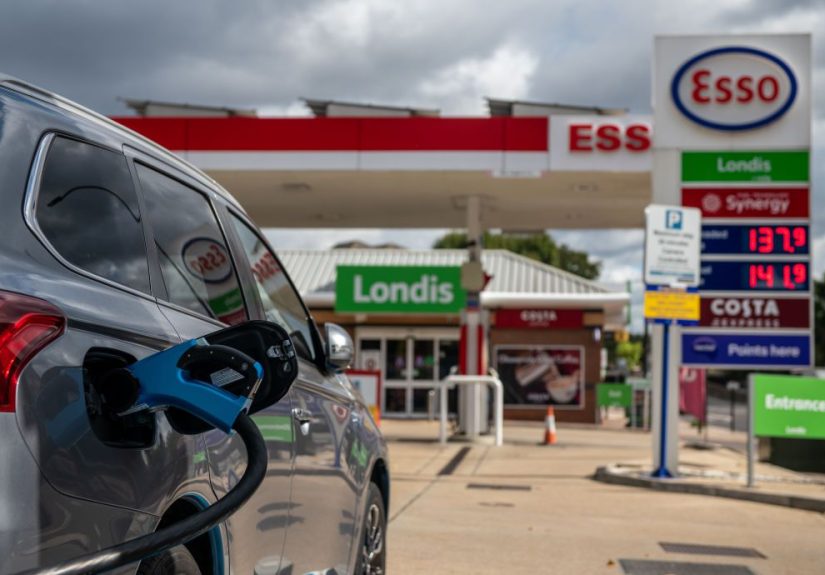
The strongest case for front-mounted charge ports appears the moment you pull into a public fast charger. Many charging sites were not built for every possible port location. They were built around a stall layout, a cable length, and a fairly specific assumption about how vehicles would park. When a car’s charge port does not match that assumption, the driver becomes a human workaround.
That is why we keep seeing the same EV charging circus: backing in, pulling through, parking diagonally, leaning the cable across the hood, or occupying an extra space just to make the plug reach. Drivers are not doing this because they enjoy being stared at. They are doing it because the cable is short and their port is in the wrong place for that station.
A front-mounted port reduces this nonsense. Pull forward, line up the nose, connect, done. No interpretive parking. No strange three-point ballet. No silent negotiation with the person in the next stall who is trying very hard not to look annoyed.
Front Ports Work Better Across More Stall Designs
One of the big advantages of a front port is flexibility. A front corner can work with pull-in stalls, angled stalls, curbside charging, many pedestal layouts, and future designs that may not resemble today’s gas-station-style sites. Rear-mounted ports can work beautifully when the stall was practically drawn around them, but they are less universal when the site is crowded, cramped, or designed by someone who clearly never tried to charge a different brand of EV in the rain.
Front ports also make more sense for mixed charging environments. As networks evolve, they need to serve more brands, more connector types, and more body styles. A public charger should not feel like a compatibility test between parking-lot paint and sheet metal. It should feel easy.
If a design choice works best only when the charger, cable, and vehicle all belong to the same ecosystem, that is not elegant design. That is a very polished workaround.
Home Charging Gets Easier Too
Your Garage Should Not Need a Strategy Meeting
Rear-mounted ports are not just a public-charging headache. They also complicate home charging. Anyone installing a Level 2 charger quickly learns that cable reach matters. The location of the port matters. The way the vehicle usually parks matters. In other words, the charger is not just going on a wall. It is being positioned around a body panel decision made months or years before the owner even bought the car.
With a front-mounted port, especially on a front corner, home charging usually gets simpler. Many drivers pull into their garage or driveway nose-first. A front port lets the charger live near the front wall, where the cable has a shorter and cleaner path. That often means less cable draped across a walkway, less strain on the connector, and less daily fuss.
And daily fuss matters. Charging is something EV owners do over and over again. The most valuable convenience is not the one that saves twenty minutes on a road trip twice a year. It is the one that saves a little irritation every single evening.
Cleaner Layout, Less Cable Chaos
A front port can also help keep a garage tidier. When the cable reaches the nose directly, there is less looping around mirrors, doors, or quarter panels. That means fewer chances to drag the cable on the ground, snag it on junk in the garage, or perform the classic EV-owner move of stepping over it while pretending this is a lifestyle choice and not a mild design failure.
In a narrow garage, the difference is even bigger. A front port lets the charger work even when one side of the car is close to a wall. A side or rear location can force the owner to reverse in every day, hug a specific side, or buy a charger with a longer cable just to compensate for the car’s layout.
Trucks and SUVs Have an Even Stronger Case for Front Ports
If you want proof that charge-port location is not a minor detail, look at electric trucks and large SUVs. These vehicles are longer, taller, and often used for towing, hauling, camping, and road trips. That means they do not just need to charge. They need to charge without turning every station stop into a parking-lot incident.
Rear-side ports on large vehicles can be especially awkward because the cable may not reach unless the vehicle is positioned just right. Put that same port on a truck with a long nose or a trailer attached, and suddenly the driver is making decisions that would make a chess coach sweat.
A front-mounted port is not a perfect solution for every towing scenario, but it is far more sensible than asking a driver with a trailer to back into a tight space so a short cable can reach a rear corner. If EV trucks are supposed to replace gas trucks in real life and not just in glossy launch videos full of mountain dust and dramatic strings, their charging hardware has to match how people actually use them.
Front access is simply more intuitive for big vehicles. Pull in. Plug in. Keep moving. That is what good design looks like.
The Industry Is Already Quietly Admitting This Problem Exists
Here is the funny part: even if some automakers still act like port location is a design flourish, the charging industry is behaving as if it is a serious usability problem. Why? Because it is.
Networks are adding longer cables. Charging companies are building smarter dispensers. Hardware makers are emphasizing cable management that can reach more vehicles regardless of where the port sits. Some systems now combine connector types more gracefully, while others rethink stall layouts to reduce the chaos caused by mismatched ports.
That tells you something important. If station operators, charger manufacturers, and software teams are all spending time, money, and engineering effort to overcome inconsistent charge-port placement, then inconsistent charge-port placement is not some charming quirk. It is friction. Expensive friction.
And when an industry starts designing around a problem instead of eliminating it, somebody should ask the obvious question: why not fix the vehicle side too?
Front Does Not Have to Mean Dead Center
To be clear, when I say the port should be in the front, I do not necessarily mean smack in the middle of the nose like a tiny robotic belly button. A front corner or front fender is often the smartest compromise.
That placement offers easy access from common parking angles while avoiding some of the drawbacks of a center-grille location. It can be protected from minor bumps more easily, integrated into the vehicle’s shape without looking goofy, and positioned to keep charging cables away from pedestrians. It also works well for both left-hand-drive and right-hand-drive market variations when manufacturers plan accordingly.
In other words, the goal is not to create one sacred universal square inch of bodywork. The goal is to standardize around the front half of the vehicle, where charging is usually easiest and most adaptable.
But What About the Counterarguments?
“Rear Ports Look Cleaner”
Maybe. Sometimes. A rear-quarter charge door can blend into the body lines nicely. But styling should not outrank usability in a feature drivers interact with constantly. Door handles, mirrors, trunk openings, and fuel doors all obey practical rules. Charge ports should too. Good design is supposed to make life easier, not just look sleek in a press photo.
“Rear Ports Match Existing Charger Layouts”
Some of them, yes. Especially layouts built around certain existing vehicles. But public charging is expanding, changing, and trying to accommodate many brands now. Designing tomorrow’s EVs around yesterday’s stall assumptions is like buying a bigger couch because the old doorway is awkward. You are solving the wrong problem.
“Front Ports Could Face More Weather or Road Grime”
This sounds reasonable until you remember that automakers already engineer front-end components to survive weather, debris, and daily abuse. Sensors, cameras, lights, active shutters, and all kinds of electronics already live up there. A properly designed port door can too.
Besides, rear ports are not magically living in a spa. They see water, dirt, salt, and road spray as well. Weather is an engineering challenge, not an argument-ending trump card.
“There Will Never Be One Perfect Location”
That part is true. There is no single placement that solves every scenario perfectly. But that does not mean all locations are equally good. A front-mounted port works well in more everyday situations for more drivers more of the time. That is enough to matter.
What Automakers Should Do Next
If automakers want EV ownership to feel easier, they should stop treating charge-port location as a styling afterthought. Put the port near the front, make it easy to reach from common stall layouts, and design it with real parking behavior in mind.
That means thinking beyond studio renderings. It means visiting crowded public chargers. It means watching how people park at apartment buildings, grocery stores, office garages, and highway plazas. It means observing what happens when a family arrives in a large SUV, when a truck has a trailer attached, or when someone is charging late at night in bad weather and does not want to perform a cable lasso routine.
Automakers also need to remember that EV adoption is no longer about early enthusiasts who will tolerate weirdness for the love of the future. It is about normal people. Busy people. People carrying groceries, backpacks, kids, and coffee. People who do not want their vehicle to demand a five-step parking theory every time they need electrons.
And if a company insists on placing the port elsewhere, it should at least be honest that it is asking the infrastructure to adapt around that choice.
Real-World Experiences: Why Drivers Keep Noticing This
Spend enough time around EV owners and you start hearing the same stories. Not stories about battery chemistry or tax credits. Stories about the physical act of plugging in.
One driver pulls into a public charger after a long day, only to realize the cable will not quite reach unless the car is parked at a weird angle. Another backs into a tight spot because that is the only way the connector can reach the rear quarter. Someone else discovers their garage setup works beautifully for one EV but turns into a cable obstacle course when they replace it with a model whose port is on the other side. A truck owner rolls up with a trailer and suddenly learns that “fast charging stop” now means “disconnect half your life in a parking lot.”
None of these stories sound dramatic on paper, but that is exactly why they matter. They are not rare disasters. They are recurring annoyances. They chip away at convenience one small moment at a time.
And convenience is the whole point. EVs are supposed to make everyday driving feel smoother, quieter, and smarter. When the charge port is placed well, charging fades into the background the way the best design always does. You park, plug in, and get on with your day. When the port is placed poorly, the car suddenly feels high-maintenance.
I have seen how quickly this changes people’s mood. A driver arrives calm, then notices the charger is on the “wrong” side for their car. Now they are creeping forward, reversing, checking the cable length, watching the curb, and hoping nobody else needs the adjacent stall. It is not catastrophic. It is just irritating. And irritation is contagious in busy charging lots.
The opposite experience is almost invisible. Pull up. Open the front port. Plug in without stretching the cable across half the vehicle. No debate, no choreography, no apology to the next driver. That kind of ease does not create a story, which is exactly the compliment. Good design should be boring in the best possible way.
There is also a psychological difference. A front-mounted port feels intuitive because it matches how many drivers naturally approach a charger. Nose in, plug close, done. The vehicle feels cooperative. It feels like it was designed by somebody who has actually used public charging instead of merely gesturing at it in a conference room.
That is why this debate keeps resurfacing. People can live with an awkward charge port. They can adapt. EV owners are excellent adapters. But once you notice how much easier charging becomes when the port is near the front, it is hard to unsee. Suddenly every diagonal parking job, every stretched cable, and every blocked stall feels unnecessary.
And maybe that is the clearest argument of all. The best EV experience is usually not created by dramatic features. It is created by hundreds of practical choices that respect the driver’s time. A front-mounted charge port is one of those choices. It will not sell every vehicle by itself. But it will make thousands of charging moments less annoying. Over the life of a car, that adds up to a surprisingly big win.
Conclusion
The EV charge port should be in the front because real life happens in parking lots, garages, road trips, apartment complexes, office decks, and crowded fast-charging sites, not just on design boards. A front-mounted port is usually easier to reach, easier to plan around, easier to use at home, and more forgiving across different charger layouts.
Rear-mounted ports are not always bad. They can work well in certain ecosystems and certain stall designs. But the broader the EV market becomes, the less sense it makes to keep building vehicles that rely on ideal conditions to charge gracefully. The industry is already spending money on longer cables, smarter hardware, and friendlier station layouts to work around inconsistent port placement. That is useful progress, but it is also an accidental confession.
We know this detail matters. We know drivers notice it. We know charging gets easier when the port is placed more logically.
So yes, the EV charge port should be in the front. Not because it is trendy. Not because it sounds futuristic. Because it is the practical choice. And in a category still trying to convince millions of drivers that electric ownership is easier, practical beats clever every time.