Table of Contents >> Show >> Hide
- Why the Brookline floor matters more than you think
- The real design twist: polished concrete lost, but the aesthetic still won
- How the floor supports the Brookline layout
- Radiant floor heat turns cool style into actual comfort
- What homeowners can learn from the Brookline floor
- Why this floor feels so true to mid-century modern style
- Experience and inspiration: what living with a Brookline-style floor might actually feel like
- Conclusion
If a house can have a personality, the Brookline Mid-century Modern house has one that walks into the room wearing slim black frames, carrying a design magazine, and quietly judging your builder-grade laminate. And nowhere is that personality more obvious than underfoot. The floor in this Brookline renovation is not just a surface. It is the visual glue, the mood setter, and the reason the whole home feels calm, modern, and expensive without shouting, “Look at me, I cost more than your car.”
That is what makes the Brookline mid-century modern floor so interesting. It tells the larger story of the house itself: how a dark, boxy 1950s split-level became a brighter, more open family home without losing the clean-lined spirit that makes mid-century modern design so enduring. Instead of treating flooring like a last-minute finish choice, this project used it as a strategic design tool. The result is a master class in modern flooring, large-format tile, radiant floor heat, and that elusive design trick of making a house feel both edited and lived-in.
For homeowners, designers, and anyone who has ever stood in a tile showroom pretending to know the difference between “warm gray” and “greige,” this floor deserves a closer look.
Why the Brookline floor matters more than you think
Mid-century modern homes live and die by flow. Their best features are usually openness, big windows, clean geometry, mixed materials, and a strong connection between indoors and outdoors. That sounds poetic until you realize one bad flooring choice can ruin the whole thing. Put busy, fussy, chopped-up flooring into an open-plan modern house and suddenly the architecture starts wheezing.
The Brookline project avoided that trap beautifully. In the main living spaces, the flooring creates a quiet visual field that lets the architecture do the talking. That matters because the home has soaring ceilings, expansive glazing, multiple split levels, and a layout designed to feel more sculptural than boxed in. The floor had to support all of that, not compete with it.
In other words, this is not the kind of floor that begs for applause. It is the kind that makes the whole room look smarter.
The real design twist: polished concrete lost, but the aesthetic still won
Here is the deliciously practical part of the story. The homeowners originally wanted polished concrete floors. That choice made perfect sense. Concrete has long been associated with mid-century and modern interiors because it feels clean, architectural, durable, and quietly cool. It also plays well with glass, steel, and minimalist cabinetry. In the abstract, polished concrete was the obvious hero.
Then reality showed up wearing steel-toe boots.
Because the existing house was in rough condition, using actual concrete would have required extra structural reinforcement to handle the weight. That meant more labor, more cost, and more headaches. And renovation projects already come with enough surprises to qualify as emotional endurance sports. So the team pivoted.
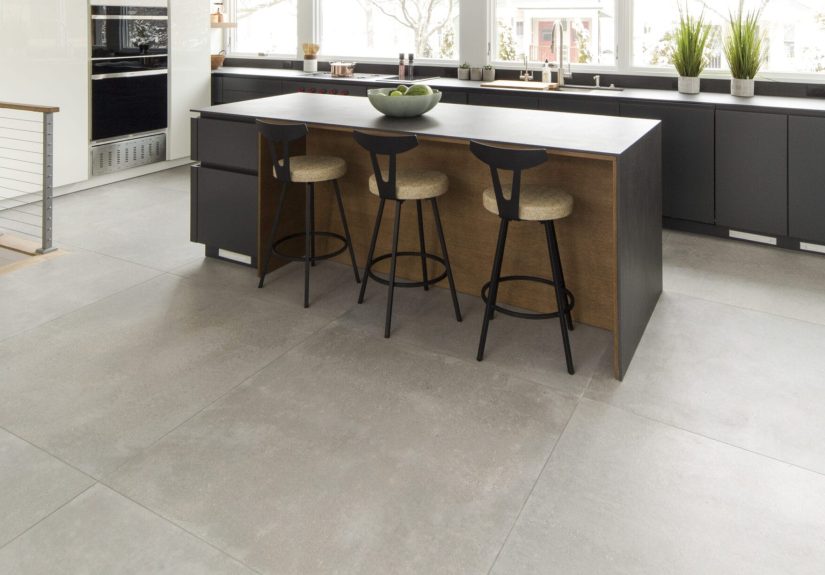
Instead of forcing a fantasy finish onto a house that did not want it, they chose oversized concrete-look porcelain tile. That move is what makes the Brookline floor genuinely smart rather than merely stylish. It preserved the visual language of concrete while solving the structural and budget problems that real concrete would have created.
Why concrete-look porcelain was the right compromise
Normally, the word compromise sounds sad, like settling for decaf at a diner. Here, it was the design win. Concrete-look porcelain offered the crisp, cool-gray, monolithic feel the homeowners wanted, but in a format that was easier to integrate into the renovation strategy. It brought durability, moisture resistance, and a cleaner installation path for a busy family home.
It also aligned perfectly with a broader mid-century modern principle: function should be beautiful, and beauty should actually work.
Thanks to advances in porcelain manufacturing, tile can now convincingly mimic materials like concrete, stone, and wood without turning your floor into a diva. That matters in a house like this one, where the floor needs to survive foot traffic, furniture, sunlight, and daily family life while still looking gallery-worthy.
The oversized tile effect
The Brookline floor gets even more interesting when you look at scale. These were not tiny little tiles doing their best. They were large-format pieces designed to reduce visual interruption. Fewer grout lines mean more continuity, and more continuity means the eye reads the space as larger, calmer, and more cohesive.
That is exactly what a mid-century modern floor should do in an open-plan setting. Rather than chopping the room into little boxes, the flooring stretches the visual field. It helps the living room, dining area, and kitchen feel connected, even as the split-level layout introduces subtle changes in elevation.
Large-format tile is especially effective in modern interiors because it supports that clean, almost effortless look people always want and almost never get by accident. The Brookline house gets it because the floor is doing serious behind-the-scenes work.
How the floor supports the Brookline layout
The renovation transformed a compact home into a much larger, more functional one, with additions that made the composition more sculptural and an interior organized across multiple split levels. That kind of layout can easily feel disjointed if finishes shift too often or fight with one another. Flooring becomes the peacemaker.
In Brookline, the main living zones use a cool-gray concrete-look surface to unify the public areas. Then the palette softens in the loft and bedroom zones, where pale oak flooring adds warmth. This is a very mid-century move: let the common spaces feel open and architectural, then let the private spaces feel quieter and more tactile.
The transition is subtle, not dramatic. Nobody is getting slapped in the face by a random flooring change at the top of the stairs. Instead, the materials work like good movie editing. You barely notice the cut, but you feel the shift.
Gray, white, oak: the palette that keeps the floor honest
One of the smartest choices in the house is the restrained material palette. Gray floors in the main living areas, white surfaces and walls, and oak accents in stairs and upper-level zones create the kind of balance mid-century modern interiors crave. The gray brings sleekness. The white keeps the light moving. The oak prevents the whole thing from feeling like a very stylish dentist’s office.
This matters because mid-century modern design is often misunderstood as cold. It is not cold. It is controlled. The Brookline floor proves that. The cool-gray tile creates the modern framework, while wood adds the human touch. Together, they deliver a house that looks polished but not precious.
Radiant floor heat turns cool style into actual comfort
There is a reason tile skeptics often make the same complaint: “It looks great, but won’t it feel cold?” Fair question. Nobody wants a gorgeous floor that punishes bare feet at breakfast.
The Brookline renovation solved that with radiant floor heat. Suddenly the modern floor is not just a visual success. It becomes a comfort feature. And that is a huge part of why this project works so well in the real world.
Radiant heating beneath tile is one of those rare home upgrades that sounds luxurious and practical because, frankly, it is both. Tile handles radiant systems well, and the combination helps take a surface that can feel austere and make it deeply livable. In a climate like Massachusetts, that is not a minor perk. That is the difference between “beautiful house” and “beautiful house where people actually want to stand around in socks.”
For a modern renovation, radiant floor heat also helps preserve visual simplicity. You are not cluttering the room with awkward heating elements or compromising sightlines. The Brookline floor stays sleek because the comfort is hidden below the surface, which feels almost offensively elegant.
What homeowners can learn from the Brookline floor
The biggest lesson here is that the best mid-century modern flooring is not always the most literal or purist choice. It is the one that protects the spirit of the architecture while working with the realities of budget, structure, maintenance, and family life.
Lesson 1: Choose the look, not the ego trip
If your house cannot realistically support polished concrete, you do not need to stage a flooring melodrama. Concrete-look porcelain may deliver most of the visual impact with fewer downsides. Design maturity means knowing when the vibe matters more than the bragging rights.
Lesson 2: Use flooring to simplify an open plan
Open layouts already have a lot going on. Big windows, exposed beams, modern lighting, statement furniture, and indoor-outdoor connections do not need a floor that tries to audition for its own spin-off show. A simple, large-format floor helps architecture breathe.
Lesson 3: Warmth matters in modern design
Brookline avoids the classic modern-home mistake of overcommitting to cool materials. The oak in the bedrooms, loft, and stairs brings texture and softness. That balance is what keeps the house from feeling sterile. Mid-century modern flooring works best when it mixes restraint with warmth.
Lesson 4: Think about lived experience, not just photos
A great floor has to look good in pictures, yes. But it also has to survive toys, chairs, spills, traffic, sunlight, and the occasional dropped mug that turns an ordinary Tuesday into a tiny crime scene. Brookline’s flooring choices reflect real life. That is why they are worth copying.
Why this floor feels so true to mid-century modern style
Mid-century modern homes are famous for clean lines, large open interiors, generous glass, and a mix of natural and industrial materials. The Brookline floor taps into all of that without becoming a theme-park version of the style.
Instead of screaming “retro,” it translates mid-century values into a contemporary family setting. The concrete-look main floor references modernist materials. The oak softens the composition in the upper zones. The large-format tile reduces clutter. The radiant heat brings comfort. And the whole package supports the indoor-outdoor, light-filled openness that defines the best modern homes.
That is why this floor feels authentic. It is not imitating the past like a costume. It is continuing the conversation.
Experience and inspiration: what living with a Brookline-style floor might actually feel like
Imagine walking into a Brookline-style mid-century modern home early in the morning, when the light is still low and the windows are doing that magical thing modern windows do best: making even your coffee routine feel vaguely architectural. The first thing you notice is not a specific tile shape or grout line. It is the calm. The floor reads almost like one continuous plane, and that quiet visual field instantly lowers the noise level of the room before anyone has said a word.
That is the power of a well-chosen mid-century modern floor. It changes how a house feels in motion. As you move from the kitchen to the dining area and into the living room, the large-format surface makes the entire main level feel connected. The eye does not stop every three feet to process a pattern change, a color shift, or a messy break between materials. It just glides. In design terms, that is cohesion. In real life, it feels like mental relief.
Then there is the tactile experience. A Brookline-inspired floor is visually cool, yes, but with radiant heat underneath, it does not punish you for liking bare feet. That matters more than design people sometimes admit. A floor can be stunning, but if it feels harsh and uncomfortable every day, the romance fades fast. Warm tile changes the equation. It takes something sleek and gives it hospitality.
And because the main floor has that concrete-look finish, it creates a subtle gallery effect. Furniture stands out more clearly. Sunlight lands differently. A walnut coffee table, a sculptural lamp, or even a child’s bright toy basket suddenly has a sharper silhouette against the quiet gray background. The floor is not attention-hungry, but it makes everything placed on top of it look more intentional. That is one of the secret pleasures of modern flooring: it edits the room for you.
Now picture the shift upstairs or into the loft, where oak begins to warm the experience. The transition feels emotional as much as visual. The public spaces say, “Welcome to the modern showpiece.” The wood-toned zones say, “Take off your shoes and stay awhile.” That kind of contrast gives a home rhythm. Without it, an all-tile modern house can feel like a chic hotel lobby where no one is fully allowed to exhale.
What makes the Brookline mid-century modern floor especially memorable is that it is not trying too hard. It does not rely on loud pattern, faux-vintage gimmicks, or trendy flourishes that will age like a bad haircut. It trusts scale, material contrast, and comfort. That is a lesson worth stealing. When people talk about timeless interiors, this is what they mean: spaces that feel considered in every season, not just photogenic on reveal day.
So if you are renovating a split-level, updating a ranch, or just daydreaming about the kind of floor that could make your house feel smarter, calmer, and more architectural, the Brookline approach is a strong blueprint. Go simple. Go large-scale. Let the floor support the architecture. Add warmth where it counts. And remember that the best design decisions are not always the flashiest ones. Sometimes the smartest floor in the room is the one quietly making everything else look better.
Conclusion
The genius of the Brookline mid-century modern floor is that it solves several problems at once. It delivers the concrete-inspired look the homeowners loved, avoids the structural burden of actual concrete, strengthens the visual flow of the open-plan main level, and pairs beautifully with radiant floor heat for real everyday comfort. Add in the pale oak used in upper-level zones, and the house gets exactly what great mid-century modern flooring should provide: clarity, warmth, durability, and style that does not expire the moment a new trend shows up with a catchy name.
If you are planning a renovation and wondering how to make a modern home feel cohesive, this project offers a very clear answer: start from the ground up. Floors are not background material. In the right house, they are the entire plot twist.