Table of Contents >> Show >> Hide
- Why Fake Pokémon Emerald Cartridges Are So Common
- Quick Checklist: Real Pokémon Emerald vs Fake
- Step 1: Check the Cartridge Shell Color and Transparency
- Step 2: Inspect the Front Label Like a Detective
- Step 3: Look for the Factory Imprint on the Label
- Step 4: Flip the Cartridge and Study the Back
- Step 5: Understand the Battery Message
- Step 6: Open the Cartridge Only If You Can Do It Safely
- Step 7: Test Gameplay, Saving, and Trading
- Step 8: Be Careful With Online Listings
- Real Pokémon Emerald vs Fake: Common Red Flags
- Are Reproduction Pokémon Emerald Cartridges Always Bad?
- Buyer’s Strategy: How to Avoid Getting Scammed
- Experience Notes: What It Feels Like to Buy Pokémon Emerald Real vs Fake
- Conclusion: Spot the Fake Before It Spots Your Wallet
Buying Pokémon Emerald in 2026 can feel like trying to catch Rayquaza with a regular Poké Ball: possible, thrilling, and occasionally followed by a lot of shouting. Because authentic Game Boy Advance Pokémon games have become highly collectible, fake copies are everywhere. Some are obvious bargain-bin bootlegs with labels that look like they were printed during a thunderstorm. Others are sneaky enough to fool casual buyers, especially in blurry online listings.
The good news? You do not need to be a museum conservator, a PCB engineer, or Professor Birch hiding in tall grass to identify most counterfeits. You simply need a checklist. A real Pokémon Emerald cartridge has consistent physical traits: the correct translucent green shell, a high-quality reflective label, proper Nintendo markings, visible board details, and reliable gameplay behavior. A fake Pokémon Emerald cartridge often slips up in one or more of those areas.
This guide breaks down Pokémon Emerald real vs fake differences in plain American English, with practical examples you can use before buying from eBay, Mercari, Facebook Marketplace, retro game stores, or that one guy who says, “Trust me bro, it’s authentic.” Spoiler: never let “trust me bro” be your authentication method.
Why Fake Pokémon Emerald Cartridges Are So Common
Pokémon Emerald Version was released for the Game Boy Advance in North America on May 1, 2005. It became one of the most beloved Generation III games thanks to the Hoenn region, Rayquaza, animated Pokémon sprites, and the Battle Frontier. Because demand stayed strong long after the GBA era ended, authentic copies became expensive. That price gap created the perfect habitat for counterfeit cartridges.
Fake copies usually exist for one reason: profit. A reproduction cartridge may cost very little to manufacture, but an unsuspecting buyer may pay authentic-game prices if the listing looks convincing. Some sellers are dishonest. Others simply do not know what they have. Either way, the result is the same: you might end up with a game that looks close enough from ten feet away but fails the moment you inspect the label, shell, or circuit board.
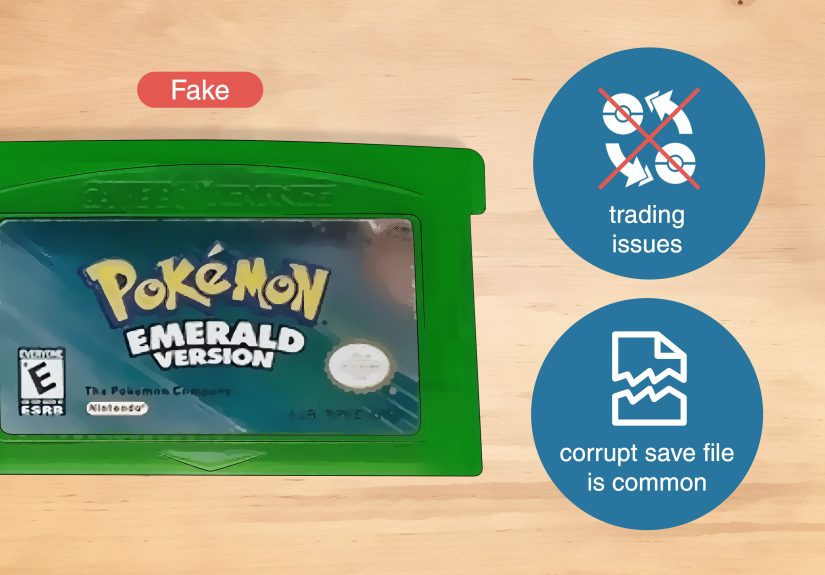
Counterfeit Pokémon Emerald games may still boot and play, but they are risky. They can have unstable saves, broken clock-based events, odd compatibility problems, poor-quality components, or no real collector value. If your goal is casual play and the listing clearly says “reproduction,” that is one thing. If you are paying for an authentic Pokémon Emerald cartridge, however, you should get the real deal.
Quick Checklist: Real Pokémon Emerald vs Fake
Before we go deep, here is the fast version. A real Pokémon Emerald cartridge should usually have:
- A translucent emerald-green Game Boy Advance shell.
- A sharp, metallic, reflective label with accurate colors.
- The correct “GAME BOY ADVANCE” molded text at the top of the cartridge.
- A proper ESRB “E” rating mark on North American copies.
- The official Nintendo seal printed cleanly on the label.
- An impressed factory stamp on the label, often two numbers or characters.
- Visible internal battery terminals and correct board features through the translucent shell.
- A clean Nintendo-style PCB if opened with the proper screwdriver.
A fake Pokémon Emerald cartridge may have dull plastic, a blurry label, incorrect fonts, suspiciously fresh condition, missing internal board details, a strange screw, bad soldering, or a battery message that does not match normal Pokémon Emerald behavior.
Step 1: Check the Cartridge Shell Color and Transparency
The first big clue is the shell. An authentic Pokémon Emerald cartridge uses a translucent green plastic shell. It should not look like solid green toy plastic, muddy teal, neon slime, or the color of a melted gummy bear. Real Emerald shells allow you to see parts of the internal circuit board when held under light.
Fakes often get the shell wrong. Some are too dark, too cloudy, too bright, or too opaque. A counterfeit may appear almost solid, making it hard to see the board inside. Others use plastic that feels cheap, slippery, or strangely lightweight. While feel alone is not enough to prove authenticity, it can support the rest of your inspection.
Also look at the molded text at the top. The words “GAME BOY ADVANCE” should be clean, evenly spaced, and properly shaped. On many fake Pokémon Emerald cartridges, this logo appears too thin, too glossy, too tall, or poorly molded. If the shell looks like it came from a knockoff vending machine, listen to your instincts.
Step 2: Inspect the Front Label Like a Detective
The label is where many fake cartridges accidentally wave a tiny red flag. A real Pokémon Emerald label has a metallic, holographic quality. It should reflect light in a controlled way, not look like a flat photocopy. The colors should be rich but not oversaturated. Rayquaza should look sharp, not like he was dragged through a low-resolution printer.
Check the label alignment. Authentic labels are generally placed straight, with clean edges and consistent positioning. A crooked label does not automatically prove a fake, because old games can be relabeled or damaged, but it should make you look more carefully.
Pay close attention to the small text. The “Nintendo” logo, “The Pokémon Company,” the product code, and legal text should be crisp. On North American copies, the label code should match the correct regional style, commonly seen as AGB-BPEE-USA for Pokémon Emerald. Fakes may use wrong codes, blurry microtext, incorrect spacing, or odd font weights. If the fine print looks like it was typed by a sleepy Zubat, be suspicious.
The ESRB Logo Test
For U.S. copies, Pokémon Emerald is rated E for Everyone. The ESRB logo on the label should look professional, with correct proportions and clean text. Counterfeit labels often mess up the ESRB mark. The “E” may be too skinny, the word “EVERYONE” may be oddly spaced, or the black border may look thicker or thinner than expected.
This is a great example of why comparison photos help. Search for high-quality images of confirmed authentic copies, then compare the ESRB box, Nintendo seal, Pokémon logo, and Rayquaza art. A fake may look fine by itself, but side-by-side it suddenly looks like it failed art class.
Step 3: Look for the Factory Imprint on the Label
Many authentic Game Boy Advance cartridges have an impressed factory stamp on the label. On Pokémon Emerald, this often appears as two small numbers or characters pressed into the sticker. It may be near the right side or around the label artwork, depending on the copy. You may need to tilt the cartridge under a lamp to see it.
Here is the important nuance: a visible imprint is a strong sign of authenticity, but the absence of an obvious stamp should not be your only evidence. Labels wear down, lighting can hide the imprint, and photos may not capture it. Still, if a listing shows a clean, shiny label with no sign of an imprint and several other suspicious traits, proceed carefully.
Fake labels often skip this detail entirely. Some counterfeiters try to imitate it, but the result may look printed rather than pressed. A real imprint is physically stamped into the label surface. It should not look like part of the artwork.
Step 4: Flip the Cartridge and Study the Back
The back of the cartridge is where the truth often starts sweating. Because Pokémon Emerald has a translucent shell, you can see parts of the PCB without opening the game. Collectors often look for visible board features, including the distinctive group of four rectangular gold contacts or test pads near the upper-left area on authentic mainline GBA Pokémon games.
If the back is too opaque to see anything clearly, that is a warning sign. If the internal board layout looks strange, incomplete, or nothing like known authentic examples, be cautious. Fakes frequently use generic boards that do not match Nintendo’s manufacturing layout.
Check the screw as well. Real GBA cartridges use a tri-wing screw. If the screw looks stripped, replaced, or mismatched, it may simply mean the cartridge was opened for a battery replacement, but it should still push you to inspect further. A replaced screw is not always bad. A weird screw paired with a suspicious shell and blurry label? That is a Team Rocket-level situation.
Step 5: Understand the Battery Message
Pokémon Emerald uses an internal battery for clock-based events. Over time, the battery can run dry. On an authentic copy, a dead battery does not usually erase your save file. Instead, the game can display a message explaining that the internal battery has run dry and that clock-based events will no longer occur.
This means berry growth, certain timed events, and other clock-related features may stop working. The game itself can still be played. So, if you boot an authentic old copy and see a dry battery message, do not panic. That is normal aging, not automatic proof of a fake.
However, some counterfeit cartridges display odd startup messages, save warnings, or shortened text that does not match the normal wording. Others save in unusual ways or lose progress after several hours. If the seller claims, “The weird message means it is rare,” please escort that claim directly to the nearest trash can.
Step 6: Open the Cartridge Only If You Can Do It Safely
The most reliable authentication method is internal inspection, but you should only open the cartridge if you own it, have permission, and have the right tool. For Game Boy Advance cartridges, that typically means a small tri-wing screwdriver. Do not use a kitchen knife, a paperclip, or “pure determination.” That is how plastic gets damaged and regret enters the Pokédex.
Inside a real Pokémon Emerald cartridge, the PCB should look clean and professionally manufactured. You should see proper chip markings, Nintendo-style board text, and a layout that matches confirmed authentic references. Authentic boards often include recognizable manufacturer markings, clean solder points, and no strange loose wires.
Fake boards may look obviously different. Watch for black epoxy blobs, messy soldering, cheap flash memory chips, wires, missing printed markings, or board shapes that do not fit the shell correctly. Some counterfeits are more polished than others, but most still fail when compared closely with an authentic PCB.
Step 7: Test Gameplay, Saving, and Trading
A fake Pokémon Emerald cartridge may boot successfully, which is why visual inspection matters. Still, gameplay testing can reveal problems. Start a file, save, power off, and reload. Then play long enough to test whether saving remains stable. Some bootlegs save at first but corrupt later, which is especially painful after you have named your starter something emotionally significant like “Waffles.”
Trading and connectivity can also expose issues. Pokémon Emerald was designed to interact with other Generation III games and accessories through original hardware. Counterfeit carts may have problems trading, migrating, linking, or handling certain save operations. If you plan to move Pokémon through legitimate hardware chains, authenticity becomes much more important.
Also pay attention to time-based features. A genuine copy with a dry battery will have clock-based limitations, but the behavior should be consistent and explainable. A fake may behave unpredictably or fail in ways that do not match the standard dry-battery condition.
Step 8: Be Careful With Online Listings
Online shopping is where many collectors get burned. A listing may show one real cartridge in the photos and ship a different one. Or the photos may be so blurry that Bigfoot would complain about image quality. Before buying, ask for clear pictures of the front, back, label close-up, top logo, and, if possible, the internal board.
A trustworthy seller should not be offended by reasonable authentication questions. Ask directly: “Is this an authentic Nintendo cartridge or a reproduction?” Save the response. If the seller avoids the question, uses only stock images, refuses extra photos, or prices the game far below market value, you have your answer.
Be especially cautious with listings that say “brand new” but show loose cartridges. Authentic sealed Pokémon Emerald copies are rare and expensive. A loose cartridge advertised as “new” usually means new reproduction, not new old stock. Words like “repro,” “replacement,” “fan-made,” “custom,” and “plays great” may indicate the cartridge is not original.
Real Pokémon Emerald vs Fake: Common Red Flags
Here are the most common warning signs buyers should watch for:
- The shell is opaque instead of translucent green.
- The label is blurry, flat, dull, or overly glossy.
- The ESRB logo looks wrong or poorly printed.
- The Nintendo seal is misshaped or low-resolution.
- The “GAME BOY ADVANCE” logo on the shell has incorrect font or spacing.
- There is no visible PCB detail through the shell.
- The back board features do not match authentic examples.
- The cartridge has strange startup messages or unstable saves.
- The seller refuses to provide clear photos.
- The price is dramatically lower than comparable authentic copies.
One red flag may not be enough to convict the cartridge. Several red flags together? That is no longer a mystery. That is a fake wearing a tiny disguise mustache.
Are Reproduction Pokémon Emerald Cartridges Always Bad?
Not every reproduction cartridge is sold with bad intentions. Some people buy repro carts because they want an affordable way to play on original hardware. The problem begins when a reproduction is sold as authentic. A clearly labeled repro at a repro price is a different situation from a counterfeit sold at collector value.
If you only want to experience the story, a reproduction may seem tempting. But remember the risks: saves can fail, clock events may not work correctly, trading may be unreliable, and the cartridge has little or no collector value. If you care about preserving your Pokémon, connecting to other games, or building a genuine collection, authentic is the better path.
For collectors, condition also matters. A real copy with label wear is still authentic. A perfect-looking fake is still fake. Do not let shiny plastic hypnotize you. Authenticity comes first; cosmetic condition comes second.
Buyer’s Strategy: How to Avoid Getting Scammed
The best strategy is to slow down. Counterfeit sellers benefit from rushed buyers. Before paying, compare the cartridge to multiple confirmed authentic examples. Look at the front label, back shell, PCB visibility, molded logo, ESRB mark, and factory imprint. If buying online, request photos taken in natural light from several angles.
Buy from sellers with strong return policies. Retro game stores that authenticate inventory are often safer than random marketplace listings, although mistakes can still happen. If buying from an individual, use a payment method with buyer protection. Avoid cash deals unless you can inspect the cartridge in person.
Finally, trust patterns, not single clues. A real Pokémon Emerald cartridge should pass several tests at once. A fake usually fails multiple small details. Authentication is not about one magic trick; it is about building confidence from the whole picture.
Experience Notes: What It Feels Like to Buy Pokémon Emerald Real vs Fake
The first time many collectors shop for Pokémon Emerald, they underestimate how emotional the process can be. This is not just another old cartridge. For a lot of players, Emerald means summer afternoons, secret bases, the Battle Frontier, and the first time Rayquaza dropped from the sky like Hoenn’s green emergency manager. So when you finally decide to buy a copy, the excitement can make you move too fast.
A common experience goes like this: you find a listing that looks decent, the price is lower than usual, and the seller says it “works great.” The front photo looks shiny enough. The label has Rayquaza. The shell is green. Your brain whispers, “This is the one.” But then you zoom in and notice the ESRB logo looks strange. The “GAME BOY ADVANCE” text seems too thin. The back photo is missing, and when you ask for one, the seller sends a blurry picture taken from what appears to be another zip code. That is when patience saves your wallet.
In real-world buying, the biggest lesson is that fakes often look convincing at first glance. They are designed to pass the quick-scroll test. The difference appears when you compare details. The label reflection may be wrong. The shell may be too opaque. The board may not show the correct features. The seller may use careful wording like “authentic style” or “plays like original.” Those phrases are not always scams, but they are invitations to ask more questions.
Another experience buyers often share is discovering that a dry internal battery is not the disaster they feared. Someone boots up a real Emerald copy, sees the battery message, and immediately thinks they bought a fake. In reality, many authentic cartridges have dry batteries simply because they are old. The key is whether the message and game behavior match a normal dry-battery Emerald copy. A dead battery can be replaced by someone with the right tools and soldering experience. A fake board cannot be turned into a genuine Nintendo board with wishful thinking.
In-person shopping brings a different rhythm. At a flea market or retro store, you can hold the cartridge, tilt the label under light, inspect the shell, and check the back. Bring reference photos on your phone. Do not feel awkward about looking closely. You are not being difficult; you are being responsible. Authentic Pokémon Emerald is valuable enough that careful inspection is normal. If a seller pressures you to decide instantly, that pressure itself is useful information.
The most satisfying buying experience happens when every detail lines up. The shell has the right translucent green tone. The label catches light correctly. The factory imprint is visible. The back shows the expected board features. The game boots with normal behavior, saves correctly, and feels like the Emerald you remember. At that moment, you are not just buying plastic and silicon. You are rescuing a small piece of handheld history from the tall grass.
Conclusion: Spot the Fake Before It Spots Your Wallet
Learning how to tell Pokémon Emerald real vs fake is one of the most useful skills a retro Nintendo collector can have. Authentic copies have a set of consistent traits: translucent green plastic, a crisp reflective label, correct Nintendo and ESRB markings, factory label impressions, visible PCB details, and stable game behavior. Fake copies usually fail somewhere, whether in the shell, label, board, battery behavior, or seller presentation.
The safest approach is simple: compare before you buy, ask for clear photos, avoid suspiciously cheap listings, and treat vague seller answers as warning signs. If you already own a copy, inspect it patiently from the outside first, then consider opening it only with the proper tool and care. A genuine Pokémon Emerald cartridge is worth protecting, and your money deserves better than a bootleg in cosplay.
In the end, spotting a fake is not about being paranoid. It is about being prepared. With the right checklist, you can shop confidently, avoid counterfeits, and keep your Hoenn adventure authentic from Littleroot Town to the Battle Frontier.