Table of Contents >> Show >> Hide
- Why Meteorites Fool So Many People
- How to Tell if the Rock You Found Might Be a Meteorite: 11 Steps
- Step 1: Check whether it feels unusually heavy for its size
- Step 2: Use a magnet, but do not fall in love with the result
- Step 3: Look for a fusion crust on the outside
- Step 4: Study the shape and surface texture
- Step 5: Rule out holes, bubbles, and hollow spots
- Step 6: Check for obvious crystals or quartz
- Step 7: Look inside for metal flecks or tiny round grains
- Step 8: Try a careful streak test only if needed
- Step 9: Ask whether the rock makes sense for the place you found it
- Step 10: Compare it against the most common meteorite look-alikes
- Step 11: Seek expert confirmation before making any big claims
- What Different Meteorite Types Usually Look Like
- Common Mistakes People Make During Meteorite Identification
- Real-World Experiences: What It Feels Like to Think You Found a Meteorite
- Final Thoughts
- SEO Tags
Finding an odd-looking rock can make even a very normal walk feel like the opening scene of a sci-fi movie. One minute you are kicking pebbles down a trail, and the next minute you are whispering, “What if this thing fell out of space?” That little thrill is understandable. Meteorites are real, they do land on Earth, and some of them look dramatically different from ordinary rocks. The catch is that countless Earth rocks, industrial slag, and rusty chunks of metal also like to audition for the part.
If you are wondering how to tell if a rock might be a meteorite, the best approach is not one magic test. It is a series of clues. A genuine space rock usually checks several boxes at once: unusual heft, some degree of magnetism, a dark fusion crust, no bubbly holes, and an interior that may show metal flecks or tiny rounded grains called chondrules. On the other hand, a rock with big gas bubbles, obvious quartz, or a streak that screams “I am magnetite” is usually not a meteorite at all. In other words, meteorite identification is less like love at first sight and more like a detective story with a skeptical geologist as the narrator.
This guide walks through 11 practical steps you can use at home before you decide whether your find deserves expert attention. It will also help you avoid the most common “meteor-wrongs,” because nature and old furnace waste both enjoy practical jokes.
Why Meteorites Fool So Many People
Meteorites are rare, but suspicious-looking rocks are not. That is why so many people mistake volcanic rocks, iron-rich minerals, concretions, and slag for something extraterrestrial. A real meteorite can be black, brown, rounded, pitted, and magnetic. Unfortunately, so can plenty of ordinary things that were born on Earth and never left the planet for even a long weekend.
The smartest way to evaluate a possible meteorite is to think in layers. Do not ask, “Does it stick to a magnet?” and declare victory. Ask instead, “Is it heavy for its size, slightly or strongly magnetic, lacking bubbles, coated in fusion crust, and unusual for the area?” The more clues line up, the more interesting your rock becomes.
How to Tell if the Rock You Found Might Be a Meteorite: 11 Steps
Step 1: Check whether it feels unusually heavy for its size
One of the first meteorite clues is density. Many meteorites contain iron-nickel metal, so they often feel heavier than an ordinary Earth rock of the same size. If your rock looks like it should weigh as much as a potato but feels more like a paperweight with trust issues, that is worth noting.
Still, do not let “heavy” do all the talking. Some terrestrial rocks and chunks of slag can also be very dense. A meteorite may be heavy for its size, but heaviness alone is not a reliable final answer. Think of it as a promising first date, not a marriage certificate.
Step 2: Use a magnet, but do not fall in love with the result
The classic magnet test exists for a reason. Many meteorites attract a magnet because of their iron content. Iron meteorites are strongly magnetic, while many stony meteorites show weaker attraction. A small hand magnet is fine, but a magnet suspended by a string can help you notice subtle pull if the sample only attracts weakly.
Here is the catch: magnetite and other iron-rich Earth materials can also attract a magnet. So yes, magnetism is helpful, but no, it does not mean you found a celebrity from the asteroid belt. Also remember that not every meteorite is noticeably magnetic. Some lunar and Martian meteorites, along with certain other types, contain little or no metal. That means a failed magnet test does not automatically close the case.
Step 3: Look for a fusion crust on the outside
A fresh meteorite often has a thin, dark outer coating called a fusion crust. This forms when the rock’s surface melts as it races through Earth’s atmosphere. Fresh fusion crust is often black. Over time, weathering can turn it brown or rusty, especially if the meteorite has been sitting outside for years.
A true fusion crust is usually thin, not thick and bubbly. That matters, because many people confuse desert varnish, weathered rinds, volcanic textures, or slag skin for fusion crust. If the outside looks like it was dipped in tar and then puffed up like burnt marshmallow foam, it is probably not your lucky day.
Step 4: Study the shape and surface texture
Most meteorites are not perfectly round, and they are usually not dramatically aerodynamic like a cartoon space torpedo. Many are irregular with rounded edges. Some show shallow dimples or thumbprint-like pits called regmaglypts, especially iron meteorites. These surface marks can be striking, but they are not present on every specimen.
A smooth but subtly pitted surface can be promising. A perfect sphere, though, should make you suspicious. So should anything that looks obviously machine-made. If your “meteorite” resembles a ball bearing, a chunk of cast iron, or a sad old piece of farm equipment, you may be dealing with human history rather than cosmic history.
Step 5: Rule out holes, bubbles, and hollow spots
This step eliminates a huge number of false alarms. Meteorites generally do not have large vesicles, which are the gas bubbles or holes commonly seen in volcanic rocks and industrial slag. In plain English, if your rock looks like it once tried to become a sponge, that is a bad sign.
Porous, bubbly, or hollow specimens are usually terrestrial. Slag is especially notorious here. It can be dark, heavy, magnetic, and weird-looking, which is basically the full costume department for meteorite confusion. But the bubbly texture gives it away far more often than people expect.
Step 6: Check for obvious crystals or quartz
Large visible crystals are another red flag. Meteorites do not typically contain big quartz crystals, amethyst-like cavities, or geode-style interiors. If you crack open the rock and it looks like a gift shop geode with stage lighting potential, it is not a meteorite.
That does not mean the inside must look boring. Many meteorites have interesting interiors, just not the same kind you see in common Earth rocks. A stony meteorite may look gray and fine-grained. A stony-iron meteorite may contain metal with olivine crystals. But obvious quartz and large showy crystals usually point you back toward Earth.
Step 7: Look inside for metal flecks or tiny round grains
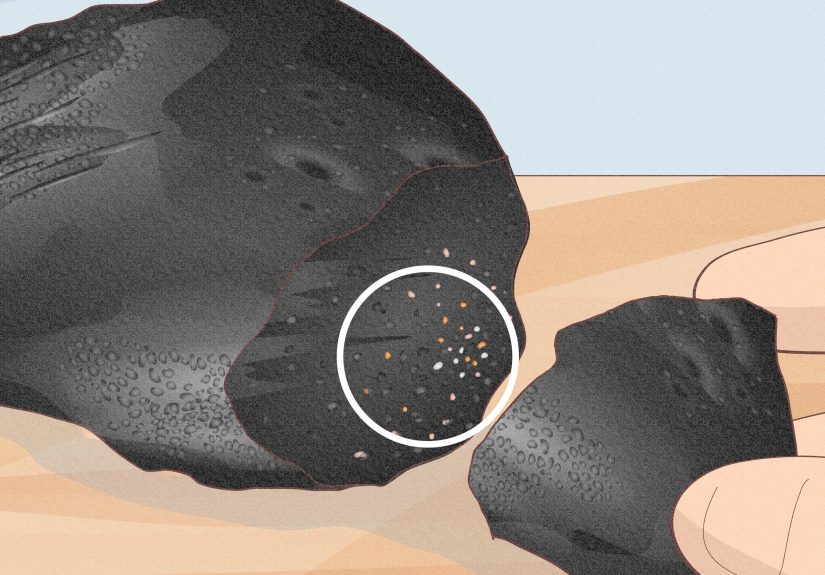
If you already have a broken surface, or if a tiny inconspicuous edge is safely exposed, inspect the interior with a magnifier. Many common stony meteorites, especially chondrites, contain small metal flecks and rounded bead-like structures called chondrules. Chondrules are tiny spheres formed early in solar system history, and they are one of the best clues you can see with the naked eye or a hand lens in some specimens.
Be careful with shiny specks, though. Mica and other minerals can glint too. Real metal flecks in meteorites tend to look more like embedded silver-gray grains than flashy glitter. If you have an iron meteorite, the inside may appear bright metallic when cut. Just do not go carving into a possibly valuable specimen like you are preparing vegetables for soup.
Step 8: Try a careful streak test only if needed
A streak test can help you rule out common impostors, especially magnetite and hematite. Rub a tiny inconspicuous area against the unglazed underside of a ceramic tile. Many meteorites will not leave a strong colored streak, while magnetite often leaves a black streak and hematite can leave a reddish-brown one.
This is a useful elimination step, not a coronation ceremony. Do not grind away a beautiful crust just to satisfy curiosity. If the specimen already looks promising, it is better to limit damage and document what you have. In meteorite hunting, restraint is surprisingly sexy.
Step 9: Ask whether the rock makes sense for the place you found it
Context matters. Is the rock unlike everything else around it? That can be a good sign. If you found one dark, dense, magnetic stone in an area full of pale sedimentary rocks, your eyebrows should rise a little. If you found it next to railroad ballast, a driveway, industrial waste, or old mining debris, your eyebrows should calm down immediately.
It also helps to remember that meteorites are not usually found in little matching families scattered across one tiny area. If you are surrounded by dozens of identical black rocks, they are probably local material. A single oddball is more interesting than a whole neighborhood of space-copycats.
Step 10: Compare it against the most common meteorite look-alikes
The best meteorite hunters learn the impostors almost as well as the real thing. The usual suspects include slag, magnetite, hematite, basalt, industrial iron debris, concretions, and weathered manmade objects. Slag may be dark, dense, and magnetic, but it often has bubbles, glassy patches, or messy melted textures. Magnetite can be black, heavy, and strongly magnetic, yet it commonly gives a black streak. Concretions may be oddly shaped and impressive, but they usually lack the right crust and internal features.
This comparison step is where many “maybe meteorites” quietly become “definitely driveway drama.” And honestly, that is still useful. Ruling out the wrong answer is real progress.
Step 11: Seek expert confirmation before making any big claims
Even when a rock passes several home tests, official meteorite identification usually requires expert examination and often lab analysis. That may involve looking at thin sections, chemistry, mineral content, or microscopic structure. In other words, your kitchen magnet is a decent scout, but it is not the Supreme Court of meteoritics.
If your specimen looks genuinely promising, take clear photos of all sides, note the weight, size, location found, and whether it was on the surface or partly buried. Contact a university geology department, natural history museum, or meteoritics expert for guidance before mailing anything. Many programs no longer accept random public samples, so always ask first. A good paper trail can be almost as useful as the rock itself.
What Different Meteorite Types Usually Look Like
Iron meteorites
These are the easiest to notice because they are heavy, metallic, and strongly magnetic. They may show deep regmaglypts and weather into rusty brown surfaces. If cut and properly etched by professionals, many display the famous Widmanstätten pattern, a crisscross structure that forms in iron-nickel metal over enormous spans of time.
Stony meteorites
These are the most common meteorites to fall to Earth, but they are often harder for non-experts to recognize. Many have fusion crust, gray interiors, tiny metal grains, and sometimes visible chondrules. They may not look especially dramatic, which is inconvenient because nothing says “important scientific object” less effectively than “gray rock.”
Stony-iron meteorites
These are rare and often beautiful, mixing metal with silicate minerals. Some contain olivine crystals in a metallic matrix. If you find one, congratulations, but also please do not use it as a doorstop.
Common Mistakes People Make During Meteorite Identification
The first mistake is relying on only one test. A magnetic rock is not automatically a meteorite. The second mistake is ignoring surface bubbles and obvious terrestrial features. The third is damaging the specimen too aggressively before documenting it. The fourth is forgetting that weathering changes appearance over time. A meteorite found long after it landed may not look jet-black and pristine.
The fifth mistake is confidence. Meteorites are amazing, but geology is full of humble pie. If three clues support your theory and four clues argue against it, listen to the four clues. Space rocks are rare. Overconfident guesses are not.
Real-World Experiences: What It Feels Like to Think You Found a Meteorite
People who think they have found a meteorite usually describe a similar emotional roller coaster. First comes the thrill. The rock looks different. It feels heavy. It sticks to a magnet. Suddenly the brain stops being a brain and becomes a movie trailer narrator: In a world where ordinary walks lead to extraordinary discoveries… Then the second phase begins, which is internet searching. Lots of internet searching. Very dramatic zooming into photos. At least one sentence that begins with, “Okay, but mine really does look like the ones online.”
In many cases, the experience becomes a lesson in observation. Someone finds a dark stone in a field, notices the rounded edges, and gets excited. Then they look closer and realize it has bubbly holes. Another person picks up a dense black rock from a dry wash, tests it with a magnet, and starts planning the museum interview. Later, a streak test reveals it is magnetite. A third person discovers a rusty metallic lump on family land and spends a week imagining retirement-by-space-rock, only to learn it is old industrial iron. None of those stories end with fame, but they do end with better eyes and better questions.
Occasionally, though, the experience moves in the other direction. A finder notices that a stone is oddly heavy for its size. It is not porous. It has a thin dark rind rather than a bubbly outer shell. A small broken edge reveals tiny silver-colored flecks and a gray interior that does not match local rock. The magnet pull is real but not exaggerated. That is when the whole process changes from daydreaming to documentation. Photos get taken in natural light. The specimen gets weighed. Notes get written down about where it was found. The finder becomes careful, not flashy, which is exactly the right move.
Another common experience is surprise at how many experts say no. Universities and museums often cannot identify every suspicious rock people send them, and many public identification programs have been reduced or suspended. That frustrates people at first, but it also teaches an important point: meteorite classification is specialized work. A real answer may require microscopy, chemistry, or comparison with known meteorite groups. The good news is that the process rewards patience. The more respectfully and thoroughly you document a sample, the easier it is for an expert to tell whether it deserves deeper analysis.
Perhaps the most valuable experience of all is learning how a possible meteorite changes the way you look at ordinary ground. After one serious attempt at meteorite hunting, people start noticing texture, density, color, crust, and context everywhere. They stop seeing “just rocks” and start seeing clues. Even when the answer is no, the experience is still strangely satisfying. You may not have found a messenger from the early solar system, but you did train your attention on the physical world in a deeper way. That is a good trade. And if your rock really is a meteorite, those careful habits are exactly what will help prove it.
Final Thoughts
If you want to know how to tell if a rock might be a meteorite, the best answer is simple: build a case, do not chase a fantasy. Look for unusual density, some degree of magnetism, a thin fusion crust, a lack of holes, and an interior that supports the story. Rule out the common impostors. Compare the rock to its surroundings. Document everything. Then let an expert decide whether your weird little treasure is truly a meteorite or just a very convincing Earth rock with great confidence.
Either way, you win something. At minimum, you get a sharper eye and a better understanding of meteorite identification. At best, you may be holding a piece of material older than Earth itself. Not bad for something you almost kicked aside on a walk.