Table of Contents >> Show >> Hide
- What Is a Radical Equation?
- Why Radical Equations Can Be Tricky
- How to Solve Radical Equations: 12 Steps
- Step 1: Identify the Radical Equation
- Step 2: Simplify Both Sides First
- Step 3: Isolate One Radical Term
- Step 4: Think About Restrictions Before Removing the Radical
- Step 5: Raise Both Sides to the Power of the Index
- Step 6: Expand and Simplify Carefully
- Step 7: Solve the New Equation
- Step 8: Repeat the Process if Another Radical Remains
- Step 9: Check Every Proposed Solution in the Original Equation
- Step 10: Watch for Extraneous Solutions
- Step 11: Handle Cube Roots and Other Indexes the Same Way
- Step 12: State the Final Answer Clearly
- A Full Example From Start to Finish
- Common Mistakes When Solving Radical Equations
- Quick Tips to Solve Radical Equations Faster
- Why This Skill Matters in Algebra
- Experiences Students Often Have While Learning Radical Equations
- Conclusion
- SEO Tags
Radical equations have a reputation for being the drama queens of algebra. Everything looks calm, and then suddenly a square root shows up, hides the variable under a radical sign, and turns a normal homework problem into a trust exercise. The good news is that solving radical equations is not magic, and it is definitely not a secret club reserved for people who enjoy writing tiny numbers as exponents. It is a process. A reliable, step-by-step, very-beat-able process.
If you want to learn how to solve radical equations without guessing, panicking, or accidentally adopting an extraneous solution like a stray cat, this guide will walk you through it. We will cover the logic behind radical equations, the exact method to solve them, common traps, and several specific examples. By the end, you will know how to isolate radicals, remove them correctly, and check your answers like a person who has seen things before.
What Is a Radical Equation?
A radical equation is an equation where the variable appears inside a radical expression. In plain English, the variable is trapped under a root sign, such as a square root or cube root. A simple example is:
√(x + 5) = 3
Here, the variable x is inside the radical, which means normal one-step algebra will not get it out right away. To solve radical equations, the main goal is to eliminate the radical by using the inverse operation. For a square root, that usually means squaring both sides. For a cube root, it means cubing both sides. Radical equations often look manageable at first, and then they sneak in a fake answer, which is why checking the final result in the original equation matters so much.
Why Radical Equations Can Be Tricky
The biggest issue is that removing a radical can change the equation in a way that creates an answer that did not belong there in the first place. This is called an extraneous solution. It is not you making a mistake. It is the algebra equivalent of the equation saying, “Technically, I never promised to play fair.”
That is why a good method matters. The best way to solve square root equations and other radical equations is to move carefully, isolate one radical at a time, raise both sides to the correct power, simplify completely, and test every proposed answer in the original equation.
How to Solve Radical Equations: 12 Steps
Step 1: Identify the Radical Equation
Before you start moving symbols around like furniture in a tiny apartment, confirm that you are actually dealing with a radical equation. Look for a variable inside a radical, such as:
- √(2x + 1) = 5
- √(x – 3) + 2 = 7
- 3√(x + 8) = 2
If the variable is under the root sign, the problem belongs in the radical-equation family.
Step 2: Simplify Both Sides First
Before doing anything dramatic, simplify. Combine like terms, reduce fractions if possible, and make sure each side is as clean as it can be. If you skip this step, the equation can get messy fast, and not in the charming “creative genius” way.
Example: If you have √(x + 9) + 3 = 10, subtract 3 first so the equation becomes √(x + 9) = 7. That is much easier to work with.
Step 3: Isolate One Radical Term
This is one of the most important steps in solving radical equations. Get one radical by itself on one side of the equation. If there are multiple radicals, isolate one first. Trying to remove two radicals at the same time is like trying to untangle two charging cables while half asleep.
Example:
√(2x + 3) + 1 = x
Subtract 1 from both sides:
√(2x + 3) = x – 1
Step 4: Think About Restrictions Before Removing the Radical
With even-index radicals like square roots, the expression under the radical must be nonnegative. Also, the other side of the equation must match what a square root can produce, which means it cannot be negative.
In the equation √(2x + 3) = x – 1, the right side must be at least 0, so x – 1 ≥ 0, which means x ≥ 1. This restriction can help you spot nonsense answers later.
For odd roots, such as cube roots, domain restrictions are usually less strict because cube roots can handle negative values.
Step 5: Raise Both Sides to the Power of the Index
Now eliminate the radical by raising both sides to the power that matches the index. For a square root, square both sides. For a cube root, cube both sides.
Example:
√(2x + 3) = x – 1
Square both sides:
2x + 3 = (x – 1)2
This is the heart of the method. It is also the point where extraneous solutions can begin sneaking onto the guest list, so stay alert.
Step 6: Expand and Simplify Carefully
After raising both sides to a power, simplify completely. If you squared a binomial, expand it correctly. This is not the moment for creative math.
Continuing the example:
2x + 3 = (x – 1)2 = x2 – 2x + 1
Move everything to one side:
0 = x2 – 4x – 2
Or write it as:
x2 – 4x – 2 = 0
Step 7: Solve the New Equation
At this point, you usually have a linear equation, quadratic equation, or sometimes something slightly fancier. Use the appropriate algebra method: factoring, completing the square, or the quadratic formula.
For x2 – 4x – 2 = 0, use the quadratic formula:
x = [4 ± √(16 + 8)] / 2 = [4 ± √24] / 2 = 2 ± √6
So the possible solutions are:
- x = 2 + √6
- x = 2 – √6
Step 8: Repeat the Process if Another Radical Remains
Some radical equations do not surrender after one round. If a radical still remains after simplifying, isolate it again and repeat the process.
Example:
√(x + 5) + √(x – 1) = 6
Isolate one radical:
√(x + 5) = 6 – √(x – 1)
Square both sides, simplify, isolate the remaining radical again, and square a second time. Multi-radical equations are basically algebra saying, “I hope you packed a lunch.”
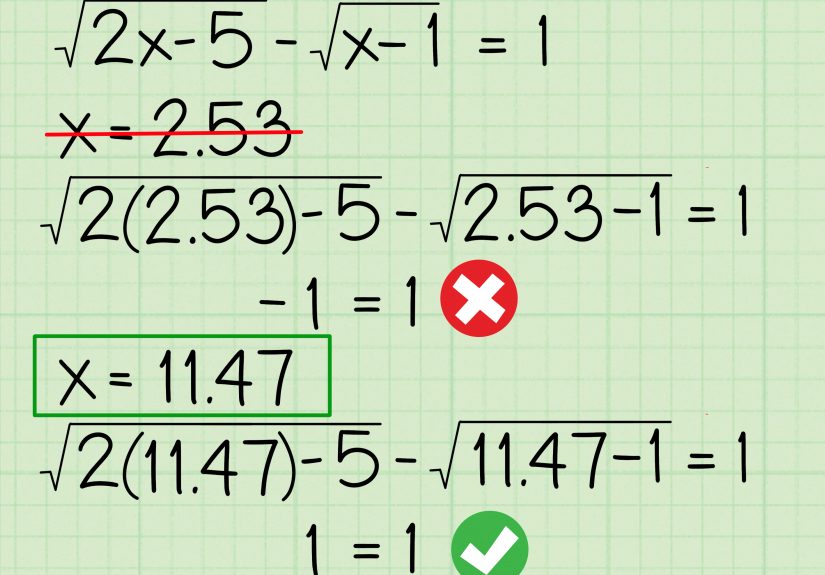
Step 9: Check Every Proposed Solution in the Original Equation
This step is not optional. It is not “recommended.” It is the step that saves you from confidently writing down the wrong answer with excellent handwriting.
Let us check the earlier possible solutions in the original equation:
√(2x + 3) + 1 = x
If x = 2 + √6, the equation works.
If x = 2 – √6, then the right side becomes less than 1, which fails the earlier restriction and does not satisfy the original equation.
So the only valid solution is:
x = 2 + √6
Step 10: Watch for Extraneous Solutions
Extraneous solutions are answers created during the solving process that do not actually satisfy the original radical equation. They happen most often when squaring both sides of an equation. This is why checking matters.
Example:
√(x + 5) = x – 1
Square both sides:
x + 5 = x2 – 2x + 1
0 = x2 – 3x – 4
(x – 4)(x + 1) = 0
Possible solutions: x = 4 and x = -1
Check them in the original equation:
- x = 4: √9 = 3 and 4 – 1 = 3, so it works.
- x = -1: √4 = 2 but -1 – 1 = -2, so it fails.
Final answer: x = 4
Step 11: Handle Cube Roots and Other Indexes the Same Way
The process is similar for cube roots and higher radicals. The only difference is the power you use to eliminate the radical.
Example:
3√(x – 7) = 2
Cube both sides:
x – 7 = 8
x = 15
Check:
3√(15 – 7) = 3√8 = 2
Done. Cube-root equations are often kinder than square-root equations because they are less likely to create the same kind of sign issues.
Step 12: State the Final Answer Clearly
After checking, write only the values that satisfy the original equation. If no proposed value works, then the radical equation has no real solution. That is a perfectly respectable answer. Not every equation ends with a happy reunion.
A Full Example From Start to Finish
Let us solve one more radical equation using the full method:
√(x + 1) + 2 = x
Step A: Isolate the Radical
Subtract 2 from both sides:
√(x + 1) = x – 2
Step B: Apply a Restriction
Because the left side is a square root, the right side must be nonnegative:
x – 2 ≥ 0, so x ≥ 2
Step C: Square Both Sides
x + 1 = (x – 2)2
x + 1 = x2 – 4x + 4
Step D: Solve the Quadratic
0 = x2 – 5x + 3
Using the quadratic formula:
x = [5 ± √(25 – 12)] / 2 = [5 ± √13] / 2
Step E: Check Both Answers
Approximate values:
- x = (5 + √13)/2 ≈ 4.30
- x = (5 – √13)/2 ≈ 0.70
The second value fails the restriction x ≥ 2, so it is out immediately. Check the first in the original equation:
√(4.30 + 1) + 2 ≈ √5.30 + 2 ≈ 2.30 + 2 = 4.30
Valid solution:
x = (5 + √13)/2
Common Mistakes When Solving Radical Equations
- Forgetting to isolate the radical first: Squaring too early can create unnecessary mess.
- Dropping parentheses: If you square x – 1, you must get (x – 1)2, not x2 – 1.
- Skipping restrictions: A square root cannot equal a negative number in the real-number system.
- Not checking answers: This is the fastest route to adopting an extraneous solution.
- Stopping too early: If another radical remains, the problem is not done yet.
Quick Tips to Solve Radical Equations Faster
- Look at the index of the radical before deciding what power to use.
- Isolate one radical term at a time.
- Keep an eye on domain restrictions, especially with square roots.
- Use factoring when possible, but do not be afraid of the quadratic formula.
- Always substitute answers back into the original equation, not the transformed one.
Why This Skill Matters in Algebra
Learning how to solve radical equations strengthens more than one algebra skill at once. You practice inverse operations, equation structure, quadratics, domain awareness, and logical checking. In other words, radical equations are not just random torment devices invented to ruin a perfectly decent afternoon. They help you become sharper at algebraic reasoning overall.
They also show up in geometry, physics, and higher math, especially in formulas involving distance, area, and relationships with squares and square roots. So yes, radical equations can feel fussy, but they are useful fuss.
Experiences Students Often Have While Learning Radical Equations
If you have ever stared at a radical equation and thought, “I know math and yet this thing looks like it was assembled by raccoons,” you are not alone. One of the most common experiences students have with radical equations is feeling confident for the first two steps and then suddenly getting betrayed by the answer check. That moment is frustrating, but it is also part of the learning process. Radical equations teach patience in a very direct, very memorable way.
Many students say the hardest part is not the squaring itself. It is remembering the structure. They may know how to square a binomial, but in the middle of a problem they rush, forget parentheses, and accidentally turn (x – 3)2 into x2 – 9. That is usually where the equation starts quietly planning revenge. Once students slow down and treat each algebra move like a deliberate step instead of a sprint, the problems become much more manageable.
Another common experience is discovering that checking answers is not just a teacher’s favorite hobby. At first, students often think checking is a formality, like saying “best regards” in an email you barely wanted to send. Then they solve a radical equation, get two answers, plug them back in, and realize one of them is completely fake. That is the day answer-checking stops feeling optional and starts feeling like armor.
There is also a strange but useful confidence boost that comes from learning restrictions. Once students understand that a square root expression cannot produce a negative value, they start spotting impossible answers before doing all the arithmetic. That shift feels powerful. It is the algebra version of suddenly knowing which characters in a mystery movie are suspicious before the soundtrack tells you.
Classroom experience shows that examples matter a lot here. Students learn faster when they see one radical equation with a clean solution, one with an extraneous solution, and one with two radicals that requires repeating the process. The variety helps them stop memorizing one exact pattern and start recognizing the underlying logic. That is when the topic finally clicks. Instead of thinking, “I hope this looks like the example from page 214,” they start thinking, “I know what the radical is doing, so I know what I need to do next.”
Tutors also notice something encouraging: students who struggle with radical equations at first often improve quickly once they develop a checklist. A simple mental routine works wonders: simplify, isolate, apply restrictions, raise both sides to the right power, solve, and check. That sequence reduces panic because it gives the brain a job. Instead of reacting emotionally to the square root, you follow the process. The square root does not have feelings. You do. Use the checklist.
In real study sessions, radical equations often become the topic that teaches discipline. They are not always the hardest equations in algebra, but they are among the best at exposing skipped steps. If you are careless, they punish carelessness. If you are methodical, they usually behave. Oddly enough, students often end up liking them more once they realize that. There is something satisfying about a problem type that rewards clean work so directly.
So if radical equations have felt annoying, confusing, or personally disrespectful, welcome to the club. The good news is that the experience improves fast with practice. Once you understand the 12 steps and commit to checking every proposed answer, these equations stop looking wild and start looking familiar. And in algebra, familiar is a beautiful thing.
Conclusion
Solving radical equations becomes much easier when you treat it like a sequence instead of a mystery. Identify the radical, simplify the equation, isolate one radical term, apply any restrictions, raise both sides to the correct power, solve the new equation, and then check every result in the original. That last move is what separates a correct answer from a very confident mistake.
If you practice the 12 steps consistently, square root equations and cube root equations will start to feel less intimidating. They may still look dramatic, because radical signs love attention, but you will know exactly how to handle them.