Table of Contents >> Show >> Hide
- What “Beating” 99 Nights in the Forest Actually Means
- Your First Few Days Decide the Entire Run
- Build a Base That Defends Itself
- The Best Resource Loop for Long Runs
- Choose Classes That Fit the Run, Not Your Ego
- How to Deal With the Biggest Threats
- Rescue Objectives Matter More Than New Players Realize
- Common Mistakes That End Otherwise Good Runs
- Late-Game Tips for Reaching Night 99
- Conclusion
- Experience-Based Tips From Real Long Runs
If 99 Nights in the Forest has been chewing up your runs, spitting out your teammates, and leaving your campfire looking like a yard sale during a hurricane, welcome. You are among friends. Or at least among other exhausted Roblox survivors who have learned the hard way that this game is not won by panic-chopping trees and screaming at wolves.
To beat 99 nights, you need more than bravery. You need a plan. A boring, practical, occasionally sweaty plan. The good news is that once you understand the game’s rhythm, the run becomes far more manageable. The better news is that you do not need superhero aim, a galaxy-brain loadout, or a PhD in campfire maintenance. You just need smart priorities, solid base defense, and a willingness to stop making the same “I’ll just go out one more time at night” mistake that gets half the lobby turned into deer snacks.
This guide breaks down the smartest ways to survive, scale, defend, and push your run all the way to Night 99. Whether you play solo, with randoms, or with a trusted crew of chaos goblins, these tips will give you a much better shot at finishing the challenge.
What “Beating” 99 Nights in the Forest Actually Means
In practical terms, beating 99 Nights in the Forest means building a run that does not collapse somewhere in the middle. Early success is about gathering. Mid-game success is about efficiency. Late-game success is about stability under pressure.
That means your goal is not to look impressive in the first few nights. Your goal is to create a camp and resource loop that still works when attacks get nastier, healing gets tighter, and one dumb decision can cost the whole squad. If your base is strong, your crafting is ahead of schedule, your food is reliable, and your team knows where to stand during invasions, Night 99 becomes realistic instead of mythical.
Your First Few Days Decide the Entire Run
1. Wood is your first real obsession
Early runs are won by players who treat wood like gold with splinters. You need it for the fire, for upgrades, for walls, for future crafting, and for basically every good decision you’ll want to make. New players often dump too much wood into the fire too fast, then stare helplessly at camp like someone who spent their grocery money on candles.
Gather aggressively at the start, but do it with purpose. Do not just strip the area clean and call it strategy. Bring back enough to secure the camp, then start thinking ahead: fuel, upgrades, barriers, and reserve stacks. A camp that has backup wood is calm. A camp that has “just enough for now” is one sneeze away from disaster.
2. Upgrade your base tools early, not late
One of the biggest run-killers is delaying your utility upgrades because you are chasing loot or trying to fight everything that moves. The better approach is simple: get your map and progress your crafting options as soon as possible. Information saves time, and time saves lives.
A map keeps you from wandering in circles like a confused raccoon with a flashlight. Better crafting opens the door to real survival tools instead of improvised nonsense. The earlier you unlock useful camp items, the smoother every future day becomes.
3. Use daylight like it pays hourly
Do your risky work during the day. Chop, loot, scout, hunt, and bring resources home while visibility is good and the camp is not under pressure. Night should be for defense, quick controlled tasks, and not pretending you are invincible because you found one decent weapon.
Players who keep daytime structured tend to win. Players who improvise everything usually invent new ways to lose.
Build a Base That Defends Itself
Prioritize function over beauty
Yes, a gorgeous camp is nice. No, your decorative masterpiece will not help when enemies flood your perimeter. Your first good base should be practical: easy to move through, easy to defend, and hard for enemies to pressure from multiple angles.
Think in layers. You want your campfire protected, your movement paths clear, and your team able to reposition without getting stuck on random furniture that looked cute ten minutes earlier.
Walls, gates, and natural barriers matter more than flex items
Solid log defenses are worth the investment because they buy time, and time is everything in this game. Every second an enemy spends chewing through a barrier is a second you get to reload, revive, reposition, or stop panicking long enough to remember where your bandages are.
Natural obstacles help too. Smart players use tight camp layouts and even planted trees as part of their defense plan. The goal is not to make your camp impossible to enter. The goal is to make every enemy approach slower, messier, and easier to punish.
Camp layout should create a kill zone
Do not let enemies fan out around your camp like they are touring a botanical garden. Funnel them. Force them into predictable lanes. Leave yourself room to move, but do not leave attackers easy angles onto the campfire or your downed teammates.
When your base is laid out well, combat feels controlled. When it is laid out badly, every invasion turns into a group project on disappointment.
The Best Resource Loop for Long Runs
Wood + scrap first, everything else second
Long runs depend on boring fundamentals. That means wood and scrap are usually more important than flashy loot early on. Good players do not just ask, “What can I pick up?” They ask, “What helps the whole run keep moving?”
If something helps your camp craft faster, defend better, heal more reliably, or scale into later nights, it matters. If something looks cool but does not solve a real problem, it can wait.
Food is not optional maintenance
Once your run stabilizes a little, food becomes part of your engine. If your hunger keeps dipping at bad times, every task becomes slower and riskier. That is why dependable food sources and cooking tools are so valuable. A run with reliable meals feels smoother, safer, and less likely to implode during a long night.
Healing items should always be in reserve
Bandages and medkits are not “nice to have.” They are your margin for error. If your team has no healing stocked, one sloppy defense can become a wipe. Save stronger healing for stronger emergencies, and do not blow through supplies because somebody lost a duel with a wolf they absolutely did not need to start.
Choose Classes That Fit the Run, Not Your Ego
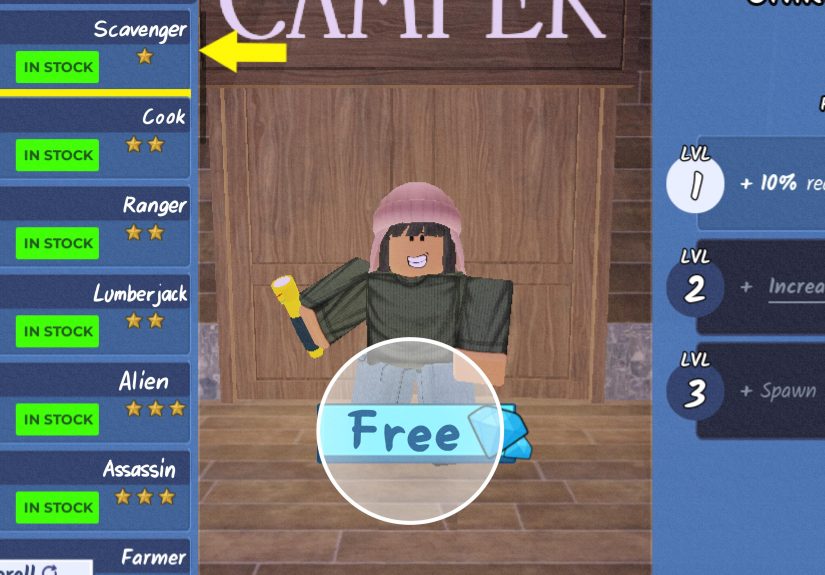
Classes matter because they shape your early tempo and your role in the group. In general, beginner-friendly runs work best when someone covers gathering, someone covers utility or support, and someone can handle pressure in combat.
Resource-focused picks are excellent because they speed up the part of the game that decides whether you will still be alive later. Support classes are great in teams because faster revives and better recovery keep mistakes from ending the run. More advanced combat classes can be amazing, but they are not magical if your camp economy is trash.
For solo players, self-sufficiency is king. For teams, specialization wins. The strongest squad is not the one where five people try to be the hero. It is the one where each player quietly makes the run easier for everybody else.
How to Deal With the Biggest Threats
The Deer
The Deer is the game’s reminder that nighttime wandering is a terrible hobby. If you are far from safety after dark, you are volunteering for trouble. Treat the campfire like your anchor. Plan routes around it. Return earlier than you think you need to. Most “bad luck” deaths are really bad timing with extra drama.
If you must be outside camp at night, move with purpose. No sightseeing. No “I’m just checking one more building.” That sentence has ended many excellent runs.
The Owl
The Owl is one of those enemies that turns confidence into a jumpscare. Once it becomes part of your run, your nighttime discipline has to improve immediately. If you do not have the right tools to handle it, staying near camp is the smart play. This is not cowardice. This is called wanting to live.
Cultist waves
Cultists are where weak camps get exposed. These attacks punish bad layouts, poor healing management, scattered teammates, and anyone who thinks revives happen by friendship alone. Stand where your defenses help you. Keep your strongest angles covered. Call targets. Revive fast. Do not chase stragglers so far that the camp becomes exposed.
The Ram and other “just survive it” threats
Some enemies are less about winning a fight and more about surviving the encounter. That is a different mindset. Use spacing. Use obstacles. Use awareness. If the game is telling you, through repeated violence, that direct confrontation is a bad idea, it may be onto something.
Rescue Objectives Matter More Than New Players Realize
Runs improve dramatically when you stop playing only for tonight and start playing for the whole arc. Rescue progress, exploration progress, and camp development all work together. You are not just surviving random nights. You are building momentum.
That is why map knowledge matters. The faster you identify useful locations, objective routes, and safe return paths, the less wasted motion your team has. In a 99-night run, efficiency compounds. Saving thirty seconds here and a minute there adds up to a camp that reaches the late game with better tools, better stockpiles, and fewer emergency scrambles.
Common Mistakes That End Otherwise Good Runs
- Starting with too many random players: Larger lobbies can make the run harder, and unreliable teammates make that worse.
- Burning your wood reserve: Fire matters, but so do walls, upgrades, and future fuel.
- Neglecting utility crafting: The flashy item can wait. The map, timing, direction, healing, and storm protection cannot.
- Loot greed at night: Most late scavenging deaths are completely self-inflicted.
- Base sprawl: A giant messy camp is harder to defend than a compact intelligent one.
- No healing reserve: If a wave goes wrong, your run should bend, not break.
Late-Game Tips for Reaching Night 99
Play cleaner, not faster
By the later stretch, the run is usually lost by impatience. Players feel strong, overextend, and create avoidable chaos. Late-game success is less about heroics and more about disciplined repetition: gather, repair, craft, restock, defend, repeat.
Keep one eye on tomorrow
Every night should end with a quick question: what does camp need before the next problem arrives? More fuel? More food? More healing? More ammo? Better barriers? If you keep answering that question honestly, the run stays ahead of the curve.
Do not treat stability as boring
A stable run is a winning run. You do not need cinematic gameplay every minute. Sometimes the smartest move in 99 Nights in the Forest is staying organized while the game begs you to become dramatic.
Conclusion
If you want to beat 99 Nights in the Forest in Roblox, stop thinking of the game as one giant survival test and start thinking of it as a series of small, correct decisions. Gather smart. Upgrade early. Defend efficiently. Respect the night. Use healing wisely. Build a camp that works under pressure, not just one that looks nice in daylight screenshots.
Once you do that, Night 99 stops feeling impossible. It starts feeling earned. And honestly, that is much more satisfying than stumbling into a win with half a wall, no food, and three teammates yelling for help while a giant owl turns your evening into a horror trailer.
Experience-Based Tips From Real Long Runs
Here is the part most guides skip: what a long run actually feels like. That matters, because the emotional rhythm of 99 Nights in the Forest is half the challenge. The early game feels manageable, almost cozy. You are chopping trees, finding scraps, making optimistic decisions, and telling yourself this run is different. Then the game starts testing whether your camp was built by serious survivors or by optimistic squirrels with tools.
In most successful long runs, there is a moment where the team stops playing casually and starts playing like a machine. One player is bringing wood before anyone asks. One is watching healing. One is handling objective routes. Somebody is always thinking ahead. That is when the run becomes real. Not because the game gets easier, but because your decisions get cleaner.
The weirdest part is that great runs rarely look flashy from the inside. They look organized. You return to camp, drop resources, repair what matters, refill what matters, and head back out with a reason. The players who survive the longest are usually not the ones making the wildest plays. They are the ones who keep the camp functioning when everyone else gets distracted by noise, danger, or shiny loot.
Another pattern shows up in long sessions: panic spreads faster than enemies. One bad invasion can make a team abandon positioning, forget revives, waste supplies, and sprint in five different directions. Strong players interrupt that spiral. They hold angles. They revive one teammate instead of trying to save the whole world at once. They prioritize the campfire, not their pride. That kind of discipline is why some runs recover and others collapse instantly.
Solo experiences are different, but just as intense. In solo play, every success feels more personal and every mistake feels louder. When you survive a rough night alone, it feels fantastic. When you realize you forgot to restock healing before dark, it feels like you personally wrote a strongly worded invitation to disaster. Solo runs reward calm, route memory, and restraint. If you can resist greedy decisions, solo play can actually teach you better habits than team play.
The best experience-based advice is simple: develop routines. Start each day with a purpose. End each night with a reset. Keep your camp tidy. Keep your reserves stocked. Keep one fallback plan in mind whenever you leave camp. If something goes wrong, your routine will save you faster than raw skill.
And yes, there will still be moments where everything goes sideways. A bad wave. A missed revive. A threat showing up at the worst possible time. That does not mean the run is over. Some of the strongest 99-night clears happen because the team survives ugly moments without mentally collapsing. In other words, the real trick is not avoiding every mistake. It is refusing to turn one mistake into six more.
So if your current runs keep ending early, do not just ask, “What weapon should I use?” Ask better questions. Was your wood reserve healthy? Was your camp layout helping? Did you leave too late? Did you craft for survival or for fun? Did your team actually have roles, or were you all freelancing in a haunted forest like unpaid interns? Those answers are usually where the next win is hiding.