Table of Contents >> Show >> Hide
- Who Is Shannon Duffy (and Why Her AI Advice Lands)
- The Real “10x” Promise: Capacity, Not Headcount
- Why Marketers Resist AI (Even When It Works)
- Duffy’s 3-Part Adoption Playbook for Scaling Marketing with AI
- How AI Actually Scales a Marketing Team: 6 High-Impact Use Cases
- Use case #1: Campaign briefs that don’t make creatives cry
- Use case #2: Creative production at scale (without sounding like a robot)
- Use case #3: Status updates and stakeholder comms that write themselves
- Use case #4: Faster insight loops from messy qualitative data
- Use case #5: Campaign operations that reduce “coordination tax”
- Use case #6: Personalizationuseful, but watch the “uncanny valley”
- The 4 Mistakes (and How to Avoid Them Without Losing Your Mind)
- Mistake #1: Trying to delegate something you don’t actually know how to do
- Mistake #2: Asking AI to “do the thing,” then being shocked when it does… a different thing
- Mistake #3: Forgetting the brand voice (aka accidentally launching “generic SaaS #47”)
- Mistake #4: Using AI as a crutch instead of a catalyst
- How to Build Guardrails So AI Scales Quality (Not Just Volume)
- A Simple 30–60–90 Day Plan to Scale Your Marketing Team with AI
- Conclusion: AI Scales What You Standardize
- Field Notes (Extra ~): What Scaling Marketing with AI Feels Like in Real Life
Marketing teams have a recurring nightmare: the calendar says “Q1 launch,” the inbox says “URGENT,” and your creative brief says
“we’ll figure it out later.” Add five stakeholder opinions, three last-minute product changes, and one mysterious spreadsheet nobody owns,
and you’ve got the modern go-to-market experience.
Now drop AI into that chaos and you’ll either get a 10x capacity boost… or a 10x faster way to ship beautifully formatted nonsense.
The difference isn’t whether you “use AI.” It’s whether you build a system where AI has context, guardrails, and a job description that
doesn’t include “replace the entire marketing department by Tuesday.”
That’s the core idea behind the playbook Shannon Duffy (then CMO at Asana) has shared publicly: scale isn’t magicit’s workflow design.
AI becomes the engine, but process is the steering wheel. And yes, there were mistakes along the way. Including at least one story
involving a pop icon (because nothing says “enterprise AI” like a cautionary tale you can hum to).
Who Is Shannon Duffy (and Why Her AI Advice Lands)
Duffy’s credibility comes from living in the messy middle where marketing meets revenue. In conversations about Asana’s marketing strategy,
she’s emphasized the intersection of creativity and data: creative work gets taken seriously when it’s tied to business outcomes, and data
becomes useful when it helps leaders make better betsnot when it’s a decorative spreadsheet with vibes.
That background matters because AI adoption in marketing fails in predictable ways. Teams either:
(a) treat AI like a slot machine (“maybe THIS prompt will write our brand manifesto!”), or
(b) treat AI like a threat (“if the robot writes the first draft, does that mean my job is… dust?”).
Duffy’s approach is more practical: start with real work, map the process, assign AI to specific steps, measure the result, and iterate
like you’re running performance marketing… but for internal productivity.
The Real “10x” Promise: Capacity, Not Headcount
When leaders say “10x,” the internet hears “do ten times the work with the same people.” Marketing hears “cool, so I’ll just stop sleeping.”
Duffy’s framing is closer to: 10x the output per team by compressing the cycle time between idea → asset → launch → learning.
In practice, that looks like:
- Faster first drafts (so humans can spend time on strategy, narrative, and differentiation)
- Cleaner handoffs (less “where is the latest doc?” energy)
- More consistent execution (fewer one-off heroics, more repeatable workflows)
- Better decision velocity (summaries, insights, and reporting that don’t take a week to assemble)
In other words: AI doesn’t replace marketers. It replaces the parts of marketing that feel like doing taxes inside a group chat.
Why Marketers Resist AI (Even When It Works)
Marketing isn’t just “output.” It’s taste, timing, empathy, cultural fluency, and brand trust. That’s why marketers often carry a specific fear:
AI will make everything sound the same, and then we’ll all be competing on who can generate the most beige.
Research and industry reporting has also highlighted a social layer: some marketers worry that using AI will make them look “lazy,” and many
organizations still haven’t provided enough training or guidance for responsible use. That’s a change-management problem, not a software problem.
Duffy’s answer is not “AI harder.” It’s “adopt AI like you’re scaling a team”with onboarding, expectations, and clear definitions of good work.
Duffy’s 3-Part Adoption Playbook for Scaling Marketing with AI
1) Start with a workflow map, not a tool list
Most AI rollouts begin with tool demos. The better starting point is: Where does marketing work actually get stuck?
Intake. Prioritization. Brief quality. Review cycles. Reporting. Cross-functional alignment. Those are the bottlenecks.
A simple way to map this is to break a campaign into stages:
- Intake & prioritization (requests, sizing, timelines, dependencies)
- Strategy (audience, positioning, offer, narrative, channel plan)
- Production (copy, design, video, landing pages, email, ads)
- Launch & orchestration (handoffs, approvals, localization, publishing)
- Measurement & learning (dashboards, insights, retro, next actions)
Then assign AI to specific tasks inside each stageespecially the repeatable ones:
summarizing inputs, drafting briefs, generating variations, checking consistency, and producing status updates.
2) Inspire adoptiondon’t mandate it
“Use AI now” is how you get compliance theater. People will paste one prompt into a chatbot, declare victory, and go back to doing work the old way.
Duffy’s better move is to connect AI to personal growth and career leverage: being AI-literate becomes part of professional development.
The practical version:
- Build a shared “prompt library” for common marketing tasks (briefs, messaging, objections, competitive angles).
- Celebrate wins publicly (“this workflow cut our review cycle by 30%”).
- Coach for quality (“AI made the draft faster; you made it good”).
- Make AI usage visible in a positive waye.g., “where AI helped” as a line in retros.
If you want daily use, you need daily usefulnessembedded in the actual workflow, not bolted on like a motivational poster.
3) Use “super connectors” to spread AI across the org
Every marketing org has a few people who are unofficial routers of information:
they talk to product, sales, CS, finance, creative, and leadershipoften before those groups talk to each other.
Duffy has pointed to these “super connectors” as the fastest path to scaling new behavior.
Why? Because they can translate AI benefits into each group’s language:
pipeline for sales, clarity for product, risk reduction for legal, and sanity for marketing ops.
How AI Actually Scales a Marketing Team: 6 High-Impact Use Cases
Use case #1: Campaign briefs that don’t make creatives cry
If your briefs are vague, AI will happily generate vague outputat incredible speed.
Instead, use AI to structure the brief:
audience, pain points, proof, differentiators, CTA, channel notes, and success metrics.
A strong pattern is “brief-to-variants”:
- AI drafts a tight campaign brief from stakeholder notes.
- Humans refine positioning and creative direction.
- AI generates channel-specific variations (email subject lines, ad angles, landing-page sections).
- Humans pick the winners, sharpen the voice, and ensure brand consistency.
Use case #2: Creative production at scale (without sounding like a robot)
AI is great at expanding a concept into multiple executions:
headline variations, CTA options, rough scripts, social captions, and localization drafts.
This is where teams feel the “10x” effect, because iteration becomes cheap.
The trick is to treat AI like a junior creative partner:
give it constraints (tone, format, audience, must-include points), and then review like you would any draft.
Use case #3: Status updates and stakeholder comms that write themselves
Marketing leaders spend an absurd amount of time translating work into updates.
AI can summarize project activity into:
what shipped, what’s blocked, what changed, and what needs a decision.
If you run your work in a system that captures tasks, owners, deadlines, and dependencies,
AI can turn that operational data into leadership-ready updateswithout someone spending Friday night “making it pretty.”
Use case #4: Faster insight loops from messy qualitative data
Marketers sit on mountains of customer calls, sales notes, community threads, and open-text survey responses.
AI can cluster themes, extract objections, and draft “what we’re hearing” summaries.
The win isn’t that AI is always right. The win is that AI gives you a starting map,
and your team validates the terrain with real data and human judgment.
Use case #5: Campaign operations that reduce “coordination tax”
The hidden cost of marketing isn’t creativityit’s coordination.
Assigning owners, tracking dependencies, chasing approvals, and reconciling “latest versions”
can swallow more time than the creative work itself.
Platforms that support AI inside the workflow increasingly focus on three requirements:
context (AI knows the project and goals),
checkpoints (humans can see and correct what AI is doing),
and control (governance, permissions, predictable usage).
Use case #6: Personalizationuseful, but watch the “uncanny valley”
AI can personalize content and offers based on behavior and data, and it can do that at a scale humans can’t match.
But personalization is also where brands can lose trust fast if it feels creepy, inaccurate, or soulless.
The best teams keep a “human connection” checkpoint:
AI drafts, humans tune. AI proposes segments, humans review fairness and logic.
And everyone agrees on privacy and transparency rules before the first personalization experiment ships.
The 4 Mistakes (and How to Avoid Them Without Losing Your Mind)
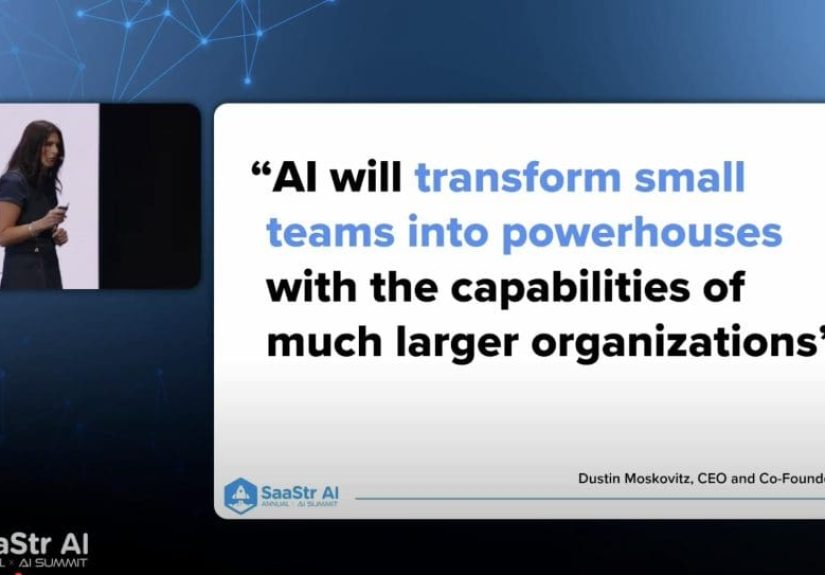
In a public recap of Duffy’s SaaStr session on scaling marketing with AI, four “mistakes along the way” stood out.
Think of these as the potholes you hit when you move from “AI curiosity” to “AI embedded in the org.”
Mistake #1: Trying to delegate something you don’t actually know how to do
Duffy’s warning is blunt: if you’re not good at the job, AI won’t save youit will help you fail faster, with better grammar.
Use AI to amplify skill, not substitute for fundamentals. A bad strategy with AI is still a bad strategy (now with bullet points).
Fix: Start with work your team already does well. Use AI to compress time and expand iteration, not to invent expertise.
Mistake #2: Asking AI to “do the thing,” then being shocked when it does… a different thing
“Write a campaign” is not a prompt. It’s a cry for help.
When AI output disappoints, it’s often because the input was a fog machine.
Fix: Give AI constraints like a real brief: audience, goal, offer, proof, tone, format, and what must be avoided.
Mistake #3: Forgetting the brand voice (aka accidentally launching “generic SaaS #47”)
AI loves averages. Brands win by being specific.
If you don’t actively inject voice, point of view, and real differentiation, AI will happily generate competent content that feels like it
could belong to any company with a logo and a quarterly target.
Fix: Create a brand-voice guide AI can follow: “we sound like this, we never sound like that,” plus examples of best-in-class copy.
Mistake #4: Using AI as a crutch instead of a catalyst
There’s a subtle trap: AI can make you feel productive because output is immediate.
But output isn’t impact. If the team stops thinking, stops learning, and stops owning the quality bar, the work degrades quietly.
Fix: Make humans accountable for the final decision. AI accelerates, humans own.
How to Build Guardrails So AI Scales Quality (Not Just Volume)
1) Define “human-required” checkpoints
Pick the moments where human judgment is non-negotiable:
final messaging, claims and compliance, sensitive customer communications, and major brand moments.
AI can draft, but humans sign.
2) Put governance where the work lives
AI governance fails when it’s a PDF policy nobody reads.
It works when it’s embedded into tools, permissions, and workflows:
who can use which features, what data is allowed, and where outputs get reviewed.
3) Measure outcomes, not vibes
Pick a few metrics that reflect real improvement:
- Cycle time from brief to launch
- Number of iterations explored per campaign
- Time spent on status/reporting
- Quality signals (revision count, stakeholder satisfaction, performance lift)
The goal is simple: prove AI is increasing impact, not just increasing the number of words produced per minute.
A Simple 30–60–90 Day Plan to Scale Your Marketing Team with AI
Days 1–30: Pilot two workflows
- Pick one content workflow (e.g., blog → social → email) and one operations workflow (e.g., status updates).
- Create a shared prompt pack and brand voice guide.
- Track time saved and quality outcomes.
Days 31–60: Expand with super connectors
- Recruit 3–5 cross-functional “super connectors” as champions.
- Roll out enablement: short trainings, office hours, and a “what good looks like” library.
- Standardize templates: briefs, checklists, and review gates.
Days 61–90: Embed governance + scale the wins
- Turn successful pilots into default workflows.
- Add checkpoints for high-risk outputs (brand, legal, claims).
- Expand to insights and reporting so learnings travel faster.
Conclusion: AI Scales What You Standardize
Shannon Duffy’s practical lesson is almost annoyingly sensible: AI doesn’t magically scale marketingsystems do.
AI is powerful, but it’s not a strategy. The strategy is building repeatable workflows, enabling your team, and protecting the brand while
increasing speed. Do that, and “10x” stops sounding like a hype headline and starts looking like a real operating advantage.
And if you mess up along the way? Congratulations. You’re doing the hard part: moving from curiosity to capability.
Just try to avoid the “generic SaaS #47” voice… and maybe keep the Britney story in your back pocket for the next all-hands.
Field Notes (Extra ~): What Scaling Marketing with AI Feels Like in Real Life
Once AI moves from “experiment” to “everyday workflow,” something funny happens: the tool gets less exciting, and the work gets more honest.
The novelty fades. The real questions show up. Here are the lived-in lessons teams tend to learnusually after the third time someone says,
“Wait, who approved this?”
First: AI doesn’t eliminate workit relocates it. You do less grunt work (first drafts, summaries, formatting),
but you do more editorial leadership. Someone still has to decide what “good” looks like. Someone still has to protect the brand voice.
Someone still has to say, “This claim is risky,” or “This is clever but off-strategy.” In healthy teams, that becomes a feature, not a burden:
senior marketers get more time to do senior-marketer things.
Second: the biggest win is often the most boring: coordination. If you embed AI into campaign opsintake forms,
structured briefs, task routing, dependency tracking, and automated status updatesyou reduce the “coordination tax” that silently burns
half your calendar. You’ll notice it when the team stops asking “what’s the latest version?” and starts asking “what did we learn?”
That’s when AI is actually scaling the teamnot just speeding up output.
Third: prompt quality becomes a team sport. The first person who learns to write good prompts becomes a hero… and then a bottleneck.
The fix is to turn prompts into shared assets: a prompt library, reusable templates, and examples of “before vs. after.”
Eventually the org develops a common language: “Give it context,” “Constrain the output,” “Ask for three options,”
“Make it match the voice guide,” “Cite what you used,” “Show your assumptions.” It sounds nerdy, but it’s how you scale taste.
Fourth: brand voice is the hill you either defend early… or lose slowly. Teams that win build a simple voice pack:
a short description of tone, a list of words you use and words you avoid, and 5–10 examples of strong copy.
AI then becomes a multiplier for consistency. Without that, AI becomes a multiplier for “meh.”
Finally: your team’s relationship with AI gets healthier when you stop treating it like a verdict and start treating it like a draft.
The best culture shift is this: “AI suggests, humans decide.” When everyone understands that rule, people experiment more, fear less,
and produce higher-quality work. And that’s the real 10x: not just faster marketing, but a calmer team that can ship, learn, and improve on purpose.