Table of Contents >> Show >> Hide
- Why “Small” Interactions Hit So Hard
- The 10 “Tiny” Interactions That Quietly Teach Sexism
- 1) “That’s for girls” (and the redirect that follows)
- 2) Complimenting girls on appearance and boys on ability
- 3) “Boys don’t cry” and emotion policing
- 4) Using “girl” as an insult
- 5) Gendered chores and “helping” vs. “leading”
- 6) “He’s just teasinghe likes you”
- 7) Calling assertive girls “bossy” and assertive boys “leaders”
- 8) Classroom and group dynamics that drift toward “boys first”
- 9) Media defaults: the hero is male, the joke is female
- 10) Adults modeling everyday disrespect
- How Those Micro-Lessons Turn Into Sexism
- Micro-Fixes: What Adults Can Do (Without Becoming a Robot)
- For Teachers and Coaches: The “Hidden Curriculum” Checklist
- What to Say in the Moment (When You Have 0.3 Seconds to React)
- Conclusion: Boys Aren’t Born SexistThey’re Schooled By Defaults
- Experiences: What This Looks Like in Real Life (and What Helped)
A cartoonist once summed up a whole cultural problem with a handful of simple scenes: a boy reaches for a female superhero toy, an adult redirects him; a teacher nudges him toward a “boy character” for an assignment; a casual joke lands like a rule. None of it looks like a Big Moment. And that’s the point.
Sexism rarely shows up in childhood wearing a name tag that says, “Hello, I’m Misogyny.” It usually arrives as background noisetiny comments, tiny laughs, tiny assumptionsso ordinary that adults don’t even notice them. Kids do. Kids are basically little meaning-making machines with sticky-note brains. They collect patterns, file them under “How the world works,” and then act accordingly.
So when a guy illustrates “how boys develop sexism,” what he’s really illustrating is a slow drip: the micro-lessons that teach boys which people matter more, whose interests count, and who is allowed to be the hero. If you’re reading this as a parent, teacher, coach, aunt, uncle, or general adult-with-a-voice, don’t panic. The good news is that micro-lessons can be replaced with micro-corrections. You don’t need a perfect speech. You need better defaults.
Why “Small” Interactions Hit So Hard
Kids don’t just learn rulesthey learn rankings
Children learn categories early (boy/girl, mine/yours, cat/not-cat). Once gender becomes a category, many kids try to enforce it with the intensity of a tiny hall monitor. During early childhood, gender rules can become especially rigid: “That’s for girls.” “Boys don’t wear that.” “You can’t be her.” These aren’t just preferences; they’re attempts to keep the world predictable.
The trouble is that adults often reinforce the rigidity without meaning to. When we steer boys away from “girl things,” we’re not only limiting their choiceswe’re quietly attaching a value judgment: girl things are lesser. That single idea can grow into a whole worldview.
Language teaches more than we think
Adults use shortcuts when talking to kids: “boys and girls,” “ladies first,” “be a man,” “don’t be such a girl.” Shortcuts save time, but they also smuggle in assumptions. Even when adults try to correct stereotypes, the wording can still imply that boys are the default standard (for example, framing girls as “catching up” to boys). Kids don’t only hear what we meant. They hear what the sentence structure suggests.
The 10 “Tiny” Interactions That Quietly Teach Sexism
Think of these as common scripts kids overhear in the wild. If you recognize yourself in any of them, congratulations: you are a normal human who grew up in a culture. The goal isn’t guilt. It’s upgrades.
1) “That’s for girls” (and the redirect that follows)
Micro-lesson: Girls are fine as long as they’re not your role models. Boys shouldn’t admire female heroes too muchor at least not publicly.
Try instead: “Cool choice. What do you like about her?” Or, if you’re worried about teasing: “Some people have silly rules about toys. We don’t. Pick what you love.”
2) Complimenting girls on appearance and boys on ability
Micro-lesson: Girls are valued for being looked at; boys are valued for doing.
Try instead: Give everyone a balanced diet of praise: effort, kindness, creativity, courage, teamwork, style, problem-solving. A boy can be “thoughtful.” A girl can be “brave.” A child can be both.
3) “Boys don’t cry” and emotion policing
Micro-lesson: Feelings are shameful unless they’re anger. Also: girls’ feelings are “dramatic,” boys’ feelings are “strength.”
Try instead: “It’s okay to feel that. Want a minute, or a hug, or a plan?” Teaching boys emotional language isn’t “soft.” It’s giving them tools so they don’t outsource emotional expression into sarcasm, shutdown, or lashing out later.
4) Using “girl” as an insult
Micro-lesson: Being compared to girls is humiliating. Therefore, girls are lower-status.
Try instead: Keep it simple and firm: “We don’t use ‘girl’ like it’s a bad word.” Then add one sentence kids can repeat: “Girls aren’t an insult.”
5) Gendered chores and “helping” vs. “leading”
Micro-lesson: Girls maintain life. Boys run life. Girls clean; boys decide.
Try instead: Rotate the invisible labor and the visible leadership. Let boys set the table and plan the playlist. Let girls carry the heavy stuff and run the drill (with supervision). Normalize competency across genders.
6) “He’s just teasinghe likes you”
Micro-lesson: Disrespect is romance. Girls should tolerate discomfort. Boys aren’t responsible for their behavior when feelings are involved.
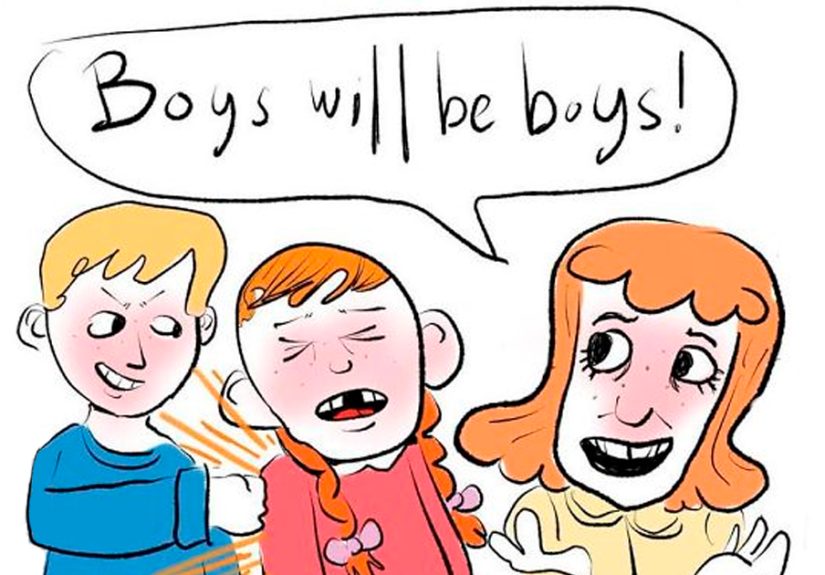
Try instead: “Liking someone means treating them well.” If a kid is being unkind, we address the unkindnessno cute excuses, no “boys will be boys” shrug.
7) Calling assertive girls “bossy” and assertive boys “leaders”
Micro-lesson: Power looks good on boys and rude on girls.
Try instead: Describe the behavior without loading it with gendered judgment: “You have a strong idea. How can you include other people’s ideas too?” That’s leadership coaching for everyone.
8) Classroom and group dynamics that drift toward “boys first”
Micro-lesson: Boys take space. Girls make space.
Try instead: Track who gets called on, who gets interrupted, and who is doing the “helper” role. Even small adjustmentsstructured turn-taking, rotating roles, interrupting the interrupterscan change what kids experience as normal.
9) Media defaults: the hero is male, the joke is female
Micro-lesson: Men act; women are acted upon. Men are funny; women are “too much.” Women exist for approval, punishment, or plot seasoning.
Try instead: Co-watch sometimes and name what you seebriefly, without turning movie night into a graduate seminar: “Notice how she’s the only one cleaning up while everyone else talks.” Then ask: “Do we want that to be normal?”
10) Adults modeling everyday disrespect
Micro-lesson: The way adults talk about women is the way boys are allowed to talk about women.
Eye-rolling about “wives,” dismissive comments about women’s competence, jokes about women drivers, “Karen” used as a gendered insultkids absorb it. If you want boys to respect women, let them see you respect women when it’s boring, not only when it’s dramatic.
How Those Micro-Lessons Turn Into Sexism
Step 1: “Girls are not for me”
It often starts with separation. Boys learn that girl characters, girl interests, and girl emotions are “other.” The message isn’t always “hate girls.” It’s “distance yourself.” That distance makes empathy harder.
Step 2: “Girls are lesser”
Once “girl” becomes an insult and “for girls” becomes a warning label, the hierarchy is baked in. And hierarchy is the seedbed of sexism: if one group is lesser, then dismissing them, interrupting them, or ignoring them feels normal.
Step 3: “I’m entitled to attention (and anger when I don’t get it)”
When boys are socialized to expect deferenceand not taught emotional skillsfrustration can turn into contempt. Not because boys are “bad,” but because they were trained to interpret social life like a scoreboard.
Step 4: “My discomfort matters more”
Sexism isn’t only bigotry. It can be the habit of centering male comfort, male opinions, and male freedom as the default setting. And yes, it can be taught by perfectly nice adults who would be horrified to think they’re contributing to it.
Micro-Fixes: What Adults Can Do (Without Becoming a Robot)
Upgrade your praise
If you notice you compliment girls mainly on appearance and boys mainly on competence, balance it out. Praise girls for effort, bravery, strategy, curiosity. Praise boys for kindness, patience, collaboration, emotional honesty. This isn’t “political.” It’s accurate.
Stop gendering the room
“Good morning, boys and girls” feels harmless, but it turns gender into the primary identity in the room. Use “everyone,” “friends,” “team,” “scientists,” “readers,” “artists,” “eighth graders,” “future tax-paying citizens” (okay, maybe not that last one unless you enjoy chaos).
Replace rules with questions
When a kid says, “That’s for girls,” try: “What makes you think that?” Then offer a simple counterexample: “Lots of boys like that. Lots of girls like this. People can like what they like.”
Teach respect as a skill, not a vibe
Respect isn’t a poster. It’s practiced in how we disagree, how we share space, how we react to “no,” and how we talk about people when they’re not there. If you want boys to grow up respectful, let them practice respectful behavior in low-stakes moments: taking turns, apologizing specifically, listening without mocking, handling disappointment without blaming.
Curate role models on purpose
Boys benefit from female heroes. Girls benefit from female heroes. Humanity benefits from female heroes. Stock your shelves (and your streaming queue) with stories where girls and women solve problems, lead teams, make mistakes, and still get to be the main character.
For Teachers and Coaches: The “Hidden Curriculum” Checklist
Notice who gets coached and who gets comforted
Adults sometimes comfort girls and coach boys, which teaches girls to be cautious and boys to be capable. Flip it sometimes. Coach girls through challenge. Comfort boys through emotion. Give everyone both.
Track participation like it’s your favorite sport
If you’re leading a group, pay attention to airtime and interruptions. Who speaks first? Who gets redirected? Who gets laughed at? The goal isn’t to shame kids; it’s to shape norms: everyone gets a voice, and nobody “wins” by steamrolling.
Retire “boys vs. girls” forever
It’s a quick way to split teams, but it forces gender to be the organizing principle of belongingand it can make kids who don’t fit neatly into stereotypes feel singled out. Use colors, animals, birthdays, table groups, random numbers, or the ancient and sacred method known as “counting off.”
What to Say in the Moment (When You Have 0.3 Seconds to React)
- “That’s for girls.” → “Toys don’t have genders. People do.”
- “Don’t cry.” → “Crying is a body’s way of letting feelings out. Want help?”
- “You throw like a girl.” → “Girls throw like athletes. Try again.”
- “He’s teasing you because he likes you.” → “If he likes you, he can be kind.”
- “Girls are so dramatic.” → “Feelings aren’t a gender. Let’s talk about what happened.”
Conclusion: Boys Aren’t Born SexistThey’re Schooled By Defaults
The illustrator’s point isn’t that adults are villains. It’s that culture is lazy. It runs on defaults. And unless we interrupt those defaults, kids inherit them.
If you want boys to grow into men who respect women, the work isn’t only in the “big talks.” It’s in the small edits: how you praise, how you joke, how you redirect, how you react when a boy admires a girl hero, how you respond when “girl” gets used as an insult.
Small interactions built the problem. Small interactions can build the fixone ordinary moment at a time.
Experiences: What This Looks Like in Real Life (and What Helped)
Below are composite, real-world-style momentsthe kind of everyday scenes adults recognize instantly. Think of them as “field notes” from schools, stores, sports, and living rooms. The details change, but the pattern stays the same: a small message lands, and an adult has a chance to either reinforce it or rewrite it.
Experience 1: The Toy Aisle Redirect
A boy picks up a doll or a female superhero figure. An adultsometimes a parent, sometimes a well-meaning strangerlaughs and says, “That’s for girls,” and guides him toward something “more boyish.” The moment is quick, almost automatic. The boy’s face does something subtle: curiosity turns into a check for safety. He looks around, like he’s asking, “Is liking this going to cost me?”
What helped wasn’t a lecture about gender theory. What helped was a calm, confident adult response: “Pick what you like.” Even better: “Tell me what you like about that character.” That second sentence does magicit moves the focus from social approval to personal taste. Over time, kids who get that support learn a quiet strength: they can like what they like without performing for the crowd.
Experience 2: “Girl” as a Weapon on the Playground
A kid misses a kick, trips while running, or loses a game. Another kid snaps, “You’re a girl!” The target isn’t actually gender; it’s status. The insult works only because everyone has learned the same ranking: “girl” equals lower. Adults sometimes ignore it because it feels like “just kid talk.”
The most effective adult responses were short and repeatable. A teacher saying, “We don’t use ‘girl’ like it’s a bad word,” followed by, “Try again without insulting people,” set a standard without turning the kid into a villain. Then the teacher reinforced the standard later with a positive note: “I like how you encouraged your teammate.” Kids notice what gets attentionand what gets corrected.
Experience 3: The “Bossy” Trap
In group work, a girl organizes the plan: assigns roles, clarifies steps, keeps the group moving. She gets labeled “bossy.” A boy does the same thing and gets called “a natural leader.” Kids learn fast which kind of confidence is “approved” for which gender.
Adults who handled this well separated behavior from identity. Instead of “Don’t be bossy,” they said, “You have good ideasmake room for other ideas too.” The message wasn’t “stop leading.” It was “lead better.” That’s fair coaching for everyone, and it keeps girls from getting punished for competence.
Experience 4: The Emotion Shut-Down
A boy cries after being embarrassed or hurt. An adult jumps in with, “You’re fine,” or “Be tough,” or the classic, “Big boys don’t cry.” The adult’s goal is usually comfort, not cruelty. But the hidden lesson is: sadness is unacceptable, vulnerability is unsafe, and feelings should be locked away.
The adults who made the biggest difference didn’t try to “fix” the feeling in five seconds. They named it and gave choices: “That was rough. Want to sit for a minute or get some water?” They also modeled repair: “I’m sorry I snapped. I was stressed.” Boys who hear this learn that emotions aren’t emergenciesthey’re information. That emotional skill is protective for friendships, school, and future relationships.
Experience 5: The Online Pipeline of ‘Jokes’
A teen boy starts repeating “jokes” about girls: they’re needy, they’re fake, they’re “gold diggers,” they’re “too emotional.” He claims it’s humor, or “just the internet.” Sometimes it is. Sometimes it’s a test balloon: “Will adults challenge this, or will they laugh along?”
The strongest responses weren’t moral panic. They were curiosity plus boundaries: “What’s the joke supposed to mean?” (curiosity) and “We don’t talk about people like that in this house/class/team” (boundary). Then came the replacement: “If a video makes you feel powerful by putting someone else down, it’s training younot entertaining you.” That line sticks because it respects the teen’s intelligence while still calling the behavior what it is.
In all these experiences, one theme repeats: kids are always learning. If adults stay silent, culture becomes the teacher. If adults speak upbriefly, consistently, and with better scriptskids learn something else: respect is normal, girls are not lesser, and boys don’t have to perform toughness to belong.