Table of Contents >> Show >> Hide
- Who Is Stephanie Pui-Mun Law?
- The Magic of Plants and Animals in Stephanie Law’s Watercolors
- Why Her Watercolor Style Feels Like a Fairytale
- Shadowscapes: The Dreamworld That Made Her Work Famous
- The Dreamscapes Books and Her Role as a Teacher
- Specific Examples of Themes in Her Plant and Animal Paintings
- Why Stephanie Law’s Art Connects With Modern Viewers
- Experience Section: Living With the Feeling of Stephanie Law’s Fairytale Watercolors
- Conclusion
Some artists paint flowers. Some artists paint animals. Stephanie Pui-Mun Law paints the moment when a fox seems to know an ancient secret, a moth looks like it has just escaped from a moonlit spellbook, and a curling vine behaves as if it has its own tiny opinion about destiny. Her fairytale-like watercolor paintings of plants and animals do not simply decorate nature; they translate it into myth.
Known widely as Stephanie Law, the Oakland-based watercolor artist and illustrator has built a dreamlike visual world where botanical accuracy, fantasy art, mythology, and delicate storytelling all sit at the same table. It is a very elegant table, naturally. There are probably mushrooms growing beneath it, a deer spirit nearby, and at least one bird acting like it knows more than everyone else.
Her work is often associated with Shadowscapes, the name of her long-running artistic universe and official art platform. Through watercolor paintings, tarot imagery, botanical illustration, instructional books, and fantasy publishing projects, Law has created a recognizable style that feels both ancient and fresh. Her paintings are graceful, intricate, and full of movement, but they also have emotional weight. They invite viewers to slow down, look closer, and remember that nature has always been the original fantasy author.
Who Is Stephanie Pui-Mun Law?
Stephanie Pui-Mun Law is an American watercolor painter and illustrator whose work blends fantasy, mythology, folklore, botanical detail, and surreal imagination. She studied at the University of California, Berkeley, earning degrees in Fine Arts and Computer Science. That combination sounds unusual at first, but it makes a strange kind of sense. Her paintings often feel emotionally intuitive, yet carefully engineered. The compositions flow like dreams, but the structure underneath is smart, deliberate, and balanced.
Before becoming a full-time artist, Law worked in technology. Eventually, however, the pull of art grew stronger than the gravitational force of office life. Her career expanded through fantasy illustration, book covers, game art, gallery shows, instructional watercolor books, and her beloved Shadowscapes Tarot. Her client history includes major names in fantasy and publishing, including Wizards of the Coast, HarperCollins, LUNA Books, Tachyon Publications, Green Ronin Publishing, and others.
Yet what makes her work memorable is not simply the résumé. It is the atmosphere. Stephanie Law’s paintings have a rare quality: they look as if they were discovered rather than invented. The viewer gets the feeling that these fox spirits, faeries, ravens, flowers, branches, fish, insects, and mythic figures were already living somewhere just beyond ordinary sight. Law merely opened the door and politely asked if she could paint them.
The Magic of Plants and Animals in Stephanie Law’s Watercolors
The title “Fairytale-like Watercolor Paintings Of Plants And Animals By Stephanie Law” fits because plants and animals are not background props in her work. They are characters. A branch may curve like a musical phrase. A flower may feel like a lantern. A bird may become a messenger between worlds. A deer may appear as both animal and symbol, rooted in the forest but stepping into myth.
Law often bridges the botanical and the fantastical. Her paintings can include real natural forms, such as leaves, blossoms, seed pods, wings, feathers, shells, and bones, but these forms are rearranged into dream logic. The result is art that feels familiar and impossible at the same time. You recognize the shape of a petal, but then it becomes part of a crown. You recognize the body of a fox, but then it carries the emotional charge of a spirit guide.
This is one reason her art appeals to fans of fantasy illustration, botanical art, tarot, folklore, and nature-inspired decor. Her paintings do not flatten nature into cuteness. They give it personality, mystery, and a touch of theatrical flair. If a fern in her painting could speak, it would not say, “Please water me.” It would say, “Follow the silver river until the owl opens the gate.”
Why Her Watercolor Style Feels Like a Fairytale
Softness Without Weakness
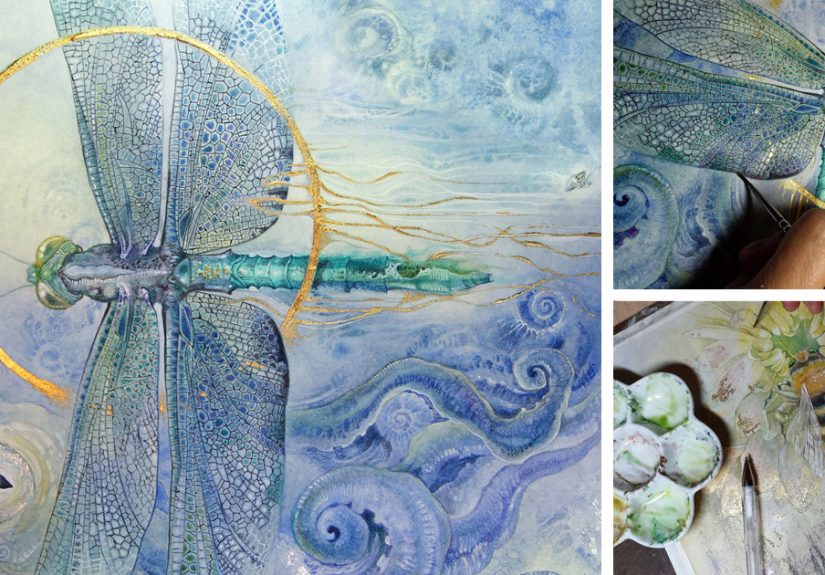
Watercolor is often described as delicate, but Stephanie Law proves that delicate does not mean timid. Her paintings are airy and luminous, yet they can also feel intense. She uses translucent washes, layered color, fine linework, and flowing compositions to create a sense of motion. The eye travels through the painting like a traveler in a forest path: first drawn to a face or animal, then carried along vines, wings, clouds, branches, or fabric.
Her color palettes often lean into jewel tones, natural greens, deep blues, soft golds, rose shadows, and misty neutrals. The colors do not shout. They glow. This glowing quality helps her paintings feel like scenes viewed at dawn, dusk, or inside a dream where the lighting department is clearly overqualified.
Nature as Pattern, Symbol, and Story
One of Law’s strongest artistic signatures is her attention to natural pattern. Leaves, feathers, flowers, insects, and animal anatomy become rhythmic design elements. Growth and decay also appear as visual themes. This gives her work a deeper connection to the cycles of nature: blooming, fading, transforming, returning. Her fairytale world is beautiful, but it is not plastic-perfect. It has roots, shadows, bones, and weather.
That balance is important. Many fantasy artworks use nature as decoration, but Law treats it as a living language. A curling plant is not just pretty; it guides movement. A swarm of small creatures may suggest change. A winged figure may carry ideas of freedom, fragility, or transition. Her visual storytelling often feels symbolic without becoming stiff or preachy.
Fantasy That Feels Handcrafted
In a world overflowing with polished digital images, Law’s watercolor work stands out because it preserves the human touch. You can sense the hand behind the layers. The small textures, softened edges, granulated pigments, and carefully placed details all remind viewers that watercolor is partly control and partly negotiation with chaos.
That unpredictability is part of the charm. Water moves. Pigment blooms. Edges soften. Colors settle in ways that are not always obedient. Instead of fighting the medium, Law often uses its natural behavior to create atmosphere. The result is a style that feels organic, as though the painting itself is growing.
Shadowscapes: The Dreamworld That Made Her Work Famous
Shadowscapes is central to Stephanie Law’s identity as an artist. It is both a body of work and a doorway into her visual mythology. The Shadowscapes Tarot, created with writer Barbara Moore and published by Llewellyn Worldwide, introduced many readers and collectors to her intricate fantasy imagery. Tarot is a natural home for her style because tarot depends on archetypes, symbols, mood, and layered meaning. Law’s paintings already speak that language fluently.
In the Shadowscapes Tarot, animals, plants, mythic figures, and dream landscapes become part of a symbolic system. Her images feel less like simple card illustrations and more like small windows into enchanted ecosystems. Fish swirl through air and water. Birds gather with purpose. Figures bend, leap, listen, and transform. Nature is never passive; it is the chorus, the stage, and occasionally the mischievous supporting actor.
Beyond tarot, the Shadowscapes world includes prints, originals, books, calendars, and other art objects. Law has also explored layered pieces, custom frames, ink, metallic leaf, resin, and botanical illustration. These materials add dimension to her already detailed compositions, reinforcing the sense that her work exists somewhere between painting, artifact, and spell.
The Dreamscapes Books and Her Role as a Teacher
Stephanie Law is not only an artist admired by collectors; she is also a teacher for artists who want to create fantasy watercolor worlds of their own. Her Dreamscapes instructional books have become well known among watercolor and fantasy art students. Titles in the series include books focused on magical beings, mythic characters, fantasy creatures, animals, landscapes, and imaginative settings.
These books are important because they reveal how much planning sits beneath the dreaminess. Law’s art may feel effortless, but the process involves sketching, composition, layering, glazing, value control, texture, and patience. In other words, the fairy dust has a schedule.
For beginners, her approach is encouraging because it shows that fantasy art is not just about drawing wings on something and hoping for applause. It is about building believable forms, understanding natural references, creating mood, and arranging visual elements so the viewer feels invited into the scene. Her teaching connects imagination with craft, which is exactly where memorable fantasy art begins.
Specific Examples of Themes in Her Plant and Animal Paintings
Foxes, Birds, and Messenger Creatures
Animals in Stephanie Law’s paintings often feel like messengers. Foxes, birds, deer, fish, insects, and other creatures appear with symbolic energy. They are not just wildlife studies, although her observational skill is clear. They seem to carry secrets from one realm to another. A fox may represent cleverness, transformation, or liminal spaces. Birds may suggest movement between earth and sky. Fish may imply intuition, dreams, or emotional depth.
Flowers, Vines, and Botanical Architecture
Plants in her art frequently behave like architecture. Vines frame figures. Flowers create rhythm. Leaves form pathways. Branches spiral across the picture plane, guiding the viewer’s eye. This gives her paintings a strong decorative quality, but the decoration is functional. It builds the world, supports the story, and creates the sensation of being surrounded by living design.
Mythology, Folklore, and the Natural World
Law’s work draws from mythology and folklore without feeling trapped in one tradition. Her paintings may suggest faeries, spirits, goddesses, animal guides, dream figures, or archetypal travelers. The imagery is open-ended, allowing viewers to bring their own interpretations. That openness is part of the pleasure. Her work does not shout, “Here is the meaning, please sign below.” It whispers, “Look again.”
Why Stephanie Law’s Art Connects With Modern Viewers
In modern life, many people experience nature through screens, errands, weather apps, and the occasional houseplant trying heroically to survive on a windowsill. Stephanie Law’s paintings offer a different relationship with the natural world. They restore wonder. They remind viewers that plants and animals are not simply scenery; they are part of a larger emotional and symbolic landscape.
Her paintings also appeal because they are deeply escapist without feeling empty. Escapism sometimes gets unfairly dismissed, as if needing beauty is a character flaw. But the best fantasy art does not help us ignore reality; it helps us re-enter reality with better eyes. After spending time with Law’s work, a weed by the sidewalk may look less like a weed and more like a small green rebellion. A moth near a porch light may seem like a visiting ambassador from the kingdom of tiny dramatic wings.
Her art also resonates with people who love slow craft. In an age of instant images, watercolor asks for patience. It requires waiting for layers to dry, paying attention to edges, accepting surprise, and knowing when to stop. Law’s paintings carry that patience visibly. They reward close looking, which makes them especially powerful for collectors, artists, tarot readers, fantasy fans, and anyone who prefers their nature with a side of moonlit mystery.
Experience Section: Living With the Feeling of Stephanie Law’s Fairytale Watercolors
Experiencing Stephanie Law’s fairytale-like watercolor paintings is a little like stepping into a garden after rain, except the garden has read more mythology than you have and is trying very politely not to brag. The first impression is usually beauty: soft color, elegant figures, delicate animals, curling leaves, and luminous atmosphere. But the longer you look, the more the paintings begin to unfold. Small details appear. A wing shape echoes a petal. A branch points toward a hidden face. A creature that seemed decorative suddenly feels essential to the story.
For art lovers, this creates a satisfying viewing rhythm. You do not consume the image all at once. You wander through it. That makes Law’s work especially enjoyable in prints, books, tarot decks, and framed pieces because the art continues to reveal itself over time. A painting that first appears gentle may later seem mysterious. A scene that feels whimsical at first glance may reveal sadness, longing, courage, or transformation beneath the surface.
For artists, studying her work can be both inspiring and mildly dangerous to the ego. One minute you are admiring the graceful movement of a vine; the next minute you are staring at your own sketchbook wondering why your tree looks like a confused broccoli floret. But that is part of the learning experience. Law’s paintings show the value of observation. Her fantasy succeeds because it is grounded in real visual knowledge: animal anatomy, botanical structure, composition, color behavior, and the emotional effect of line.
A useful exercise inspired by her approach is to take a simple natural subject, such as a leaf, moth, mushroom, bird feather, or seed pod, and ask what kind of story it might carry. Is the leaf a cloak? Is the moth a messenger? Is the mushroom a tiny tower? This kind of imaginative transformation is at the heart of Law’s appeal. She does not abandon reality; she invites reality to dress up for the fairytale ball.
Her work can also change how viewers experience actual nature. After spending time with her paintings, a walk through a park may become more attentive. The pattern of bark, the curve of a fern, the tilt of a bird’s head, or the strange architecture of a dried flower can feel newly significant. That is one of the quiet gifts of fantasy art: it trains the eye to notice wonder without needing the world to become louder.
In home decor, Stephanie Law’s plant and animal watercolors can create a mood that is peaceful but not boring. They suit reading corners, studios, bedrooms, creative workspaces, and any wall that secretly wants to become a portal. Unlike mass-produced fantasy imagery that depends on spectacle, her paintings rely on intimacy. They do not roar from the wall. They hum, shimmer, and occasionally make you suspect that the fox in the frame knows your Wi-Fi password.
Ultimately, the experience of her art is one of re-enchantment. It brings together the discipline of botanical observation, the looseness of watercolor, and the symbolic richness of myth. It reminds us that plants and animals are not small subjects. In the right hands, they become entire worlds.
Conclusion
Stephanie Pui-Mun Law’s fairytale-like watercolor paintings of plants and animals stand out because they combine technical skill with poetic imagination. Her work is rooted in watercolor craft, botanical detail, fantasy storytelling, and a deep affection for the natural world. Through Shadowscapes, the Dreamscapes books, tarot imagery, publishing projects, and gallery work, she has created an artistic language that feels instantly recognizable.
Her paintings invite viewers into a place where flowers are symbols, animals are messengers, and every delicate wash of color feels like part of a larger dream. In Stephanie Law’s world, nature is never ordinary. It is enchanted, intelligent, and beautifully alive. And honestly, if a beetle in one of her paintings offered directions to a secret moonlit kingdom, many of us would follow it without asking too many practical questions.
Note: This article is based on publicly available artist biographies, publisher descriptions, interview materials, and information about Stephanie Law’s books, watercolor practice, Shadowscapes artwork, and fantasy illustration career. Source links are intentionally omitted for a clean publishing draft.