Table of Contents >> Show >> Hide
- What Makes This Drift Trike So Different?
- Why Ice Wheels Sound Ridiculous But Make Sense
- The Physics Are Slipperier Than They Look
- A Maker Project Disguised as a Joke Vehicle
- Why the Internet Loves Projects Like This
- The Safety Reality Check
- What This Project Really Says About Innovation
- Experience: What a Machine Like This Feels Like in the Real World
- Conclusion
Some projects arrive politely. Others kick open the garage door, track slush across the floor, and demand attention with the confidence of a raccoon wearing safety goggles. A drift trike with ice wheels belongs firmly in the second category. It is weird, clever, slightly absurd, and exactly the kind of machine that makes the internet lean forward and say, “Wait, that actually worked?”
At first glance, the idea sounds like a dare whispered by winter itself: take a drift trike, replace ordinary low-friction rear wheels with frozen composite wheels, and send the contraption skidding across cold pavement like physics decided to become an entertainer. But underneath the chaos is a surprisingly interesting story about traction, materials, engineering compromises, and the eternal human urge to ask dangerous-looking but technically fascinating questions.
This is why the project lands so well. It is not just a stunt. It is a rolling experiment in how much grip you need, how much slip you can tolerate, and how far a creative builder can push a goofy concept before the laws of nature file a formal complaint. The result is a machine that feels equal parts science fair, backyard motorsport, and comedy sketch with torque.
What Makes This Drift Trike So Different?
A traditional drift trike usually follows a simple recipe: one driven front wheel, two rear wheels designed to offer very little grip, and a low-slung frame that lets the rider swing the back end through corners. The rear wheels are often wrapped or sleeved in slippery material so the trike can break traction on purpose. That loss of grip is not a bug. It is the whole point. Without it, a drift trike is just a tricycle with ambition issues.
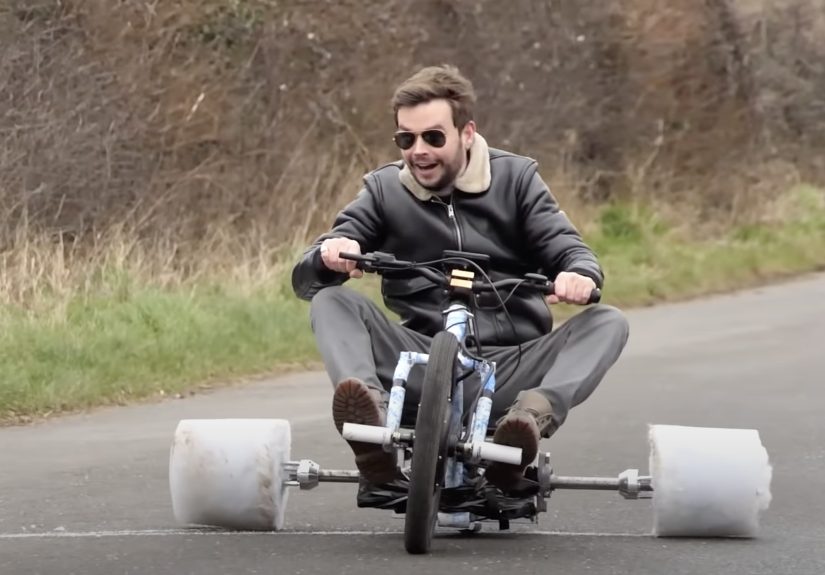
The ice-wheel version takes that formula and gives it a glorious plot twist. Instead of relying only on slick plastic sleeves or hard surfaces, it experiments with frozen composite wheels inspired by pykrete-like thinking. That matters because plain ice is not exactly famous for toughness. It is great in a drink, less impressive when asked to survive repeated impacts, side loads, vibration, and whatever emotional damage comes from being dragged sideways at speed.
So the magic is not “ice” alone. It is engineered ice. The concept borrows from the old idea that reinforcing frozen water with fibers can make it tougher and slower to fail than ordinary ice. In other words, this trike is not rolling on deluxe snow cones. It is rolling on the frosty cousin of a composite material, which is much more interesting and much less snackable.
Why Ice Wheels Sound Ridiculous But Make Sense
The Rear of a Drift Trike Is Supposed to Misbehave
The entire personality of a drift trike comes from the mismatch between front grip and rear slip. The front wheel must steer, pull, and stay composed enough to keep the machine pointed somewhere useful. The rear wheels, meanwhile, are basically the drama department. Their job is to slide, rotate, and make the rider feel like they just negotiated a treaty between momentum and chaos.
Ice wheels fit that logic beautifully. Ice is famous for low traction, especially when surface conditions, temperature, and pressure line up just right. That means it can deliver the kind of reduced grip a drift trike craves. The twist is that reduced grip alone is not enough. The wheel also has to hold shape long enough to be a wheel and not an emotional support slush pile. That is where the composite angle becomes the real star of the build.
Cold Materials Create Strange Trade-Offs
Using frozen composite wheels sounds delightfully unhinged, but it also highlights a serious engineering truth: the best material for one job is often terrible at three others. A wheel that slides beautifully may wear fast. A wheel that feels strong in the cold may crack under impact. A wheel that survives a straight line may protest loudly when cornering loads enter the chat. Materials science is full of these tiny betrayals.
That is why this project feels more than gimmicky. It turns wheel design into a balancing act. Toughness, shape retention, friction, weight, temperature sensitivity, and durability all start wrestling in public. And once a vehicle starts drifting, every little weakness gets tested immediately. Drifting is rude that way.
The Physics Are Slipperier Than They Look
Ice has a reputation for being slippery in a simple, cartoonish way, but the real story is messier and more fascinating. Friction on ice depends heavily on temperature, pressure, surface condition, and speed. Near the melting point, a thin lubricating layer can form more easily. At lower temperatures, ice can become harder and behave differently under load. Add motion, vibration, and varying contact pressure, and the surface stops acting like a single thing. It becomes a moving target.
That matters for an ice-wheel drift trike because each contact patch is doing a different job. The front wheel wants traction for steering and propulsion. The rear wheels want just enough structure to stay intact while still being slick enough to let the back step out. If the rear grips too much, the trike feels stubborn. If it grips too little, the ride becomes less “controlled drift” and more “unplanned geometry lesson.”
There is also the temperature problem. Ice can behave very differently depending on whether conditions are just below freezing or far colder. A wheel that performs one way in a chilly test session may act completely different after a few hard slides, repeated impacts, or contact with a warmer surface. That is part of what makes the project fascinating to watch. The machine is not just fighting the road. It is negotiating with a material that is changing as it works.
A Maker Project Disguised as a Joke Vehicle
One reason this concept resonates is that it lives at the sweet spot between improvisation and real engineering. The drift trike begins with familiar maker ingredients: an old bike, modified components, custom fabrication, and a willingness to experiment until the garage starts looking like a crime scene for zip ties and frozen water. But it also shows the discipline behind silly-looking builds.
Every strange machine worth talking about has a serious backbone. Someone has to solve load paths, steering geometry, weight balance, drivetrain compatibility, and wheel construction before the final product can go sideways with style. That is especially true when the materials are unconventional. Using a frozen composite wheel is not just quirky. It forces the builder to think about molds, freezing behavior, reinforcement ratios, and whether the finished part will survive first contact with reality.
And reality, as always, is a strict reviewer. It does not care how good the concept looked on paper or how cinematic the camera angle was. If a weld is weak, a frame flexes, or a part was rushed, the machine will reveal that truth immediately and usually with sound effects. In that sense, the project is pure maker culture: build boldly, test honestly, laugh a little, learn a lot.
Why the Internet Loves Projects Like This
Because they are rebellious without being pointless. A drift trike with ice wheels is not trying to save the world, optimize logistics, or disrupt transportation with a suspicious amount of venture capital. It is just trying to answer a question nobody needed answered but everybody is happy someone asked. That kind of curiosity has charm.
It also reminds people that engineering can be playful. Too often, innovation is packaged in gray boxes and serious fonts. This project shows the opposite. It says invention can be loud, silly, and a little bit theatrical while still teaching us something real about traction, composites, and design trade-offs. Sometimes the best way to understand a system is to make it ridiculous on purpose.
There is a long tradition of that in garage culture. Builders take familiar machines and push them into strange territory to see what breaks, what survives, and what surprises them. The result may never become a product, but that is not the point. The point is discovery. Also, occasionally, the point is making your neighbors stare through the blinds in total disbelief.
The Safety Reality Check
Now for the part that wears a reflective vest and clears its throat. Projects like this are entertaining because they flirt with unstable traction, sudden load changes, and unusual materials. That combination is exactly why they deserve serious caution. Sliding vehicles, frozen surfaces, and experimental wheels are not beginner-friendly ingredients, and they are definitely not interchangeable with ordinary recreational riding.
That does not make the project uninteresting. It makes it a reminder that inventive machines should be treated with respect. The same low friction that creates beautiful sideways motion also shortens the margin for error. A surface can look predictable and turn treacherous in seconds. A wheel can appear solid until repeated impacts say otherwise. The machine may look like a toy, but physics never agreed to that job title.
The smartest takeaway is not “everyone should try this.” It is “this is a brilliant demonstration of how quickly vehicle behavior changes when materials and traction are pushed outside the ordinary.” That framing keeps the wonder while ditching the recklessness, which is a trade I will happily make every day of the week and twice on frozen pavement.
What This Project Really Says About Innovation
The ice-wheel drift trike works as a story because it bundles together several timeless ideas. First, constraints breed creativity. No perfect parts? Adapt what you have. Ordinary wheel material too boring? Freeze something stronger. Second, novelty alone is not enough. The weirdest idea in the room still has to obey balance, force, and material limits. Third, failure is not the opposite of making. It is the receipt.
That last point matters most. Every machine like this carries a visible record of its own development. Maybe the frame gives up before the wheel does. Maybe a mold releases too early. Maybe an experiment creates one glorious run and then retires in a puddle. None of that makes the build a flop. It makes the build honest. Engineering without honest failure is usually just marketing in safety glasses.
So yes, the project is funny. It is weird. It looks like winter and a drift trike had a wonderfully irresponsible brainstorming session. But it also reveals how real innovation often happens: through playful curiosity, rough prototyping, and the stubborn refusal to leave an outrageous idea unexplored.
Experience: What a Machine Like This Feels Like in the Real World
Watching an ice-wheel drift trike for the first time is a strange sensory experience because your brain keeps switching channels. One part of you sees a tricycle and expects childhood logic. Another part sees a powered machine with sideways attitude and realizes this is not recess anymore. Then the wheels start moving, the rear steps out, and suddenly the whole thing looks like someone taught a science project how to powerslide.
The sound is the first surprise. You expect grinding, crunching, maybe a dramatic squeal worthy of a parking lot action scene. Instead, the noise can feel oddly muted and fleeting, especially compared with rubber on dry pavement. There is often a softer, stranger quality to it, as if the machine is skimming across the edge between grip and glide. It sounds less like a race vehicle and more like a bad idea with excellent commitment.
Visually, it is even better. Tire marks from ordinary drifting look permanent and aggressive. Ice-wheel marks look temporary, almost mischievous. They appear, they smear, and then they are gone, like the vehicle signed its name in disappearing ink. That gives the whole ride a surreal quality. The machine feels physical and theatrical at the same time, leaving evidence that seems to evaporate out of embarrassment.
There is also a unique tension in the way the trike moves. Ordinary vehicles usually reward confidence with stability. This thing rewards balance with a question mark. It is constantly negotiating. The front wants to pull. The rear wants to rotate. The surface wants to keep changing its mind. Watching that relationship play out is like seeing three coworkers try to carry a couch through a doorway while refusing to communicate.
From a rider’s perspective, the sensation would likely feel exaggerated in every direction. Sitting so low to the ground makes modest speed feel faster. Small changes in direction feel dramatic. A little slip at the back feels like the opening line of a very persuasive argument. Because the rear wheels are meant to slide, the machine broadcasts every twitch in a way that taller, more conventional vehicles do not. There is no bodywork to hide behind and no illusion of calm. You are right there in the conversation with the surface.
What makes the experience memorable, though, is not just the movement. It is the absurdity of knowing what you are looking at. This is not a polished factory machine optimized by committees and launched with cinematic commercials. It is a handmade answer to a ridiculous question. That gives every slide extra personality. You are not just seeing traction at work. You are seeing experimentation made visible.
And maybe that is why projects like this stick in the mind. They turn engineering into a story you can feel immediately. You do not need a graduate degree to understand that the builder is playing with friction, structure, and control. The machine shows you. It teaches through motion. It explains itself in arcs, slips, and sudden corrections. Honestly, a lot of textbooks could use that level of commitment.
By the end, the biggest impression is not “I want one.” It is something better: “I understand why someone needed to make one.” There is joy in that. There is curiosity in that. There is also a useful reminder that progress does not always show up in neat forms. Sometimes it arrives sideways, on frozen wheels, with a grin and a very questionable plan.
Conclusion
Drift Trike Puts A New Spin On Things With Ice Wheels is the kind of story that works on multiple levels at once. On the surface, it is funny and unforgettable: a custom drift trike using frozen composite wheels to turn traction into performance art. Underneath, it is a compact lesson in friction, wheel design, prototyping, and the make-it-weirder spirit that keeps maker culture alive.
Its real appeal comes from contrast. Ice is fragile, yet the wheel concept aims for strength. Drift trikes depend on low grip, yet still need control. The build looks playful, yet it forces serious decisions about materials and balance. Those contradictions are exactly what make it interesting. Great engineering stories rarely come from perfect ideas. They come from bold ones that reveal something useful when tested.
And that is the best way to view this project: not as a template for imitation, but as a sharp, funny example of how creative engineering turns oddball questions into memorable machines. It is proof that invention does not always move in a straight line. Sometimes it slides.