Table of Contents >> Show >> Hide
- How smart water meters changed the game
- Why your water meter can reveal more than you think
- The privacy problem is not science fiction
- The cybersecurity angle is not optional
- What utilities get right when they do this well
- What homeowners should ask before shrugging and moving on
- The bottom line: smart water data needs grown-up rules
- Real-world experiences: what this topic feels like at home
- Conclusion
Once upon a time, your water meter was basically a sleepy little accountant. It sat outside, minded its business, and occasionally helped the utility send you a bill that made you mutter, “How is showering this expensive?” Today, that humble gadget has gone to grad school, learned analytics, and returned as a data machine with surprisingly sharp instincts. Modern smart water meters can help utilities spot leaks, improve billing accuracy, manage drought pressure, and even support faster response during water-quality incidents. That is the good news.
The slightly spooky news is that detailed water-use data can reveal a lot more than most homeowners realize. Depending on the system, utilities can collect readings far more frequently than the old once-a-month snapshot. Researchers have shown that high-resolution water data can be broken down into appliance and fixture events, while privacy experts have warned for years that granular utility data can expose daily routines, occupancy patterns, and lifestyle clues. In plain English: your water meter may not know your favorite movie, but it can get uncomfortably close to guessing when you wake up, when you shower, when nobody is home, and whether something in your house is dripping away money at 2:13 a.m.
This is where the conversation gets interesting. Data mining home water usage is not automatically sinister. In fact, when done well, it can save water, cut costs, reduce damage, and make utilities more responsive. But it also raises an uncomfortable modern question: how much convenience are we trading for visibility? The answer is not “panic and wrap the meter in aluminum foil.” The answer is smarter governance, better cybersecurity, and a clear understanding of what these systems can actually do.
How smart water meters changed the game
Traditional meters were built for a simple job: measure usage over time and support billing. Advanced Metering Infrastructure, usually called AMI, changes that entirely. AMI combines the meter, communications network, and information systems that let utilities collect water-use data remotely and much more often. That means no more relying only on periodic manual reads, estimated bills, or slow-motion leak surprises that show up after a month of damage and a small heart attack.
For utilities, this is a dream setup. Frequent and accurate readings improve billing. Better visibility helps detect leaks sooner. Richer data helps utilities understand demand patterns, run conservation programs, and manage water resources with more precision. Some systems also feed customer portals, mobile tools, and alerts that help households see their own consumption in near real time. Your water bill is no longer just a monthly verdict. It can become a dashboard, a warning system, and, occasionally, a passive-aggressive life coach.
The practical upside is real
Let’s be fair to the meter. Smart water systems solve real problems. A household leak can waste thousands of gallons a year, and many leaks are sneaky enough to operate like tiny aquatic pickpockets. The average American family uses a lot of water indoors, especially in bathrooms, and even small fixture failures can pile up fast. A smart meter can flag unusual continuous flow, nighttime usage, or sudden spikes before the homeowner notices water damage, mold, or an ugly bill.
These systems also help with conservation. When people can see detailed usage patterns, they tend to understand consumption differently. Water stops being an invisible service and starts looking like a behavior map. Long shower? There it is. Running toilet? Also there. Irrigation system going rogue at dawn? Absolutely there, and now it has charts. Utilities like that because informed customers often waste less water. Homeowners like it because invisible waste is the worst kind of waste: expensive, annoying, and weirdly smug.
Why your water meter can reveal more than you think
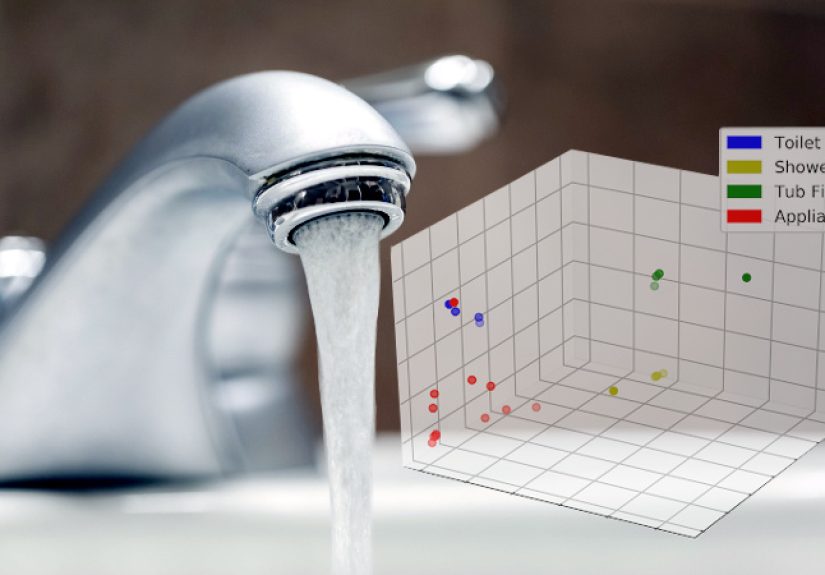
The phrase “data mining home water usage” sounds technical, but the concept is simple. If you collect enough readings at fine enough intervals, patterns start to emerge. Different water events have different signatures. A toilet flush does not look like a shower. A clothes washer does not look like a faucet rinse. Irrigation has its own rhythm. Researchers have shown that one-second resolution data can identify household trends, pinpoint valve-open and valve-close events, and sort water use into appliance or fixture categories. Other work has used water-flow data and occupancy signals to infer fixture-level events with impressive accuracy.
That means detailed usage data is not just “how much water this house used today.” It can become “what happened in the house, roughly when, and how often.” At a high level, that is useful for conservation. At a personal level, it starts to feel like the meter is taking notes.
Some of the inferences are surprisingly intimate
Think about what water does inside a home. It is tied to the most routine parts of human life: waking up, using the bathroom, showering, washing dishes, doing laundry, watering the yard, cleaning, cooking, and sleeping. If you can classify enough of those events over time, you do not merely know consumption. You know habits.
A sparse morning pattern may suggest nobody is home. Regular midday water use may hint at remote work, caregiving, or a stay-at-home schedule. Continuous low flow overnight can suggest a leak. Weekend spikes may align with guests, family gatherings, or aggressive attempts to revive a lawn that has seen better days. In multifamily or rental settings, high-frequency data can also become a management tool for identifying chronic leaks, vacancy patterns, or abnormal consumption.
To be clear, not every utility is running hyper-detailed behavior models on every household. Data resolution varies. System capabilities vary. Utility policies vary. But the technical possibility matters, because once data can reveal personal routines, privacy is no longer a side issue. It becomes part of the product.
The privacy problem is not science fiction
Privacy concerns around smart utility data did not begin with water. Energy regulators, privacy scholars, and consumer advocates have spent years wrestling with what granular usage data can reveal. In smart-grid debates, experts have warned that fine-grained meter streams can expose waking times, shower patterns, occupancy, sleeping habits, vacations, health clues, and other lifestyle details. Water-specific analytics make that concern even more concrete because water events are often tightly connected to intimate household behavior.
The core issue is not that utilities are villains twirling metaphorical mustaches over your shower schedule. The issue is that data collected for a legitimate purpose can easily become useful for other purposes. That is where things get messy. Who owns the data? Who can access it? How long is it retained? Can it be shared with vendors, analytics providers, or app developers? Is secondary use opt-in or assumed? Is it aggregated or tied to an addressable household profile? If a utility can answer those questions clearly, trust improves. If the answers are fuzzy, people start imagining the meter wearing sunglasses and whispering into a headset.
Data ownership and consent are still awkward territory
One of the biggest headaches in the smart-meter world is governance. U.S. policy discussions have long acknowledged that customer data needs privacy protections, customer access, and clear rules around third-party sharing. That sounds obvious, but in practice it is a maze of utility policy, state regulation, vendor contracts, legacy systems, and whatever legal document nobody reads until there is a problem.
The best frameworks tend to focus on a few common-sense ideas: tell customers what data is collected, explain why it is collected, limit secondary uses, require clear consent for extra sharing, keep records of disclosures, de-identify or aggregate data when possible, and secure the whole pipeline. None of that is glamorous. It is the privacy equivalent of flossing. But it matters precisely because detailed utility data can become revealing faster than people expect.
The cybersecurity angle is not optional
If privacy is about who should see the data, cybersecurity is about who should not. That distinction matters a lot in water systems. Utilities are under increasing pressure to secure operational technology, remote access tools, interfaces, and data pathways. Guidance from U.S. agencies has emphasized controls like asset inventories, data integrity, multi-factor authentication, secure remote access, and network segmentation between IT and operational systems. There is good reason for that urgency.
Water systems have faced cyber threats, and agencies have specifically warned about internet-exposed human-machine interfaces and weak remote access practices. When those systems are poorly secured, the risk is not just stolen data. It can be operational disruption. In some cases, utilities have had to revert to manual operations after malicious activity. That should get everyone’s attention, because the smart water future only works if the smart part is protected.
For homeowners, this means the privacy conversation should not stop at “Will they know I take long showers?” It should also include, “How is this data stored, transmitted, and accessed?” A beautiful customer portal is not very comforting if weak credentials, poor segmentation, or exposed systems leave the back door open.
What utilities get right when they do this well
There is a responsible version of all this. In fact, the best utilities treat data as both an operational asset and a customer trust obligation. They use frequent data to detect leaks, improve billing, support conservation, and help customers save money. They avoid collecting more than necessary. They explain retention and sharing clearly. They offer customer access to usage data without turning that access into a free-for-all. They protect secondary sharing behind meaningful consent. They secure the infrastructure with modern cyber controls instead of hoping nobody notices the old admin password still says “water123.”
They also respect context. A family home is not just an endpoint on a dashboard. It is a private space where ordinary life leaves measurable traces. Treating that reality seriously is not anti-innovation. It is the price of innovation that people will actually trust.
What homeowners should ask before shrugging and moving on
Most people do not need to become utility-policy nerds overnight, but a few questions go a long way. First, ask how often your meter records and transmits data. There is a big difference between monthly, hourly, fifteen-minute, and near-real-time information. Second, ask whether your utility offers alerts for leaks or unusual use. That can turn the meter from “creepy” to “genuinely useful” pretty quickly.
Third, read the privacy notice with one eyebrow raised and at least half a cup of coffee. Look for retention periods, third-party access, data sharing, secondary uses, and whether consent is required. Fourth, secure any customer portal account with a strong password and multi-factor authentication when available. Fifth, use the data for your own benefit. If the portal shows steady overnight flow, do not ignore it because you are busy. A toilet flapper does not care about your calendar.
Finally, ask the utility how it protects operational systems and customer data. You do not need a dissertation-length answer. But if the response sounds like “security is very important to us” followed by interpretive dance, keep asking.
The bottom line: smart water data needs grown-up rules
Smart water meters are not the enemy. They are tools, and like most powerful tools, they can be incredibly helpful or deeply uncomfortable depending on how they are used. Used responsibly, they can catch leaks earlier, improve customer service, support conservation, and help utilities manage increasingly stressed water systems. Used carelessly, they can normalize silent household surveillance, sloppy data-sharing practices, and cyber exposure in infrastructure people depend on every day.
That is why the conversation around home water usage can no longer be just about efficiency. It also has to be about dignity, control, and trust. Your water meter should be good at spotting a leak. It should not feel like a gossip columnist with a network connection. The future of water data should be smarter than that.
Real-world experiences: what this topic feels like at home
The most relatable part of this issue is not the acronym soup. It is the moment people realize that water data describes their lives more vividly than they expected. One common experience starts with a leak alert. A homeowner opens a utility app and sees continuous use in the middle of the night, even though nobody ran a shower, washing machine, or dishwasher. At first, it feels like a mistake. Then they discover a worn toilet flapper or a tiny irrigation leak. The result is gratitude mixed with mild existential discomfort. On one hand, the alert saved money and water. On the other hand, the meter knew something was wrong before the humans in the house did. That is both impressive and a little humbling.
Another familiar experience is the family accountability effect. Once near-real-time data becomes visible, water use stops being abstract. Suddenly, someone notices that “quick showers” are not quick, that the guest bathroom toilet runs more often than anyone admitted, or that outdoor watering starts before sunrise with all the determination of a lawn trying out for a sports movie montage. The portal does not merely report usage. It changes conversations in the house. Families begin to connect habits to costs, and small efficiencies become easier to discuss because the evidence is right there in black and white. Sometimes that inspires better conservation. Sometimes it inspires suspiciously defensive teenagers.
There is also the remote-work experience. People who are home more often often see how closely water patterns mirror daily life. Morning bathroom use, midday dish rinsing, afternoon laundry, evening showers, weekend cleaning burstsnone of it feels especially private until it appears as a pattern. Then the homeowner starts to see the hidden biography inside ordinary plumbing. That can make people more water-aware, but it can also shift how they think about household privacy. The data may be useful, yet it clearly reflects occupancy and routine. For renters, landlords, or property managers, that realization can feel even sharper because the same data that helps detect leaks can also suggest when a unit is vacant or behaving unusually.
A fourth experience is the “bill mystery solved” moment. Many households have lived through a confusing water bill and the long-standing ritual of blaming everyone else. Smart meter history changes that. Instead of debating vague memories, people can inspect actual usage trends. They may find a seasonal irrigation spike, an unnoticed hose issue, a recurring high-flow event, or a pattern of continuous use. The experience is often empowering. It replaces guesswork with evidence. But it also teaches a deeper lesson: water-use data is behavioral data. It is not just billing data wearing a nicer outfit.
And then there is the privacy shift itself. Once people understand what the data can show, they start asking better questions. Who can access it? How long is it saved? Is it shared with vendors? Is it used only for operations and billing, or also for analytics, targeting, or benchmarking? That change in attitude may be the healthiest outcome of all. Smart water systems work best when customers are not passive endpoints but informed participants. In that sense, the “your meter knows you a bit too well” reaction is not paranoia. It is the beginning of digital maturity at the kitchen-sink level.
Conclusion
Data mining home water usage sits right at the intersection of convenience and caution. Smart meters can save households from silent leaks, help utilities manage scarce resources, and turn invisible waste into visible action. They can also build detailed pictures of how life unfolds inside a home. That does not mean smart metering is bad. It means smart metering deserves strong privacy rules, clear customer choice, and real cybersecuritynot just optimistic brochures and a login screen. When the technology is governed well, everybody wins. When it is not, your water meter starts feeling less like infrastructure and more like an overachieving roommate with boundary issues.