Table of Contents >> Show >> Hide
Filipino last names are tiny time capsules. Some sound unmistakably Spanish. Some come from Tagalog, Ilocano, Kapampangan, or other Philippine languages. Some reflect Chinese-Filipino heritage. And some exist because colonial administrators once decided that family naming needed a spreadsheet, a catalog, and probably a stronger cup of coffee. The result is one of the most fascinating surname traditions in Asia: layered, mixed, practical, and full of history.
If you have ever wondered why so many Filipino surnames look Iberian, the short answer is history. In the nineteenth century, Spanish colonial officials pushed a standardized surname system across the Philippines. That is why names like Dela Cruz, Reyes, Santos, and Garcia became so widespread. But that is only part of the story. Filipino last names can also reflect geography, religion, occupation, personal traits, local languages, and long-standing Chinese trade and migration networks. In other words, a Filipino surname can hint at your family story, but it cannot tell the entire plot on its own.
This guide rounds up 125+ common Filipino last names and their meanings in plain English. A quick note before we dive in: many surname meanings are best understood as common historical interpretations, not courtroom-level proof. Some names have multiple roots. Some changed spelling over time. Some traveled through Spanish, Hokkien, Tagalog, and local dialects before landing in the form we know today. Genealogy is a detective story, not a microwave dinner.
Why So Many Filipino Last Names Sound Spanish
The Philippines spent more than three centuries under Spanish colonial rule, so Spanish naming patterns left a lasting mark. That explains why many of the most common Filipino surnames look familiar in Spain or Latin America. However, that does not mean every family with a Spanish-looking surname is descended from Spanish bloodlines. In many cases, surnames were assigned for administrative reasons rather than inherited from a Spanish ancestor.
That is also why meaning matters. A surname like Torres points to “towers.” Flores means “flowers.” Martinez means “son of Martin.” Dimaano, on the other hand, comes from a local linguistic root and is commonly understood to mean “invincible.” Put those side by side and you can see the Philippines in miniature: Catholic influence, Spanish administration, local languages, and regional identity all sharing the same family reunion buffet table.
125+ Common Filipino Last Names & Their Meanings
Below are commonly accepted meanings and glosses. They are organized by style and origin so the list is easier to read and does not feel like a census report wearing dress shoes.
Religious and Classic Filipino Surnames
- Dela Cruz “of the Cross,” one of the most recognizable Filipino surnames.
- Cruz “cross.”
- Reyes “kings.”
- Santos “saints.”
- Ramos “branches” or “bouquets.”
- Flores “flowers.”
- Bautista “Baptist.”
- Francisco from Francis, often glossed as “Frenchman” or “free one.”
- Domingo “Sunday,” and also tied to the personal name Domingo.
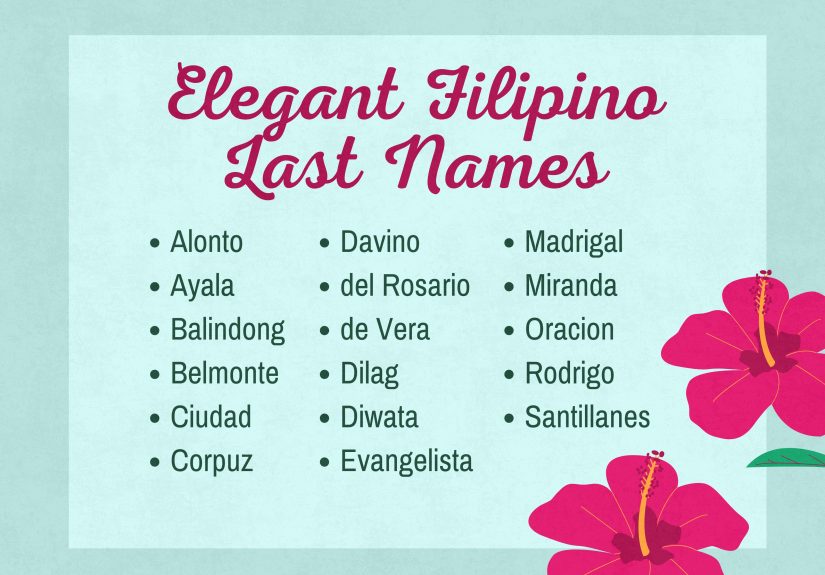
- Del Rosario “of the Rosary.”
- Rosario “rosary.”
- De Jesus “of Jesus.”
- Encarnacion “incarnation.”
- Evangelista “evangelist” or bearer of the gospel.
- Pascual tied to Easter or Passover.
- Roque from the personal name Roque.
- Salvador “savior.”
- Andres from Andrew, usually understood as “manly” or “strong.”
- Aquino a locational surname from Aquino.
- De Guzman from the place-name Guzman.
- Guzman from Guzman, an old place-name.
- Garcia from the old personal name Garcia; the deeper root is debated.
- Gonzalez “son of Gonzalo.”
- Lopez “son of Lope.”
- Perez “son of Pedro” or “son of Pero.”
- Martinez “son of Martin.”
- Sanchez “son of Sancho.”
- Torres “towers.”
- Rivera “riverbank.”
- Castillo “castle.”
- Castro “fort” or “fortified settlement.”
- Villanueva “new town.”
Patronymic, Occupational, and Descriptive Surnames
- Rodriguez “son of Rodrigo.”
- Hernandez “son of Hernando” or “son of Hernan.”
- Ramirez “son of Ramiro.”
- Fernandez “son of Fernando.”
- Alvarez “son of Alvaro.”
- Dominguez “son of Domingo.”
- Enriquez “son of Enrique.”
- Gutierrez “son of Gutierre.”
- Jimenez “son of Jimeno.”
- Mendez “son of Mendo.”
- Nunez “son of Nuno.”
- Suarez “son of Suero.”
- Vasquez “son of Vasco.”
- Velasquez “son of Velasco.”
- Cabrera “goat place” or goat pasture.
- Herrera “smithy” or ironworker’s place.
- Molina “mill.”
- Mercado “market.”
- Fuentes “springs” or “fountains.”
- Campos “fields.”
- Montes “mountains” or wooded hills.
- Rios “rivers.”
- Aguilar “place of eagles.”
- Leon “lion.”
- De Leon “of Leon,” a place-name often associated with “lion.”
- Moreno “dark-haired” or “dark-complexioned.”
- Rubio “blond” or “fair-haired.”
- Delgado “slender.”
- Bravo “bold” or “fierce.”
- Bueno “good.”
- Noble “noble.”
- Gallardo “gallant,” “spirited,” or stylishly brave.
- Espinosa “thorny place.”
- Serrano “from the mountains.”
- Guerrero “warrior.”
- Pastor “shepherd.”
- Ferrer “blacksmith” or metalworker.
- Abad “abbot.”
- Solis commonly linked to the sun.
- Luna “moon.”
Place, Landscape, and Floral Surnames
- Valle “valley.”
- Del Valle “of the valley.”
- Sierra “mountain range.”
- Peña “rock” or “crag.”
- Dela Peña “of the rock.”
- Navarro “from Navarre.”
- Miranda “lookout,” “pleasant view,” or scenic vantage point.
- Valencia from Valencia, a well-known place-name.
- Salazar a Basque place-name often interpreted as “old hall” or “old manor.”
- Villarreal “royal town.”
- Villareal spelling variant of Villarreal, also “royal town.”
- Villafuerte “strong town” or fortified village.
- Palma “palm tree.”
- Pineda “pine grove.”
- Sevilla “from Seville.”
- Marquez “son of Marcos.”
- Javier from Xavier, a place-name meaning “new house.”
- Pascua “Easter.”
- Dela Rosa “of the rose.”
- Delos Santos “of the saints.”
- Arellano from the place-name Arellano.
- Alvarado a locational surname, sometimes tied to Alvaro.
- Zamora “from Zamora.”
- Lara usually a locational surname from Lara.
Indigenous, Regional, and Chinese-Filipino Surnames
- Manalo from Tagalog, “to win.”
- Dimaano commonly understood as “invincible” or “cannot be defeated.”
- Macapagal linked to a Philippine root meaning “to tire”; likely an old nickname.
- Ilagan linked to a root meaning “to dodge” or “avoid.”
- Pangilinan tied to ili, meaning “town,” “homeland,” or “native land.”
- Panganiban from panganib, meaning “danger.”
- Carandang linked to drying things by the fire; probably occupational in origin.
- Magbanua from banwa or banua, meaning “town” or “village.”
- Tabon tied to filling land, embankments, or a place-name.
- Bayani “hero.”
- Lansangan “road” or “street.”
- Manila from Manila, itself connected to the Tagalog nila, the indigo plant.
- Paguirigan Ilokano-based, linked to a bent or leaning place.
- Agbayani Ilocano-based, often understood as “to be heroic.”
- Macaraeg linked to daig, meaning “to surpass” or “excel.”
- Sumulong “to move forward” or “advance.”
- Dalisay “pure” or “spotless.”
- Magtibay “to grow strong,” “endure,” or “remain steadfast.”
- Maghirang “to appoint,” “select,” or “choose.”
- Malay “awareness,” “consciousness,” or sometimes an ethnic reference to “Malay.”
- Lacson a Chinese-Filipino surname often glossed as “sixth grandchild.”
- Sison a Chinese-Filipino surname whose second element means “grandchild.”
- Tuazon a Chinese-Filipino surname meaning “eldest grandson.”
- Ong a Hokkien form often linked to Wang or Wong, commonly glossed as “king.”
- Tan a Hokkien form of Chen or Tran, an old clan or state name.
- Lim often linked to Lin, meaning “forest.”
- Uy a Chinese surname form whose exact meaning depends on the original character.
- Chua a Chinese surname form often linked to Cai or Tsai; meaning varies by character.
- Yap a Chinese surname form often associated with “leaf.”
- Go a Chinese surname form often linked to Wu; the precise meaning depends on the original character.
- Sy a Chinese surname form tied to a character-based root, so meaning can vary.
- Dy another Chinese surname form whose exact meaning depends on the original written character.
What a Filipino Last Name Can Reveal and What It Cannot
A Filipino surname can reveal a lot, but not everything. It may tell you that your family’s name likely passed through Spanish administration. It may suggest a connection to Catholic devotion, a town, a trade, a personality trait, or a local language. It may hint at Chinese-Filipino heritage that became naturalized over generations. It may even show how names adapted to spelling changes, colonial paperwork, and migration.
What it cannot do is serve as a perfect shortcut to ancestry. Two people named Dela Cruz are not automatically cousins. A family named Torres is not automatically Spanish by blood. A name like Tuazon may signal Chinese-Filipino roots, but the real family story still lives in records, oral history, photographs, parish books, and the grandma who remembers everyone’s nickname and absolutely refuses to forget a scandal from 1987. Surnames open the door; they do not furnish the whole house.
The Lived Experience Behind Filipino Last Names
Carrying a Filipino last name is often a cultural experience all by itself. For many people, it begins in school roll call. A teacher pauses at Dimaano, Pangilinan, or Villafuerte, gives it a brave but doomed attempt, and the student gently corrects the pronunciation for what feels like the nine-hundredth time. That moment can be awkward, funny, and strangely affirming all at once. Your surname becomes the first tiny speech you give about where you come from, even before anyone asks about your family, your language, or your history.
Then there is the diaspora experience. In the United States and other countries, a Filipino last name often works like a cultural signal flare. Someone sees Reyes, Dela Cruz, Manalo, or Tuazon on a class list, a work badge, or a social media profile and says, “Wait, are you Filipino too?” Suddenly the conversation moves from names to food, then to hometowns, then to whether your family also brings enough food for a village to every gathering. The surname becomes a point of recognition, a bridge between strangers, and sometimes the opening scene of an instant friendship.
For others, the experience is more complicated. A Spanish-looking Filipino surname can confuse people who assume identity should be obvious from spelling alone. Someone with the last name Garcia or Santos may be read as Hispanic, while someone with Ong or Lim may be read only through a Chinese lens, even though both are fully part of the Filipino story. That is one reason Filipino surnames are so interesting: they push back against neat categories. They remind people that history is messy, migration is real, and identity rarely fits into the tidy little boxes forms love so much.
Family memory also lives inside these names. A surname can carry stories about where a family once lived, what language grandparents spoke at home, which branch of the family moved abroad first, or what old nickname became official because a clerk wrote it down and nobody argued. Sometimes the meaning of the name is known and celebrated. Sometimes it is half-remembered, like a story missing a few pages. A family may know that Dalisay means “pure,” or that Bayani means “hero,” and repeat that proudly across generations. Another family may simply know, “This is our name, and this is us,” which is honestly its own kind of meaning.
There is also a quiet emotional power in researching a Filipino surname. People often begin with curiosity about translation and end up learning about colonial history, local languages, migration, religion, and family resilience. A last name that once felt ordinary suddenly becomes a clue. Why this spelling? Why this town? Why this language root? Why did one branch keep the old form while another changed it? That kind of research can feel surprisingly personal. It is not just about definitions. It is about belonging. It is about realizing that your name survived paperwork, empire, travel, and time. Not bad for a few syllables on a driver’s license.
So yes, Filipino last names are meaningful. They are historical, practical, beautiful, and sometimes gloriously confusing. They can point to saints, flowers, rivers, mountains, heroes, markets, villages, kings, and ancestors you may never have met but still carry with you. And that is probably the best way to understand them: not as static labels, but as living pieces of identity. A Filipino surname may begin as a word, but it stays alive because generations keep answering to it, adding to it, and making it their own.