Table of Contents >> Show >> Hide
- The Hair That Ate the Room
- Why the Look Went Viral So Fast
- The Stylist’s Defense Was the Key Plot Twist
- Why Gwendoline Christie Was the Perfect Person to Wear It
- Did the Hair “Work”?
- The Real Story Wasn’t Just the Hair
- What This Viral Moment Says About Fashion in 2025
- Extended Reflection: The Experience of Watching One Wild Look Hijack an Entire Awards Night
- Final Take
Some red carpet moments arrive politely. They wave, pose, sparkle a little, and leave behind a tidy trail of best-dressed applause. Gwendoline Christie’s 2025 Fashion Awards appearance did the exact opposite. It barged into the room, blew open the windows, and sat on the throne like a giant halo made of static electricity, theatrical nerve, and enough teased volume to frighten a humble blow dryer into early retirement.
At a ceremony designed to celebrate fashion excellence, Christie somehow managed to become the thing everyone was talking about. Not the winners. Not the trophies. Not even the usual parade of immaculate gowns and carefully calibrated glamour. Instead, the internet locked onto her massive, cloudlike hair and refused to let go. In a matter of hours, the look became meme fuel, group-chat material, and the kind of cultural side quest that hijacks an awards show whether the hosts like it or not.
That is why this viral Gwendoline Christie hair look matters more than it first appears. It was not just another celebrity beauty gamble. It became a live test of what people actually want from a fashion carpet in 2025: elegance, shock, artistry, weirdness, or just something juicy enough to interrupt dinner. Christie’s answer seemed to be, “Why choose?”
The Hair That Ate the Room
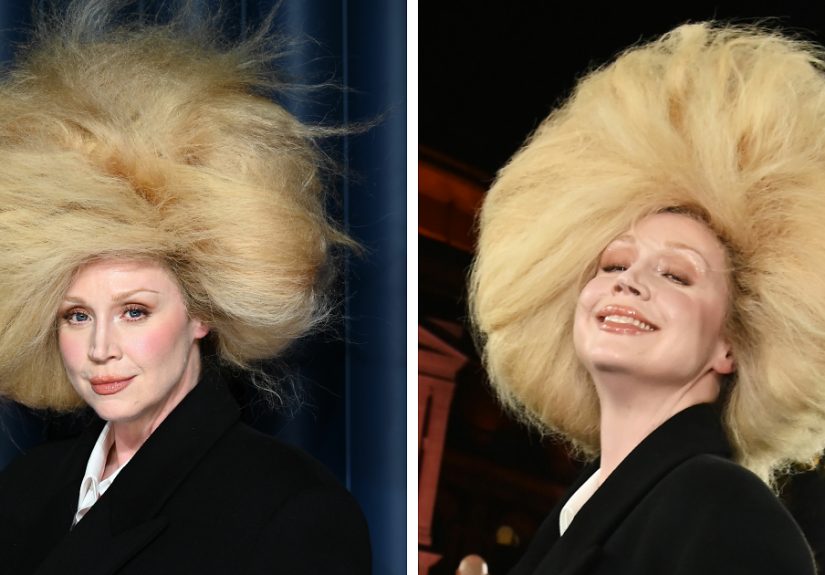
Let’s start with the obvious. The hairstyle was enormous. Not “big hair” in the classic pageant sense. Not “Old Hollywood with extra mousse.” This was an intentionally unruly, sculptural, gravity-bothering, backcombed spectacle that looked less like a salon finish and more like the aftermath of a passionate argument between couture and a thunderstorm.
Paired with a dark tailored look and crisp white shirt, the hair did all the loud talking. It framed Christie’s face like a blown-out art installation and turned an already statuesque performer into a walking editorial statement. She did not merely wear the hairstyle. She appeared to inhabit it. That distinction matters, because on someone else the look could have collapsed into costume. On Christie, it landed somewhere between performance, provocation, and fashion dare.
That, of course, did not stop the internet from acting like it had discovered oxygen. Social media reactions ranged from delighted disbelief to full roast mode. The now-viral “new home for lice” line was only one of many jokes comparing the style to cotton candy, troll hair, and the sort of thing you might get after sticking your head out of a moving train for the sake of art. If there is one thing the online world loves, it is a celebrity look that seems to arrive pre-memed.
And yet the mockery was only half the story. Plenty of viewers also understood exactly what Christie was doing: refusing to shrink, refusing to smooth herself into palatable beauty, and refusing to treat a fashion awards carpet like a school picture day with better jewelry.
Why the Look Went Viral So Fast
Because Fashion Is Now a Content Sport
The modern red carpet is no longer just a red carpet. It is a battlefield for screenshots. A celebrity can wear something technically flawless and still disappear by morning if the look does not generate conversation. In that environment, Christie’s hair was practically engineered for digital survival. It had silhouette. It had absurdity. It had enough personality to jump off a thumbnail and smack the timeline awake.
That is what made the moment so potent. People did not need to know who won what to have an opinion. They just needed one glance. In a culture that rewards instant reaction, her hairstyle functioned like a visual alarm bell. You could hate it, love it, laugh at it, or defend it, but ignoring it was simply not on the menu.
And there is another reason the moment spread so quickly: Christie already has a reputation for embracing dramatic fashion. She does not approach public style like a celebrity trying to look “relatable.” She approaches it like a tall, luminous art object who understands that dressing up can still be theatrical, strange, and genuinely fun. So when she arrived looking like a windswept blonde storm cloud, the response was less “Where did this come from?” and more “Ah yes, Gwendoline Christie has chosen chaos again.”
The Stylist’s Defense Was the Key Plot Twist
This Wasn’t Random. It Was Conceptual.
The most important detail in the whole saga came after the jokes. According to coverage of the look, stylist Lachlan Mackie explained that the hair was meant as a nod to Comme des Garçons. That changes the conversation immediately. Suddenly, this was not just “crazy celebrity hair.” It was a deliberate reference to one of fashion’s most celebrated houses of provocation.
Comme des Garçons has never built its reputation on being merely pretty. The label’s legacy is rooted in challenging proportion, beauty, symmetry, wearability, and sometimes even common sense. Rei Kawakubo’s work often asks viewers to think before they flatter. It pushes the body into shape-shifting silhouettes and treats discomfort as a valid artistic tool. In that context, Christie’s hair begins to make a lot more sense.
It was not trying to be soft, tidy, or universally appealing. It was trying to create tension. It was trying to distort the usual expectation of red carpet beauty. It was trying to say that a fashion awards carpet should be allowed to look like fashion, not just luxury shampoo advertising.
Now, did everyone get that? Absolutely not. But conceptual fashion has never required unanimous approval. In fact, if nobody argues about it, there is a decent chance it failed.
Why Gwendoline Christie Was the Perfect Person to Wear It
There is a reason this look landed on Christie instead of a safer, more algorithmically polished celebrity. She has spent years building a fashion identity that thrives on transformation. In interviews and profiles, she has spoken openly about being fascinated by design, beauty, creative reinvention, and the art of becoming someone else for a moment. She is not a dabbler in fashion fantasy. She is one of the rare actors who seems genuinely nourished by it.
That history matters. Christie has long shown affection for designers, visual storytelling, and unusual silhouettes. She has leaned into everything from regal armor-coded glamour to haunted-doll couture, sharply tailored suiting, dramatic sleeves, and high-concept editorial beauty. One month she can look like a gothic queen emerging from a dream sequence. The next she can appear in a clean, tailored tuxedo so severe it practically has its own legal team.
In other words, this Fashion Awards hair was not a random detour. It was the latest stop on a very Gwendoline Christie road map.
That road map has become even more interesting lately. Her recent public appearances have shown a wider range of experimentation: dramatic BAFTA styling, a striking red Givenchy moment, severe red carpet tailoring, and the kind of theatrical fashion language that keeps turning her into a favorite of editors and beauty watchers. Add in her recent comments about transformation and becoming more comfortable with herself through creative partnerships, and the Fashion Awards look starts to read less like a stunt and more like a declaration.
Did the Hair “Work”?
That Depends on What You Think Red Carpets Are For
If your definition of a successful red carpet look is “attractive in a conventional way,” then no, this was probably not your winner. It was too chaotic, too oversized, too anti-pretty, too unwilling to behave. But if your definition is “impossible to forget,” then Christie may have beaten half the room before the first award was handed out.
Fashion people have always known that memorable is often more powerful than beautiful. The history of style is packed with looks that were mocked first and respected later. Not every strange look ages into genius, of course. Sometimes weird is just weird. But risk is the engine. Without it, every carpet becomes a parade of tasteful sameness, and tasteful sameness rarely becomes culture.
Christie’s look also exposed a tension that never goes away: audiences say they want originality, then panic the second originality walks in wearing a storm cloud. They say fashion should be daring, but only within boundaries that remain flattering, feminine, and easy to compliment in one sentence. Christie stepped outside those boundaries and got exactly the reaction such a move always triggers: fascination disguised as outrage.
The Real Story Wasn’t Just the Hair
The real story was the speed with which the conversation became personal. Instead of simply saying the hairstyle was not to their taste, many commenters went straight for ridicule. That happens constantly in celebrity culture, especially when a woman presents herself in a way that is theatrical rather than immediately beautifying. The internet often claims to admire boldness, but it has a curious habit of punishing it the moment it stops being sexy in a familiar way.
That is partly why Christie’s look felt important. She did not seem apologetic. She did not wobble under the weight of the jokes. She stood there looking fully committed, which is exactly how a high-concept fashion moment survives. Commitment is the glue. Without it, a bizarre look becomes an accident. With it, the same look becomes a statement.
There is also something refreshing about watching a celebrity choose maximalism without chasing obvious approval. Plenty of stars now dress as if they are auditioning for a “best dressed” slideshow. Christie dressed like she was auditioning for the memory of the night. That is a very different ambition, and frankly, a more interesting one.
What This Viral Moment Says About Fashion in 2025
Fashion in 2025 is caught between two competing urges. One is the polished luxury machine: clean tailoring, quiet wealth, expensive understatement, and that eternal promise of looking rich without looking like you tried. The other is spectacle: theatrical beauty, meme-friendly silhouettes, editorial weirdness, and outfits that seem engineered to dominate feeds before they ever dominate sales.
Christie’s hair lived squarely in the second camp. It reminded people that fashion can still be absurd, dramatic, and slightly ridiculous in the best possible way. That is not a bug. That is part of the joy. Awards shows are not board meetings. A little visual lunacy is healthy for the ecosystem.
It also reinforced something else: the line between celebrity styling and performance art keeps getting blurrier. Hair is no longer just hair. It is branding, narrative, character, rebellion, and meme bait all at once. Christie’s look succeeded because it understood that modern celebrity beauty is not just about looking good in person. It is about telling a story instantly, before the scroll moves on.
Extended Reflection: The Experience of Watching One Wild Look Hijack an Entire Awards Night
Anyone who has watched a major red carpet live knows this experience. The show starts with a parade of beautiful people wearing beautiful clothes. A gown sparkles. A tuxedo fits perfectly. Someone looks elegant. Someone looks chic. Someone looks expensive in that very serious way celebrities do when the tailoring alone could probably cover a month of rent. And then, suddenly, one look arrives that changes the temperature in the room.
That is what Christie’s hair did. It created the kind of shared viewing experience that awards shows desperately need now. You can practically map the reaction in real time. First comes confusion. Then comes the pause. Then the zoom. Then the group chat explodes. Screenshots start flying. One friend says it is disastrous. Another says it is genius. Someone else says both can be true. Ten minutes later, people who did not even know the event was happening are now emotionally invested in a giant cloud of blonde backcomb.
That is the weird magic of these moments. They are communal. They remind us that fashion is not just commerce, branding, or luxury theater. It is conversation. It is disagreement. It is the pleasure of seeing something so strange that your brain has to do a full lap before deciding how to feel about it. Even the jokes become part of the event’s afterlife. They may be mean, but they also confirm that the look connected. Safe outfits do not produce that level of collective reaction. They earn polite nods and vanish by breakfast.
There is also an almost sporting quality to watching a daring look survive the internet. If the wearer flinches, the moment dies. If the wearer stands tall, the look starts to evolve in public opinion. That is often when the backlash softens and curiosity creeps in. People revisit the outfit. They ask what the reference was. They notice the tailoring. They see the makeup differently. They begin, reluctantly, to respect the nerve. Christie’s confidence gave her hair the kind of backbone outrageous styling always needs.
For viewers, the experience is deliciously messy. You may not want the look on your own head. You may not even want it near your own head. But you are grateful somebody wore it. It breaks the rhythm of predictable glamour. It reminds you that fashion can still surprise you, and surprise is becoming an increasingly valuable thing. We live in a time when every carpet is photographed from every angle, discussed in real time, and flattened into instant consensus. A truly odd look interrupts that machinery.
And for the event itself, one viral appearance can become the memory anchor. Years from now, many people will not remember the exact order of winners from that ceremony without looking it up. But they will remember the giant hair. They will remember the jokes. They will remember the debate over whether it was awful, brilliant, or weirdly fabulous. That is the experience Christie created. She did not just attend the Fashion Awards. She turned them into a live wire.
Final Take
Gwendoline Christie’s bizarre Fashion Awards hair was never going to please everybody. That was not the point. The point was to make fashion feel dangerous again for a few minutes, to turn a beauty look into an argument, and to remind everyone that spectacle still has a seat at the table. The internet called it many things, some funny, some cruel, and some wildly unprintable. But boring was not one of them.
And in the current celebrity style economy, that may be the biggest win of all.