Table of Contents >> Show >> Hide
- What Is Zombie Ice, Exactly?
- Why Greenland Is a Big Deal for Global Sea Level
- The Study Behind the 10.6-Inch Number
- How Greenland Melts
- Why 10.6 Inches Is a Bigger Problem Than It Sounds
- What the Number Does Not Mean
- Why This Story Resonates Beyond Science Headlines
- What Coastal Communities Should Take From This
- Experiences That Make the Greenland Story Feel Real
- Conclusion
If the phrase zombie ice sounds like something cooked up by a movie studio after too much coffee, welcome to climate science in the age of weirdly accurate nicknames. “Zombie ice” does not shamble through the Arctic looking for brains. It is ice on Greenland that is effectively already dead: still physically attached to the main ice sheet, but no longer getting enough fresh snowfall to replace what it loses each year. In other words, it is ice with a one-way ticket to the ocean.
That is why the headline figure matters so much. Scientists found that melting zombie ice in Greenland is now committed to raising global sea level by at least 10.6 inches. Not maybe. Not only if things go badly. Not only in some distant sci-fi future. This is the minimum amount of sea-level rise already locked in from this portion of Greenland’s ice loss, based on recent climate conditions.
And yes, 10.6 inches may sound modest if you are picturing a ruler on your desk. But at the coast, inches are troublemakers. They push storm surge farther inland, make nuisance flooding more common, worsen erosion, strain drainage systems, and turn “once in a while” flooding into a recurring neighborhood event. A little water goes a long way when the land is flat, the tides are high, and the infrastructure is old enough to remember dial-up internet.
This article breaks down what zombie ice means, why Greenland matters so much to sea level rise, what the science actually says, and why the rest of the world should pay attention even if it lives nowhere near an iceberg.
What Is Zombie Ice, Exactly?
In simple terms, zombie ice is doomed ice. It is part of the Greenland Ice Sheet that is still there in a literal sense, but no longer sustainable in a climate sense. Normally, an ice sheet can remain stable if snowfall in colder months balances the ice it loses through melting, runoff, and glacier discharge into the ocean. But when less snow falls, more surface melting occurs, and coastal glaciers retreat, some zones of the ice sheet become stranded. They are not being “fed” enough anymore.
Think of it like a bank account that keeps making withdrawals while the paycheck gets smaller. For a while, the balance still exists. Then the math wins. Zombie ice is the cryosphere’s version of that uncomfortable financial reality.
The Greenland Ice Sheet is especially vulnerable because warming affects it from multiple directions at once. Higher air temperatures encourage more surface melt. Darker, wetter surfaces absorb more solar energy and melt faster. At the edges, warmer ocean waters can also eat away at marine-terminating glaciers. So Greenland is not just being nibbled from above; it is also being undermined from the sides.
Why Greenland Is a Big Deal for Global Sea Level
Greenland is not some tiny frozen garnish on the side of the climate plate. It is one of the largest ice masses on Earth. If the entire Greenland Ice Sheet melted, it would raise global sea level by roughly 23 to 24 feet. No one is saying that will happen tomorrow morning, so you may cancel the canoe purchase for now. But that enormous reservoir of frozen water is the reason scientists watch Greenland so closely.
Even partial loss matters. Over recent decades, Greenland has been losing ice at an alarming pace, and researchers estimate that it has contributed a substantial share of current global sea-level rise. That means what happens in Greenland does not stay in Greenland. It shows up in flood maps, insurance tables, engineering plans, and very awkward city council meetings in coastal communities around the world.
One especially important point is that sea-level rise is not uniform. Meltwater from Greenland does not spread out like someone carefully frosting a cake. Changes in gravity, ocean circulation, and land motion mean some regions get more relative sea-level rise than others. In North America, the southern East Coast and Gulf Coast are among the regions expected to see especially fast increases. That is not comforting news for areas already dealing with high-tide flooding, storm surge, and sinking land.
The Study Behind the 10.6-Inch Number
The now-famous 10.6 inches comes from research on Greenland’s climate imbalance. Scientists examined the ice sheet’s condition under the recent climate of roughly 2000 to 2019 and estimated how much ice retreat is already committed, regardless of what happens with future emissions pathways. Their conclusion was striking: Greenland’s imbalance commits the planet to at least about 274 millimeters of global mean sea-level rise, which is roughly 10.6 inches.
That figure represented more than many earlier estimates had suggested, which is one reason the study made such a splash. Researchers also described a much worse possibility if extreme melt conditions like 2012 were to persist, meaning the 10.6-inch figure should be understood as a minimum committed amount, not a cap.
In plain English, the message was this: some sea-level rise from Greenland is no longer waiting for permission from the future. It has already been set in motion by the climate of the recent past.
That matters because public discussion often treats climate impacts as if they will happen only if emissions continue indefinitely at high levels. The science here is more sobering. Rapid emissions cuts still matter tremendously for limiting additional damage, but they do not erase the melt that has already been locked in. Climate change is not a light switch. It is more like a freight train that needs distance to slow down, and Greenland is already several stations past the point where nothing changes.
How Greenland Melts
Surface Melting and Runoff
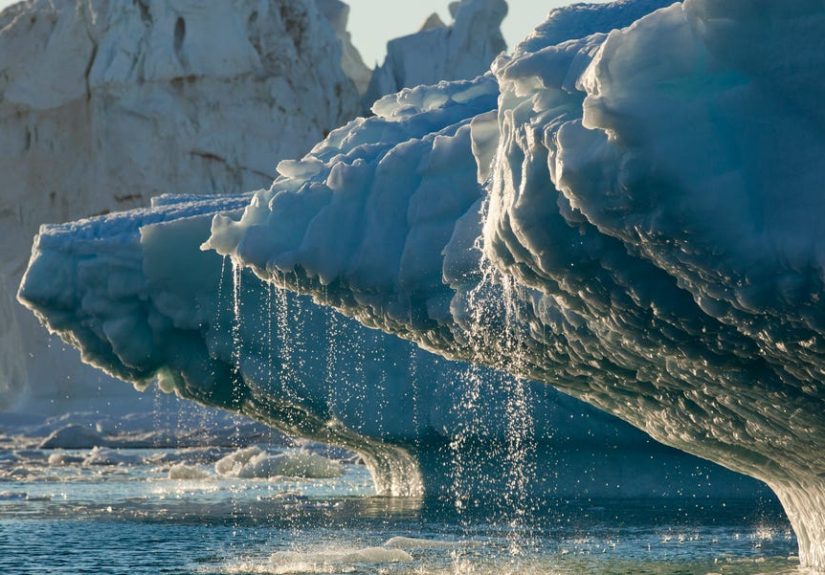
One major route is surface melt. Warmer air, longer melt seasons, and darker ice surfaces can create more meltwater on top of the ice sheet. Some of that water refreezes. Some gets stored temporarily in snow and firn. But a significant amount runs off into the ocean, directly adding to sea level.
Surface conditions matter more than many people realize. Snow is bright and reflective. Wet snow, bare ice, dust, soot, and melt ponds are not. As Greenland darkens in places, it absorbs more sunlight, which encourages more melting. It is a nasty little feedback loop: the ice melts, becomes darker, absorbs more heat, and melts more.
Glacier Flow and Ice Discharge
The second route is glacier discharge. Greenland’s outlet glaciers act like conveyor belts, moving ice from the interior toward the coast, where it calves into the ocean. When those glaciers speed up or retreat, more land-based ice ends up in the sea. That is a direct contribution to global sea-level rise.
This is where ocean water becomes a major accomplice. NASA’s Oceans Melting Greenland mission showed that warmer ocean temperatures on Greenland’s continental shelf strongly affect ice loss at the glacier margins. So even if you focus only on the atmosphere, you are missing half the plot. Greenland is under pressure from both the sky and the sea.
Why 10.6 Inches Is a Bigger Problem Than It Sounds
A rise of 10.6 inches in global average sea level would be significant on its own. But it does not arrive in an empty world. It stacks on top of sea-level rise that has already happened and adds to future rise from other sources such as mountain glaciers, Antarctic ice loss, and the thermal expansion of warming seawater.
Global average sea level has already risen roughly 8 to 9 inches since 1880, and the rate has accelerated sharply. Satellite measurements show the rise since the early 1990s has continued upward, and NASA has reported that the rate of annual sea-level rise has more than doubled over the last three decades. In 2024, sea level rose faster than expected, largely because unusually warm ocean water expanded while land ice continued to add water to the sea.
That broader context is crucial. The 10.6-inch zombie-ice commitment is not the whole sea-level story. It is one very serious chapter in a book that is already getting too long for coastal planners to read comfortably in one sitting.
What does that mean in practice? More frequent “sunny day” flooding. Higher baseline water levels before storms even arrive. Saltwater intrusion into freshwater systems. Greater damage to roads, storm drains, septic systems, wetlands, and homes. A hurricane hitting a higher starting ocean is like a boxer starting a match from a step stool. The punch lands harder.
What the Number Does Not Mean
It does not mean the ocean suddenly rises 10.6 inches next Tuesday. Sea-level rise unfolds over time. The committed melt from zombie ice will play out over years to decades, and the exact pace depends on how the ice sheet responds physically as it continues adjusting to warming.
It also does not mean every coastline will see exactly 10.6 inches. Local sea level depends on land subsidence, ocean currents, gravitational effects, and regional climate patterns. Some places will get more relative rise. Some will get less. Greenland itself can even experience local sea-level fall near the ice sheet as the gravitational pull of the shrinking ice weakens and land rebounds upward.
Finally, it does not mean climate action is pointless. That would be the world’s most incorrect takeaway. The study identifies a minimum amount already committed, but future emissions still determine how much additional ice loss and sea-level rise occurs. The difference between “bad” and “catastrophic” is still very much in human hands.
Why This Story Resonates Beyond Science Headlines
Part of the reason the zombie-ice story traveled so widely is that it gives a vivid name to a difficult concept: committed change. We tend to imagine climate change as something that only responds to what we do tomorrow. But in reality, the atmosphere and oceans have memory. Ice sheets do too. Greenland is responding not just to a hot month or one dramatic summer, but to years of accumulated warming and shifting snow, melt, and ocean patterns.
That makes the story emotionally powerful because it carries both warning and urgency. The warning is that some consequences are already unavoidable. The urgency is that the future beyond that minimum is still negotiable.
It also exposes the sneaky danger of climate language. Ten inches sounds small until you pair it with tides, storm surge, coastal population growth, and aging infrastructure. Then it starts sounding less like a footnote and more like a bill that somebody definitely has to pay.
What Coastal Communities Should Take From This
For local governments, engineers, and homeowners, Greenland’s zombie ice is not merely a polar curiosity. It is a planning signal. Roads, ports, drainage systems, power stations, wastewater treatment plants, and housing developments all have lifespans measured in decades. The sea-level decisions made today have to account for the water levels of tomorrow.
Communities do not need to wait for total certainty to act. In fact, waiting for perfect precision is one of the fastest ways to get a very expensive surprise. Better flood mapping, resilient infrastructure, restored wetlands, smarter zoning, elevated structures in vulnerable places, and updated building codes are no longer “someday” conversations. They are the grown-up part of coastal life now.
For the rest of us, the Greenland story is a reminder that climate change is both global and intimate. It connects a melt pond in the Arctic to a flooded street in Florida, a damaged marsh in Louisiana, and a higher insurance premium almost anywhere near the coast. The chain of cause and effect can be long, but it is not imaginary.
Experiences That Make the Greenland Story Feel Real
Reading about Greenland ice melt on a screen is one thing. Feeling the reality of it is another. Scientists who work on the ice often describe Greenland as both majestic and unsettling. One day they are crossing bright snowfields under a clean blue sky, and the next they are picking their way around swollen meltwater channels, softening surfaces, and patches of darker ice that absorb heat more aggressively. The landscape is beautiful, but it also carries the eerie feeling of change happening in plain sight. Even routine fieldwork can turn into a reminder that the system is shifting faster than it used to.
There is also a sensory side to this story that data alone cannot fully capture. The crunch of boots on crusted snow, the hiss of wind over exposed ice, the trickle of water where there should be solid surface, the sudden appearance of melt ponds that look almost jewel-like from a distance. Researchers often return from Greenland with measurements and satellite calibrations, yes, but also with a sharpened emotional understanding of what acceleration looks like. It is one thing to read “longer melt season” in a chart. It is another to stand in a place that used to stay frozen longer and watch water move across it.
Then there are the experiences far from Greenland, where the consequences show up in less cinematic but equally important ways. Coastal residents do not usually describe sea-level rise in scientific units. They describe the street that now floods more often during high tide. They describe the storm drain that backs up after routine rain. They describe saltwater creeping into marsh edges, foundations needing more work, and the strange new habit of checking tide forecasts the way previous generations checked baseball scores. Sea-level rise has a way of turning ordinary errands into planning exercises.
For families in vulnerable neighborhoods, the issue is not abstract. It is practical and personal. It is whether a child’s school bus route floods after a coastal storm. It is whether an elderly neighbor can get out during a nuisance flood. It is whether home repairs are still affordable after the third water-related problem in a few years. No one stands in a flooded driveway and says, “Ah yes, cryospheric disequilibrium.” They say something closer to, “Why is this happening again?” Greenland is one of the answers.
Even travelers to Arctic regions often describe a strange tension between awe and grief. They see icebergs, vast white expanses, and landscapes that feel timeless. But they also hear guides, researchers, and local observers talk about instability, retreat, and warmer conditions that have become easier to notice over time. It creates a kind of double vision: the frozen world still looks enormous, but it no longer feels invincible.
That may be the most human lesson in the zombie-ice story. Climate change rarely arrives as one dramatic movie scene. More often, it enters life through repeated experiences: more meltwater, more flooding, more repairs, more caution, more adaptation. Greenland’s zombie ice is a scientific term for committed loss, but for people on the ground, committed loss is experienced as a series of changing routines. The world still looks recognizable, right up until daily life quietly stops working the way it used to.
Conclusion
The phrase “Melting Zombie Ice in Greenland Will Raise Sea Level 10.6 Inches” may sound dramatic, but the science behind it is sober and serious. Greenland contains an immense store of frozen water, and part of that ice is already committed to melting because it is no longer being replenished fast enough. That means at least 10.6 inches of global average sea-level rise from this committed loss alone, on top of broader sea-level rise already underway from warming oceans and other melting land ice.
The key takeaway is not panic. It is clarity. Some change is now unavoidable, which makes adaptation essential. But much worse outcomes are still avoidable, which makes emissions cuts and better planning just as essential. Greenland’s zombie ice is not a quirky climate headline. It is a warning label on the future coastline.