Table of Contents >> Show >> Hide
- Why Patents Matter So Much in 3D Printing
- The Foundational Patents That Built the Industry
- The Patent Cliff Effect: What Happened When Protection Expired
- What These Key Patents Actually Protected
- What Businesses, Engineers, and Creators Can Learn From This History
- What the Patent Story Feels Like in Real Life
- Conclusion
If 3D printing has ever seemed like a magical machine that turns plastic, resin, or powder into useful objects by sheer wizardry, patents are the part of the trick where the magician quietly locks the stage door. For decades, the biggest breakthroughs in additive manufacturing were not just engineering achievements. They were also legal fortresses. A handful of key patents helped define the modern 3D printing industry, shaped who could sell what, kept some machines expensive, and then, once they expired, flung open the door for a new wave of desktop printers, startups, makers, and garage-level tinkerers with suspiciously large filament collections.
This is the real story behind 3D printing patents: not a dull parade of filing dates and government paperwork, but a map of how the industry actually grew. The most important patents did not simply protect a neat idea. They protected entire methods of building objects layer by layer. In some cases, they also protected the little technical details that make the whole process commercially useful, such as powder handling, support structures, thermal control, and recoating. In other words, the headline invention got the glory, while the follow-on patents guarded the cash register.
To understand modern additive manufacturing, you have to understand which patents mattered, why they mattered, and what happened when the legal fences started coming down.
Why Patents Matter So Much in 3D Printing
Patents have always mattered in manufacturing, but in 3D printing they mattered in a particularly dramatic way because the field was built around process inventions. A patent on a coffee mug design is one thing. A patent on the method a machine uses to create almost any shape, layer by layer, is another beast entirely. That kind of protection affects not just one product, but a whole category of machines, materials, and business models.
That is why the history of additive manufacturing often looks like a relay race. One company invents a process, patents it, commercializes it, and enjoys years of limited competition. Then the patents expire, prices start to fall, hobbyists and smaller firms rush in, and the technology suddenly feels “new” to the broader public even though the core invention may be decades old. The public sees a trend. Patent lawyers see a term expiration. Engineers see opportunity. Investors see dollar signs. Makers see a reason to start assembling things with hex keys at midnight.
It also helps to use the language carefully. “3D printing” is the umbrella term most people know, while standards bodies group these technologies into broader additive manufacturing categories such as vat photopolymerization, material extrusion, powder bed fusion, and binder jetting. Those categories matter because one company’s trademark or product brand is not always the generic name of the process. That is why “FDM” often shows up in conversation, even though the broader generic idea belongs under material extrusion.
The Foundational Patents That Built the Industry
1. Chuck Hull’s Stereolithography Patent: The Blueprint for Modern 3D Printing
If you were building a Mount Rushmore of 3D printing, Chuck Hull would absolutely get a face on the rock. His stereolithography patent is one of the defining documents in the history of the field. Hull’s breakthrough was elegant and powerful: use light to selectively cure a liquid photopolymer, build one thin layer at a time, and stack those layers into a solid object. Today that sounds obvious. At the time, it was a genuine leap.
The genius of stereolithography was not just that it could make objects. It could make precise objects from digital data, with a workflow that became foundational for the industry. Hull’s work also helped establish ideas that remain central to 3D printing software, including digital slicing and the STL file format that became a workhorse for moving 3D models into printable form. This was not merely a patent for a machine. It was a patent that helped define the logic of the modern 3D printing pipeline.
Hull later co-founded 3D Systems, which became the first major company built around commercial 3D printing. That matters because a landmark patent alone does not change an industry. A company that turns the patent into a usable machine does.
2. Scott Crump’s FDM Patent: The Idea That Eventually Came Home to Everyone
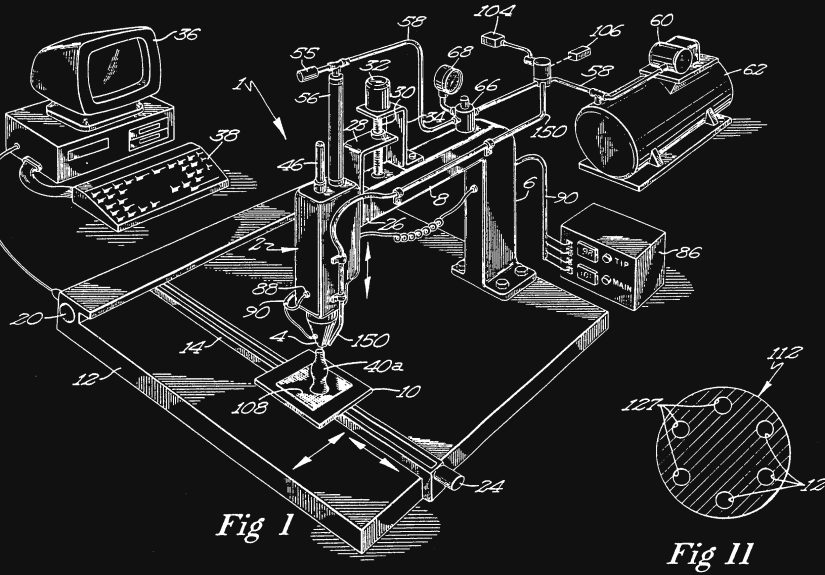
Scott Crump’s patent for fused deposition modeling, or FDM, became one of the most culturally important patents in 3D printing. The method is simple to explain and endlessly tricky to perfect: melt a thermoplastic material, extrude it through a nozzle, and deposit it layer by layer to form a part. In other words, it is a controlled hot-glue gun with a PhD and a motion system.
Crump’s invention was important because it made additive manufacturing more mechanically approachable. Instead of lasers and vats of resin, the process relied on extrusion. That made the technology more understandable, more maintainable, and eventually more affordable. Stratasys commercialized the process and built a powerful business around it. For years, that patent family helped keep the method largely in industrial and professional hands.
There is also a terminology wrinkle worth noting. FDM is a Stratasys trademark, which is why many people outside the company use terms like FFF, or fused filament fabrication, or simply material extrusion. Same family idea, different naming politics. In 3D printing, even the vocabulary has an intellectual property backstory.
3. Carl Deckard’s SLS Patents: Powder Bed Fusion Enters the Scene
While resin and filament get most of the mainstream attention, selective laser sintering, or SLS, was one of the biggest industrial leaps in the field. Developed by Carl Deckard and Joe Beaman at the University of Texas, SLS uses a laser to selectively fuse powder in thin layers. Instead of extruding plastic or curing liquid resin, the machine works across a powder bed and builds a part from sintered material.
This opened the door to a very different set of capabilities. Powder acts as a kind of natural support around the part during printing, which means SLS can produce complex geometries without the same support-structure headache common in other systems. The result is a process that became highly valuable for functional parts, short-run manufacturing, and applications where geometry freedom is a major advantage.
Deckard’s early patent, and later follow-on patents tied to SLS systems, were major gatekeepers. They helped keep the technology expensive and mostly industrial for years. When people later predicted that patent expirations would unleash a cheaper SLS market, they were responding to the legacy of this protection.
4. MIT’s Binder Jetting Patent: “3D Printing” Gets Its Name
One of the most fascinating twists in this history is that the term “3D printing” became strongly associated with MIT’s binder-jetting work led by Emanuel Sachs and colleagues. Their core idea was to spread a powder layer and selectively jet a binder onto chosen areas, bonding the powder into a desired cross-section. Repeat that process enough times and a three-dimensional object appears.
Binder jetting mattered because it introduced a different economic and technical pathway. It borrowed logic from inkjet printing, which made the process conceptually familiar, and it created possibilities for ceramics, metals, molds, medical applications, and other specialized uses. It also helped popularize the phrase “3D printing” itself, which eventually escaped the lab and became the everyday term people now apply to nearly everything in the additive manufacturing universe.
In branding terms, binder jetting may be the process that gave the whole industry its most popular nickname. Not bad for a patent portfolio that sounds, at first glance, like it belongs in a dry engineering library next to a lonely vending machine.
The Patent Cliff Effect: What Happened When Protection Expired
The most dramatic thing about 3D printing patents is not that they existed. It is what happened when key ones expired. This is where the industry changed from a niche professional market into a broad ecosystem.
FDM and the 2009 Consumer Boom
When important FDM patents expired around 2009, the consumer market took off. Prices fell. Open-source designs spread. RepRap-inspired projects gained traction. MakerBot and similar desktop printer companies arrived at exactly the moment when a process that had been commercially guarded became far more accessible. Suddenly, the technology that once lived mainly in engineering labs started showing up in classrooms, makerspaces, libraries, and homes.
This did not happen because the machines became magically easy. Early desktop printers still required patience, tinkering, calibration, and the occasional spiritual conversation with a tangled spool of filament. But the patent expiration removed a major structural barrier. Once the legal gate opened, the technical and community ecosystems moved fast.
SLS and the Slower 2014 Shift
The SLS story was similar, but less explosive. When key SLS patents expired in 2014, many people expected the same instant price collapse and desktop wave that material extrusion had experienced. The shift did happen, but more slowly. That is because SLS is not just legally complex. It is also harder to execute well. Powder handling, thermal control, laser systems, safety considerations, and post-processing all add cost and complexity.
So yes, patent expiration mattered. But it did not turn SLS into a plug-and-play toaster oven for nylon parts overnight. It created room for more competition and experimentation, not an immediate mass-market flood.
Follow-On Patents and Lawsuits Kept the Chess Match Going
A common misconception is that once a foundational patent expires, the legal game ends. Not even close. In 3D printing, follow-on patents often protected refinements that still mattered commercially. That is part of why companies could continue to defend their turf even after the first-generation inventions aged out.
The dispute between 3D Systems and Formlabs is a useful example. By the time desktop resin printing was becoming exciting and accessible, companies still had to navigate later stereolithography-related patents. The lesson is simple: an expired landmark patent can open a door, but a thicket of narrower patents may still line the hallway. In additive manufacturing, the first patent writes history, but the later patents often write the profit model.
What These Key Patents Actually Protected
It is tempting to think each famous patent protected one neat machine concept. In reality, the important patents often covered method claims, apparatus claims, material behavior, layer formation, exposure control, recoating, support logic, or powder delivery. Those details matter because additive manufacturing succeeds or fails on process control.
A basic 3D printing idea sounds charmingly simple: make one layer, then another. But the actual engineering questions are far messier. How do you maintain layer thickness? How do you prevent warping? How do you manage heat? How do you deal with unsupported features? How do you spread powder evenly? How do you cure resin precisely enough to keep fine details from turning into sad little blobs? Patents that solved those problems were often just as commercially important as the first headline invention.
That is why the patent history of 3D printing is really a history of problem solving. Each major process became viable not because of one magical spark, but because inventors kept patenting the practical steps that moved the technology from “interesting demo” to “repeatable product.”
What Businesses, Engineers, and Creators Can Learn From This History
The biggest lesson is that additive manufacturing has always been a mix of invention, commercialization, and timing. The best-known patents created technological categories, but the real market winners often came later, when they combined better software, cheaper components, smarter materials, and improved user experience after the legal barriers weakened.
For businesses, the lesson is that patent strategy in 3D printing is rarely about one blockbuster filing. It is about building portfolios across process, materials, hardware, and workflow. For engineers, the lesson is that clever technical details can become highly defensible assets. For creators and startups, the lesson is both encouraging and cautionary: big openings often arrive when core patents expire, but success still depends on execution, usability, and the ability to navigate whatever legal weeds remain.
Most of all, these patents remind us that the 3D printing market did not emerge in a smooth straight line. It lurched forward in waves. Invention. Lock-up. Expiration. Expansion. Repeat. If that sounds a bit like layer-by-layer fabrication itself, well, that feels oddly on brand.
What the Patent Story Feels Like in Real Life
One of the most interesting experiences around 3D printing patents is how differently the technology feels depending on when a person entered the field. Engineers who first encountered additive manufacturing in the 1990s or early 2000s often remember it as something expensive, tightly controlled, and almost ceremonial. The machines were impressive, but they lived behind corporate doors, inside prototyping departments, or in service bureaus where every build felt like an event. You did not casually “try a print.” You submitted a file, waited, crossed your fingers, and hoped accounting did not faint at the invoice.
Then came the desktop era, and the emotional vibe changed completely. Suddenly 3D printing was not just a professional tool. It was a hobby, a classroom exercise, a maker fair attraction, a side hustle, and occasionally a machine that spent five hours making a spaghetti monster because someone forgot to tighten one screw. That shift was not purely technical. It was cultural. When key patents expired and lower-cost machines appeared, the experience of 3D printing became personal rather than institutional.
People who worked with early resin systems often describe them with a mix of awe and mild chemical suspicion. The detail was stunning, but the workflow was messy, the materials felt precious, and every print required cleanup, curing, and a tolerance for sticky gloves. By contrast, the first wave of hobbyist extrusion printers felt more mechanical and forgiving, even when they were temperamental. You could see the nozzle move. You could swap filament. You could fix things with common tools. The machine might fail loudly, but at least it failed in a way that made you feel involved.
Patent history also shaped what users learned to expect. When a process remained locked behind expensive systems, users often assumed high reliability and polished results were simply part of the technology. Once cheaper printers arrived, the public discovered the less glamorous truth: affordability often means tinkering, calibration, upgrades, and learning by failure. In that sense, expired patents did not just democratize access. They democratized frustration. More people got to experience the joy of successful fabrication and the heartbreak of discovering that a six-hour print detached from the bed at hour five.
There is also a business-side experience that rarely gets enough attention. Designers, founders, and product teams learned that patents can shape not only what machine you build, but how you describe it, market it, and position it. A startup entering the field had to think carefully about process names, design choices, material systems, and which features might wander too close to someone else’s claims. In 3D printing, innovation has often involved not just inventing something new, but inventing around what already belonged to somebody else.
That is why the lived experience of 3D printing has always been bigger than the machine itself. It includes the excitement of watching a digital design become physical, the irritation of failed builds, the thrill of cheaper access after a patent cliff, and the constant awareness that technology and intellectual property are dancing together whether users notice it or not. The machines build in layers, and so does the industry. Under every successful print is a stack of engineering decisions, business decisions, and yes, patent decisions too.
Conclusion
The key patents in 3D printing did more than protect clever inventions. They shaped the industry’s timing, pricing, vocabulary, and access. Chuck Hull’s stereolithography patent helped define the digital workflow. Scott Crump’s FDM patent laid the groundwork for the desktop boom that eventually brought printers into homes and schools. Carl Deckard’s SLS patents pushed powder bed fusion into industrial relevance. MIT’s binder-jetting work helped popularize the very phrase “3D printing.”
Seen together, these patents tell a bigger story about additive manufacturing. Innovation matters, of course, but so does the legal architecture around it. A patent can launch a category, slow a competitor, delay affordability, or create the conditions for a boom years later when it finally expires. That is why anyone serious about 3D printing patents, additive manufacturing trends, or the future of fabrication should pay attention not just to what machines can do, but to what the patent landscape allows them to become.