Table of Contents >> Show >> Hide
- Why Plank Variations Deserve a Spot in Your Core Workout
- 15 Plank Variations Your Core Will Thank You for Later
- 1. Forearm Plank
- 2. High Plank
- 3. Knee Plank
- 4. Side Plank
- 5. Side Plank With Hip Dips
- 6. Reverse Plank
- 7. Plank Shoulder Taps
- 8. Plank Up-Downs
- 9. Plank Jacks
- 10. Mountain Climber Plank
- 11. Spiderman Plank
- 12. Plank With Arm Reach
- 13. Plank With Leg Lift
- 14. Bear Plank
- 15. Stability Ball Plank or Stir-the-Pot
- How to Build a Plank Workout Without Overdoing It
- Common Plank Mistakes to Avoid
- Who Should Be Careful With Plank Exercises?
- Real-World Experience: What Plank Training Actually Feels Like
- Conclusion
- SEO Tags
If your core had a group chat, planks would be the responsible friend reminding everyone to stand up straight, lift with their legs, and stop pretending that “one crunch after dinner” counts as a workout plan. The classic plank looks simple: hold your body in a straight line, brace your middle, breathe, and try not to make dramatic eye contact with the floor. But simple does not mean easy.
Plank variations are some of the most efficient core exercises because they train your body to resist movement, stabilize your spine, and coordinate your abs, glutes, shoulders, back, and hips at the same time. That matters far beyond gym selfies. A stronger core can support better posture, smoother daily movement, safer lifting, and improved balance. In other words, planks help with the glamorous stuff, like carrying groceries in one trip and getting out of a chair without making sound effects.
This guide covers 15 plank variations for beginners, intermediate exercisers, and advanced plank enthusiasts who have made peace with mild shaking. You will learn how to do each variation, what it targets, how to modify it, and how to use these moves in a realistic workout routine.
Why Plank Variations Deserve a Spot in Your Core Workout
The plank is an isometric exercise, meaning your muscles contract without a big visible movement. Instead of repeatedly bending your spine like you might during crunches, planks ask your body to hold steady against gravity. This makes them excellent for building core endurance and teaching your trunk to stay stable during real-life movement.
Your core is not just your “six-pack” muscle. It includes the rectus abdominis, transverse abdominis, obliques, spinal stabilizers, glutes, hip muscles, and even the muscles that help your shoulders stay strong and steady. A good plank variation can light up this whole support system without requiring a gym membership, expensive machine, or motivational poster yelling “No pain, no gain” in neon letters.
Basic Plank Form Before You Get Fancy
Before jumping into plank jacks, side dips, or stability ball adventures, master the fundamentals. Good form is the difference between a core workout and an awkward floor-based waiting room.
- Keep your shoulders stacked over your elbows or wrists, depending on the variation.
- Brace your abs as if someone is about to poke your stomach.
- Squeeze your glutes lightly to prevent your hips from sagging.
- Keep your neck neutral and look slightly ahead of your hands or forearms.
- Breathe steadily instead of holding your breath like you are defusing a bomb.
- Stop when your form breaks. A clean 20-second plank beats a wobbly 90-second plank every time.
15 Plank Variations Your Core Will Thank You for Later
1. Forearm Plank
The forearm plank is the classic version and the best place to start. Place your forearms on the floor with elbows under shoulders, step your feet back, and create a straight line from head to heels. Brace your core, squeeze your glutes, and hold.
This variation targets your deep core muscles, shoulders, glutes, and lower back stabilizers. It is beginner-friendly, but do not let that label fool you. Done properly, it can humble even confident gym-goers in under a minute.
Try it: Hold for 15 to 30 seconds for 2 to 4 rounds. Rest between rounds and focus on perfect alignment.
2. High Plank
The high plank looks like the top of a push-up. Place your hands under your shoulders, extend your legs behind you, and keep your body long and strong. Press the floor away to activate your upper back and shoulders.
This version adds more shoulder and wrist involvement than the forearm plank. It is also the starting position for several dynamic plank exercises, including shoulder taps, mountain climbers, and plank jacks.
Form tip: Spread your fingers wide and distribute your weight across your whole hand. If your wrists complain, use dumbbells as handles or switch to a forearm plank.
3. Knee Plank
The knee plank is not “cheating.” It is smart training. Start in a forearm or high plank position, then lower your knees to the floor while keeping your hips, shoulders, and head aligned. Brace your core and avoid sitting your hips back toward your heels.
This move is ideal for beginners, people returning from a workout break, or anyone learning proper plank mechanics. It reduces the load while still training core stability.
Try it: Hold for 20 to 40 seconds. Once that feels controlled, alternate between knee planks and full planks.
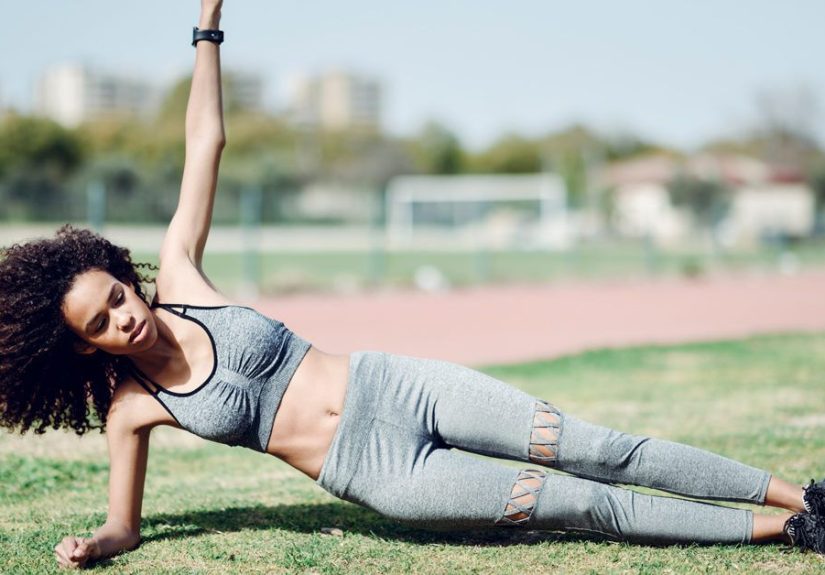
4. Side Plank
Side planks shift the spotlight to your obliques, the muscles along the sides of your torso. Lie on one side with your elbow under your shoulder, stack your feet or stagger them, and lift your hips until your body forms a straight line.
This variation improves lateral core strength, which helps with balance, posture, and movements that require twisting or resisting rotation. It is especially useful because daily life rarely happens in a perfectly straight line.
Modification: Bend your bottom knee and keep it on the floor for extra support.
5. Side Plank With Hip Dips
Once your side plank feels steady, add hip dips. Start in a side plank, slowly lower your hip toward the floor, then lift it back up using your obliques. Keep the movement controlled and avoid collapsing into your shoulder.
This dynamic plank variation increases time under tension and makes your side body work harder. It is excellent for building oblique endurance and improving control through your waist and hips.
Try it: Perform 8 to 12 reps per side. Move slowly enough that your musclesnot momentumdo the work.
6. Reverse Plank
The reverse plank flips the traditional plank upside down. Sit with your legs extended, place your hands behind your hips, press through your palms, and lift your hips until your body forms a straight line from shoulders to heels.
This variation targets your posterior chain, including glutes, hamstrings, lower back, shoulders, and upper back. It also opens the front of the body, which can feel wonderful if you spend long hours sitting.
Form tip: Keep your chest open and avoid letting your hips sag. If straight legs feel too intense, bend your knees and try a reverse tabletop hold.
7. Plank Shoulder Taps
Start in a high plank with feet slightly wider than hip-width. Lift one hand and tap the opposite shoulder, then return it to the floor and switch sides. The goal is to keep your hips as still as possible.
Shoulder taps train anti-rotation, which means your core works to prevent your body from twisting. This is a practical skill for sports, lifting, carrying bags, and chasing a runaway laundry basket down the hallway.
Try it: Do 10 to 20 taps total. Widen your feet to make the move easier, or bring them closer together to increase the challenge.
8. Plank Up-Downs
Plank up-downs, also called plank walk-ups, move between a forearm plank and a high plank. Start on your forearms, place one hand under your shoulder, press up, then bring the other hand up. Lower back down one arm at a time.
This variation adds upper-body strength, shoulder stability, and coordination to your core workout. It is tougher than it looks, mostly because your abs have to keep your hips from swaying like a shopping cart with one bad wheel.
Form tip: Alternate the lead arm each rep to avoid overloading one side.
9. Plank Jacks
Start in a high plank or forearm plank. Jump both feet out wide, then jump them back together, similar to a jumping jack. Keep your shoulders stable and your core braced.
Plank jacks add a cardio element while challenging your abs, hips, shoulders, and legs. They are great for increasing intensity without leaving the floor.
Modification: Step one foot out at a time instead of jumping. This lowers impact while keeping the core challenge.
10. Mountain Climber Plank
Begin in a high plank. Drive one knee toward your chest, return it, then switch legs. Move slowly for control or increase speed for conditioning.
Mountain climbers combine core stability with hip flexor work and cardiovascular effort. The key is to keep your shoulders stacked over your wrists and avoid bouncing your hips too high.
Try it: Perform 20 to 40 seconds. For a stronger core focus, slow the movement and pause briefly as each knee comes forward.
11. Spiderman Plank
Start in a high plank. Bring your right knee toward your right elbow, return to plank, then repeat on the left side. Keep your torso steady and your foot off the floor as the knee travels forward.
This variation targets the obliques, hip flexors, shoulders, and deep abdominal muscles. It also adds mobility through the hips, making it a useful move for athletes and desk workers alike.
Form tip: Do not rush. A slow Spiderman plank is usually more effective than a fast, flailing one.
12. Plank With Arm Reach
From a forearm or high plank, reach one arm forward without letting your hips rotate. Return the hand or forearm to the floor and switch sides.
The arm reach makes your core fight harder to maintain balance. It also challenges your shoulder stabilizers and teaches your body to stay organized while one limb moves.
Modification: Perform this move from your knees until you can reach forward without shifting your hips.
13. Plank With Leg Lift
Start in a forearm plank. Lift one leg a few inches off the floor, squeeze your glute, pause, then lower and switch sides. Keep both hips facing the floor.
This plank variation strengthens the glutes and lower back while forcing your core to stabilize against imbalance. It is especially helpful if you want a plank that feels more like a full-body exercise.
Try it: Hold each lift for 2 to 3 seconds and complete 8 to 12 reps per side.
14. Bear Plank
Start on all fours with hands under shoulders and knees under hips. Tuck your toes, brace your core, and lift your knees about one inch off the floor. Hold while keeping your back flat.
The bear plank looks tiny, but it is sneaky. Because your knees hover close to the ground, your abs, quads, shoulders, and hip stabilizers have to stay active the entire time.
Form tip: Imagine balancing a glass of water on your back. If that imaginary glass would spill, slow down and reset.
15. Stability Ball Plank or Stir-the-Pot
For an advanced challenge, place your forearms on a stability ball and step your feet back into a plank. Hold steady, or carefully move your forearms in small circles to perform “stir-the-pot.”
The unstable surface makes your core work harder to control movement. This is not the first plank variation to try, but it is an excellent progression once you can hold a standard plank with confidence.
Safety note: Use a properly inflated ball on a non-slip surface. If your form falls apart, return to a regular forearm plank.
How to Build a Plank Workout Without Overdoing It
You do not need to perform all 15 plank variations in one workout unless your goal is to personally offend your abdominal muscles. A smart core routine uses a few variations, balances difficulty, and leaves you able to move normally afterward.
Beginner Plank Routine
- Knee plank: 20 seconds
- Forearm plank: 15 to 25 seconds
- Side plank from knees: 15 seconds per side
- Rest 30 to 60 seconds and repeat 2 to 3 rounds
Intermediate Plank Routine
- Forearm plank: 30 seconds
- Plank shoulder taps: 16 total taps
- Side plank: 20 seconds per side
- Mountain climbers: 30 seconds
- Rest 45 seconds and repeat 3 rounds
Advanced Plank Routine
- Plank up-downs: 10 reps
- Spiderman plank: 10 reps per side
- Plank with leg lift: 10 reps per side
- Stability ball plank: 20 to 30 seconds
- Rest 60 seconds and repeat 3 to 4 rounds
Common Plank Mistakes to Avoid
The plank is simple, but it is also easy to sabotage. One common mistake is letting the hips sag, which can irritate the lower back and reduce core engagement. Another is hiking the hips too high, turning the move into a downward-dog impersonation. You also want to avoid shrugging your shoulders, holding your breath, or staring forward so hard that your neck joins the workout without permission.
A better approach is to shorten your hold and improve your form. Think quality before quantity. If your body starts shaking a little, that is normal. If your lower back starts hurting, your shoulders pinch, or your form collapses, stop and modify.
Who Should Be Careful With Plank Exercises?
Planks are accessible for many people, but they are not automatically right for everyone. If you have wrist pain, shoulder injuries, uncontrolled high blood pressure, recent surgery, pregnancy-related concerns, or persistent back pain, check with a qualified healthcare provider or fitness professional before pushing intense plank variations.
You can also modify the exercise to fit your body. Use knee planks, incline planks with hands on a bench, forearm planks instead of high planks, or shorter holds. Progress is still progress, even when it arrives wearing sensible shoes.
Real-World Experience: What Plank Training Actually Feels Like
The first thing many people notice when adding plank variations to a workout routine is that the challenge is not limited to the abs. Your shoulders start negotiating. Your glutes wake up. Your legs wonder why they were invited. A plank may be labeled a core exercise, but it quickly becomes a full-body lesson in teamwork.
In the first week, most beginners do best with short, clean holds. A 20-second forearm plank with steady breathing can feel more productive than forcing a full minute while your hips sink and your face slowly becomes one with the mat. The experience is humbling, but in a useful way. Planks give immediate feedback. If your core is tired, your body shows it. If your shoulders are unstable, you feel it. If your breathing disappears, the clock suddenly moves at the speed of cold syrup.
By the second or third week, the body often starts adapting. The same 20-second hold feels less dramatic. Shoulder taps become smoother. Side planks feel less like a personal attack from gravity. This is when variety becomes valuable. Instead of simply chasing longer holds, adding plank variations can make the routine more interesting and more functional. A mountain climber plank brings energy. A side plank builds control. A reverse plank reminds you that the back side of your body deserves attention too.
A practical experience-based tip is to pair plank variations with normal strength training instead of treating them as punishment at the end of a workout. For example, after squats, perform a 20-second forearm plank to practice bracing. After rows, add shoulder taps to train anti-rotation. After a long day of sitting, use reverse planks and bear planks to reconnect with posture and hip stability.
Another lesson: the best plank routine is the one you can repeat consistently. Doing a heroic seven-minute plank once and then avoiding core work for three weeks is not a strategy; it is a dramatic short film. A better plan is 5 to 8 minutes of focused plank training, three or four times per week. Rotate variations, keep the reps controlled, and stop before your form gets messy.
Most people also discover that planks build confidence. There is something satisfying about holding steady under pressure, even if that pressure is just your own body weight and a timer that appears to be mocking you. Over time, plank training can make daily movement feel stronger: carrying groceries, climbing stairs, lifting boxes, playing sports, or sitting upright at a desk without folding like a lawn chair.
The real magic is not in one perfect plank variation. It is in learning how to brace, breathe, stabilize, and progress. Your core will thank you laternot with words, obviously, because abs are terrible conversationalistsbut with better support when you need it.
Conclusion
Plank variations are a powerful way to train your core without making your workout complicated. From beginner-friendly knee planks to advanced stability ball planks, each movement teaches your body to stay strong, aligned, and controlled. The key is to choose variations that match your current level, focus on form, and progress gradually.
You do not need marathon plank holds to build a stronger core. You need consistency, smart exercise selection, and enough patience to let your muscles adapt. Start with the basics, add variety when you are ready, and remember: if your plank looks good and your breathing stays steady, you are doing far better than the person holding a three-minute plank with hips sagging like a tired hammock.