Table of Contents >> Show >> Hide
- First, a quick reality check: what “hard to turn” usually means
- 60-second safety checklist (do this before “testing” anything)
- Cause #1: Low (or wrong/contaminated) power steering fluid
- Cause #2: A power steering fluid leak (the sneaky thief behind the low level)
- Cause #3: Failing power steering pump (hydraulic systems)
- Cause #4: Serpentine belt or belt tensioner problems (hydraulic pump drive)
- Cause #5: Steering rack/gear problems (wear, internal leakage, or binding)
- Cause #6: Electric power steering (EPS) faults: motor, sensor, wiring, or control module
- Cause #7: Tire pressure, alignment, or binding front-end parts (the “it’s not always the steering system” category)
- DIY triage: narrow it down in 5 minutes
- When to stop driving (and why “I can muscle it home” is a bad plan)
- How mechanics usually fix it (so you know what you’re agreeing to)
- Bottom line
- Experiences From the Real World (Extra): What “Hard to Turn” Looks Like Day-to-Day
- 1) “It’s only hard when I’m parking.”
- 2) “It got worse when it got cold.”
- 3) “The steering was fine… then the warning light came on and it wasn’t.”
- 4) “It feels heavy in one direction but not the other.”
- 5) “I heard a squeal, then steering got heavy.”
- 6) “I kept topping off fluid… and it kept coming back.”
- 7) “It wasn’t the steering system at all.”
A steering wheel should not feel like an upper-body workoutunless you’re auditioning for a role as “Person Who Parallel-Parks a Dump Truck.”
If your steering wheel is hard to turn, your car is telling you something is off. Sometimes it’s minor (a quick tire-pressure fix).
Other times it’s a safety issue (a power-assist failure that can turn a simple left turn into a wrestling match).
This guide breaks down the seven most common reasons a steering wheel becomes stiff, what each one feels like,
and the smart next stepwithout guessing, panicking, or “just living with it.” (Your shoulders deserve better.)
First, a quick reality check: what “hard to turn” usually means
Most modern vehicles use some form of power steering assist to reduce the effort needed to steereither:
hydraulic (fluid pressure from a pump), electric (an electric motor provides assist), or a hybrid.
When assist is reduced or something is binding in the steering/suspension, you’ll notice:
- Heavier steering at low speeds (parking lots, driveways, tight turns)
- Intermittent stiffness (fine one minute, heavy the next)
- Noises like whining, squealing, grinding, or clunking while turning
- Warning lights (often a power steering/EPS light)
- Steering not returning to center smoothly after a turn
60-second safety checklist (do this before “testing” anything)
If the steering got suddenly heavy, if you see a power steering/EPS warning light,
or if the wheel feels like it might bind or catch, treat it as a safety concern.
Find a safe place to pull over. Driving is still possible with reduced assist, but steering effort risesespecially at low speeds
and that’s when many close calls happen (think: parking lots, turns, quick maneuvers).
- If you hear metal-on-metal grinding, stop driving and get it checked.
- If the wheel won’t turn smoothly or feels “stuck” at certain angles, stop and call for help.
- If it’s just gradually heavier, you may be able to drive carefully to a shopbut don’t delay.
Cause #1: Low (or wrong/contaminated) power steering fluid
If your vehicle uses hydraulic power steering, power steering fluid is the muscle behind the assist.
When fluid is low, the system can’t build the pressure needed to help you steerso the wheel feels heavy, especially at low speeds.
Sometimes the fluid isn’t low, it’s wrong for the vehicle, dirty, or aerated (foamy),
which also reduces effective pressure.
What it feels like
- Steering is hardest when parking or turning at low speed
- Whining or groaning noise when you turn the wheel
- Steering may feel “notchy” or inconsistent
What to check (easy, quick)
Look for the power steering reservoir under the hood (your owner’s manual will confirm location and the correct fluid type).
Check the level and condition. Healthy fluid is usually translucent; burned fluid looks dark and may smell “off.”
If you repeatedly need to top off, don’t just keep feeding the leakfind the source.
Example: Your steering feels fine on the highway but becomes a bear in a parking lot,
and you hear a faint whine when you crank the wheelclassic low-fluid behavior.
Cause #2: A power steering fluid leak (the sneaky thief behind the low level)
Fluid usually doesn’t vanish for fun. If the reservoir is low again after topping off, a leak is the most common reason.
Leaks can come from hoses, seals, the pump, or the steering rack. You might spot a reddish or amber fluid under the front of the car
after it’s been parked.
What it feels like
- Steering gradually gets heavier over days or weeks
- Whining noise increases as the fluid level drops
- Occasional stiffness that comes and goes (depending on fluid level and air in the system)
What to check (no tools required)
Park on clean pavement overnight and look for fresh drips in the morning.
Then inspect visible hoses for wetness. Even if you can’t find the exact leak point,
a shop can pressure-test and pinpoint itmuch better than “fluid roulette.”
Cause #3: Failing power steering pump (hydraulic systems)
In a hydraulic setup, the pump pressurizes fluid. When it weakens, steering assist weakens.
A pump may fail from age, contaminated fluid, running low on fluid (leaks), or internal wear.
If you hear a loud whine that changes with engine RPM, the pump is waving a red flag.
What it feels like
- Stiff steering that’s worst at low speeds or at full lock
- Whining/groaning when turning, sometimes louder when cold
- Steering assist that feels delayed (you turn, the car responds slowly)
A helpful clue
If the noise gets louder as you turn and can be heard even at idle, the pump may be struggling to build pressure.
But pumps also complain when fluid is lowso always check the fluid first.
Cause #4: Serpentine belt or belt tensioner problems (hydraulic pump drive)
Many hydraulic power steering pumps are driven by the engine via the serpentine belt.
If that belt is loose, glazed, cracked, or the tensioner is failing, the belt can slipreducing pump speed and pressure.
Result: heavier steering, often with a squeal that makes your car sound like it’s protesting adulthood.
What it feels like
- Steering gets heavy suddenly, especially right after starting
- Squealing noise when turning the wheel or when accessories load up
- May come with other symptoms (battery light, overheating) if the belt affects multiple components
What to do
A visual inspection can reveal cracking or glazing, but belt tension issues can be subtle.
Because the serpentine belt also powers other critical systems on many cars, don’t ignore belt symptoms.
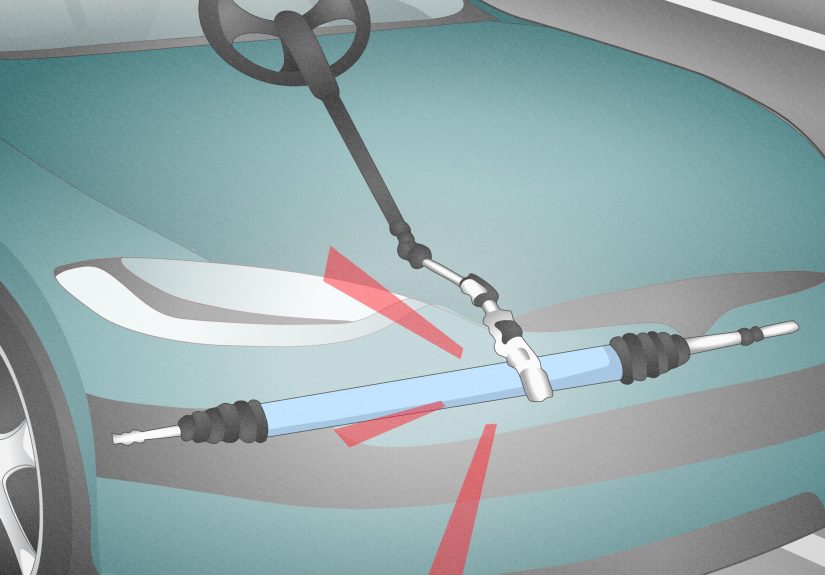
Cause #5: Steering rack/gear problems (wear, internal leakage, or binding)
Your steering wheel’s input has to be translated into the wheels actually turning.
In many vehicles, that job belongs to a rack-and-pinion system.
If the rack is worn, internally leaking, or mechanically binding, steering can feel heavy, inconsistent, or rough.
What it feels like
- Stiff steering paired with clunks, vibrations, or sloppy response
- Fluid leakage near the rack area (on hydraulic racks)
- Uneven effort: easy one direction, harder the other
Why this matters
Rack issues tend to get worse, not betterand they can affect vehicle control.
If you feel binding or hear clunking during turns, don’t keep “testing” it in traffic.
Cause #6: Electric power steering (EPS) faults: motor, sensor, wiring, or control module
If your car uses electric power steering, there may be no fluid or pump at all.
Instead, sensors measure steering effort and a motor provides assistcontrolled by electronics.
When something in that chain fails (torque sensor, steering angle sensor, motor, wiring, module),
assist can drop or disappear. Many vehicles will illuminate an EPS/power steering warning light
when the system detects a fault.
What it feels like
- Sudden heavy steering (sometimes without warning)
- Intermittent stiffness that “resets” after restarting the car
- Warning light on the dash; sometimes messages about steering assist
What to do next
EPS issues are often diagnosis-driven. A scan tool can pull codes and point to the faulty circuit or sensor.
Also, because some EPS problems have been tied to recalls on certain models,
it’s worth checking your vehicle’s recall status through official channels.
Cause #7: Tire pressure, alignment, or binding front-end parts (the “it’s not always the steering system” category)
Sometimes the steering wheel is hard to turn because the wheels and suspension are fighting you.
Underinflated front tires increase resistance.
Poor wheel alignment can make the car feel like it doesn’t want to turnor doesn’t want to return to center.
And worn or seized parts (ball joints, tie rods, strut mounts, control arm bushings, even a steering shaft U-joint)
can create binding that power assist can’t fully mask.
What it feels like
- Steering is heavy and the car may pull to one side
- Steering doesn’t return to center smoothly after turns
- Clunking/popping noises over bumps or during turns
- Stiffness that changes with wheel position (binding at certain angles)
Quick checks you can do today
- Check tire pressure when tires are cold and inflate to the door-jamb spec (not the tire sidewall max).
- Look for uneven tire wear (inside edges, feathering) that suggests alignment issues.
- If you hear clunks or feel binding, schedule a steering/suspension inspection soon.
DIY triage: narrow it down in 5 minutes
You don’t need to be a master mechanic to gather useful clues. Here’s a fast, low-risk workflow:
- Check tire pressure (easy win, and it affects steering feel more than most people realize).
- Notice when it’s worst: only at low speeds? only when cold? all the time?
- Listen: whining points toward pump/fluid; squealing points toward belt slip; clunks suggest front-end parts.
- Look for leaks: drips under the car, wet hoses, low reservoir.
- Check the dashboard: an EPS/power steering light makes electronics a prime suspect.
When to stop driving (and why “I can muscle it home” is a bad plan)
If steering effort jumps suddenly, if the wheel binds, or if you have an EPS warning plus noticeably reduced assist,
the safest move is to stop and get help. Even if you can steer, emergency maneuvers and tight turns become harder.
And if the root cause is a belt problem, continuing to drive can trigger other failures depending on what that belt runs in your car.
How mechanics usually fix it (so you know what you’re agreeing to)
Repairs depend on the cause, but common paths include:
- Fluid service + leak repair: fix the leaking hose/seal, then refill and bleed the system properly.
- Pump replacement: often paired with a fluid flush to protect the new pump.
- Belt/tensioner replacement: restores pump drive and prevents accessory failure.
- Rack replacement/repair: for internal leakage, wear, or binding.
- EPS diagnosis: scan codes, test wiring/sensors, then repair the faulty component.
- Alignment + worn parts: replace worn tie rods/ball joints/strut mounts and align the vehicle.
Bottom line
A steering wheel that’s hard to turn is your car’s way of saying, “Hey… I’m not okay.”
Start with the easy checks (tire pressure, warning lights, visible leaks).
If the problem is sudden, severe, or comes with binding/noises, treat it as a safety issue and get it inspected.
The sooner you catch the cause, the more likely it’s a straightforward fixrather than a domino chain of expensive parts.
Experiences From the Real World (Extra): What “Hard to Turn” Looks Like Day-to-Day
People rarely describe steering problems with calm, technical poetry. The usual review is more like:
“It feels like my car randomly turns into a 1992 forklift.” And honestly? That’s not far off.
Here are a few common experiences drivers reportplus what they often learn after the diagnosis.
1) “It’s only hard when I’m parking.”
This is the classic: highway driving feels normal, but the moment you’re backing out of a space, the wheel gets heavy.
Low-speed steering needs the most help because your tires have more friction against the pavement when the car isn’t rolling fast.
That’s why low power steering fluid, a weakening pump, or low tire pressure often reveals itself in parking lots first.
A lot of drivers assume, “Maybe I’m just tired,” when really the car is quietly begging for attention.
2) “It got worse when it got cold.”
Cold mornings can make any existing issue feel louder and more dramaticlike your car woke up on the wrong side of the garage.
Fluids thicken in low temperatures, which can amplify a weak pump or a low-fluid situation.
Belts can also slip more when cold, and a worn belt may squeal like it’s trying to communicate in dolphin.
The lesson drivers learn: if cold weather changes the symptom, don’t ignore ituse it as a clue.
“Only in the cold” still counts as a real problem, not a seasonal personality trait.
3) “The steering was fine… then the warning light came on and it wasn’t.”
EPS drivers often describe a moment where everything feels normal, then an EPS/power steering light appears and steering effort jumps.
That can happen if a sensor reading goes out of range, wiring loses connection, or the module detects a condition it doesn’t like.
Some people notice a restart temporarily helps (which feels like magic), but the issue usually returns.
In these cases, guessing is expensiveproper code scanning and diagnostics save time, money, and frustration.
4) “It feels heavy in one direction but not the other.”
This one sends drivers down a rabbit hole fast. Uneven effort can point toward rack issues, front-end binding,
or alignment/suspension geometry problems. Sometimes it’s a worn joint that binds at certain angles.
People describe it as “catching,” “notchy,” or “like something is rubbing.” If you ever feel the wheel resist at specific positions,
that’s a big hint that something mechanical is bindingand it’s not the kind of mystery you want to solve on a busy road.
5) “I heard a squeal, then steering got heavy.”
When a belt slips, it can announce itself with a squealsometimes right before you notice the wheel getting harder to turn.
Drivers often describe the timing like a movie jump-scare: you turn the wheel, the car screams, and suddenly you’re gripping the wheel
like you’re steering a ship through a storm. The takeaway is simple: squeals aren’t just “annoying noises.”
They’re warningsespecially if they show up during steering input or right after startup.
6) “I kept topping off fluid… and it kept coming back.”
This is the most common “I tried” story. Topping off fluid can temporarily restore assist, so it feels like progress.
But leaks don’t heal themselves. Over time, the system can pull in air, the pump can get noisy, and wear can accelerate.
The best version of this story ends with: “I found the leak early, fixed a hose/seal, and avoided bigger damage.”
The worst version ends with: “Then I needed a pump too.” Moral: topping off is a short-term move, not the finish line.
7) “It wasn’t the steering system at all.”
Plenty of drivers swear it must be power steeringuntil they check tire pressure and discover one front tire is significantly low,
or the tires are mismatched, or alignment is off enough to make the car feel like it’s pushing against itself.
The good news is those fixes can be simpler than major steering repairs.
The great news is you get to stop doing accidental arm workouts every time you turn into a grocery store parking space.
If you recognize yourself in any of these experiences, you’re not aloneand you’re not doomed.
Most steering stiffness issues follow patterns, and once you match the pattern to the cause,
the solution becomes a lot less mysterious (and a lot less sweaty).