Table of Contents >> Show >> Hide
- Why Dinosaur Sounds Are So Hard to Reconstruct
- What Makes the 3D-Printed Fossil Instrument So Interesting?
- The Crest Wasn’t Just for Looks (Probably)
- So… Did Dinosaurs Roar, Honk, Boom, or Coo?
- Why the Dinosaur Choir Project Matters Beyond Dinosaurs
- What We Can Say With Confidence (and What We Still Can’t)
- Extended Experiences: What It Feels Like to Hear a Dinosaur Through a Fossil-Inspired Instrument (Approx. )
- Conclusion
If Hollywood had its way, every dinosaur would sound like a cross between a lion, a chainsaw, and a truck that forgot its muffler. Fun? Absolutely. Accurate? Probably not. That’s why a project like Dinosaur Choir is so fascinating: instead of guessing wildly, it uses fossil anatomy, CT scans, 3D fabrication, and sound modeling to build an instrument that lets us explore what at least some dinosaurs might have sounded like.
The key word here is might. Paleontologists and acoustics researchers are not claiming someone found a “dinosaur audio file” tucked inside a rock. What they are doing is combining fossil evidence, living animal comparisons, and resonance physics to create informed reconstructions. And honestly, that’s cooler than another movie roar. It means we can start treating dinosaur sound as a scientific questionnot just a sound-effects problem.
In this article, we’ll break down why dinosaur vocalization is so hard to reconstruct, why the 3D-printed fossil instrument matters, what fossils and modern animal anatomy can tell us, and what this whole movement says about the future of science communication. Spoiler: the answer is not “T. rex sounded exactly like a foghorn,” though I admit that would be memorable.
Why Dinosaur Sounds Are So Hard to Reconstruct
Figuring out what dinosaurs sounded like is one of those scientific puzzles that looks simple until you try to solve it. We have lots of fossil bones. We do not have preserved soft tissue in most casesespecially not the delicate structures responsible for vocalization. And without a preserved vocal organ, scientists have to infer sound from anatomy, evolutionary relationships, and physical modeling.
That challenge matters because the “voice” of an animal depends on more than its size. It also depends on the shape of the airways, the sound-producing tissues (like a larynx or syrinx), airflow, resonance chambers, and behavior. Two animals of similar size can sound wildly different if their anatomy is different. Just compare a swan, a crocodile, and a tuba. (Okay, one of those is not an animal, but it proves the point.)
Researchers usually start with a basic evolutionary framework: non-avian dinosaurs are more closely related to birds and crocodilians than to mammals. That means comparisons to birds and crocodiles are generally more useful than comparisons to lions, elephants, or studio sound libraries. Once you accept that, the standard Hollywood roar starts looking less like paleontology and more like theater.
And to be fair, theater is doing its job. Movie sound design is meant to make you grip the armrest, not pass a dissertation defense. But if your question is “What did dinosaurs sound like in real life?”, then fossil-based acoustic reconstruction is the more exciting path.
What Makes the 3D-Printed Fossil Instrument So Interesting?
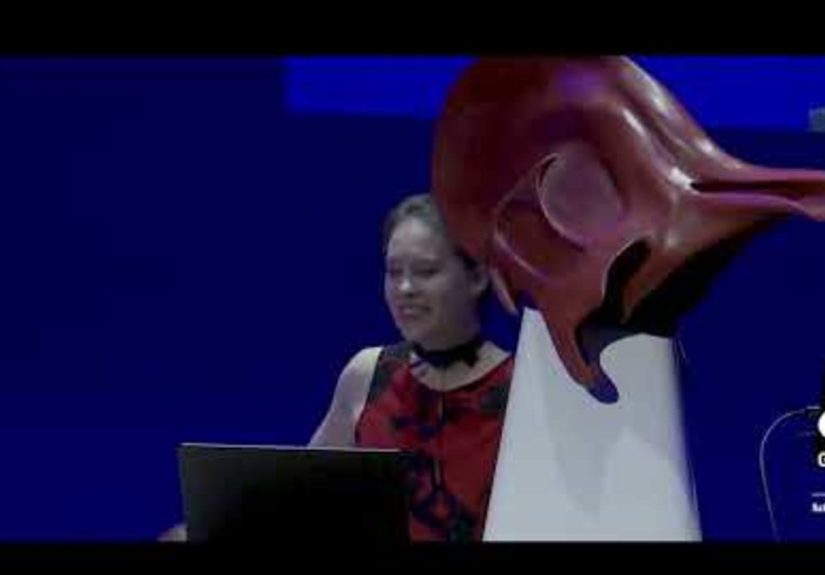
Dinosaur Choir is a creative-scientific project that explores dinosaur vocalization through musical skull instruments, with a current focus on lambeosaurine hadrosaurs such as Corythosaurus. These dinosaurs had large crests and long nasal passages, which scientists have long suspected could have functioned as resonating structures.
What makes the project especially compelling is the way it combines disciplines that don’t usually share a lab bench: paleontology, music technology, industrial design, computation, and public performance. The creators use CT-based reconstructions of fossil skull anatomy and build sound-generating systems that send vibrations through a 3D replica of the dinosaur’s nasal cavities and skull. In plain English: they are using real fossil geometry as part of the instrument’s sound path.
That is not the same thing as claiming a perfect dinosaur voice. It is better described as a physically informed sound experiment. The project openly treats the sound model as a work in progress and adapts as new research appears. In fact, that transparency is one of its biggest strengths. It invites people to hear the science and the uncertainty at the same time.
The project’s current instruments center on Corythosaurus, a duck-billed dinosaur from the Late Cretaceous. According to the project materials, Corythosaurus was a crested hadrosaur, lived roughly 75–77 million years ago, and adults reached around 8–9 meters in length. The instrument skulls themselves are much smaller than the animal, of course, but large enough to create a striking physical experience when seen or played in person.
That public-facing design matters. People understand fossil diagrams with their brains. They understand sound with their bodies. The moment air moves through a reconstructed pathway and produces a mournful, resonant call, the question “What did dinosaurs sound like?” becomes tangible instead of abstract.
The Crest Wasn’t Just for Looks (Probably)
Lambeosaurine hadrosaurs like Corythosaurus and Parasaurolophus are famous for their dramatic head crests, and paleontologists have proposed multiple functions for those crests over the years, including display, species recognition, and sound resonance. These explanations are not mutually exclusive. In biology, evolution loves multitasking.
One reason the resonance idea keeps coming back is anatomy: the crest contains elongated nasal passages that look, frankly, like nature got very interested in instrument design. A complex air pathway can shift frequencies, amplify certain tones, and create distinctive acoustic signatures. That does not automatically prove a dinosaur “played its head like a trumpet,” but it does make acoustic modeling a very reasonable line of inquiry.
This is where the modern wave of reconstruction gets especially fun. In the 1990s, researchers and science communicators already used digital modeling to explore the likely cry of Parasaurolophus, showing the public that fossil-based sound reconstruction was possible in principle. More recently, newer projects have expanded the idea with better scans, better computing, and more flexible physical and mathematical models.
A recent acoustics-focused example is work presented on modeling the Parasaurolophus crest using a tube-based physical setup inspired by resonance chambers. The point of that system is not to pretend the simplified device is a perfect dinosaur head, but to test and verify the mathematical framework behind the acoustics. That’s exactly how science often progresses: build a useful model, test it, refine it, then move closer to the real structure.
In other words, the field is moving from “cool thought experiment” toward “repeatable acoustic investigation.” That’s a major step forward for dinosaur sound research and paleoacoustics more broadly.
So… Did Dinosaurs Roar, Honk, Boom, or Coo?
The most honest answer is: different dinosaurs likely made different sounds, and we’re still piecing the picture together. There was no single “dinosaur voice.” A giant theropod, a crested hadrosaur, and an armored ankylosaur would not be expected to vocalize in identical ways any more than a goose, an alligator, and an ostrich do today.
That said, several lines of evidence suggest many dinosaur sounds may have been less lion-like and more resonant, low-frequency, and possibly produced with closed-mouth behaviors in some contexts. A widely cited evolutionary study on birds and related groups discussed closed-mouth vocalizations (think coos, booms, and hoots) and proposed that at least some non-avian dinosaurs may have had the capacity for similar vocal behavior. The paper also noted that such calls tend to favor lower-frequency resonance conditions.
This matters because it gives paleontologists a behaviorally plausible framework: instead of imagining every dinosaur screaming with an open mouth, we can also consider inflated-throat, chesty, booming, or low-carrying display callsespecially in larger-bodied species and in courtship or territorial contexts.
Another major clue comes from the fossil record of vocal anatomy itself. A famous 2016 discovery reported the fossilized syrinx (the specialized bird vocal organ) in an ancient bird relative from the Mesozoic. Its apparent absence in non-avian dinosaur fossils of similar age suggested that the bird syrinx may have evolved later in avian history. That does not mean non-avian dinosaurs were silent. It means many of them may have relied more on different structuressuch as the larynxrather than a bird-like syrinx.
Then came a 2023 study on an ankylosaur larynx that provided fresh insight into the possibility of more bird-like vocalization features in some non-avian dinosaurs. Again, this is not a universal answer and not a direct recording. But it is exactly the kind of fossil evidence researchers need: concrete anatomy that helps narrow the range of plausible sounds.
So if you’re hoping for a one-word verdict, here it is: dinosaurs probably sounded strangerand more variedthan pop culture trained us to expect. Some may have produced deep resonant calls. Some may have used airflow and anatomy in ways that resemble parts of modern birds or crocodilians. And some likely still made sounds we would struggle to compare neatly to anything alive today.
Why the Dinosaur Choir Project Matters Beyond Dinosaurs
It would be easy to treat a 3D-printed dinosaur skull instrument as a novelty. It looks dramatic, makes unusual sounds, and immediately wins the room. But reducing it to “weird art object” misses the point.
Projects like this are valuable because they make scientific uncertainty interactive. Instead of presenting the public with a single polished answer (“dinosaurs sounded like this”), they show the process: fossil anatomy, hypotheses, modeling decisions, limitations, revisions, and experimentation. That is a better model for science literacy than any number of overconfident documentaries.
There’s also an educational advantage in the instrument format itself. Sound is temporal. It changes as breath pressure changes, mouth shape changes, and resonance changes. A musical interface lets audiences experience those variables directly. You are not just reading “crest shape affects tone.” You are hearing it happen in real time.
And yes, there’s a delightful side effect: it makes paleontology feel alive. Museumgoers, students, and curious adults who might glaze over during a wall label suddenly lean in when a fossil starts “singing.” That moment of curiosity is where serious learning begins.
What We Can Say With Confidence (and What We Still Can’t)
What we can say with reasonable confidence
- Movie dinosaur roars are mostly cinematic inventions, not direct scientific reconstructions.
- Crested hadrosaurs like Corythosaurus and Parasaurolophus had anatomy consistent with acoustic resonance hypotheses.
- Physical and mathematical models can test plausible sound behavior in fossil-inspired structures.
- Bird and crocodilian comparisons are useful because they bracket non-avian dinosaurs evolutionarily.
- New fossil finds (like vocal anatomy evidence) continue to reshape the range of plausible reconstructions.
What remains uncertain
- The exact sound-producing tissues used by many non-avian dinosaurs.
- How much vocal behavior varied by species, age, sex, and social context.
- Whether certain reconstructed tones represent everyday calls, display calls, or rare behaviors.
- How soft tissues not preserved in fossils changed the final sound quality.
That uncertainty is not a weakness. It’s the reason the field is so exciting right now. Every new scan, fossil, and model moves the conversation from “pure speculation” to “better-constrained possibilities.”
Extended Experiences: What It Feels Like to Hear a Dinosaur Through a Fossil-Inspired Instrument (Approx. )
One of the most interesting parts of this topic is not just the science itself, but the experience of encountering it. People often imagine paleontology as a quiet discipline: bones, brushes, labels, diagrams, maybe a dramatic skeleton pose under museum lighting. But a project like a 3D-printed fossil instrument changes the sensory script. It adds soundand with sound comes emotion, surprise, and memory.
Imagine walking into a gallery expecting “static dinosaur display” and instead hearing a low, wavering tone drift across the room. You turn a corner and see a crest-headed skull replica, not mounted like a trophy but wired like an instrument. Someone is interacting with it, and the sound shifts as they change their breath and mouth shape. That moment feels less like reading history and more like briefly sharing space with a possibility from deep time.
For many listeners, the first reaction is not “Aha, definitive evidence!” It’s something better: “Wait… I never thought dinosaurs might sound like that.” The call is often described as mournful, eerie, or haunting rather than aggressive. That alone can reset the imagination. We’re so used to blockbuster roars that a resonant, almost voice-like wail can feel surprisingly intimate. Instead of a monster soundtrack, you get a communication experiment.
In educational settings, the experience can be even more powerful. Students who struggle to connect with fossil diagrams sometimes light up when they can hear how shape affects resonance. A lesson on nasal passages, crest anatomy, or acoustic chambers suddenly becomes hands-on (or lungs-on). Instead of memorizing terms, they begin asking real scientific questions: “Would a bigger crest make a lower sound?” “Did juveniles sound different from adults?” “Could this be for mating calls?” Those are exactly the kinds of questions that turn curiosity into learning.
There’s also a maker-space angle that resonates with artists and engineers. A 3D-printed dinosaur sound project demonstrates that scientific storytelling doesn’t have to live in separate boxes: one for museums, one for musicians, one for coders, one for designers. It can be all of them at once. A fossil scan becomes a model; a model becomes a physical object; a physical object becomes an instrument; an instrument becomes a public conversation. That chain of translation is its own kind of magic.
Even online, interactive versions of these ideas can create memorable experiences. When people experiment with a web-based dinosaur vocal model, they’re not just consuming contentthey’re participating in reconstruction. They hear how changing a parameter affects tone, and suddenly “paleoacoustics” no longer sounds like an intimidating niche term. It sounds like a playground for evidence-based imagination.
And maybe that’s the biggest takeaway from the experience side of this story: hearing a fossil-inspired instrument doesn’t give us a final dinosaur soundtrack. It gives us something arguably more valuablea visceral sense of how science works when evidence is incomplete but meaningful. You leave with wonder, yes, but also with a better appreciation for modeling, uncertainty, and the creativity required to study the ancient world. Not bad for a skull with stage presence.
Conclusion
So, what did dinosaurs sound like? We still don’t have a single, final answerand that’s exactly why the question remains so compelling. The 3D-printed fossil instrument featured in projects like Dinosaur Choir offers a scientifically grounded, artistically powerful way to explore the possibilities. By using fossil geometry, CT scans, and acoustic modeling, it moves the conversation beyond movie roars and toward evidence-based reconstruction.
The smartest takeaway is not “this is the dinosaur sound.” It’s “this is a better way to ask the question.” And as new fossil discoveries, vocal anatomy research, and sound models continue to emerge, the prehistoric soundscape will likely become richer, stranger, and more fascinating than we once imagined.
If nothing else, the next time a movie dinosaur roars like a demonic motorcycle, you’ll at least know enough to raise an eyebrow and say, “Nice sound design. But where’s the resonance model?”