Table of Contents >> Show >> Hide
- Why Programming Needed a Hero (Or at Least a Shortcut)
- Who Was Tony Brooker?
- Autocode, Explained Like You’re Not Holding a Soldering Iron
- Mark 1 Autocode: Brooker’s Big Move
- So… Was Autocode the First High-level Language?
- The Autocode Family: Not One Language, but a Lineage
- The Compiler-Compiler: A Very Nerdy Power Move
- What Autocode Got Right (That Still Matters)
- Common Questions (Because History Nerds Are Not Quiet)
- Conclusion: The Quiet Revolution of Writing Code Like a Human
- Experiences: What It’s Like to “Touch” Autocode Today (A 500-Word Time-Travel Add-On)
If you’ve ever typed for (i = 0; i < n; i++) without having to personally negotiate with a magnetic drum,
you owe a quiet “thank you” to a bunch of early computing pioneers. And near the front of that thank-you line is
Tony Brooker, the guy who looked at early machine coding and basically said, “This is ridiculous.
Let’s invent a better way.”
That better way was Autocodea family of early programming languages that helped pull programming
out of the “hand-assemble every instruction like you’re building a ship in a bottle” era and into something
recognizably modern: write readable instructions, let a program translate them, and stop treating programmers like
human compilers with caffeine dependencies.
Was Autocode truly the first high-level language? That depends on how you define “high-level” and “first.”
(Historians love definitions almost as much as programmers love arguing about indentation.)
But Brooker’s Mark 1 Autocode is widely remembered as one of the earliest practical, user-facing high-level systems
and it arrived before high-level languages became fashionable dinner-party topics.
Why Programming Needed a Hero (Or at Least a Shortcut)
Early computers weren’t “hard to program” in the cute way that people say a new JavaScript framework is “hard.”
They were hard in the “you must manage hardware quirks directly” way: fixed-point scaling, tiny fast memory,
slower secondary memory, and instruction formats that looked like they were designed by a committee of angry
calculators.
On machines like the Manchester/Ferranti systems, even a simple scientific calculation could require:
keeping track of numeric scale factors to avoid overflow, manually shuffling values between fast and slow storage,
and writing code in a machine-oriented notation that was unpleasant to read and even more unpleasant to revise.
In other words: early programming was less “writing software” and more “operating a very fast, very picky
mechanical loomexcept the loom is electronic and it hates you.”
Who Was Tony Brooker?
Tony (Ralph Anthony) Brooker was a British computer scientist who worked at the University of Manchester in the
early 1950s, right when stored-program computing was turning from experimental miracle into practical tool.
He was involved in software support and user servicesmeaning he saw, day after day, how painfully people had to
talk to these machines.
And when you’re the person answering “Why doesn’t my program work?” questions for a living, you either develop
patience… or you develop a higher-level language. Brooker chose option two.
Autocode, Explained Like You’re Not Holding a Soldering Iron
“Autocode” wasn’t one single language as much as a family name. The big idea was consistent:
create a more readable notation for programming, then translate it into machine code using a compiler-like tool.
It’s the ancestor of a concept you now take for granted: write source code once, let software handle the translation.
Autocode’s core promise
- More human-readable instructions than raw machine orders.
- Automatic coding: a translator that converts your program into machine instructions.
- Less mental overhead for scaling, storage juggling, and repetitive housekeeping.
That sounds obvious today. In the early 1950s, it was a major shift in what “programming” even meant.
You weren’t just telling the machine what to doyou were letting another program figure out how to say it
in the machine’s native tongue.
Mark 1 Autocode: Brooker’s Big Move
Brooker’s best-known contribution is Mark 1 Autocode, introduced to users in the mid-1950s for the
Manchester/Ferranti Mark I environment. It wasn’t “high-level” in the sense of modern Python, but it absolutely
was high-level relative to the alternativesbecause it focused on what users wanted to compute, not on the
machine’s mood swings.
A tiny example that shows the vibe
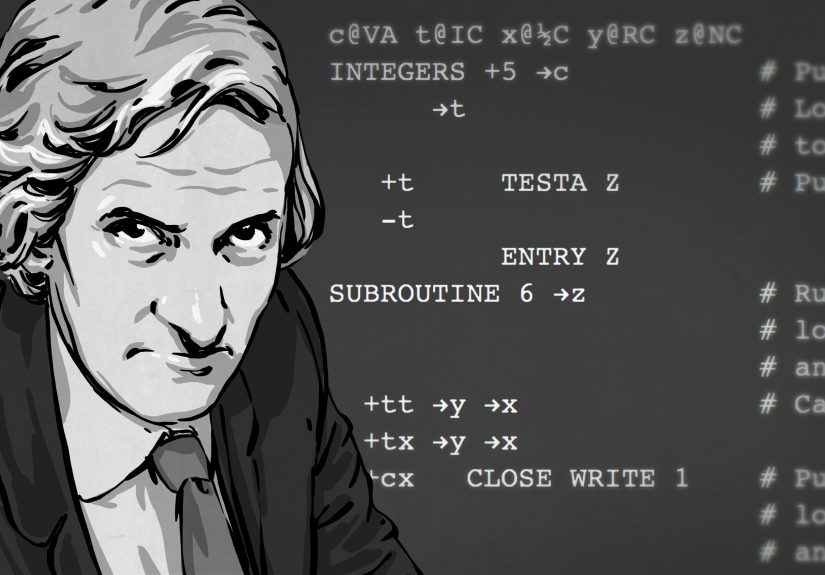
One way to see Autocode’s flavor is to look at a simple loop: sum of squares (or a close cousin). A classic sample
from early Mark 1 Autocode materials looks like this:
Even if you’ve never seen Mark 1 Autocode before, you can probably guess what’s happening:
initialize a counter, accumulate a running total, square elements, and loop until you hit a limit.
That’s the whole pointAutocode aimed to make programs readable enough that they could be understood
without decoding a pile of numeric instructions and timing constraints.
What made it “high-level” for its time?
Brooker’s approach targeted three problems that were devouring programmer attention:
- Awkward machine coding that made programs hard to update, debug, and explain to anyone else (including Future You).
- Two-level storage managementfrequently swapping information between small fast memory and large slow memory.
- Scaling and precisionhandling scientific calculations (often floating point) without convenient hardware support.
Autocode didn’t magically erase every constraint, but it moved a chunk of the pain from “human brains”
to “translation tools.” That tradebuild better tools so humans can think at a higher levelis basically the
entire history of programming in one sentence.
So… Was Autocode the First High-level Language?
If you want a single, universally agreed winner, I have bad news: computer history is not a single-elimination
bracket. It’s more like a group project where everyone remembers it differently.
How the “first” debate usually breaks down
-
First algorithmic language (conceptually): Some histories point to earlier theoretical work (for example, Plankalkül),
which was visionary but not widely implemented or used at the time. - First compiler actually implemented: Early Autocode efforts are often cited in this category.
- First widely accepted high-level language: Many sources credit FORTRAN for mainstream adoption and impact.
- First practical, user-facing high-level system on a real computer service: This is where Brooker’s Mark 1 Autocode often shines.
Here’s the most honest way to say it: Autocode was among the first practical high-level languagesand one of the earliest
to show everyday users that programming didn’t have to be machine-code misery.
FORTRAN later proved the concept at scale and became the widely accepted standard-bearer. Autocode helped set
the stage, especially in the U.K. ecosystem, by demonstrating what a real programming service could look like when
you gave users a friendlier notation and a translator that did the grunt work.
The Autocode Family: Not One Language, but a Lineage
As computers evolved, Autocode evolved too. The term became attached to multiple systems designed for different
machineseach aiming to simplify programming while keeping efficiency respectable.
Mercury and Atlas: Autocode grows up
As hardware advanced (faster machines, better memory, more ambitious workloads), the software expectations
exploded. That meant languages and compilers needed to scale, too.
The Autocode tradition continued into systems associated with later machines such as Mercury and Atlas, where the
programming environment needed to support bigger problems and bigger communities.
This is also where Brooker’s work intersects with a genuinely modern-sounding idea:
if you’re going to build multiple compilers, it’s handy to have a tool that helps you build compilers.
Yesthis is basically the ancestor of parser generators and compiler toolchains.
The Compiler-Compiler: A Very Nerdy Power Move
Brooker is also associated with the notion of a compiler-compilera system designed to help create compilers for
languages described by formal rules. If that sounds abstract, it’s because it is… and because it’s brilliant.
The moment you can define a language by its grammar and automatically produce a translator, you’ve changed the
economics of language design. Suddenly, inventing a language isn’t just “write a book and cry.”
It’s “write a specification and build tooling that can keep up.”
Modern developers see echoes of this everywhere: lexer/parser generators, compiler frameworks, domain-specific
languages, and the whole “describe the rules, generate the machinery” mindset.
Autocode wasn’t just an early language storyit was an early tooling story.
What Autocode Got Right (That Still Matters)
1) Abstraction is a productivity feature
Autocode made a blunt argument: the computer is fast, humans are expensive. If you can move repetitive,
error-prone work into an automatic translator, you should.
2) Tooling shapes who gets to program
When programming requires intimate knowledge of machine conventions, only a small group can participate.
When you provide a higher-level language and supporting documentation, you expand the community of people who
can solve problems with software.
3) “Efficiency” and “readability” aren’t mortal enemies
Early critics worried that compilers would be too slow or produce inefficient code. Autocode-era systems helped
prove that you could trade a bit of machine-level control for a big gain in developer timewithout making the
computer fall over dramatically.
Common Questions (Because History Nerds Are Not Quiet)
Was Autocode used outside universities?
Variants of Autocode were used in real computing services and influenced programming practice on several
early British machines. It wasn’t just a lab curiosity; it was part of how people actually got work done.
Is Autocode still used today?
Not as a production language. But its ideasreadable source, automated translation, structured toolingare
foundational. In a sense, Autocode “won” by becoming invisible: its philosophy is baked into modern software development.
How can I see Autocode for myself?
If you enjoy historical computing, look for preserved manuals, code samples, and museum materials. Even reading a
short snippet is enough to appreciate the conceptual leap: “Let’s program the problem, not the machine’s instruction table.”
Conclusion: The Quiet Revolution of Writing Code Like a Human
Tony Brooker’s Autocode story isn’t just “a language happened.” It’s “a mindset changed.”
Autocode treated programming as something humans should be able to do reasonablywith notation that looked like
the task at hand, with tools that carried the translation burden, and with an eye toward making computing services
usable by more than a tiny priesthood of machine whisperers.
The next time you complain that your build system takes 45 seconds, just remember:
at least you’re not hand-managing a two-level store while praying your scale factor doesn’t explode your results.
Progress!
Experiences: What It’s Like to “Touch” Autocode Today (A 500-Word Time-Travel Add-On)
Reading Autocode in the modern era feels a little like finding a great-grandparent’s toolbox and realizing half the
“weird old tools” are actually the prototypes of everything in your garage. The first experience is surprise:
Autocode doesn’t read like raw machine code at all. It reads like someone tryingearnestlyto make programming
resemble the math and procedures people actually cared about. Variables, simple assignment, looping by jumping to
labeled lines… it’s not pretty in a contemporary sense, but it’s recognizably software, not wiring.
The second experience is humility. Modern languages hide an absurd amount of complexity: memory hierarchies,
numeric representation, optimization, calling conventions, I/O conventions, and scheduling. Autocode lived closer to
the metal, which means you can still “see” the constraints in the style of the code. Loops are explicit. The language
nudges you to think in steps. And you can feel the machine model peeking throughlike a stagehand visible at the
edge of the spotlight. That’s not a flaw; it’s history showing its seams.
If you try to recreate the experiencesay, by studying original samples and mentally translating themyou quickly
notice how much cognitive bandwidth early programmers spent on issues that now barely register. Consider numeric
scaling: today you casually write floating-point expressions and trust the runtime and hardware to behave. In early
environments, precision and scaling were constant companions. Autocode’s promise to reduce that burden wasn’t a
convenience feature; it was a survival mechanism for getting correct scientific work done without drowning in bookkeeping.
There’s also a weirdly satisfying moment when you recognize familiar patterns wearing unfamiliar clothes. A snippet
that accumulates a sum inside a loop is still a snippet that accumulates a sum inside a loopjust with different
punctuation and stricter habits. You start to appreciate why high-level languages took off: not because programmers
got lazy, but because the work got bigger. When your problems scale, you can’t afford to spend human attention on
tasks that a translator can do more reliably.
Finally, the most modern feeling is realizing Autocode’s real legacy is cultural: it made a case that “programming”
isn’t synonymous with “hardware-specific incantations.” It’s a way of expressing intent. Once that door opens, everything
else followscompilers, portability dreams, language design, and the endless parade of new abstractions. In that sense,
exploring Autocode today is less about nostalgia and more about perspective: the problems change, the tools change,
but the best breakthroughs keep repeating the same ideamake the computer do the busywork so humans can do the thinking.