Table of Contents >> Show >> Hide
- Why “An Afternoon With” Feels So Real (and Why That Matters)
- The Artist House as a Self-Portrait
- Design Lessons You Can Borrow from Artists’ Houses
- Mini Case Studies: The Homes That Tell the Story
- John Silvis: Let color do curatorial work
- Mikael Kennedy: Blend life and work without losing the plot
- Richard Haines: Build a home office that’s a studio, not a corporate cubicle
- Robert Fontanelli: The windowsill as a tiny museum
- Antonio Serna and Peggy Tan: Shared space needs shared rules
- Kim Krans: Keep instruments and tools within arm’s reach
- Yasmine Chatila and James Holland: The open loft as a flexible stage
- Ruth Marten: The worktable is the real throne
- Martynka Wawrzyniak: Minimal doesn’t mean sterile
- When the House Becomes the Archive: Visiting Real Artists’ Homes
- How to Create an “An Afternoon With” Feeling in Your Own Home
- A Gentle Reminder: Looking Without Turning People Into Décor
- Afterword: of “An Afternoon With” Experiences
- Conclusion
There are two kinds of homes in this world: the ones that look like a catalog page, and the ones that look like
a life actually happened there. Artists’ homes tend to be the second kindsometimes gloriously so. A paint-splashed
floor, a stack of books that functions as a side table, a chair that’s half furniture and half mood. It’s not mess.
It’s evidence.
That’s the magnetic pull behind An Afternoon With, a portrait-and-interiors project that drops you into the
lived-in spaces of creative people and lets the rooms do some talking. The premise is simple and oddly profound:
what we live with tells our story. Not the “we bought matching throw pillows” storythe real one. The “I keep this
rock because I found it the day I quit my job” story. The “this is where I work when my brain won’t cooperate”
story.
This article is a guided walk through the ideas that make those spaces so compelling, plus practical lessons you can
steal (politely, without lifting any ceramics). We’ll look at patterns that show up again and again in artists’
houseslight, ritual, display, storage, and the fine art of leaving things out on purposethen end with a
500-word “experience” section that helps you translate the vibe into your own life.
Why “An Afternoon With” Feels So Real (and Why That Matters)
The most refreshing thing about the An Afternoon With approach is what it doesn’t do.
The spaces aren’t prepped like a home tour for a glossy magazine. The point isn’t perfection; it’s personality.
The series leans into the honest overlap between living and making: the kitchen table that becomes a desk, the
hallway wall that becomes a gallery, the bedside stack of books that becomes a brainstorming tool (and occasionally
a headboard substituteno judgment).
That matters because creative work is deeply environmental. Your surroundings constantly “nudge” your attention:
toward your tools, toward your ideas, toward your unfinished projects, toward your distractions. Artists’ homes
tend to be arranged like an ongoing conversation with the self. The room is asking, Are we making something
today or are we pretending we’re “just reorganizing supplies”?
When you study these homes as more than aesthetic inspiration, you start to see a playbook. Not a rigid “do this,
buy that” checklistbut a set of principles that make creativity easier to start and easier to sustain.
The Artist House as a Self-Portrait
Art history is full of artists depicting themselves in their studios, not just as a flex (“look, I own brushes”)
but as a statement: this is where I become myself. The studio isn’t only a workspace; it’s a stage set for
identity. And when the studio shares an address with the living room, the whole home starts acting like a
self-portraitone painted in objects, light, and habit.
You can spot this self-portrait logic in small, telling choices:
- Curated chaos: Things are visible because visibility is how memory and momentum stay alive.
- Collections with meaning: Not “stuff,” but a personal museumbones, postcards, zines, thrifted frames, stones, fabric scraps.
- Work-in-progress as décor: Sketches, test prints, half-finished canvasesliving proof that the house supports experimentation.
- Sentimental anchors: A photo, a gift, a letterquiet objects that keep the maker emotionally plugged in.
Here’s the secret: creative homes are rarely minimalist in spirit, even when they are minimalist in appearance.
The point isn’t emptinessit’s intention. Some artists express that intention through sparse rooms and sharp lines.
Others express it through layers and piles and a shelf that looks like it’s auditioning for a still-life painting.
Both can be deeply functional.
Design Lessons You Can Borrow from Artists’ Houses
1) Light is not just lightingit’s a creative tool
In creative spaces, light is practical (so you can see what you’re doing) and psychological (so you feel like doing it).
Many artists chase soft, consistent daylight because it’s easier on the eyes and steadier for color perception.
You’ll often hear “north light” praised as the dependable, diffuse kind that doesn’t whip shadows around the room
like they’re in a dance competition.
What you can do in a regular home:
- Pick a “light seat”: One spot where daylight is reliably pleasant. That becomes your default thinking chair.
- Layer your lighting: Overhead for general use, a task lamp for making, and a softer light for winding down. Creativity hates glare.
- Use light to separate modes: Bright for production, warmer for reflection. You’re essentially giving your brain a cue card.
2) One “yes” surface beats five “someday” surfaces
Artists’ homes often feature a single, reliable surface where work actually happens: a table, a desk, a counter,
a sturdy board across sawhorses. It doesn’t have to be fancy. It has to be trustworthy. A “yes” surface is cleared
enough that starting doesn’t require a 20-minute excavation.
Try this: create one dedicated making surface that stays mostly available. Not spotlessjust startable.
If your home is small, your “surface” can be a rolling cart top, a folding table, or a desk that doubles as a nightstand.
The goal is reduced friction.
3) Storage that supports flow, not just tidiness
Creative people store tools differently than non-creative people. (This is not an insult; it’s a lifestyle.)
Traditional organization hides things away. Creative organization keeps the right things visible, because visibility
triggers use. If you can’t see the sketchbook, it may as well be buried in a time capsule.
The pattern you’ll notice in artists’ houses:
- Open storage for active tools (jars, shelves, pegboards, trays).
- Closed storage for visual noise (bins, drawers, cabinets).
- “Quarantine zones” for in-progress projects so they can pause without disappearing.
4) Walls do heavy lifting
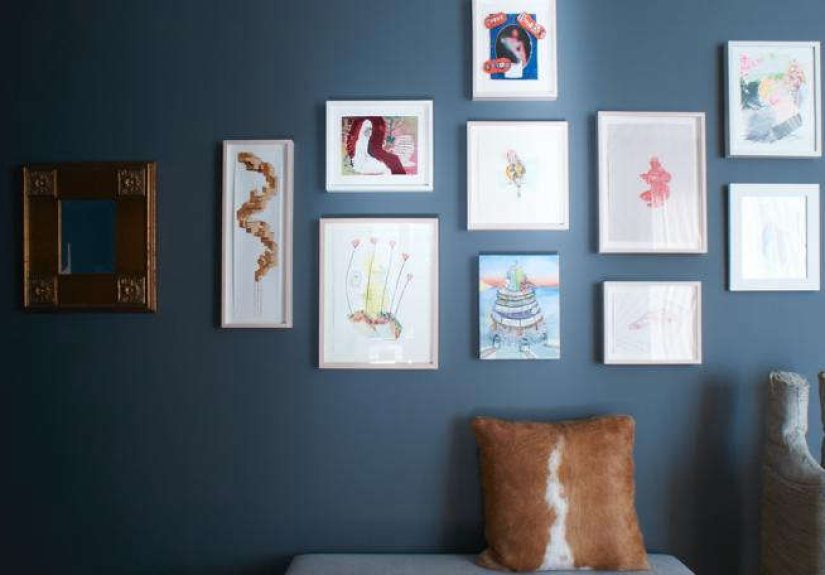
Artists use walls like external hard drives. A bold paint color becomes a backdrop for artwork. A cluster of frames
becomes a living gallery. A few pinned references become a mini mood board. Even a single shelf can function as a
rotating exhibition.
If you want to borrow the effect without committing to a full gallery wall, try a “one rail rule”: one picture ledge,
one cork strip, or one magnetic bar. Keep it flexible so the wall can change as your attention changes.
Mini Case Studies: The Homes That Tell the Story
The Remodelista roundup of An Afternoon With artist spaces highlights a truth that becomes obvious once you see
enough creative homes: no two look the same, but the best ones share a logic. Below are bite-size takeaways inspired
by featured artists and creativesless “copy this look,” more “copy this approach.”
John Silvis: Let color do curatorial work
A deep, saturated wall color can make art feel intentional even when the rest of the room is casual. Think of it as
an instant museum trick: the wall becomes the frame for everything on it. If your home tends to collect visual noise,
a strong, consistent wall color can turn “random” into “collected.”
Mikael Kennedy: Blend life and work without losing the plot
When photographs live near the kitchen, the message is clear: art isn’t quarantined. It’s part of daily rhythm.
The practical lesson is to place creative output where you’ll actually encounter itnear coffee, near breakfast,
near the place you stand while waiting for water to boil. Routine viewing builds relationship with your own work.
Richard Haines: Build a home office that’s a studio, not a corporate cubicle
A creative office doesn’t need motivational posters or a chair that screams “quarterly synergy.” It needs access:
to materials, to references, to a place where drafts can exist without embarrassment. If you work from home, aim for
a desk setup that welcomes iterationpaper within reach, a pin-up zone, and enough light that you don’t feel like
you’re designing in a cave.
Robert Fontanelli: The windowsill as a tiny museum
The humble windowsill is underrated. It’s naturally lit, naturally visible, and naturally good at turning small objects
into a still life. Artists often use these micro-spaces to display meaningful itemsobjects that spark ideas or simply
feel good to look at. Your takeaway: create one small “inspiration shelf” instead of trying to decorate the whole house.
Antonio Serna and Peggy Tan: Shared space needs shared rules
Creative couples (or roommates) often turn the home into a negotiated masterpiece: a little studio, a little sanctuary,
a little storage puzzle. The secret is agreeing on “sacred zones” (don’t touch) and “flex zones” (moveable).
It’s not romance; it’s survivalwith better lighting.
Kim Krans: Keep instruments and tools within arm’s reach
When one person makes in multiple modesvisual art, music, writingthe home becomes a set of “ready stations.”
The trick is not owning everything; it’s reducing setup time. A guitar on a stand is played more than a guitar in a case.
The same is true for sketchbooks, cameras, and sewing supplies.
Yasmine Chatila and James Holland: The open loft as a flexible stage
Open spaces work best when they’re quietly zoned. Creative lofts often rely on furniture placement, rugs, and lighting
to create invisible walls: a work zone, a lounge zone, a display zone. If your home is open-plan, give each area a job.
Otherwise the room becomes one big “I’m not sure what I’m supposed to do here” echo chamber.
Ruth Marten: The worktable is the real throne
A sturdy worktable can be more valuable than any trendy chair. Tables hold process: cutting, sorting, laying out,
stepping back. If you want your home to support making, prioritize one surface that can take a little wear and tear.
Art-friendly furniture is furniture that doesn’t panic when it sees glue.
Martynka Wawrzyniak: Minimal doesn’t mean sterile
A pared-back bedroom can still be deeply creative if it’s designed for thought. The key is what minimalism protects:
mental quiet. If your brain is loud all day, a visually calm room can be a reset button. Creativity needs both input
and silence; a minimal space can be where ideas finally finish loading.
When the House Becomes the Archive: Visiting Real Artists’ Homes
If An Afternoon With shows how creative people live right now, historic artist home sites show how creative work
leaves footprints. Across the United States, preserved homes and studios let visitors see what “process” looks like in
physical form: where the light fell, how tools were arranged, what kind of space the artist needed to keep going.
That’s the idea behind Historic Artists’ Homes and Studios (HAHS), a national coalition dedicated to telling
site-specific stories of American art through the places where it was made. These aren’t just houses with velvet ropes.
They’re working environmentsevidence you can walk through.
The Pollock-Krasner House: A studio you can almost hear
In East Hampton’s Springs neighborhood, the Pollock-Krasner House preserves the former home and studio of Jackson
Pollock and Lee Krasner. What makes a place like this compelling is not just the star powerit’s the clarity it gives
you about the relationship between space and work. You start noticing scale, movement, and the way a studio accommodates
physical making. A preserved site turns “genius” into something more relatable: routines, constraints, and decisions.
Georgia O’Keeffe’s Home & Studio: Where restraint becomes a superpower
O’Keeffe’s Northern New Mexico homes (including her Abiquiú home and studio) offer a different lesson: how a carefully
edited environment can sharpen vision. The architecture and the land become part of the creative toolkit. Her space is
famous for its clean lines, strong doorways, and the way privacy and quiet are designed into the daily experience.
It’s proof that “less” can be a working strategy, not just an aesthetic preference.
Whether the environment is energetic or austere, historic artist homes underline the same truth you see in
An Afternoon With: creativity isn’t only an internal talent. It’s also a relationship with place.
How to Create an “An Afternoon With” Feeling in Your Own Home
You do not need a giant loft. You do not need exposed brick. You do not need to adopt a houseplant you can’t emotionally
support. What you need is a home that makes starting easier.
Step 1: Pick your creative “center of gravity”
Choose one spot where creative work naturally wants to happen. It could be a corner of the dining table, a desk, a chair
by the window, or a rolling cart that appears like a helpful assistant and disappears like a magician when guests come over.
The goal is a consistent launchpad.
Step 2: Build a three-item “start kit”
Instead of organizing every supply you own (which is how people accidentally become professional organizers), create a tiny kit
that lets you begin immediately. Example:
- One sketchbook or notebook
- One favorite tool (pen, brush, camera, laptop)
- One reference pile (two books, a folder, a small mood board)
Step 3: Display what you want to become
Artists’ houses often show their values on the walls. Do the same, gently. Hang one piece of work you love (yours or someone
else’s), or pin up a reference image that embodies your direction. You’re not “decorating.” You’re setting a compass.
Step 4: Make room for “unfinished”
The enemy of creativity is the belief that everything should look complete before anyone is allowed to see it.
Give yourself a safe place to store work-in-progresseither visible (to stay engaged) or tucked away (to stay calm),
depending on how your brain behaves. The key is that unfinished work has a home, so it doesn’t become a guilt pile.
A Gentle Reminder: Looking Without Turning People Into Décor
Home tours are fun because they let us peek into other lives. But the best versions of these projects aren’t about
voyeurism; they’re about respect. An Afternoon With works because it treats people as creators, not props,
and spaces as narratives, not trophies.
If you borrow ideas from artists’ homes, borrow the human parts too: permission to evolve, to iterate, to collect meaning,
to change your mind, to leave a draft visible long enough for it to become real.
Afterword: of “An Afternoon With” Experiences
Imagine you’re spending an afternoon in a creative homenot as a judge, not as a shopper, but as a curious witness. The door
opens and the first thing you notice is not the furniture; it’s the temperature of the light. Maybe it’s soft daylight
sliding across a floor. Maybe it’s a warm lamp that makes the room feel like a secret. The space doesn’t shout. It signals.
You take a few steps and realize the house is arranged like a mind. There’s a corner where ideas get started: a chair near a
window, a notebook on the armrest, a pencil that looks like it has been waiting patiently. There’s a surface where work becomes
physical: a table with a cutting mat, a paint rag, a stack of paper that is definitely not “just papers,” and a mug that says,
“I’m staying here until the next breakthrough.”
In a creative home, objects have biographies. A ceramic bowl isn’t just a bowl; it’s a Sunday market, a friend’s studio,
a trip that changed someone’s taste. A stack of books isn’t décor; it’s a map of questions. You can almost read the person’s
attention span by the pile: one book for craft, one for comfort, one for ambition, one for procrastination (it happens).
The best part is the quiet permission in the air. You can feel it: the house allows making. It allows half-finished drafts.
It allows experiments that won’t work. It allows a weird little collection of stones on the windowsill because the stones
don’t need a reason beyond “they’re nice to look at and they remind me I’m alive.”
Now take that feeling home. You don’t need to duplicate the room. You only need to duplicate the permission.
Pick one spot. Put one tool there. Leave one meaningful object in sight. Let the space whisper, “You’re allowed to begin.”
Then do the smallest possible version of your workfive minutes, one sketch, one paragraph, one photo. The afternoon doesn’t
need to produce a masterpiece. It only needs to prove that your creative life has an address.
Conclusion
Artists’ houses are inspiring for the same reason artists’ work is inspiring: they show us a life shaped by attention.
An Afternoon With captures that truth in everyday interiorshomes that function as studios, galleries, archives, and
resting places all at once. When you look closely, you see a pattern you can use: light that supports focus, surfaces that
invite starting, storage that protects flow, walls that hold identity, and rituals that make creativity feel like a normal
part of the day.
If you take only one idea, take this: your home doesn’t have to be perfect to be creative. It only has to make starting easier.
And if you can build thatone corner, one table, one wall, one small kityou’ve already begun designing your own “afternoon with”
the person you’re becoming.