Table of Contents >> Show >> Hide
- The Light Problem at 5,000 Feet
- How Color Vision Usually Works (and Why the Deep Sea Should Break It)
- The Plot Twist: Rods That Act Like Color Sensors
- Meet the Deep-Sea Color Specialists
- Why Color Matters Down There
- How Scientists Figure This Out (Without Asking a Fish to Name Colors)
- What “Seeing in Color” Probably Looks Like at 5,000 Feet
- FAQ: Quick Answers for Curious Humans With Surface-Level Lungs
- Conclusion: The Deep Sea Isn’t ColorlessIt’s Just Selective
- Experiences: How to “Meet” Deep-Sea Color Vision From the Surface (Without Becoming a Pressure Pancake)
At about 5,000 feet below sea level (roughly 1,500 meters), sunlight doesn’t “fade” so much as it
gives up and goes home. The ocean down there is the midnight zone: cold, pressurized, and so dark
that “pitch-black” feels like an optimistic review.
And yetplot twist worthy of a streaming thrillerresearch suggests some deep-sea fish can still
distinguish colors down there. Not “bright tropical reef” color, obviously. More like “I can tell
whether that glow is lunch, danger, or my weird cousin Steve.” But in the deep ocean, that’s a big deal.
The Light Problem at 5,000 Feet
Water is a ruthless bouncer for light. Longer wavelengths (reds and oranges) get filtered out quickly,
while shorter wavelengths (blue) travel farther. By the time you’re deep enough, the natural light
environment is mostly goneespecially the red part of the spectrum.
So what light is left?
Two main “sources” remain:
- Bioluminescence (living light), which is often blue-green but can vary by species.
- Extremely faint downwelling light in the upper deep zones, which becomes negligible as depth increases.
That’s why deep-sea biology is packed with glowing organs, blinking lures, and flash-bomb defenses.
If the sun won’t pay your electric bill, you become the power company.
How Color Vision Usually Works (and Why the Deep Sea Should Break It)
In most vertebrates, color vision is strongly associated with conesphotoreceptor cells
that compare signals from different light-sensitive pigments (opsins). Cones are great in bright light.
In dim light, your visual system leans on rods, which are far more sensitive but typically
don’t deliver color discrimination. That’s why humans are basically “color-off” at night.
For decades, the standard assumption was: deep-sea fish mostly rely on rods and therefore are largely
colorblind in their everyday darkness. Many species do have a single, blue-tuned visual pigmentan
efficient setup for a world where most visible signals are blue.
Then researchers started looking at deep-sea fish genomes more closely… and found reasons to rewrite
the script.
The Plot Twist: Rods That Act Like Color Sensors
A major study published in Science analyzed the visual opsin genes of over 100 fish species and
found something startling: some deep-sea fish have multiple rod opsin genes.
Why is that surprising? Because in the vast majority of vertebrates, rods use just one rod opsin type.
One rod opsin generally means you can detect brightness in dim lightbut you can’t compare wavelengths
the way classic color vision does.
Multiple rod opsins = potential “rod-based color vision”
If rods can be tuned to different wavelengths (via different opsins), and if the visual system compares
those signals, a fish could discriminate colors (or at least spectral differences) in light levels that
would make human cones tap out immediately.
Researchers identified more than a dozen species with more than one rod opsin gene, including several
deep-sea fish with multiple rod opsinssuggesting a form of color discrimination in near-total
darkness could be biologically plausible.
Important nuance: “can see in color” here doesn’t necessarily mean these fish experience a vivid
rainbow the way humans do. It means they likely have the hardware to separate different
wavelengths of dim lightespecially bioluminescent signalsand use that information for survival.
Meet the Deep-Sea Color Specialists
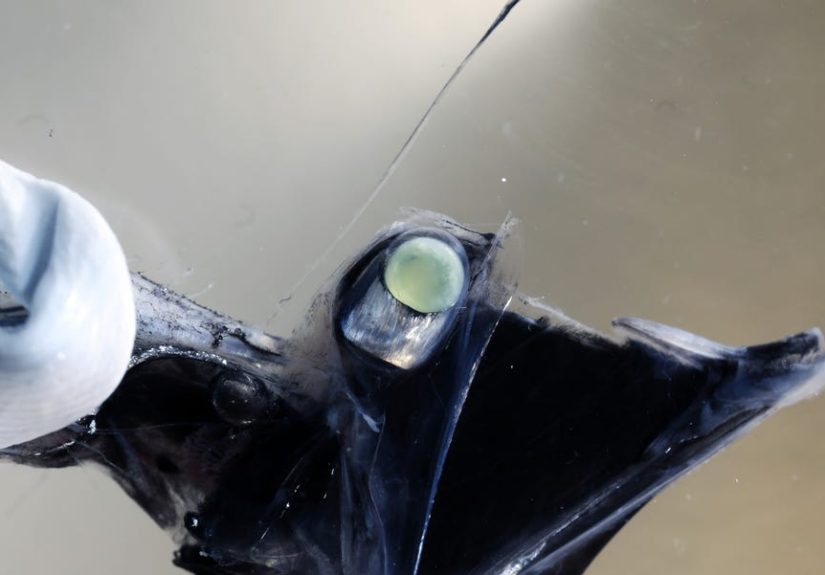
1) The Silver Spinyfin (Diretmus argenteus): The Opsin Overachiever
If opsins were Pokémon, the silver spinyfin would be the person who somehow caught all of them… plus
a few that don’t officially exist.
This fish was found to have an astonishing number of rod opsin genesdozensfar more than
what’s typical for vertebrates. The idea is that different rod opsins are tuned to different wavelengths,
potentially helping the fish detect and discriminate among the many “shades” of bioluminescence produced
by prey, predators, and potential mates.
In a world where a faint glow might be a tiny shrimp, a toothy predator, or a “romantic signal,” that
extra spectral information could mean the difference between dinner and becoming dinner.
2) Lanternfishes and Other Midwater Players: Reading the Light Codes
Many midwater fish live in zones where bioluminescent patterns function like a living language: species-specific
photophores can help with camouflage (counterillumination), coordination, and mate recognition.
If multiple rod opsins help distinguish slightly different wavelengths, fish may be better at decoding these
signalsespecially when different species emit slightly different spectral “flavors” of blue-green light.
3) Dragonfishes and the “Private Red Flashlight” Trick
Now let’s talk about the deep sea’s stealthiest cheater: the dragonfish group that can produce and detect
red light.
Red light doesn’t travel far in seawater and doesn’t naturally exist at depth in any meaningful amount.
Many deep-sea animals are effectively blind to red wavelengths. That’s why so many deep-sea animals are red:
without red light to reflect, red bodies look blackexcellent camouflage.
But a few dragonfish (including the famous “stoplight loosejaw” in the genus Malacosteus) have evolved
a jaw-dropping workaround: they can produce red bioluminescence and also detect it. Think of it like having
night-vision goggles in a world where everyone else forgot to charge theirs.
Some reporting and educational resources describe how this red sensitivity may be linked to specialized molecules
associated with chlorophyll derivativesan astonishing example of “you are what you eat” biology. In other words,
an animal’s diet and chemistry can help shape what wavelengths it can effectively use.
Why Color Matters Down There
If the deep sea is mostly dark and mostly blue, why bother distinguishing colors at all?
Because “mostly” is doing a lot of work in that sentence.
Bioluminescence isn’t one-size-fits-all
While blue-green bioluminescence is common, bioluminescent emissions can varysometimes toward violet, sometimes
toward greener-yellow, and very occasionally into red in specialized organisms. That spectral variation is exactly
what multiple opsins could exploit.
Three practical advantages of deep-sea color discrimination
-
Hunting: Different prey species may glow differently. Detecting subtle wavelength differences can
help identify what’s worth chasing. -
Avoiding predators: The deep sea is full of “bait lights” and deceptive flashes. Better spectral
discrimination may help fish avoid traps or recognize threat signatures. -
Communication: If your species uses photophores for signaling, being able to detect spectral nuances
can improve mate recognition and social cues in a visually sparse environment.
How Scientists Figure This Out (Without Asking a Fish to Name Colors)
We can’t exactly hand a deep-sea fish a color chart and say, “Point to ‘teal.’” (Also, it would point with its face.)
So researchers use a combination of approaches:
Genomics: counting opsins and predicting sensitivity
By sequencing genomes and identifying opsin genes, scientists can infer how many distinct photopigments a species could
produce and what wavelengths those pigments are likely tuned to. Multiple rod opsin genes are a major clue that a fish
could compare signals across wavelengths in dim light.
Physiology: measuring retinal responses
Researchers can measure how eyes respond to controlled wavelengths of light using electrophysiology. Some ocean research
education materials describe how scientists record signals from eyes to determine spectral sensitivityessentially letting
the eye “tell” you what it detects.
Behavior and ecology: connecting the hardware to real life
If a fish has multiple opsins, the next question is: what does it do with them? That’s where behavior, habitat depth,
prey choices, and signaling patterns come in. Deep-sea work is hard, expensive, and technically demandingso this part
tends to evolve as technology and access improve.
What “Seeing in Color” Probably Looks Like at 5,000 Feet
Let’s keep expectations realistic. At 5,000 feet, there’s no coral reef palette. But there is information in
wavelength differencesand the deep sea runs on information scarcity.
A useful way to think about it: deep-sea color vision may be less about appreciating a sunset, and more about
classification:
- Is that glow the same “kind” of glow as the prey I usually eat?
- Is that flash pattern a defensive cloud I should avoid?
- Is that signal from my species, or from something that wants to swallow me like a protein bar?
In other words, deep-sea color discrimination is probably more like having an advanced “bioluminescence decoder”
than having a painter’s palette.
FAQ: Quick Answers for Curious Humans With Surface-Level Lungs
Are all deep-sea fish colorblind?
No. Many likely rely on a single blue-sensitive pigment, but research indicates some species have multiple rod opsins
and may discriminate wavelengths in dim conditions.
Do these fish have cone cells?
Some deep-sea species may have reduced cones or cone function, while others show unusual adaptations. The key finding
in the “5,000 feet color vision” conversation is the unusual diversification of rod opsins.
Why do so many deep-sea animals look red or black?
Because red wavelengths don’t penetrate deep water. Without red light to reflect, red surfaces appear blackexcellent
camouflage in the deep.
Is red bioluminescence real?
Yes, but it’s rare. Some dragonfish can produce red light and also detect iteffectively creating a private illumination
channel in a world dominated by blue-green light.
Conclusion: The Deep Sea Isn’t ColorlessIt’s Just Selective
The deep ocean has a reputation for being an endless, monochrome void. And to be fair, it mostly isif you’re a human
drifting down there with nothing but regret and a flashlight.
But evolution doesn’t accept “mostly” as a final answer. Where there’s even a sliver of usable informationlike slight
differences in the color of living lightsome animals will evolve to capture it. For certain fish at depths around
5,000 feet, multiple rod opsins and specialized visual chemistry may provide a surprising advantage: the ability to
tell one glow from another in a world built on bioluminescent secrets.
And honestly? That’s the most deep-sea thing imaginable: even the darkness has a spectrumif you’re equipped to see it.
Experiences: How to “Meet” Deep-Sea Color Vision From the Surface (Without Becoming a Pressure Pancake)
Unless you have access to a research vessel, an ROV team, and a spare submersible (plus a healthy fear of implosion),
your “experience” with deep-sea color vision will probably happen from dry land. Good news: you can still get a surprisingly
vivid sense of what’s going on down thereespecially if you treat it like a sensory story instead of a textbook.
Start with the simplest, most honest experiment: walk into a dark room and try to identify colors. Your cone cells will
immediately act like tired interns and hand the task to your rods. Suddenly, everything looks grayscale-ish. That shift is
the everyday reality for most deep-sea animalsexcept some fish seem to have found a workaround by giving their rods extra
“settings.” It’s like discovering your phone has a secret camera mode you didn’t know existed.
Next, recreate the deep sea’s most famous light source: bioluminescence vibes. Use glow sticks or LED lights in a dim room
and notice how different shades feel more “visible” than others when light levels are low. Blue-green looks strong; reds look
weak or disappear. That’s basically the ocean’s physics in actionwater filters red fast, and dim environments punish long wavelengths.
Now imagine being a fish whose survival depends on decoding tiny differences in that glow. The deep sea is less “colorful scenery”
and more “visual intelligence work.”
If you want the closest thing to a front-row seat, watch deep-sea expedition footage and ROV dives from ocean exploration groups.
When a dragonfish drifts by with photophores lit, it doesn’t look like a cute glow-in-the-dark stickerit looks like a moving,
communicating organism broadcasting information. Many deep-sea signals are about function: attracting prey, confusing predators,
finding mates, or blending into downwelling light. Once you watch with that mindset, every flicker starts to feel like a sentence.
You stop asking, “What is it?” and start asking, “What is it saying?”
Aquarium visits can also sneak up on you here, especially exhibits that highlight the “twilight zone” and deep pelagic animals.
Even if the animals aren’t the exact species from the 5,000-foot research, you’ll notice patterns: oversized eyes, strange head
shapes, and bodies built for a low-light world. You also get an intuitive sense of how “dark” can be a habitat, not just an absence.
It’s one thing to read that red appears black at depth; it’s another to watch how quickly warm colors lose their punch in dim, blue-tinted light.
Finally, the most underrated experience is simply letting the idea rewire your imagination. The deep ocean is often portrayed as
featureless black. But if some fish can distinguish wavelengths there, then the deep sea isn’t truly colorlessit’s coded.
A faintly greener glow might mean a different species. A slightly shifted spectrum might mean a different strategy. A “private red flashlight”
might mean a predator is hunting without advertising. And suddenly, the midnight zone feels less like emptiness and more like a secret city
whose streetlights are aliveand whose residents have eyes built to read them.