Table of Contents >> Show >> Hide
- What Happened, Exactly?
- Quick Reality Check: Is This Really a “Hologram”?
- How the Touchable 3D Display Works
- Why This Matters for Human-Computer Interaction
- Real-World Uses: Where Touchable Holograms Could Actually Help
- What This Technology Still Can’t Do (Yet)
- What Comes Next for Touchable Holograms?
- Why This Breakthrough Feels Different
- Extended Experience Section (500+ Words): What It Feels Like to Interact with a Touchable Hologram
- Conclusion
For years, movies have promised us the same thing: a glowing 3D object floating in mid-air while someone dramatically pinches, spins, and zooms it like they’re designing a superhero suit before lunch. In real life, we got… a lot of touchscreens and a healthy amount of finger smudges.
But now, scientists have taken a real step toward that sci-fi dream. A research team demonstrated a 3D display system that lets people reach in and directly manipulate floating visuals with their hands. You can grab, rotate, and poke virtual objects without wearing a headset. That’s a big deal for human-computer interaction, education, design, and potentially medical visualization.
Before we all start yelling “Tony Stark mode activated,” let’s slow down just enough to understand what this technology actually is, how it works, why it matters, and what it still can’t do (yet). Spoiler: no holodeck. But also: very cool.
What Happened, Exactly?
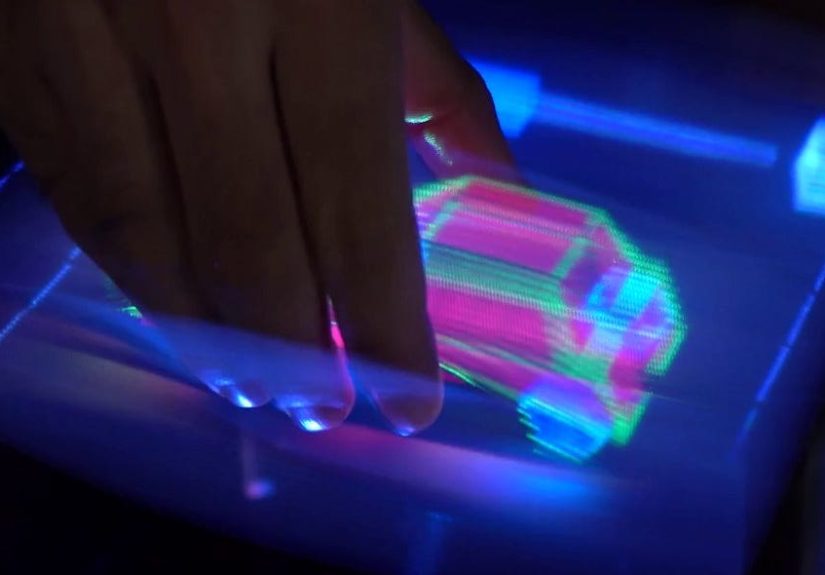
Researchers at the Public University of Navarra (UPNA) built a system often described in headlines as a “touchable hologram.” More precisely, it’s an interactive volumetric display that creates true 3D graphics in space and allows users to interact with them using hand gestures.
The team’s system, known as FlexiVol, replaces a traditionally rigid moving diffuser (a key component in many volumetric displays) with an elastic diffuser. That simple-sounding change solves a major problem: users can now insert their fingers into the display volume without breaking the hardware or hurting themselves.
In demonstrations, users could do things like pinch and rotate a 3D skull, manipulate a cube, and interact with other virtual objects in ways that feel much more natural than using a mouse or joystick. It’s not just visually impressiveit’s an interface breakthrough.
Quick Reality Check: Is This Really a “Hologram”?
Technically, the term hologram gets used a little loosely in pop culture. If you’ve ever called any floating-looking 3D image a hologram, congratulationsyou are normal and also in excellent company.
In strict optics language, a hologram usually refers to an image created using diffraction and wavefront reconstruction. What this research demonstrates is better described as a volumetric display, meaning it creates visible 3D imagery throughout a volume of space rather than simulating depth on a flat screen.
Why does that distinction matter? Because volumetric displays can offer natural depth cues and multi-angle viewing without requiring special glasses. Multiple people can stand around the same display and see the object from different viewpoints. That’s incredibly useful for collaboration and public-facing experiences.
So yes, the headline word “holograms” is understandable. But the more accurate phrase is “interactive volumetric 3D display.” Not as punchy, but your physics teacher would be proud.
How the Touchable 3D Display Works
The Basic Volumetric Display Idea
Volumetric displays typically work by moving a projection surface (called a diffuser) very quickly through space and projecting many 2D image slices onto it at precisely timed positions. Thanks to persistence of vision, your eyes blend those slices into what looks like one continuous 3D object.
Think of it like a flipbook for 3D spaceexcept the flipbook is happening so fast that your brain says, “Yep, that floating object seems real enough.”
In this research, the system synchronizes thousands of projected images per second to create the volumetric effect. That speed is what makes the illusion stable and viewable from multiple angles.
The Problem with Older Systems
Traditional volumetric displays often use a rigid diffuser. That works fine if users only look, but the moment a human hand enters the scene, things get risky. A fast-moving rigid component and curious fingers are not a dream team.
This physical limitation has been one of the biggest reasons many volumetric displays feel like “look, don’t touch” exhibits. Beautiful? Yes. Intuitive to manipulate? Not really.
The FlexiVol Breakthrough: Elastic Diffusers
The researchers solved this by replacing the rigid surface with an elastic diffuser made from flexible strips. These strips can deform when a hand passes through them and return to shape afterward. That means users can reach into the display volume and directly interact with the 3D graphics.
Of course, flexible materials introduce a new problem: deformation distorts the projected image. A floppy projection surface sounds great for safety, but terrible for optical precision.
To fix that, the team developed image correction techniques so the projected graphics still appear properly formed even as the elastic diffuser moves and bends. In other words, they didn’t just make the hardware softerthey made the visuals smarter.
Hand Tracking Makes the Magic Feel Natural
The system also tracks the user’s hand and finger positions so gestures map to the 3D object in real time. That’s what enables actions like pinching, dragging, rotating, and tracing.
This is where the experience shifts from “interesting demo” to “useful interface.” Humans are extremely good at reaching, grasping, and manipulating objects in space. FlexiVol taps into those built-in skills instead of forcing users to learn awkward controls.
Why This Matters for Human-Computer Interaction
The most exciting part of this work is not just that the graphics floatit’s that the interaction feels direct. Direct manipulation is often faster to learn, easier to remember, and more satisfying than indirect control systems.
We already know this from phones and tablets. Dragging a file icon with your finger feels natural. Now imagine doing that in real 3D space with a model of an engine, a molecule, or a surgical plan.
This research points toward interfaces that combine:
- True 3D visualization (not just simulated depth)
- No headset required
- Multi-user viewing from different angles
- Natural hand interaction with spatial objects
That combination is rare. Many existing systems give you one or two of those benefitsbut not all four at once.
Real-World Uses: Where Touchable Holograms Could Actually Help
Let’s move from “wow” to “why.” Here are the most realistic near-term applications for hand-manipulable holograms (or, more accurately, interactive volumetric displays).
1) Education and Training
Science classrooms, engineering labs, and museums could all benefit from shared 3D objects that students can physically manipulate. Imagine rotating a heart model, exploring a geological structure, or assembling an engine component in mid-air without goggles or headsets.
Mixed reality and holographic learning research has already shown that 3D visualization can improve spatial understanding and engagement in some educational settings. A system like FlexiVol adds something extra: walk-up, hands-on interaction for groups.
2) Medical Visualization and Surgical Planning
Medicine is full of complex 3D data: CT scans, MRI volumes, vascular maps, orthopedic structures. Doctors and trainees often have to mentally reconstruct anatomy from 2D slices on a monitor.
Touchable volumetric displays could make that process more intuitive by letting teams inspect anatomy in a shared 3D space. Even if the display doesn’t yet provide true tactile feedback, the ability to manipulate a volumetric model directly could improve communication during planning or teaching sessions.
And yes, this is one of those moments where the phrase “let me grab your tumor model” sounds weird, but in a medical planning room, it could be genuinely useful.
3) Engineering, Product Design, and Architecture
Design reviews often involve rotating CAD models on flat screens while several people pretend they all see the same thing. (They do not. One person is upside down. Another is zoomed into a screw.)
A shared 3D volumetric model that can be manipulated by hand could help teams inspect form, proportions, clearances, and layout decisions faster. The interface naturally supports discussion because everyone can look at the same object from their own position.
4) Retail, Museums, and Public Exhibits
The team and outside observers have pointed to museums and exhibits as a strong fit. This makes sense: interactive displays attract attention, encourage exploration, and make abstract concepts memorable.
Retail and e-commerce showrooms could also use smaller versions for 3D product previewsespecially for complex items like tools, components, or collectibles. Shoppers are much more likely to remember a product they got to “spin” in the air than one they scrolled past in 1.8 seconds.
5) Games and Creative Tools
A no-headset 3D game or creative sandbox is an obvious long-term opportunity. Think virtual pets, tabletop-style strategy experiences, or 3D art tools where you shape and position objects in space with your fingers.
The research demos already hint at this direction, including playful interaction concepts and scene editing. In other words, yes, science happenedand then immediately someone thought, “Could this be a game?” As tradition demands.
What This Technology Still Can’t Do (Yet)
As exciting as this is, it’s still an experimental system, and there are real limitations.
- Scale: The prototype is relatively small, closer to a desktop display than a room-sized environment.
- No true touch sensation: You can interact visually, but you’re not feeling a solid object in the way you would touch a real cube.
- Complex hardware and calibration: Fast motion, synchronized projection, optical correction, and hand tracking all need to work together precisely.
- Durability and commercialization: Lab success is not the same as a rugged consumer product that survives years of enthusiastic poking.
In short: this is a major interface milestone, not a finished consumer gadget. We are closer to “powerful demo with serious promise” than “buy now, ships Tuesday.”
What Comes Next for Touchable Holograms?
One of the most interesting next steps is adding haptic feedbackthe sensation of touch. Researchers in adjacent fields have explored ultrasound-based mid-air haptics, which can create tactile sensations on the skin without wearable devices. If that kind of feedback can be integrated with interactive volumetric displays, the result could feel dramatically more convincing.
The FlexiVol team has also discussed ideas for improving seamlessness and expanding how users can access the display volume. Future versions may become more practical for specialized desktop applications before they ever become mainstream consumer products.
That’s usually how important interface technology evolves, anyway: first in labs, then in niche professional tools, and only later in broader consumer experiences.
So no, your kitchen probably won’t have a floating holographic recipe onion you can toss around this year. But this research makes that sentence sound slightly less ridiculous than it did last year.
Why This Breakthrough Feels Different
We’ve seen countless “future of display” headlines. Many are flashy, some are brilliant, and plenty vanish into the great startup graveyard in the sky. What makes this work stand out is that it improves something fundamental: how humans interact with 3D information.
The scientists didn’t just make a prettier display. They removed a physical barrier that prevented direct interaction and replaced it with a system designed around human behavior. That’s the kind of innovation that often has a longer shelf life than pure spectacle.
In other words, the breakthrough is not merely “look, a floating object.” It’s “look, a floating object you can actually use.”
Extended Experience Section (500+ Words): What It Feels Like to Interact with a Touchable Hologram
Let’s talk about the human side of this technology, because that’s where the story gets genuinely fun.
The first experience most people have with a touchable hologram-like volumetric display is hesitation. You can see the object floating there. Your brain recognizes it as a thing in space. But years of interacting with screens train you to expect a flat surface. So when you reach forward, there’s a split-second of uncertaintylike your hand is asking, “Am I allowed to do this?”
Then your fingers pass into the display volume.
That moment matters. It breaks a habit. Instead of tapping a pane of glass, you’re moving inside the visual space itself. Users in early demonstrations and reports described the interaction as surprisingly natural, and that matches what we know about direct manipulation interfaces: when control maps closely to your body movement, the learning curve drops fast.
Imagine a classroom demo with a 3D skull model. A student pinches near the jaw and rotates it slightly. Another points at the orbit of the eye. A teacher walks around to the other side and sees the same model from a different angleno headset swapping, no “wait, can you share your screen?” chaos. The display becomes a shared object of attention, not just a single-user device.
In an engineering lab, the experience could be even more practical. A designer nudges a virtual component into position while a colleague checks the spacing from the side. Instead of narrating depth (“No, no, move it backmore backtoo far”), the team interacts with the model directly. That doesn’t mean traditional CAD tools disappear. It means certain review tasks become faster and more intuitive because the object behaves more like an object.
In a museum setting, the emotional effect may be the biggest win. Visitors don’t just observe a rotating artifact reconstruction; they participate. They poke, spin, and inspect. Kids lean in. Adults pretend they’re being serious and then absolutely start playing with it too. A good interactive exhibit doesn’t just display informationit creates memory. Touchable volumetric visuals have that “wait, what?!” quality that makes people stop and engage.
There’s also a subtle ergonomic advantage to no-headset experiences in group environments. Headsets can be immersive, but they also isolate people. A tabletop or desktop volumetric display keeps everyone in the same physical and social space. You can look at the object, then look at the person next to you, then point, laugh, argue, and collaborate. That social continuity is underrated.
Of course, the experience is not the same as holding a real object. You’re interacting with light and motion, not solid matter. The object won’t press back on your fingers. It won’t have weight. It won’t feel cold, rough, or sticky (which is probably a plus for museum displays, honestly). But even without full tactile realism, direct visual manipulation can still feel satisfying because the response is immediate and spatially meaningful.
The most exciting part is how quickly people may invent new interaction habits once the novelty wears off. Every major interface shift starts with imitation of old behaviors, then evolves into new ones. Early touchscreen apps looked like physical buttons. Later, gestures became their own language. Touchable holograms may follow the same path: first we pinch and rotate cubes, then we discover interactions that only make sense in shared 3D space.
That’s when the technology moves from “cool demo” to “new medium.”
Conclusion
Scientists have now demonstrated a practical way to create hand-manipulable 3D volumetric graphics by using an elastic diffuser and real-time interaction tracking. While headlines call them hologramsand that shorthand is understandablethe deeper story is about a new class of interfaces that bring natural hand interaction to true 3D visuals.
The technology is still early, but its potential is clear: education, medical visualization, engineering, museums, and creative tools could all benefit from shared, no-headset, directly interactive 3D displays. It’s not a holodeck, and it doesn’t need to be. Sometimes the future arrives not as a cinematic leap, but as a clever engineering fix that lets us finally do the obvious thing: reach out and touch the thing we can see.